Wormhole强行抬价横插一脚,LayerZero收购Stargate还能推进吗?

Odaily星球日报Опубліковано о 2025-08-21Востаннє оновлено о 2025-08-21

原创 | Odaily 星球日报(@OdailyChina

作者|Azuma(@azuma_eth

已进入正式投票流程的“LayerZero 收购 Stargate”提案突然生变。

8 月 21 日,LayerZero 的直接竞争对手 Wormhole 基金会于 X 公开宣布,LdayerZero 对 Stargate 提出的约 1.1 亿美元收购报价低估了 Stargate 的协议资产及增长,因此 Wormhole 计划提交更高报价,并请求暂停当前 Snapshot 投票 5 个工作日,以便完善竞标流程,保障 STG 持有者利益。

背景提要:LayerZero 发起收购

关于 LayerZero 对 Stargate 的收购提案,可追溯至 8 月 11 日 —— 参考阅读《LayerZero 提议收购 Stargate:代币双双暴涨 20%+,但这一群体却强烈反对》。

当日凌晨,LayerZero 基金会在 Stargate 的治理论坛内发布了一则草案,提议以 1.1 亿美元的总价格对 Stargate 进行收购。

具体而言,LayerZero 基金会提议按照发文时每 STG 0.1675 美元(实际上略高于当时的市场价格)和每 ZRO 1.94 美元的价格,将所有流通中的 STG(包括处于质押/投票状态的 STG)以 1 STG : 0.08634 ZRO 的比例兑换为 ZRO。收购完成后,Stargate 将更深入地融入 LayerZero 生态系统,Stargate DAO 将解散,Stargate 未来产生的所有超额收入将通过回购计划用于减少 ZRO 的流通供应。
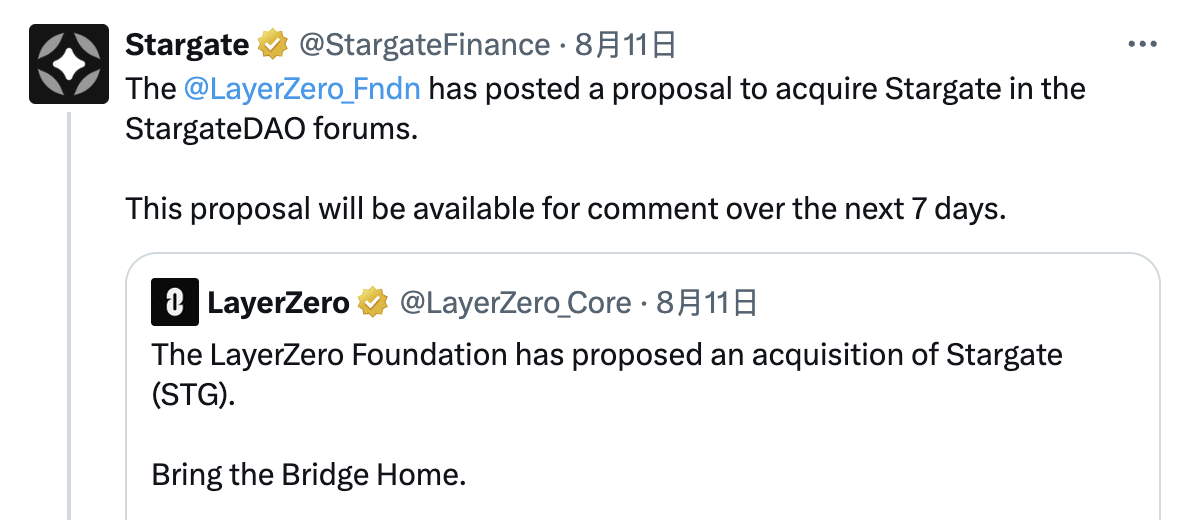
提案公布后,LayerZero 和 Stargate 的官推频频互动,双方大谈“合作共赢”,受此影响当日 ZRO 和 STG 也双双暴涨,但细看 Stargate 的治理论坛讨论内容,绝大多数 Stargate 均对该收购提案持反对态度,认为 LayerZero 的报价过于低估

前期进展:投票启动,大户碾压

8 月 18 日,该提案正式在 Snapshot 上启动投票,STG 持有者将共同决定是否接受该收购要约。相较于最初的提案,LayerZero 并未提高收购报价,而是宣称将向 veSTG 的持有者(即直接投票的用户)分享 Stargate 接下来六个月内总收入 50% 的分成。

投票启动后,不但快速突破了最低票数要求,支持率更是一度上冲至 97% 以上(根据规则,结束时超过 70% 即通过)。LayerZero 联合创始人 Bryan Pellegrino 在参与 CounterParty 的播客时甚至还骄傲地大谈:“这是 Stargate 历史上参与票数最多的投票。”
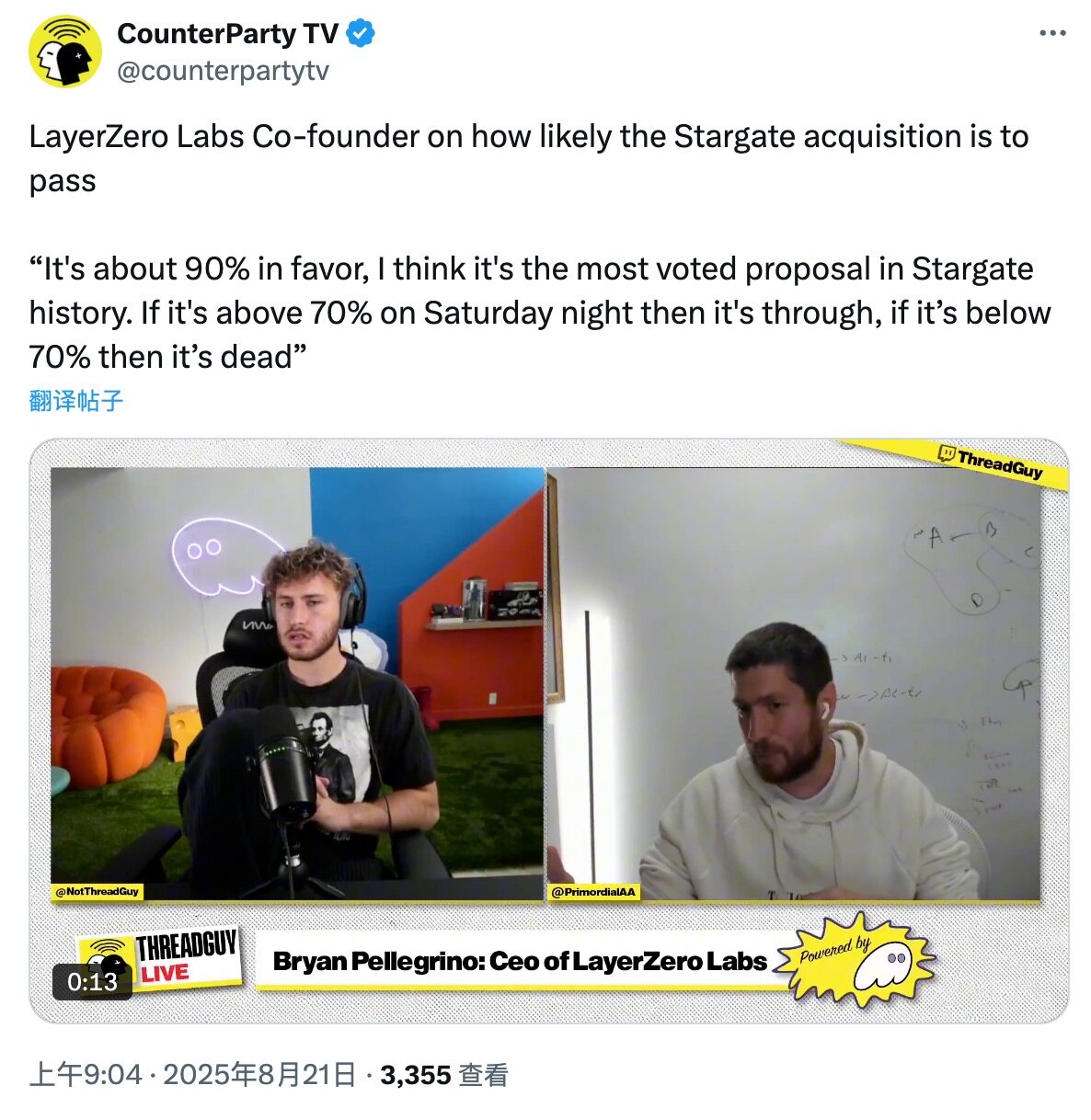
如此一边倒的票型并不令人意外,虽然许多 Stargate 社区成员对报价持反对态度,但 LayerZero 和 Stargate 作为完全绑定的后端协议与前端产品,两家项目本就很难作为两个独立实体看待,甚至于 Stargate 基金会一半的董事会成员都由 LayerZero 方面出任……再结合 LayerZero 和 Stargate 的互动话术来看,不难想象双边的利益相关方本就控制着足够的票权,说白了这就是一场“注定会通过,但需要有个过场”的投票

Wormhole 的阳谋:即便抢不动,也得恶心你一下

可能就连 LayerZero 和 Stargate 双方都没想到,Wormhole 会在如此关键的时刻横插一脚。

截至发文,有别于 LayerZero 提出收购后双方频频互动的“和谐景象”,在 Wormhole 提出有意收购后,Stargate 官方推特没有发布任何一条相关动态,而 LayerZero 方面也仅有联合创始人 Bryan 疑似回应了一句:“这不可能发生。”

截至发文,Wormhole 方面尚未提出正式报价,而原因也让人哭笑不得 —— Wormhole 声称需要更多时间对 Stargate 的估值进行尽调,因为他们不像 LayerZero 那样熟悉 Stargate,熟悉到占了后者半数的基金会董事席位……
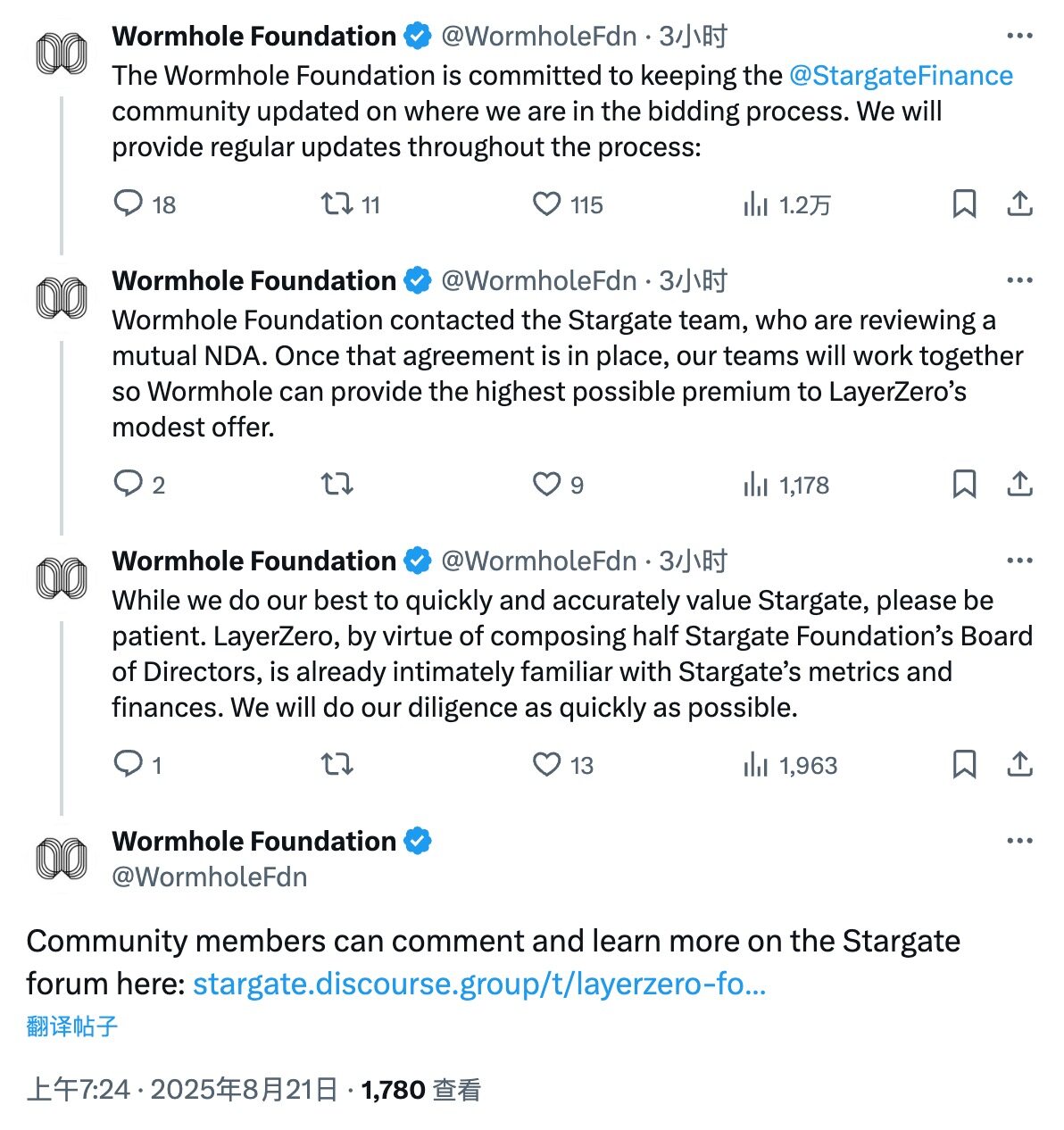
综合目前的情况看来,该起事件后续的发展无非以下四种情况,而无论哪种情况,Wormhole 都会乐见其成。

  • 第一种情况是 Stargate 方面暂停投票,继而进入 Wormhole 和 LayerZero 的竞价,最终假设 Wormhole 获胜。如此一来,Wormhole 将直接夺走最大竞争对手的核心产品,从而抢占更多的市场份额。
  • 第二种情况则是假设 LayerZero 竞价获胜,或是 LayerZero 单方面提高报价并推进提案,如此一来 LayerZero 将支付给多资金给予 STG 持币用户,Wormhole 一分钱不出也能看着对手消耗更多。
  • 第三种情况则是 Stargate 方面以流程已启动为由无视 Wormhole 的报价,提案将以原状况继续推进(目前支持率仍超),如此一来假设 LayerZero 完成了收购,利益上错失更高报价的 STG 必然会因此而恼怒,Wormhole 很乐于看到 LayerZero 方面的社区分裂。
  • 第四种情况也是 Stargate 强行推进投票,假设提案最终以 Stargate 社区反对而失败(目前支持率仍超 88%,失败可能性极低),Wormhole 阻挠计划成功。

综合来看,我个人会更倾向第二种和第三种剧本,毕竟 Stargate 作为 LayerZero 的核心产品,后者绝对不愿意承担损失该产品的后果。

Fluid 首席运行官 DMH 很精炼地概括了当下的状况:“显然 Stargate 和 LayerZero 在提案之前就已经达成一致;Wormhole 很生气,LayerZero 竟然用一袋米买了新加坡;因此 Wormhole 选择抬价,试图扰乱 LayerZero 的收购计划;但 Stargate 最终一定会被 LayerZero 吸收,这一点市场都心知肚明,所以不会有出现任何戏剧情况。”

Wormhole 可能在报价之前也已知道最终的结果早就注定,但动动嘴皮子就能让最大的竞争对手极度恶心,且自己毫无损失,这波简直是顶级阳谋。
Пов'язані матеріали

Breaking: OpenAI Undergoes Major Reorganization, President Brockman Assumes Command

OpenAI has announced a major internal reorganization just months before its anticipated IPO. The company is merging its three flagship product lines—ChatGPT, Codex, and the API platform—into a single, unified product organization. The most significant leadership change involves co-founder and President Greg Brockman moving from a background technical role to take full, permanent control over all product strategy. This follows the indefinite medical leave of AGI Deployment CEO Fidji Simo. Additionally, ChatGPT's longtime lead, Nick Turley, has been reassigned to enterprise products, with former Instagram executive Ashley Alexander taking over consumer offerings. The consolidation, internally framed as a strategic move towards an "Agentic Future," aims to break down internal silos and create a cohesive "Super App." This planned desktop application would integrate ChatGPT's conversational abilities, Codex's coding power, and a rumored internal web browser named "Atlas" to autonomously perform complex user tasks. The reorganization occurs amid significant internal and external pressures. OpenAI has recently seen a wave of high-profile departures, including Sora co-lead Bill Peebles and other senior technical leaders, leading to concerns about a thinning executive bench. Externally, rival Anthropic recently secured funding at a staggering $900 billion valuation, surpassing OpenAI's own. Google's upcoming I/O developer conference also poses a competitive threat. Analysts suggest the dramatic restructure is a pre-IPO move to present a clearer, more focused narrative to Wall Street—streamlining operations and demonstrating decisive leadership under Brockman to counter internal turbulence and intense market competition.

marsbit1 год тому

Breaking: OpenAI Undergoes Major Reorganization, President Brockman Assumes Command

marsbit1 год тому

Two Survival Structures of Market Makers and Arbitrageurs

Market makers and arbitrageurs represent two distinct survival structures in high-frequency trading. Market makers primarily use limit orders (makers) to profit from the bid-ask spread, enjoying high capital efficiency (nominally 100%) but bearing inventory risk. This "inventory risk" arises from passive, fragmented, and discontinuous order fills in the limit order book (LOB). This risk, while a potential cost, can also contribute to excess profit if managed within control boundaries, allowing for mean reversion. Market makers essentially sell "time" (uncertainty over execution timing) to the market for price control and low fees. In contrast, cross-exchange arbitrageurs typically use market orders (takers) to exploit price differences or funding rates, resulting in lower nominal capital efficiency (requiring capital on both exchanges) and higher transaction costs. Their risk exposure stems from asymmetries in exchange rules (e.g., minimum order sizes), execution latency, and infrastructure risks (e.g., ADL, oracle drift). These exposures are active, exogenous gaps that primarily erode profits rather than contribute to them. Arbitrageurs essentially sell "space" (capital sunk across venues) for localized, immediate certainty. Both strategies engage in a trade-off between execution friction and residual risk. Optimal systems allow for temporary, controlled risk exposure rather than enforcing zero exposure at all costs. Their evolution converges towards hybrid models: arbitrageurs may use maker orders to reduce costs, while market makers may use taker orders or hedges for risk management. Ultimately, both use different forms of risk exposure—market makers exposing inventory, arbitrageurs immobilizing capital—to extract marginal, hard-won certainty from the market.

链捕手1 год тому

Two Survival Structures of Market Makers and Arbitrageurs

链捕手1 год тому

Who Will Define the Rules of the AI Era? Anthropic Discusses the 2028 US-China AI Landscape

This article, based on Anthropic's analysis, outlines the intensifying systemic competition between the U.S./allies and China for AI leadership by 2028. It argues that access to advanced computing power ("compute") is the critical bottleneck, where the U.S. currently holds a significant advantage through chip export controls and allied innovation. However, China's AI labs remain competitive by exploiting policy loopholes—via chip smuggling, overseas data center access, and "model distillation" attacks to copy U.S. model capabilities—keeping them close to the frontier. The piece presents two contrasting scenarios for 2028. In the first, decisive U.S. action to tighten compute controls and curb distillation locks in a 12-24 month AI capability lead, cementing democratic influence over global AI norms, security, and economic infrastructure. In the second, policy inaction allows China to achieve near-parity through continued access to U.S. technology, enabling Beijing to promote its AI stack globally and integrate advanced AI into its military and governance systems, altering the strategic balance. Anthropic contends that maintaining a decisive U.S. lead is essential for shaping safe AI development and governance. The core recommendation is for U.S. policymakers to urgently close compute and model access loopholes while promoting global adoption of the U.S. AI technology stack to secure a lasting strategic advantage.

marsbit3 год тому

Who Will Define the Rules of the AI Era? Anthropic Discusses the 2028 US-China AI Landscape

marsbit3 год тому

Торгівля

Спот
Ф'ючерси
活动图片