XRP–ISO 20022 Narrative Is A ‘Complete Charade,’ Warns Ex-Ripple Developer

bitcoinistОпубліковано о 2025-08-13Востаннє оновлено о 2025-08-13

Анотація

A fresh flare-up over XRP’s oft-repeated “ISO 20022 compliance” claim is forcing a basic but consequential distinction back into view:...

Trusted Editorial content, reviewed by leading industry experts and seasoned editors. Ad Disclosure

A fresh flare-up over XRP’s oft-repeated “ISO 20022 compliance” claim is forcing a basic but consequential distinction back into view: Ripple, the private company that builds enterprise payment software, is not the XRP Ledger, the open, decentralized network that settles XRP transactions. The latest round was ignited by investor Jake Claver, who asserted that “before any other cryptocurrency, XRP prioritized… ISO 20022 compliance,” adding that “the network processes more than $434 billion in transactions every day,” and casting ISO 20022 as the bridge that will let Ripple “tokenize and transfer massive volumes of assets” across banking rails. Claver’s post went viral. It also drew a categorical rebuttal from Matt Hamilton, Ripple’s former Director of Developer Relations.

XRP–ISO 20022 Claims Debunked

Hamilton did not mince words. “XRP did not prioritise ISO20022 whatsoever. There is literally nothing in the XRP Ledger codebase or network that has anything at all to do with ISO20022. It has been entirely a charade perpetuated by scammers like yourself,” he wrote on August 12. The stark phrasing reprises a line he has taken for years against the meme of “ISO-compliant coins,” arguing that ISO 20022 is a financial messaging standard used by institutions—not a property a token can possess.

The pushback did not stop there. After another account claimed that “to be able to initiate [ISO 20022], [cryptocurrencies] need to have an API and only selected few have that API ready,” Hamilton agreed with the premise about messaging but drew the same boundary line: “Correct. And the XRP Ledger does not have that API.” When a separate user argued that Ripple is a member of the ISO 20022 standards community and uses the format on RippleNet, “primarily for ODL,” Hamilton replied that such interoperability belongs to Ripple’s software stack, not to the ledger itself: “RippleNet can work with ISO20022 compliant messages. But the XRP Ledger has no such functionality.”

Claver subsequently acknowledged that “the post should have said ‘Ripple’ in the first sentence,” accepting the core correction while defending the broader thesis that ISO 20022-aligned infrastructure can funnel value into crypto settlement layers. Hamilton wasn’t persuaded: “Replace ‘XRP’ with ‘Ripple’ and the tweet makes even less sense,” he countered, objecting to the leap from enterprise messaging alignment to claims about tokenization and XRP’s role by default.

Underneath the social-media heat is a definitional point the industry has struggled to communicate. ISO 20022 is an international methodology and data dictionary for financial messages—think payments, securities, trade, FX—that enables richer, structured, machine-readable payloads across banks and market infrastructures. It standardizes how messages are modeled and carried, not how value is represented on a blockchain. That is why standards bodies and market infrastructures—SWIFT for cross-border payments, central banks for high-value domestic rails—speak about ISO 20022 in terms of message schemas, migration timelines, and coexistence windows, not tokens.

That context also explains why Ripple’s corporate announcements reference ISO 20022 at the network-integration layer. Ripple joined the ISO 20022 Registration Management Group in 2020, billing itself as the first DLT-focused participant and positioning RippleNet’s single API and data model to interoperate with banks’ ISO-native flows. None of that turns  the asset into an “ISO-compliant coin,” because compliance, in this domain, attaches to message formats, systems integration, and operational processes.

None of this means XRP cannot be used in workflows that originate from ISO 20022-formatted instructions. Hamilton himself has repeatedly said anyone can make payments on the ledger, and that RippleNet can translate ISO 20022 messages into whatever internal calls are needed to orchestrate settlement, including ODL-style flows that source and settle liquidity with the token. What he objects to is the rhetorical shortcut that collapses corporate messaging compliance into token-level attributes, particularly when it is leveraged to imply privileged regulatory status or inevitable valuation upside.

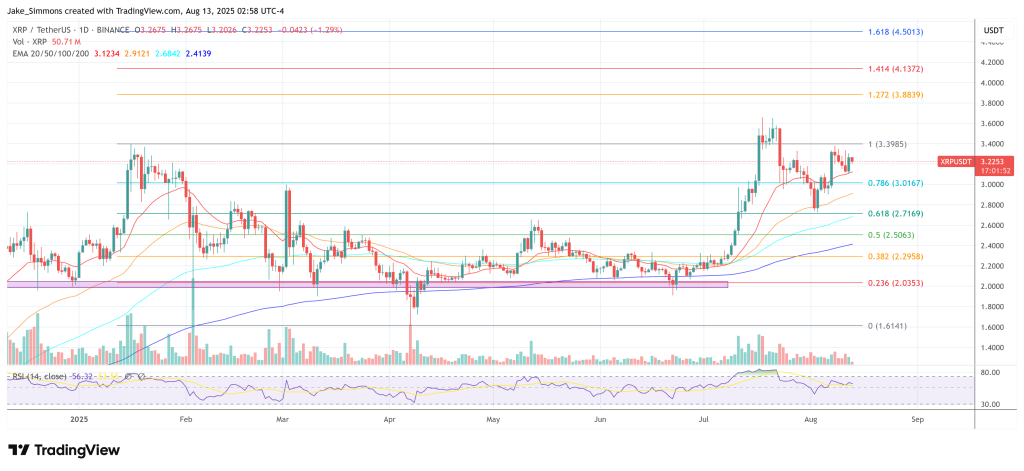
At press time, XRP traded at $3.22.
XRP price
XRP bounces from the EMA20, 1-day chart | Source: XRPUSDT on TradingView.com
Featured image created with DALL.E, chart from TradingView.com
Editorial Process for bitcoinist is centered on delivering thoroughly researched, accurate, and unbiased content. We uphold strict sourcing standards, and each page undergoes diligent review by our team of top technology experts and seasoned editors. This process ensures the integrity, relevance, and value of our content for our readers.

Jake Simmons has been a Bitcoin enthusiast since 2016. Ever since he heard about Bitcoin, he has been studying the topic every day and trying to share his knowledge with others. His goal is to contribute to Bitcoin's financial revolution, which will replace the fiat money system. Besides BTC and crypto, Jake studied Business Informatics at a university. After graduation in 2017, he has been working in the blockchain and crypto sector. You can follow Jake on Twitter at @realJakeSimmons.

Пов'язані матеріали

Grayscale: After Halving, BTC is Nearing the Bottom of This Cycle

Grayscale Research suggests Bitcoin's recent decline below $60,000, a >50% drop from its October peak, represents a cyclical correction within a long-term uptrend rather than a trend reversal. Key factors behind the pullback include a shift in market expectations toward Federal Reserve rate hikes under new Chair Kevin Warsh, uncertainty around the CLARITY Act's Senate passage, pressure on leveraged entities like Strategy, and concerns over quantum computing risks. The path out of the current bear market hinges on upcoming catalysts. An optimistic scenario, where the CLARITY Act passes, leverage is contained, and the Fed refrains from hiking, could mean Bitcoin is nearing its cycle bottom. A pessimistic scenario, featuring legislative failure, further deleveraging, and Fed rate hikes, could lead to additional moderate downside. Grayscale does not expect a historically deep ~80% drawdown due to a more measured prior bull run and stickier institutional demand. Despite short-term headwinds, Grayscale remains highly optimistic about crypto's long-term structural prospects, driven by institutional adoption of public blockchains, unsustainable government debt, declining trust in intermediaries, and AI's potential demand for alternative systems. The report concludes that while the exact cycle low depends on near-term catalysts, current valuations present an attractive entry point for long-term investors betting on the decade-ahead growth of digital assets.

marsbit4 хв тому

Grayscale: After Halving, BTC is Nearing the Bottom of This Cycle

marsbit4 хв тому

Web3 Bear Market Survival Guide: Ten Great Books to Help You Navigate the Cycles

"Web3 Bear Market Survival Guide: Ten Books to Help You Navigate the Cycle" This article presents a curated book list aimed at helping Web3 enthusiasts and professionals endure and grow during crypto market downturns. It argues that bear markets are not just periods of waiting but crucial times for deepening one's foundational understanding beyond technical whitepapers and price charts. The ten recommended books offer perspectives on technology, economics, philosophy, and strategy to build resilience and long-term vision. The list includes: 1. **"The Inevitable" by Kevin Kelly:** For using a long-term technological lens to combat uncertainty about the future, including the role of crypto and AI. 2. **"Human Action" by Ludwig von Mises:** To upgrade one's economic and philosophical framework, understanding action, speculation, and calculation in a bear market context. 3. **"The Nature of Technology" by W. Brian Arthur:** For viewing blockchain and crypto as combinatorial evolutions of existing technologies, understanding their modular and economic development. 4. **"The Distant Savior" (Chinese novel):** Explores the cultural attributes of self-reliance ("strong culture") versus dependency ("weak culture"), crucial for surviving industry cycles. 5. **"The Sovereign Individual" by James Dale Davidson & Lord William Rees-Mogg:** A prophetic 1997 work on how technology empowers individuals and challenges nation-states, foreshadowing Bitcoin's emergence. 6. **"Japanization: What the World Can Learn from Japan's Lost Decades" (Adapted title):** Uses Japan's economic history as a case study to identify structural opportunities that persist even during broader recessions. 7. **"Denationalisation of Money" by F.A. Hayek:** The ideological blueprint for Bitcoin, arguing for competitive currency issuance beyond state monopoly. 8. **"Duan Yongping Investment Q&A" (Chinese compilation):** Emphasizes the simple discipline of "doing the right things and doing things right," focusing on fundamentals and maintaining a "stop doing list." 9. **"The Network State: How To Start a New Country" by Balaji Srinivasan:** A visionary text from a crypto insider outlining bold predictions and concrete ideas for a blockchain-based future across media, governance, and identity. 10. **"Selected Works of Mao Zedong" (Vol. 1):** Analyzed as a strategic playbook for a weak force challenging a powerful establishment, offering lessons on strategy, alliance-building, and perseverance for the crypto movement. The conclusion states that bear markets filter out those with weak conviction, not weak skills. Survival depends on cognitive depth and mental fortitude, which these books aim to provide.

Foresight News27 хв тому

Web3 Bear Market Survival Guide: Ten Great Books to Help You Navigate the Cycles

Foresight News27 хв тому

Who is the Most Profitable Man in the Crypto World? Trump Rakes in Over $1.427 Billion in 2025

Who is the most profitable man in crypto? President Trump's 2025 financial disclosure, filed with the Office of Government Ethics, reveals crypto-related earnings exceeding $1.427 billion, starkly contrasting the broader market downturn. The bulk of this wealth stems not from passive investment but from his entities' roles as issuers and licensors. CIC Digital LLC, his memecoin operation, generated approximately $636 million in 2025, primarily from "Celebration Coins" royalty fees. DT Marks Defi LLC, a stakeholder in World Liberty Financial, earned about $594 million from asset sales and token distribution proceeds. Other entities held significant Bitcoin, Ethereum, and various altcoin wallets, along with substantial income from stablecoin ventures and his wife's NFT sales. This "issuer model" shields him from market downturns. While his namesake memecoin plummeted from ~$74 to ~$1.68, leaving many retail investors at a loss, his royalty income remained unaffected. The disclosure emerges as the U.S. Senate debates the CLARITY Act, which includes contentious ethics provisions aimed at preventing officials from profiting from the crypto sector they regulate. Critics argue Trump's earnings exemplify a critical conflict of interest, fueling demands for stricter rules to separate regulatory power from personal financial gain in the industry.

Foresight News46 хв тому

Who is the Most Profitable Man in the Crypto World? Trump Rakes in Over $1.427 Billion in 2025

Foresight News46 хв тому

Trump's 25-Year Financial Report: Family Earns Over $1 Billion Annually from Crypto, While Retail Investors Lose Money on $TRUMP

Former President Donald Trump's family earned approximately $1.2 billion from cryptocurrency ventures in 2025, according to a financial disclosure report. This revenue stream, outlined in a 927-page filing, now surpasses income from most of his long-established real estate holdings. The crypto earnings originated from two main sources: over $500 million from the sale of products like "governance tokens" by World Liberty Financial, a DeFi project co-owned by the Trump family, and roughly $635 million in royalties from the Trump-themed meme coin $TRUMP, issued by CIC Digital LLC. While Trump's entities profited, retail investors faced significant losses. The $TRUMP token, which peaked above $74 shortly after its January 2025 launch, has plummeted to around $1.68. World Liberty Financial's token has also fallen roughly 80% since its debut. Reports indicate that the majority of meme coin buyers have lost money, with Trump-linked entities still holding about 80% of $TRUMP's supply under vesting plans. The disclosure highlights a stark contrast: Trump's crypto and real estate businesses flourished—with new international property deals bringing in tens of millions—even as his administration shifted to crypto-friendly policies, relaxing the stringent regulatory stance of the previous Biden administration. The White House maintains that Trump acts only in the public interest, with his businesses placed in a trust managed by his sons, denying any conflict of interest. However, the report notes the difficulty of assessing such conflicts, particularly regarding foreign business dealings with countries that later received favorable U.S. policy decisions.

marsbit47 хв тому

Trump's 25-Year Financial Report: Family Earns Over $1 Billion Annually from Crypto, While Retail Investors Lose Money on $TRUMP

marsbit47 хв тому

From 'Address Clustering' to 'Evidence Standards': Why is Chainalysis Redefining Blockchain Tracing?

**Summary:** In June 2026, Chainalysis introduced the **Blockchain Tracing Ontology (BTO)**, a proposed data framework aiming to establish standardized, transparent, and verifiable models for blockchain analysis. This initiative addresses a core industry issue: despite public blockchain data, different firms often produce inconsistent results (e.g., differing entity labels for the same address) due to non-uniform methodologies, particularly in **address clustering**. This lack of standardization poses challenges for judicial investigations, AML, and enforcement. The BTO is not a new clustering algorithm but a **common "language" or conceptual framework**. It moves beyond the simplistic "cluster" model by introducing a hierarchical structure: **Entity → Wallet → Wallet Segment → Address**, which better reflects complex organizational wallet management. A key shift is from presenting mere results to ensuring **process trust and explainability**. The framework emphasizes documenting the **Evidence** and **Confidence** behind each analytical claim—specifying the on-chain/off-chain data, rules applied, and certainty levels—enabling third-party verification. This focus is partly informed by legal precedents like the **Bitcoin Fog** case, where Chainalysis's methods underwent rigorous judicial scrutiny (Daubert hearing), highlighting the need for reproducible, scientifically sound analysis. The proposal clarifies that on-chain analysis identifies address relationships and flow patterns, not real-world identities, which still require off-chain evidence (e.g., KYC data). Ultimately, Chainalysis envisions steering the industry from an "experience-driven" to a **"standards-driven"** future, where competition centers on **data quality, analytical transparency, and judicial admissibility** rather than just label coverage. Widespread adoption could facilitate cross-agency collaboration, reduce disputes, and provide a more reliable foundation for global compliance and enforcement.

marsbit1 год тому

From 'Address Clustering' to 'Evidence Standards': Why is Chainalysis Redefining Blockchain Tracing?

marsbit1 год тому

Торгівля

Спот
活动图片