30-Year Treasury Yield Breaks 5% Again: The Era of 'Everything Is Cheap' Is Over

marsbitОпубліковано о 2026-06-01Востаннє оновлено о 2026-06-01

Анотація

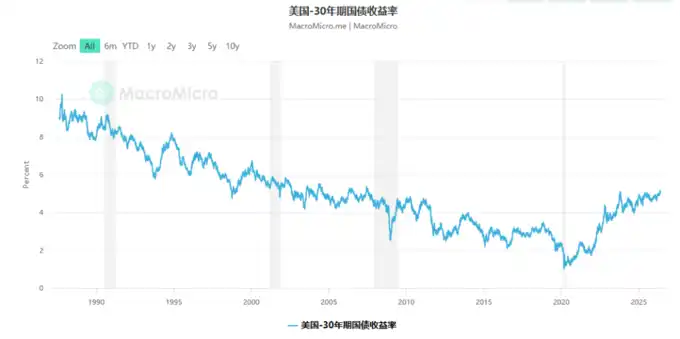
The yield on the 30-year U.S. Treasury bond has again surpassed 5%, signaling a fundamental shift as markets begin to accept that high interest rates are here to stay. This reflects the simultaneous breakdown of three pillars that underpinned half a century of low inflation and low rates: cheap capital, cheap labor, and cheap energy. Global capital flows are shifting, energy security is strained, and labor costs are rising due to shortages and unionization, though partly offset by AI's impact. Long-term pressures like soaring government debt, geopolitical friction, and populism are also pushing up long-term borrowing costs. The role of AI remains the biggest uncertainty—it could boost productivity and lower debt or become a new source of inflation if it merely automates jobs while consuming vast resources. The core challenge for investors is adapting their models and expectations, calibrated during decades of cheap money, to this new, more persistent high-rate environment.

The yield on the 30-year Treasury bond has once again broken through 5%. This time, the market's reaction is markedly different from that in 2023—investors are beginning to truly accept the reality that high interest rates will persist for a long time.

Analysis points out that behind this lies a deeper structural shift: the three pillars supporting low inflation and low interest rates in the U.S. over the past 50 years—cheap capital, cheap labor, and cheap energy—are simultaneously eroding. And the direction of AI will be the biggest unknown determining future inflation trends.

The yield on the 30-year U.S. Treasury bond recently broke through 5% again. Writing in the Financial Times, columnist Rana Foroohar points out that, unlike the brief breach of 5% in 2023 followed by a rapid decline, this time the market's reaction is distinctly different—investors finally seem to be truly accepting the reality that the U.S. is bidding farewell to the era of low interest rates and entering a new phase with more persistent and diverse inflationary pressures.

The article cites a recent report to clients by Apollo chief economist Torsten Sløk, which states, "Investors should position their portfolios for a persistent high interest rate environment in the short, medium, and long term."

Behind this lies a larger structural story: the three cheap factors that drove U.S. economic growth over the past 50 years—cheap capital, cheap labor, and cheap energy—are simultaneously reversing.

How Did Half a Century of "Cheap Dividends" Come About?

The nearly half-century-long downward trend in the 30-year Treasury yield, falling from around double-digit percentages in the early 1980s to about 1% during the pandemic, was not an accident.

It was underpinned by a complete macro logic:

Cheap Capital: Decades of globalization and manufacturing technology advancements kept goods prices low; oil-exporting countries recycling massive petrodollars into the U.S. provided ample cheap funding; pension privatization reforms spurred enormous demand for various financial products; global investors vied to buy U.S. Treasuries, as no country was safer than America.

Cheap Labor: Outsourcing of industries, weakening of unions, automation waves, and the "shareholder primacy" corporate culture (emphasizing financial engineering over employee investment) collectively suppressed wages, especially for non-college-educated workers, persistently supporting corporate profit margins.

Cheap Energy: The petrodollar system helped curb inflation to some extent, and the global energy trade being settled in dollars also reinforced the dollar's global dominance.

These three pillars jointly supported half a century of low-inflation, low-interest-rate prosperity in the U.S.

The Three Pillars Are Simultaneously Loosening

In her article, Rana Foroohar notes that each of these supporting factors is now changing.

On the Capital Front: With each U.S. Treasury auction, international buyers are decreasing, not increasing. Deglobalization and supply chain reshoring will push up goods and services prices in the short term. Meanwhile, the foundation of the petrodollar system is being eroded.

On the Energy Front: Continued tensions in the Middle East directly impact Asian energy-importing countries. But in the longer term, this may accelerate the deployment of clean energy in major Asian nations—while the U.S. is retreating from climate commitments. This means long-term capital flows may shift from the U.S. to major Asian countries.

On the Labor Front: In recent years, labor shortages, large-scale strikes (including successful union action in the auto industry), tighter immigration restrictions, and growth in union membership in some sectors (especially white-collar industries) have all pushed wages higher. However, this trend is being partly offset by two factors: one is rising corporate healthcare insurance costs, leading companies to hedge by suppressing wages; the other is the impact of artificial intelligence.
And Then There Are the Slow Variables: Debt, Geopolitics, and Populism

In addition to the explicit factors above, there are several "slow variables": rising government debt, intensifying geopolitical friction, and the spread of populism.

The combined effect of these risks is that lenders demand a higher risk premium to lend money out—especially for terms of several years.

This directly pushes up long-term interest rates, i.e., the yield on the 30-year Treasury bond.

AI: Savior or New Source of Inflation?

Of all the variables, the direction of artificial intelligence is the most difficult to judge, yet its impact could be the most far-reaching.

Rana Foroohar outlines two starkly different scenarios:

The Optimistic Scenario: The productivity benefits of AI diffuse widely across industries and individuals, creating new jobs and income sources. Models from Yale's Budget Lab show that in this scenario, U.S. national debt would fall significantly, and inflation would also recede.

The Pessimistic Scenario: AI serves merely as a tool for corporate layoffs, cost compression, and profit expansion, while the infrastructure construction of AI itself (consuming vast amounts of chips, land, water, and electricity) creates new inflationary pressures. The net effect is to raise, not lower, costs. Governments would also be forced to bail out displaced workers, increasing debt instead.

Currently, AI giants are voraciously consuming real estate, chips, water resources, and electricity, already pushing up the prices of these resources in the overall economy. The final outcome will likely take years to become clear.

The Real Challenge Facing Investors

The article's conclusion is direct and sobering: Most market participants have spent their entire careers in the "cheap era." Their intuition, models, and expectations were calibrated in a low-interest-rate environment.

And now, that environment is changing.

"Expectational inertia" is a powerful force—when the 30-year yield broke 5% in 2023, many thought it was just a brief anomaly that would soon recede. But this time, the market's reaction is already different.

Adjusting means abandoning old expectations. For investors accustomed to low interest rates, that is no easy task.


Пов'язані питання

QWhat is the main reason behind the recent sustained rise in the 30-year US Treasury yield above 5%, according to the article?

AThe main reason is a deeper structural shift where the three pillars supporting low inflation and low interest rates in the US for the past 50 years—cheap capital, cheap labor, and cheap energy—are simultaneously eroding, leading investors to accept that a high-rate environment is here to stay.

QWhat were the three 'cheap pillars' that drove US economic growth for half a century?

AThe three pillars were cheap capital (from globalization, petrodollar recycling, and high demand for safe US debt), cheap labor (due to outsourcing, weaker unions, automation, and a 'shareholder-first' culture), and cheap energy (supported by the petrodollar system).

QHow might Artificial Intelligence (AI) contribute to future inflation, based on the pessimistic scenario described in the article?

AIn the pessimistic scenario, AI does not boost broad productivity but is used mainly for cost-cutting and layoffs. Meanwhile, AI infrastructure itself (consuming chips, real estate, water, and electricity) creates new inflationary pressures. Governments may also need to bail out displaced workers, increasing debt.

QBesides the three main pillars, what other 'slow-moving' factors are contributing to higher long-term interest rates?

AOther factors include rising government debt, increasing geopolitical friction, and the spread of populism. These factors increase risk premiums, meaning lenders demand higher yields for long-term loans, which pushes up long-end rates like the 30-year Treasury yield.

QWhy is adjusting to the new high-rate environment particularly challenging for investors, as stated in the article's conclusion?

AAdjusting is challenging because most market participants have spent their entire careers in the 'cheap era' of low interest rates. Their instincts, models, and expectations are calibrated for that environment, creating a powerful 'expectational inertia' that makes it difficult to abandon old assumptions.

Пов'язані матеріали

ETH Bull and Bear Views Compilation: Can Ethereum's Value Flow Back to ETH?

Titled "ETH Bull and Bear Views: Can Ethereum's Value Flow Back to ETH?", this article synthesizes the current heated debate around Ethereum's native token, ETH, following Bankless co-founder David Hoffman's decision to sell his entire ETH holdings. The **bullish case**, represented by figures like Tom Lee (BitMine CEO) and Raoul Pal, argues that ETH's core thesis remains intact. They contend Ethereum is the essential, secure, and neutral foundational layer for future finance—encompassing stablecoins, RWA, DeFi, L2s, and Agentic AI. Bulls bet on ETH's long-term revaluation as institutional adoption of on-chain finance grows, with significant buying activity from entities like BitMine and Consensys cited as evidence. Conversely, the **bearish perspective**, led by Hoffman and analysts like Markus Thielen, questions ETH's value capture mechanism. They acknowledge Ethereum's network success but argue that the value created by L2s, DeFi, and applications does not sufficiently accrue to the ETH token itself. Bears point to ETH's prolonged underperformance versus the broader crypto market, lack of traditional cash flows, weakening "ultrasound money" narrative, and apparent institutional retreat (e.g., Harvard Management Company exiting its ETH ETF position) as key concerns. The debate highlights a pivotal shift: ETH is no longer just a community belief asset. The central question is whether ETH can transition from being a "**used infrastructure**" to a "**continuously bought and held core asset**" as more value enters the Ethereum ecosystem. The market is now critically examining the direct link between network growth and ETH's value.

marsbit45 хв тому

ETH Bull and Bear Views Compilation: Can Ethereum's Value Flow Back to ETH?

marsbit45 хв тому

Crypto is dead, Perps are forever

The crypto industry is shifting from a focus on creating native assets (like altcoins and protocol tokens) to becoming a "global asset pipeline." Native cryptocurrencies, except for Bitcoin, are seen as failing in their value storage and utility promises, with demand driven largely by speculation. Attention and liquidity are now moving toward real-world assets (RWAs) like U.S. stocks, bonds, gold, and oil traded on-chain via perpetual contracts (Perps). Stablecoins like USDT and USDC set the precedent, proving blockchain's core strength is efficient global settlement and transfer, not inventing new monetary systems. Meanwhile, assets like Ethereum and many DeFi tokens struggle as their narratives weaken against tangible traditional assets and the rapid real-world progress of AI. Perpetual contracts have emerged as a pivotal innovation. They simplify trading by offering pure price exposure to any asset, bypassing complexities of ownership, custody, and traditional market hours. Projects like Hyperliquid gained traction by combining CEX-like efficiency with on-chain transparency, capitalizing on post-FTX distrust, macroeconomic volatility, and the surge in demand for 24/7 stock trading. In conclusion, while the era of speculative native "crypto assets" may be over, perpetual contracts persist as the industry's most potent financial instrument—transforming all assets into globally accessible, constantly tradable instruments centered on price speculation.

marsbit51 хв тому

Crypto is dead, Perps are forever

marsbit51 хв тому

Tencent, Alibaba, ByteDance in a Battle for the Skill Store

Skill is becoming a key concept in the AI field, essentially serving as a structured "instruction manual" for AI Agents that specifies tool calls, decision logic, and output standards. This allows Agents to execute predefined tasks. As the number of Skills grows, distribution platforms have emerged. Major tech companies are swiftly entering this space. In March, Tencent, Alibaba, and ByteDance launched Skill stores within their respective Agent platforms. Subsequently, players like Zhipu AI, Meituan, and Xiaohongshu joined the fray. This competition for the "Skill store" is fundamentally a battle for the AI-era user entry point; whoever controls distribution controls the users. While ByteDance's Coze has experimented with paid Skills, most platforms offer them for free. The real value lies not in the stores themselves but in using them to attract and retain users within an ecosystem, driving revenue from services like cloud computing, model calls, or advertising. The landscape features three main player types: 1) **Internet giants** (e.g., Alibaba, ByteDance, Tencent, Meituan), leveraging Skills to drive traffic and monetize through their broader ecosystems (cloud services, transactions, ads). 2) **Large model companies** (e.g., Zhipu AI, Moonshot AI), using Skill stores to increase user engagement and monetize model API calls. 3) **Content platforms** (e.g., Xiaohongshu), treating Skills as a new content format to generate traffic and ad revenue. However, transforming Skill stores into a sustainable business faces significant hurdles. Key challenges include: the **difficulty in pricing Skills** due to inconsistent outputs across different models and contexts; **lack of cost transparency** (varying token consumption); **security risks** like Skill poisoning; and the **absence of standardized protocols** for development and evaluation. Unlike standardized mobile apps, Skills are often personalized workflows resistant to uniformity, which hinders the establishment of a reliable review and monetization system akin to the App Store. While there is genuine user demand for paid Skills—particularly in enterprise (e.g., contract review) and certain personal productivity scenarios—current platforms offer developers limited and unpredictable distribution. The future of Skill stores depends on overcoming these standardization, evaluation, and safety challenges to make acquiring a Skill as straightforward as downloading an app. For now, the stores function more as display shelves than robust marketplaces.

marsbit51 хв тому

Tencent, Alibaba, ByteDance in a Battle for the Skill Store

marsbit51 хв тому

The Crypto Scene Is Dead, Perpetual Swaps Are Eternal

The crypto industry is undergoing a fundamental shift. The era defined by minting novel, native digital assets (altcoins) is fading. These assets, lacking real-world cash flows or clear value, are losing relevance as attention and capital flow elsewhere. Two powerful external forces are reshaping the space. First, traditional assets like U.S. stocks, bonds, gold, and oil are being tokenized and traded on-chain. Second, the explosive growth of AI, with its tangible products, has overshadowed crypto's once-dominant "future narrative." This marks a critical pivot: crypto is transitioning from being a "factory for new assets" to becoming a "global conduit for existing assets." Its validated utility is not complex financial reinvention but efficient global settlement, transfer, and trading—the original promise of blockchain. Stablecoins like USDT and USDC exemplify this, offering faster dollar movement rather than replacing it. Consequently, native ecosystems like Ethereum face profound challenges. While still crucial infrastructure, ETH struggles to capture value as users interact with Layer 2s or trade traditional assets without needing to hold it. DeFi's grand narrative of rebuilding finance has narrowed to core needs like cheap transfers and deep liquidity. The true breakout innovation is the perpetual contract (Perp). It brilliantly bypasses the complexities of direct asset ownership (custody, compliance, dividends) by creating pure price exposure. Users can speculate on the price movement of *any* asset—NVIDIA, gold, oil—24/7, globally, and with leverage. This "price casino" model, while risky and ethically fraught, delivers unmatched liquidity and accessibility. Projects like Hyperliquid succeeded not by inventing new mechanics but by perfecting the timing and execution of this model. Key drivers included making on-chain Perps feel like centralized exchanges, post-FTX trust migration towards transparency, and rising demand to trade macro assets and equities round-the-clock. In conclusion, the crypto world's most enduring successes are the dollar (via stablecoins), Bitcoin, and trading. Its new frontier is not creating alternative assets but providing a seamless, perpetual trading layer—a new API—for the world's existing financial system. The age of native altcoins is over; the age of perpetual synthetic exposure has begun.

Odaily星球日报1 год тому

The Crypto Scene Is Dead, Perpetual Swaps Are Eternal

Odaily星球日报1 год тому

Торгівля

Спот
Ф'ючерси

Популярні статті

Як купити ERA

Ласкаво просимо до HTX.com! Ми зробили покупку Caldera (ERA) простою та зручною. Дотримуйтесь нашої покрокової інструкції, щоб розпочати свою криптовалютну подорож.Крок 1: Створіть обліковий запис на HTXВикористовуйте свою електронну пошту або номер телефону, щоб зареєструвати обліковий запис на HTX безплатно. Пройдіть безпроблемну реєстрацію й отримайте доступ до всіх функцій.ЗареєструватисьКрок 2: Перейдіть до розділу Купити крипту і виберіть спосіб оплатиКредитна/дебетова картка: використовуйте вашу картку Visa або Mastercard, щоб миттєво купити Caldera (ERA).Баланс: використовуйте кошти з балансу вашого рахунку HTX для безперешкодної торгівлі.Треті особи: ми додали популярні способи оплати, такі як Google Pay та Apple Pay, щоб підвищити зручність.P2P: Торгуйте безпосередньо з іншими користувачами на HTX.Позабіржова торгівля (OTC): ми пропонуємо індивідуальні послуги та конкурентні обмінні курси для трейдерів.Крок 3: Зберігайте свої Caldera (ERA)Після придбання Caldera (ERA) збережіть його у своєму обліковому записі на HTX. Крім того, ви можете відправити його в інше місце за допомогою блокчейн-переказу або використовувати його для торгівлі іншими криптовалютами.Крок 4: Торгівля Caldera (ERA)Легко торгуйте Caldera (ERA) на спотовому ринку HTX. Просто увійдіть до свого облікового запису, виберіть торгову пару, укладайте угоди та спостерігайте за ними в режимі реального часу. Ми пропонуємо зручний досвід як для початківців, так і для досвідчених трейдерів.

464 переглядів усьогоОпубліковано 2025.07.17Оновлено 2026.06.02

Як купити ERA

Обговорення

Ласкаво просимо до спільноти HTX. Тут ви можете бути в курсі останніх подій розвитку платформи та отримати доступ до професійної ринкової інформації. Нижче представлені думки користувачів щодо ціни ERA (ERA).

活动图片