30-Day Doubling, 15-Fold Year-to-Date Gain: Why is the English-Speaking Crypto Community FOMOing Over $ZEC Again?

marsbitОпубліковано о 2026-05-09Востаннє оновлено о 2026-05-09

Анотація

Over the past week, ZEC has surged back into the spotlight on English Crypto Twitter, driven by endorsements from prominent figures like Naval, Arthur Hayes, and Mert Mumtaz, alongside a public "significant" position announcement from Multicoin Capital at Consensus Miami. The price has skyrocketed, with ZEC gaining over 110% in 30 days and 1500% year-to-date, now ranking among the top 20 cryptocurrencies by market cap. The primary catalyst is a shifting investment thesis. Multicoin Capital's Tushar Jain argues that while Bitcoin resists censorship, its transparent ledger leaves holdings vulnerable to potential wealth confiscation via taxation. Zcash's shielded pool, using zk-proofs to obscure transaction details, is positioned as "insurance against Bitcoin" for true financial privacy. Arthur Hayes has set a long-term price target of 10% of Bitcoin's value. Further momentum comes from technical developments announced at Consensus, including a roadmap for quantum-recoverable wallets and full post-quantum security within 12-18 months. Institutional adoption signals are growing, with a Grayscale ETF application pending, Robinhood listing ZEC, and Foundry launching a mining pool. However, a critical caveat is the recent departure of the entire original Zcash development team (ECC) due to governance conflicts, leaving the project's future development uncertain. While narrative and institutional interest are clearly fueling the current rally, distinguishing between genuine adopti...

Author: Curry, Deep Tide TechFlow

If you've been browsing English Crypto Twitter lately, you've likely seen ZEC all over the screen.

Names like Naval, Arthur Hayes, Mert Mumtaz, Balaji, and Cobie are popping up repeatedly around the same topic. Coupled with Multicoin Capital's public announcement of a significant position and multiple privacy-focused panels at Consensus Miami, ZEC's social media buzz over the past week has reached its highest point since the rally at the end of 2025.

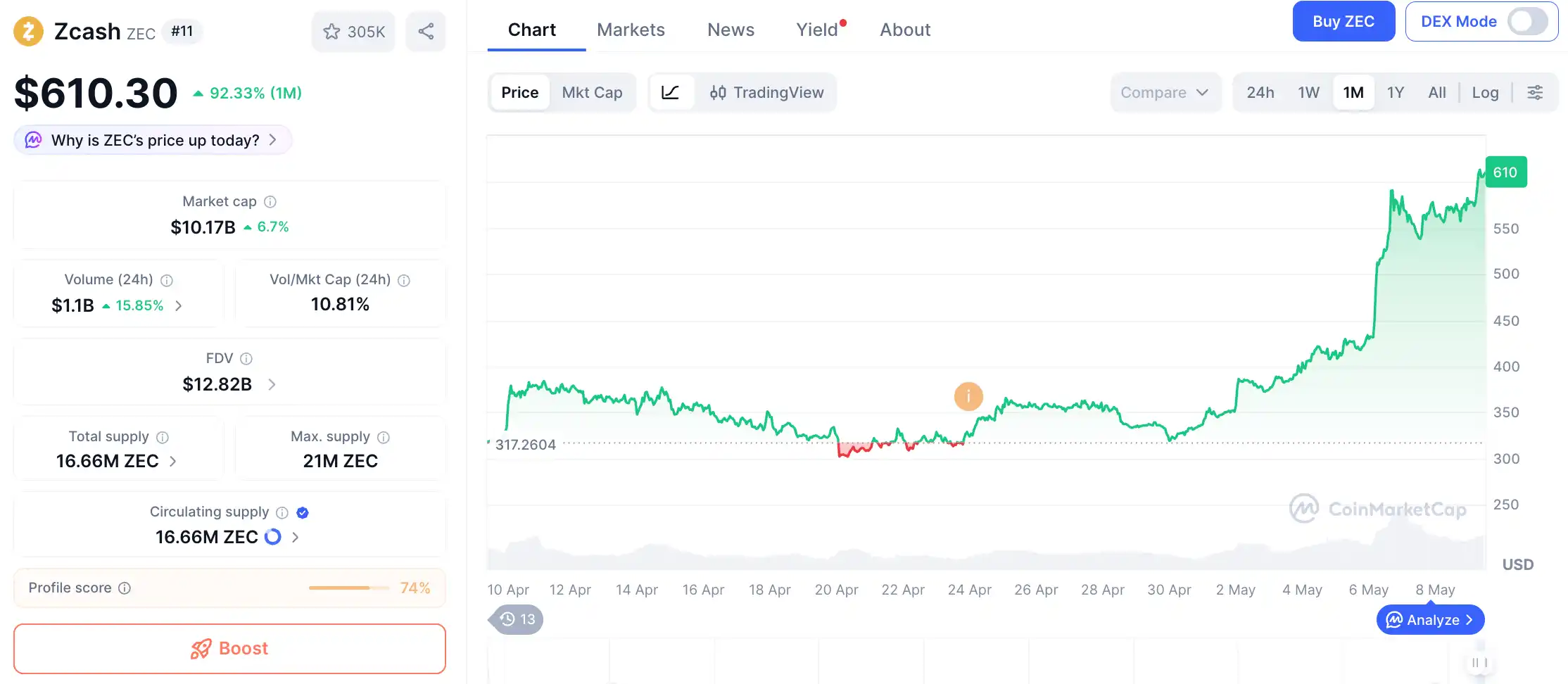
The price has already run ahead of the narrative. At the time of writing, ZEC is trading around $580, with gains exceeding 110% over the past 30 days and cumulative year-to-date gains surpassing 1500%. Its market cap has exceeded $9.5 billion, overtaking the veteran privacy coin Monero (XMR) and climbing into the top 20 on CoinGecko.

On May 6th, ZEC surged nearly 30% in a single day, triggering over $62 million in short liquidations, with shorts accounting for $46.7 million of that.

So the question is: What's driving this wave?
Multicoin's Heavy Position: "Bitcoin is Censorship-Resistant, But It Can't Stop a Wealth Tax"

The most direct catalyst came from Multicoin Capital.

On May 6th, Multicoin Capital co-founder and managing partner Tushar Jain publicly stated during a panel at Consensus Miami that the firm had built a "significant position" starting in February. He didn't disclose the specific size but provided a clear investment logic framework.

In a subsequent long post on X, Jain wrote: "Bitcoin is censorship-resistant; nobody can freeze your BTC or stop you from using it. But it does not stop governments from confiscating known holdings via a wealth tax."

His direct evidence is California's Initiative 25-0024 proposal, which aims to impose a one-time 5% wealth tax (including unrealized gains) on residents with a net worth exceeding $1 billion, expected to raise approximately $100 billion.

Jain's core thesis is: Bitcoin is insurance against fiat currency, but its on-chain balances are completely transparent; a tax agency with a blockchain explorer can see everything. ZEC's shielded pool, using zero-knowledge proof technology, hides the sender, receiver, and amount, making on-chain assets invisible to external observers.
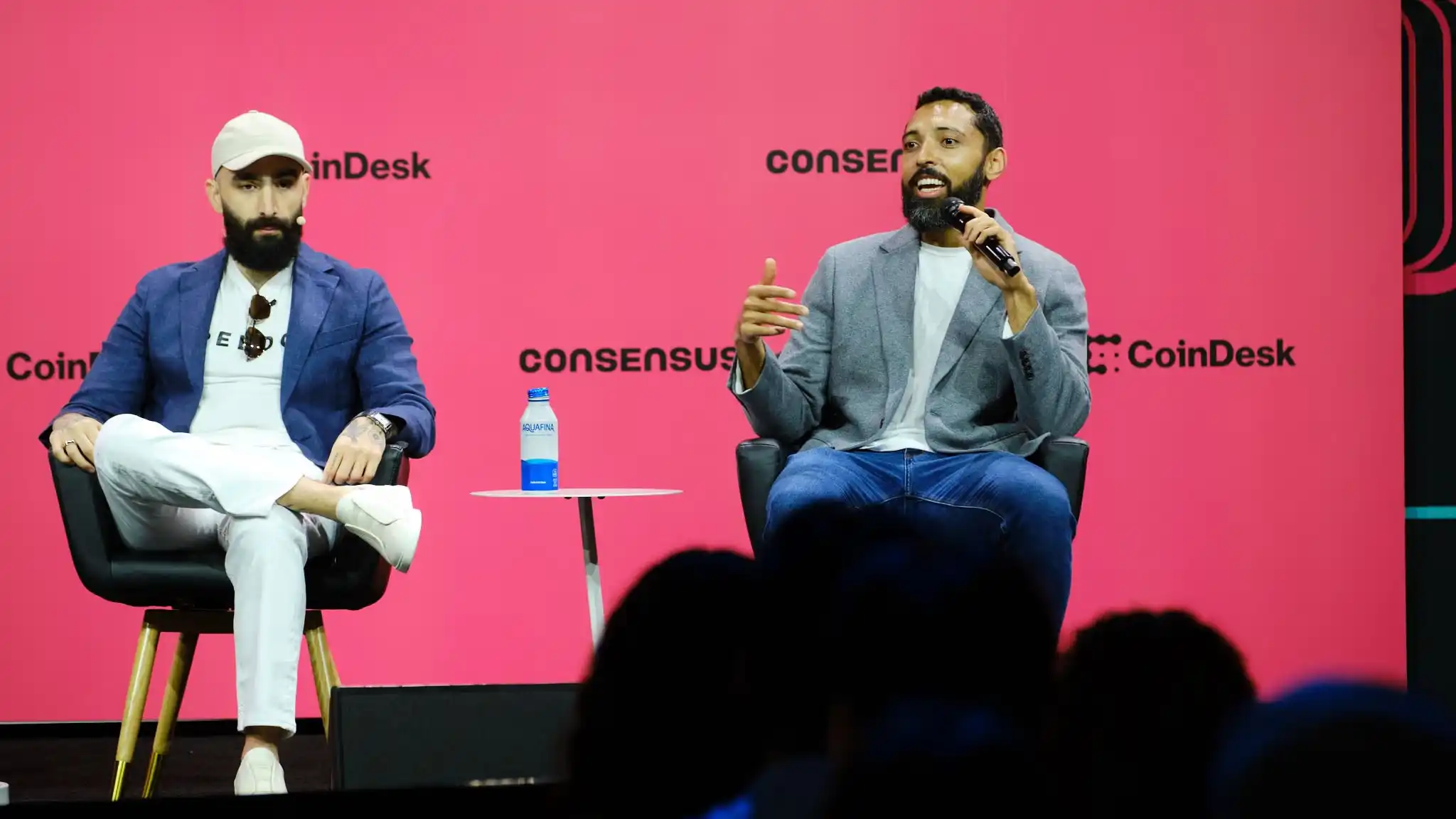
"We think there is clear product-market fit for truly private, censorship- and seizure-resistant assets, and demand is accelerating," Jain wrote, "Zcash is the cleanest way to express this thesis in public markets."

This represents a clear shift in stance for Multicoin.

In 2019, the fund published an article arguing that "privacy is a feature of valuable cryptocurrencies, not a standalone product," suggesting users shouldn't sell BTC or ETH to buy ZEC just for privacy.

Seven years later, this public statement looks like they are betting real money to overturn their past conclusion.

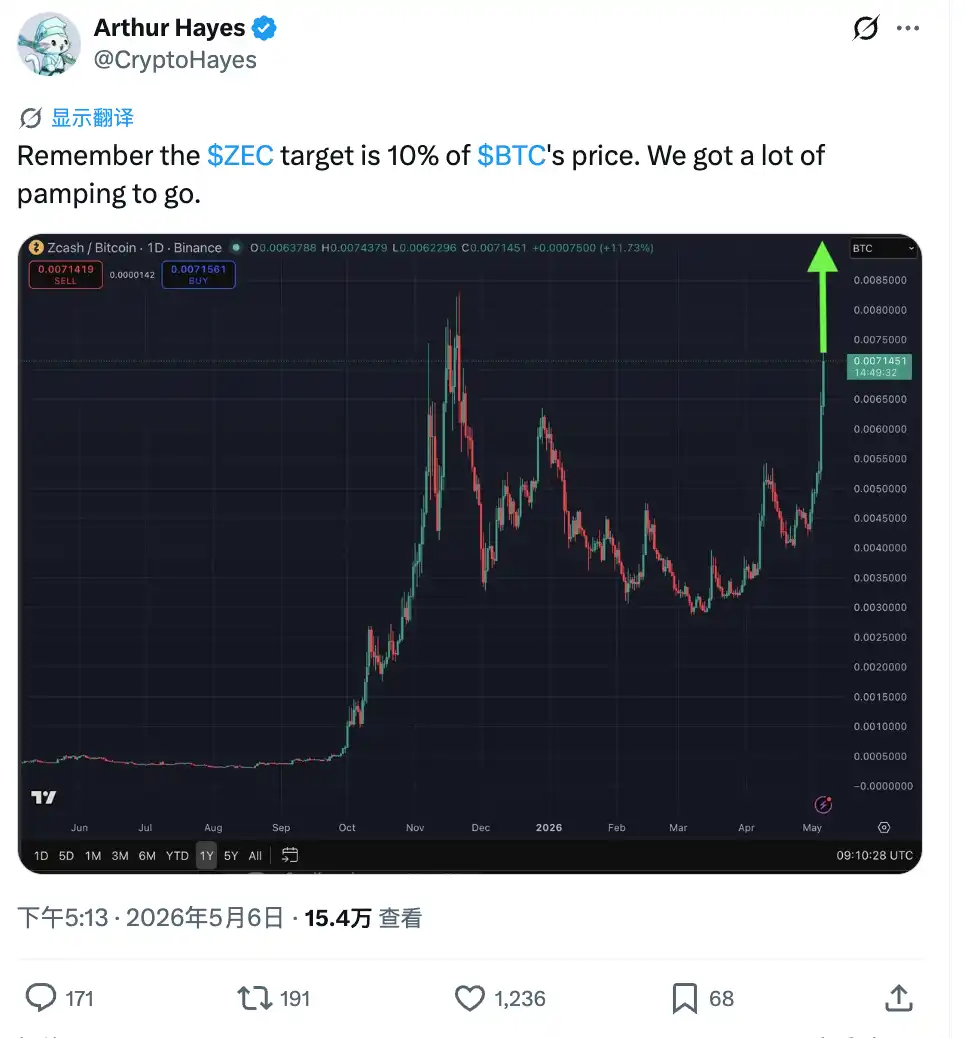
KOLs Rally, Arthur Hayes Calls for "10% of BTC's Price"

The seeds for this ZEC narrative were actually planted in the second half of 2025.

BitMEX co-founder Arthur Hayes, AngelList co-founder Naval Ravikant (also an early Zcash investor), Helius founder Mert Mumtaz, along with other top crypto KOLs like Balaji Srinivasan and Cobie, began voicing strong support for ZEC intensively starting last fall.

Naval tweeted in October last year: "Bitcoin is insurance against fiat. Zcash is insurance against Bitcoin."

Hayes's stance was more aggressive. At Consensus 2026, he bluntly stated ZEC's long-term target price should be "10% of Bitcoin's price." Based on BTC's current price of around $80,000, this implies a target of approximately $8,000 for ZEC, representing over 13x upside from the current price. Tyler Winklevoss also endorsed a thesis this week targeting $9,700 for ZEC based on capturing offshore wealth.

These calls themselves might not be reliable investment advice, but their concentrated emergence indicates one thing: the top capital and top voices in the English-speaking crypto space are simultaneously tilting towards the privacy sector.
The Quantum-Resistant Narrative at Consensus Miami

If Multicoin and the KOLs provided catalysts on the capital and narrative fronts, the release of the technical roadmap at Consensus Miami gave the market a fundamental story.

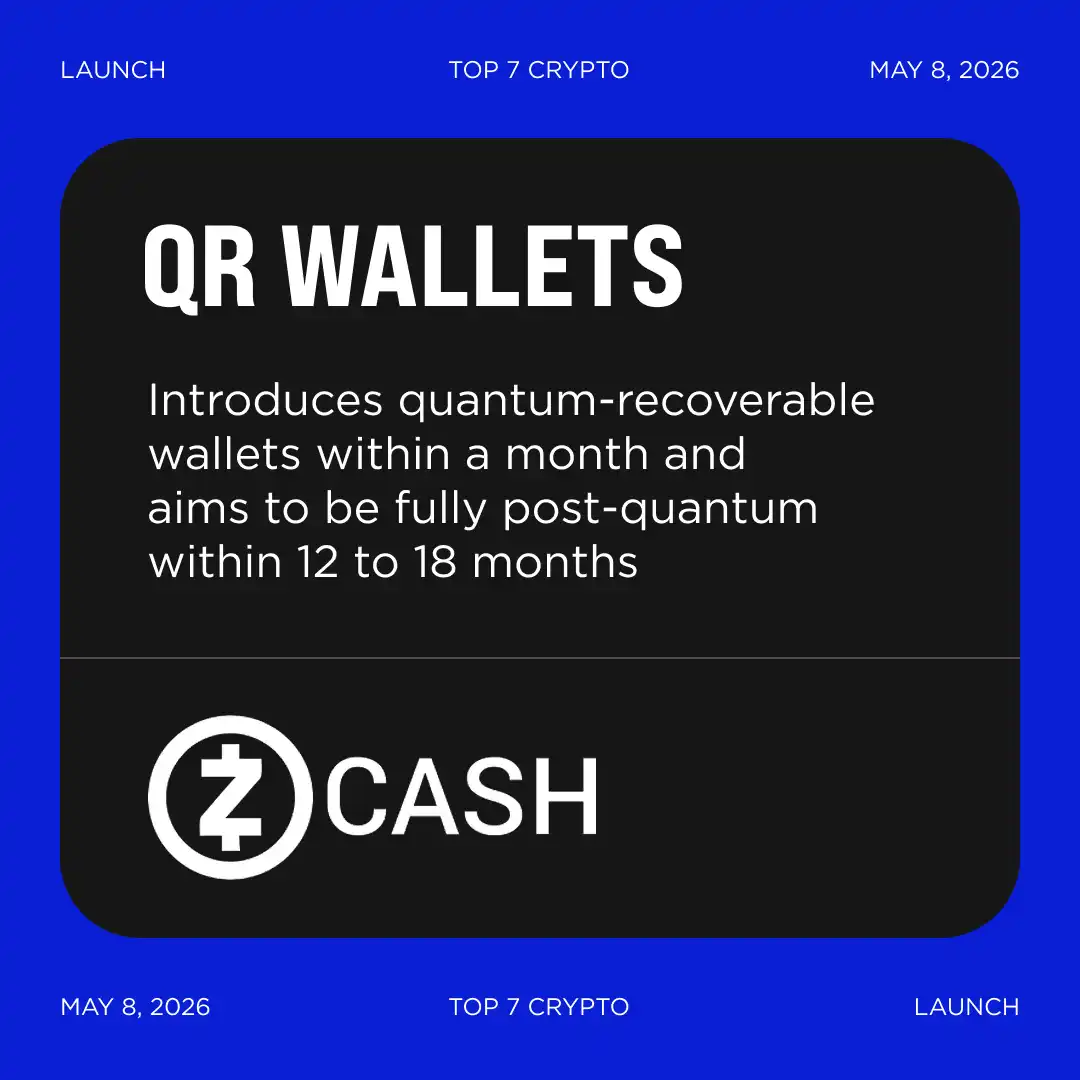
At a dedicated privacy panel on May 8th, Zcash Open Development Lab founder and CEO Josh Swihart announced that quantum-recoverable wallets will launch within a month, and Zcash plans to achieve full post-quantum security within 12 to 18 months.
The logic here is: the ECDSA signature algorithm used by most cryptocurrencies today will become vulnerable once quantum computing matures. A more dangerous scenario is the "harvest now, decrypt later" strategy, where adversaries record encrypted data now and decrypt it later when quantum hardware is available. For a privacy coin whose entire value proposition is built on the confidentiality of transaction data, this is an existential threat.

Swihart also disclosed that since the ECC wallet integrated Near Intents cross-chain swap functionality last October, $6-7 billion has flowed in and out through this channel, primarily swapping for dollars and USDC. Zcash's shielded pool currently holds about 30% of the circulating ZEC supply, the highest level in history.

Institutional Entry Signals: Grayscale ETF, Robinhood Listing, Foundry Mining

Beyond Multicoin's heavy position, ZEC is accumulating more institutional-level catalysts.

Grayscale has filed for a ZEC spot ETF, still awaiting an SEC ruling. Grayscale has previously stated publicly that ZEC's upside potential is closely tied to the "repricing of financial privacy in an AI-driven world."

Robinhood recently listed ZEC for trading, opening up a retail gateway. Foundry (under Digital Currency Group) announced the launch of large-scale ZEC mining pool operations. This is the second asset supported by the company after Bitcoin, adding credibility to ZEC's mining security and institutional acceptance.

On the on-chain data front, Santiment data shows retail investor interest in privacy coins is rising, driven by tighter exchange compliance rules and growing data tracking concerns. In a March report, CoinDesk Research stated that Zcash has reached a "encryption supremacy" tipping point, driven by the convergence of three forces: AI tools can de-anonymize users on transparent blockchains by tracking transaction patterns, the threat of quantum computing to current crypto wallet security is becoming more real, and quarterly trading volume has surpassed $100 billion.

However, The Team That Built Zcash Has All Left

The catalysts above paint a bullish picture, but one fact shouldn't be ignored: the core team that built Zcash is gone.

In January of this year, Electric Coin Company (ECC) CEO Josh Swihart and the entire ECC team resigned collectively, citing governance conflicts with the Bootstrap Project board and characterizing the departure as "constructive discharge." ECC was the core organization that created and maintained Zcash. The team's departure means the chain is now operating without its original engineering team.

Therefore, what's more apparent with ZEC currently is that the narrative hype is far outpacing the fundamentals. KOL calls, fund heavy positions, consecutive Consensus panels—these are stories of capital and attention, but on-chain public transaction volume hasn't grown much.

Because transactions in the shielded pool are, by design, invisible, you can't use on-chain data to distinguish between "real adoption" and "speculative capital sitting idle."

But lacking fundamentals is the norm for most coins. In this wave of "old guard coin" revival, ZEC is undoubtedly one of the brightest stars, but it likely won't be the last.


Пов'язані питання

QAccording to the article, what is the main reason behind Multicoin Capital's significant investment in ZEC?

AMulticoin Capital's main investment thesis is that while Bitcoin resists censorship, it does not protect against government confiscation via mechanisms like wealth taxes on transparent holdings. They believe ZEC, with its shielded pool using zero-knowledge proofs, offers a truly private, censorship-resistant, and confiscation-resistant asset, which they see as having clear product-market fit with accelerating demand.

QWhat ambitious price target for ZEC was mentioned by BitMEX co-founder Arthur Hayes?

AArthur Hayes stated that the long-term price target for ZEC should be "10% of Bitcoin's price." With Bitcoin around $80,000, this would imply a ZEC target price of approximately $8,000.

QWhat key technical development for ZEC was announced at Consensus Miami?

AAt Consensus Miami, it was announced that quantum-recoverable wallets for ZEC will launch within a month, with the goal of achieving full post-quantum security for the Zcash network within 12 to 18 months to address the threat posed by future quantum computers.

QWhat major organizational change has recently occurred concerning Zcash's core development team?

AThe entire team of the Electric Coin Company (ECC), the core organization that created and maintained Zcash, including its CEO Josh Swihart, resigned in January. This departure was due to governance conflicts with the Bootstrap Project board, leaving the chain to operate without its original engineering team.

QBesides Multicoin Capital's investment, what are two other institutional-level catalysts mentioned for ZEC?

ATwo other institutional catalysts mentioned are: 1) Grayscale has filed for a ZEC spot ETF, which is pending SEC approval, and 2) Robinhood has listed ZEC for trading, providing a major retail access point.

Пов'язані матеріали

Warsh's First Day in Office, Markets Deliver a 'Wake-up Call': Rate Hike Expected This Year

On his first day in office, newly inaugurated Federal Reserve Chairman Warsh received a stark market warning, with expectations now fully pricing in a 25-basis-point interest rate hike this year. The shift was triggered by hawkish remarks from Fed Governor Waller, who stated that inflation is now the key policy "driver" and that the odds of a hike or cut are evenly split. This sent short-term Treasury yields higher. Waller signaled a significant pivot in his stance, citing disappointing inflation and labor data. He suggested removing "easing bias" language from Fed statements and did not rule out future rate increases if inflation fails to recede, though he noted immediate action isn't warranted without signs of unanchored inflation expectations. Chairman Warsh faces immediate pressure at his first FOMC meeting in June. With the preferred inflation gauge at a three-year high, analysts warn that failing to hike could be interpreted as an implicit easing of policy. The geopolitical situation in the Middle East is adding to existing price pressures. The market's expectation for a hike contrasts sharply with earlier forecasts for multiple cuts. While long-term Treasury yields have been contained by lower energy prices recently, analysts note they remain under structural upward pressure. Warsh's swearing-in at the White House highlights political scrutiny over Fed independence. However, the market has made it clear that inflation is the most urgent challenge, leaving the new chairman little time to settle in.

marsbit3 год тому

Warsh's First Day in Office, Markets Deliver a 'Wake-up Call': Rate Hike Expected This Year

marsbit3 год тому

Has Microsoft Lost Its Way in the AI Race, and Can Copilot Bring It Back on Track?

Microsoft, once seen as an early AI frontrunner due to its investment in OpenAI, is navigating a strategic shift amid increased competition. Its initial reliance on OpenAI’s GPT models has been complicated by OpenAI’s growing ambitions as a direct competitor, rapid advancements from rivals like Claude and Gemini, and the disruptive rise of AI agents, which challenge its traditional SaaS business model. These factors contributed to stock declines and slower-than-expected adoption of its flagship Copilot products. In response, CEO Satya Nadella has taken a hands-on role in product development, signaling the urgency of change. Microsoft is pivoting from a model-centric strategy to a "model-agnostic" enterprise platform approach. It aims to become the foundational layer connecting various AI models—from OpenAI, Anthropic, or its own new "Superintelligence" team—with enterprise workflows, data, security, and cloud services. Recent organizational changes merged consumer and enterprise Copilot teams to accelerate innovation, exemplified by new products like Copilot Tasks and Copilot Cowork. However, this transformation comes at a high cost. Microsoft faces massive capital expenditures, potentially reaching ~$190 billion by 2026, to support AI infrastructure. While its platform strategy shows early signs of traction with growing Azure AI revenue, it must balance startup-like agility with the reliability expected by enterprise clients. The core challenge is no longer being the sole AI winner but defending its position as the essential enterprise software entry point amidst rapid technological commoditization and the shift towards always-on AI agents.

marsbit4 год тому

Has Microsoft Lost Its Way in the AI Race, and Can Copilot Bring It Back on Track?

marsbit4 год тому

Why Haven't Forex Stablecoins Taken Off?

Why FX Stablecoins Never Took Off: A Path Forward via Synthetic FX Despite the explosive growth of stablecoin-powered digital banking, which has seen ~$6B in VC investment and a 24x surge in crypto card spending in under a year, a major limitation persists: these banks are essentially dollar-only accounts. This leaves 95-99% of global accounts, which are denominated in non-USD currencies, underserved. Attempts to create native foreign currency (FX) stablecoins (like EURC) have largely failed, with total FX stablecoin TVL at ~$600M compared to $400B for USD stablecoins—a 700x gap. These FX tokens face critical challenges: fragile pegs due to low liquidity, limited exchange/FinTech acceptance, poor on/off-ramps, complex regional compliance, and a chicken-and-egg adoption problem. The article argues that the solution lies not in competing with entrenched USD stablecoin networks (USDT/USDC), but in adopting a synthetic FX model inspired by traditional finance. Specifically, it advocates for Mark-to-Market Non-Deliverable Forwards (NDFs)—cash-settled FX derivatives that allow users to maintain underlying USD stablecoin holdings while having their account balance and P&L denominated in a foreign currency. This approach offers key advantages: strong oracle-based pegs, retention of deep USD stablecoin liquidity and yield, superior on/off-ramps, scalability to any currency with a reliable feed, and capital efficiency. It mirrors how modern institutional FX markets operate. Primary use cases for on-chain NDFs include: 1. **Digital Banks/Wallets:** Enabling multi-currency accounts for international users without leaving the USD stablecoin ecosystem, boosting deposits and retention. 2. **FX Carry Trade Vaults:** Offering access to sovereign interest rate differentials (e.g., earning yield on BRL) in a more stable and scalable format than crypto-native products like Ethena. 3. **Global Enterprise Payments:** Allowing merchants to receive payments in local currency equivalents while settling in USD stablecoins, similar to services offered by Stripe for fiat. The conclusion is that synthetic FX, not native FX stablecoins, is the viable path to integrating foreign exchange into the growing stablecoin digital banking landscape, potentially unlocking the next phase of institutional DeFi and multi-trillion-dollar global adoption.

链捕手5 год тому

Why Haven't Forex Stablecoins Taken Off?

链捕手5 год тому

Торгівля

Спот
Ф'ючерси

Популярні статті

Як купити ZEC

Ласкаво просимо до HTX.com! Ми зробили покупку Zcash (ZEC) простою та зручною. Дотримуйтесь нашої покрокової інструкції, щоб розпочати свою криптовалютну подорож.Крок 1: Створіть обліковий запис на HTXВикористовуйте свою електронну пошту або номер телефону, щоб зареєструвати обліковий запис на HTX безплатно. Пройдіть безпроблемну реєстрацію й отримайте доступ до всіх функцій.ЗареєструватисьКрок 2: Перейдіть до розділу Купити крипту і виберіть спосіб оплатиКредитна/дебетова картка: використовуйте вашу картку Visa або Mastercard, щоб миттєво купити Zcash (ZEC).Баланс: використовуйте кошти з балансу вашого рахунку HTX для безперешкодної торгівлі.Треті особи: ми додали популярні способи оплати, такі як Google Pay та Apple Pay, щоб підвищити зручність.P2P: Торгуйте безпосередньо з іншими користувачами на HTX.Позабіржова торгівля (OTC): ми пропонуємо індивідуальні послуги та конкурентні обмінні курси для трейдерів.Крок 3: Зберігайте свої Zcash (ZEC)Після придбання Zcash (ZEC) збережіть його у своєму обліковому записі на HTX. Крім того, ви можете відправити його в інше місце за допомогою блокчейн-переказу або використовувати його для торгівлі іншими криптовалютами.Крок 4: Торгівля Zcash (ZEC)Легко торгуйте Zcash (ZEC) на спотовому ринку HTX. Просто увійдіть до свого облікового запису, виберіть торгову пару, укладайте угоди та спостерігайте за ними в режимі реального часу. Ми пропонуємо зручний досвід як для початківців, так і для досвідчених трейдерів.

537 переглядів усьогоОпубліковано 2024.12.12Оновлено 2025.03.21

Як купити ZEC

Обговорення

Ласкаво просимо до спільноти HTX. Тут ви можете бути в курсі останніх подій розвитку платформи та отримати доступ до професійної ринкової інформації. Нижче представлені думки користувачів щодо ціни ZEC (ZEC).

活动图片












