$30 Billion in Funding Just the Starting Point? Anthropic's Valuation Could Exceed $2 Trillion by 2030

marsbitОпубліковано о 2026-03-31Востаннє оновлено о 2026-03-31

Анотація

According to an internal investor presentation from Coatue Management, Anthropic is projected to reach a valuation of $1.995 trillion by 2030, potentially rising to $2.413 trillion in 2031. The forecast anticipates $18 billion in revenue by 2026, though with an EBITDA loss of $14 billion, and an annual recurring revenue (ARR) of $30 billion. By 2031, revenue is expected to surge to $200 billion, with $48 billion in EBITDA profit and $224 billion in ARR. In February, Anthropic completed a $30 billion Series G round led by Coatue and GIC, reaching a post-money valuation of $380 billion. However, the company's growth has already exceeded expectations, with ARR nearing $20 billion by March—more than double the $9 billion recorded at the end of 2025. CEO Dario Amodei highlighted the strong performance of Claude Code and enterprise clients, which make up 80% of its customer base. As a key competitor to OpenAI, Anthropic is recognized for its focus on safe and reliable AI, with its Claude models gaining significant traction in coding and enterprise applications. The company has achieved rapid revenue growth, surpassing $10 billion in under three years, fueled by strong demand in generative AI and enterprise digital transformation.

Author: Bright Company
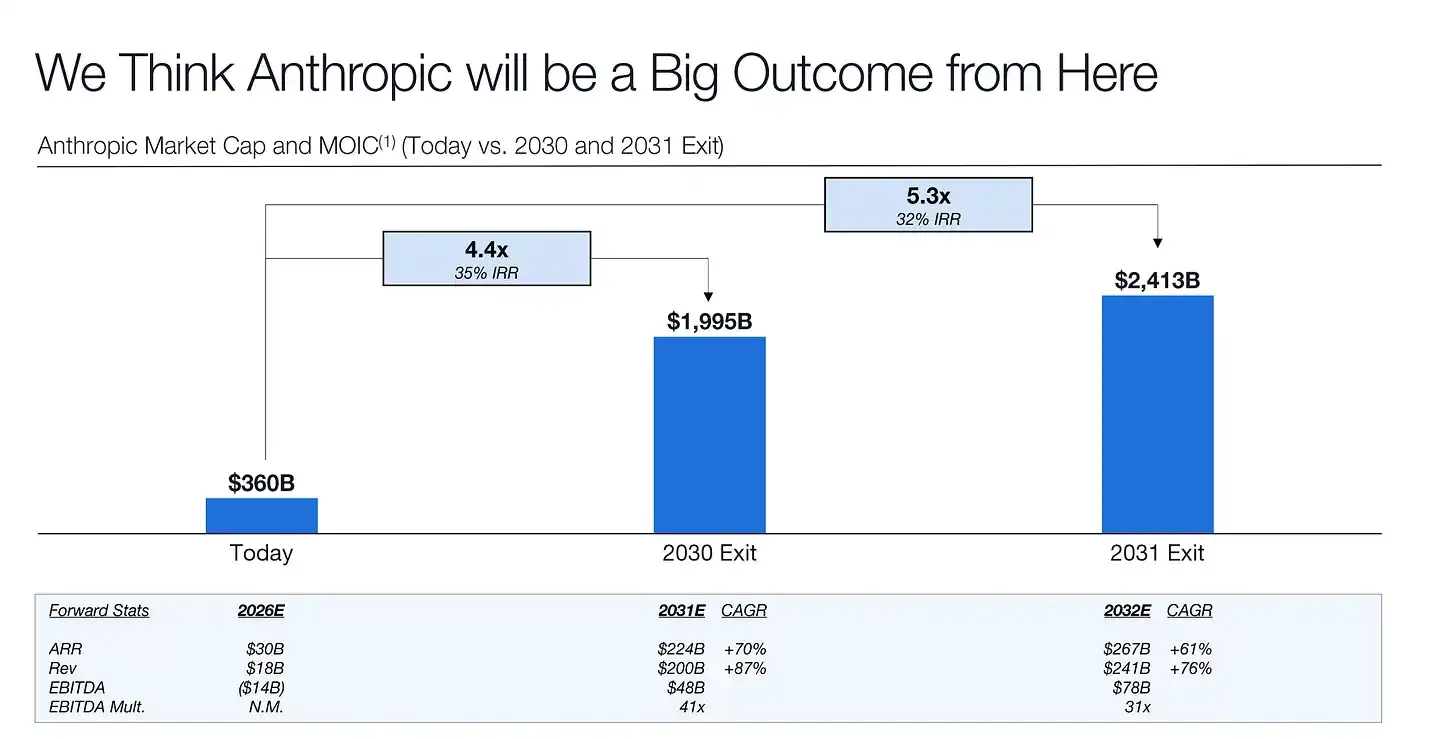
According to the Substack account Newcomer, renowned investment firm Coatue Management predicted in an internal investor presentation from January that Anthropic's valuation would soar to $1.995 trillion by 2030.

Based on the Coatue PPT released by Newcomer, Anthropic is projected to achieve revenue of $18 billion in 2026, but with an EBITDA loss of $14 billion, and its ARR is expected to reach $30 billion by the end of the year.

By 2031, the company's revenue is anticipated to jump to $200 billion, with an EBITDA profit of $48 billion, and ARR further climbing to $224 billion.

Using this as a basis, Coatue applied a 41x forward EBITDA multiple to derive a valuation of $1.995 trillion for 2030, suggesting it could potentially rise to $2.413 trillion in 2031.

In February of this year, Anthropic just completed a new round of financing. Coatue and Singapore's sovereign wealth fund GIC co-led Anthropic's $30 billion Series G funding round, resulting in a post-money valuation of $380 billion. This round of financing is among the largest in the history of the AI field, with participation from other top-tier institutions including D.E. Shaw Ventures and Founders Fund. Coatue founder Philippe Laffont stated at the time that the firm is highly confident in Anthropic's positioning in enterprise AI and Agent Coding.

However, Anthropic's actual growth rate has already partially exceeded Coatue's optimistic expectations. By early March, the company's ARR had approached $20 billion, doubling from $9 billion at the end of 2025, with particularly significant growth in February alone. Anthropic CEO Dario Amodei confirmed at a Morgan Stanley conference that products like Claude Code have made outstanding contributions, with enterprise customers accounting for as much as 80% of the business, and consumption-based billing models further amplifying revenue elasticity.

As a major competitor to OpenAI, Anthropic is known for its "safe and reliable" AI philosophy, and its Claude series of models are rapidly penetrating the coding and enterprise application markets. Since 2025, weekly active users of Claude Code have doubled, and the proportion of code generated by it on GitHub has significantly increased. The company achieved the leap from zero to tens of billions in revenue in less than three years, a growth rate far surpassing that of early cloud computing giants. The generative AI market is in a period of explosion, driven by data centers, computing power demands, and enterprise digital transformation, collectively fueling expectations of trillion-dollar growth.


Пов'язані питання

QWhat is the projected valuation of Anthropic by 2030 according to Coatue Management's internal investor presentation?

ACoatue Management projects that Anthropic's valuation will reach $1.995 trillion by 2030.

QHow much revenue is Anthropic expected to generate in 2026 and 2031 based on Coatue's forecast?

AAnthropic is expected to generate $18 billion in revenue in 2026 and $200 billion in revenue in 2031.

QWhat recent financing round did Anthropic complete, and what was the post-money valuation?

AAnthropic completed a $30 billion Series G financing round in February, led by Coatue and GIC, with a post-money valuation of $380 billion.

QWhich product has been a significant contributor to Anthropic's rapid growth, particularly in enterprise applications?

AClaude Code has been a significant contributor to Anthropic's rapid growth, especially in enterprise applications, with enterprise customers accounting for 80% of its business.

QHow does Anthropic's AI philosophy differentiate it from competitors like OpenAI?

AAnthropic is known for its 'safe and reliable' AI philosophy, differentiating itself by focusing on safety and reliability in its Claude series models, which have gained rapid traction in coding and enterprise applications.

Пов'язані матеріали

$9.4 Billion: The Largest Robotics Funding This Year Has Emerged

Munich-based humanoid robotics company Neura has completed a $1.4 billion (approximately RMB 94.9 billion) Series C funding round, valuing the company at around $7 billion and positioning it among the global leaders in the sector. The investment round is notable not just for its size—reportedly the largest in robotics this year—but also for its strategic backers, which include tech giants like NVIDIA and Amazon, alongside established industrial players such as German engineering firms Bosch and Schaeffler. This mix of investors signals a significant shift in the industry's focus from technological demonstrations and general-purpose narratives toward practical, industrial deployment and commercialization. Neura's approach centers on developing humanoid robots for defined, high-value industrial tasks rather than pursuing a general-purpose model. Its early validation comes from a partnership with BMW, where its robots are being tested on actual production lines. The involvement of Bosch and Schaeffler, companies deeply embedded in global manufacturing, underscores a growing belief that humanoid robots are transitioning from labs to viable factory-floor solutions. The article highlights two converging trends driving investment: advancements in AI and large language models, which enhance robots' perception and decision-making in unstructured environments, and mounting pressure from labor shortages and rising costs in major manufacturing regions. The funding landscape is now bifurcating between companies like Figure AI, focusing on versatile general-purpose robots, and firms like Neura, targeting specific vertical industrial applications with clearer, shorter paths to ROI. While technical hurdles remain, the core challenges for widespread adoption are increasingly seen as engineering and commercial in nature: managing the high integration and customization costs for different factory environments and establishing robust, localized maintenance and service networks. The record investment in Neura, particularly from industrial capital, indicates the industry's growing confidence in moving from proving feasibility to solving the practical problems of scalability, reliability, and building sustainable business models around humanoid robots in real-world settings like automotive manufacturing and hazardous labor environments.

marsbit5 год тому

$9.4 Billion: The Largest Robotics Funding This Year Has Emerged

marsbit5 год тому

Торгівля

Спот
Ф'ючерси
活动图片




