The Next Crypto Bull Run? Gemini Predicts the Next Cryptos to Explode

bitcoinistОпубліковано о 2025-08-12Востаннє оновлено о 2025-08-12

Анотація

Although we’ve grown accustomed to seeing bull runs in crypto, the current rally feels extra special – because it’s driven...

Trusted Editorial content, reviewed by leading industry experts and seasoned editors. Ad Disclosure

Although we’ve grown accustomed to seeing bull runs in crypto, the current rally feels extra special – because it’s driven not just by price action, but by a wave of groundbreaking pro-crypto developments happening outside the charts.

Over the past month alone, the U.S. has unleashed a barrage of policy announcements, including:

  • 401(k) Crypto Access Expansion: New rules allowing retirement savers to allocate a portion of their 401(k) plans to crypto assets, effectively democratizing access to digital assets for millions of Americans.
  • Project Crypto: Announced by the SEC Chair, this ambitious initiative aims to position the United States as the crypto capital of the world by streamlining regulations and fostering innovation.
  • The GENIUS Act: A landmark bill designed to boost blockchain adoption across sectors by funding research, incentivizing crypto-friendly startups, and creating clearer tax frameworks for digital assets. Stablecoins gained a lot after GENIUS.

And it’s not just policy. Institutions are buying up Bitcoin and Ethereum at a record pace, while market analysts are trying to outdo each other with bullish predictions.

Now, while it’s relatively easy to pinpoint why crypto could thrive over the next year, five years, or even decade, identifying the next cryptos to explode is an entirely different ballgame.

That’s why we turned to Gemini, Google’s homegrown AI chatbot with access to Google Search and cutting-edge analytical and narrative-building skills.

With the brainpower to digest the latest market developments and filter through the noise, it can zero in on the best altcoins to buy right now without much effort.

Keep reading to discover Gemini’s top picks and how they’re uniquely positioned to deliver outsized gains in the months ahead.

1. Bitcoin Hyper ($HYPER) – Bitcoin Layer 2 for High Speeds, Low Fees, and Enhanced Programmability

Bitcoin Hyper ($HYPER) is a new cryptocurrency project aiming to tackle Bitcoin’s long-standing issues of slow speeds, high costs, and limited programmability, bringing its blockchain performance up to modern standards.

Currently, Bitcoin’s base layer can process a grand total of just 7 transactions per second (TPS), while Solana can handle up to 3,000 TPS.

Moreover, Bitcoin isn’t well-suited for DeFi or other decentralized applications, as it lacks native smart contract capabilities.

Thanks to $HYPER’s Solana Virtual Machine (SVM) integration, Solana’s lightning-fast transaction speeds, ultra-low fees, and full Web3 compatibility are now coming to Bitcoin.

Simply put, the SVM allows Bitcoin Hyper to run Solana-compatible smart contracts and dApps directly on its Layer 2. This unlocks high-speed DeFi trading, NFTs, gaming, lending, staking, DAO governance, and other Web3 use cases on the Bitcoin network.

But how do you interact with this Web3 environment if Layer 1 $BTC isn’t compatible with Layer 2? This is where $HYPER’s decentralized, non-custodial canonical bridge comes in.

It lets you seamlessly convert your original $BTC into ‘wrapped’ Layer 2-compatible $BTC, unlocking entry into the Bitcoin Hyper ecosystem.

Bitcoin Hyper's layer-2 ecosystem explained, step by step.

Remember that the bridge will also convert your wrapped tokens back into native $BTC whenever you choose. All you have to do is raise a withdrawal request on Layer 2.

According to our Bitcoin Hyper price prediction, the token could surge by up to 2,400% by the end of 2025, potentially hitting $0.32.

So, if you bought $500 worth of $HYPER now, you could have $12,500 by the end of the year, if everything goes well with the presale and listing.

Here’s how to buy $HYPER now for just $0.01265 and join one of this year’s hottest crypto presales, which has already attracted an eye-popping $8.5M in early investor funding.

Visit Bitcoin Hyper for more information.

2. Best Wallet Token ($BEST) – Powering One of the Best Non-Custodial Crypto Wallets

Best Wallet Token ($BEST) is the horsepower behind Best Wallet, a free crypto wallet that’s setting new benchmarks for usability while offering foolproof security through self-custody and other advanced features.

As a self-custodial crypto wallet, Best Wallet gives you complete control over your private keys, ensuring only you can access your funds. Say goodbye to nosy third parties!

Moreover, Best Wallet also integrates advanced encryption, multi-factor authentication, and safeguards against hacks, scams, and phishing websites, offering a comprehensive security suite.

One of its biggest standouts, though, is the Presale Aggregator, which allows you to buy new meme coins on presale from directly within the app, i.e., without having to visit any external sites.

Best Wallet's useful features, from multi-chain support and swaps to keyless security.

Speaking of ease of use, it also lets you set up a new wallet in under 60 seconds, seamlessly exchange tokens across multiple blockchains, and even create separate wallets for different goals, like trading, HODLing, or staking.

Want in? Buy Best Wallet Token ($BEST), which could potentially make you a chunky 180% in gains over just the next few months, as it’s predicted to hit $0.072 by year-end.

In addition to generous staking rewards (currently yielding 92%), holding $BEST also unlocks a bunch of exclusive perks, including:

  • Reduced trading and fees
  • Early access to tokens in the Presale Aggregator
  • Governance rights

The project has already amassed more than $14.6M in presale funding, with 1 $BEST currently available at a low price of $0.025475.

Learn all about $BEST by visiting its presale website.

3. XRP ($XRP) – Payments-Based Crypto Gearing up for Another Rally

Gemini rounded off its list of suggestions with a listed, proven performer that looks primed for another explosive rally in the coming weeks. Enter XRP ($XRP).

One of the biggest positives for $XRP heading into August is the official end of its long-standing legal battle with the SEC, which wrapped up on August 7 when both parties filed a joint stipulation of dismissal with the U.S. Court of Appeals for the Second Circuit.

Additionally, growing anticipation over a potential XRP ETF approval is adding more momentum to the rally. According to the prediction market Polymarket, the odds now sit at 81%.

An ETF would make it far easier for traditional investors to gain exposure to $XRP through regulated markets, potentially unlocking a surge of fresh capital.
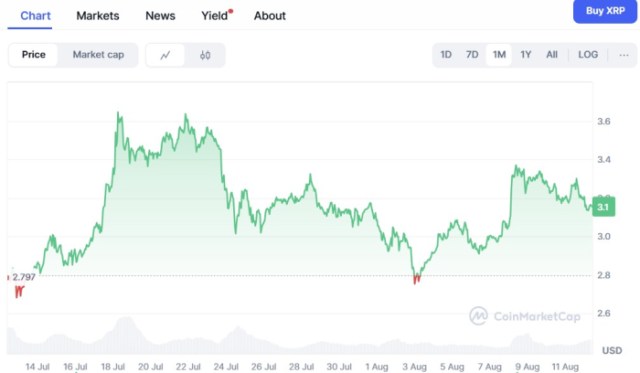
XRP ($XRP) CoinMarketCap

And there are plenty of technical positives, too. For instance, on the 4-hour chart, the token is bouncing off the 0.5-0.618 Fibonacci retracement zone, which is a key area that often signals the continuation of bullish momentum.

Meanwhile, on the all-important daily chart, $XRP’s price remains above short-term EMAs such as the 10, 20, and 50, another classic indicator that buyers are still firmly in control.

$XRP is currently trading around $3.15, and based on the trading patterns outlined above, it could climb up around 8% (a conservative prediction) in its current rally, potentially setting the stage for a push toward new all-time highs.

Conclusion

All in all, asking Gemini for its help in crafting a crypto portfolio proved to be a smart move.

The AI chatbot delivered a solid mix of low-priced, high-upside tokens like Bitcoin Hyper ($HYPER) and Best Wallet Token ($BEST), along with established performers with strong momentum, such as XRP ($XRP).

That said, kindly remember that the crypto market is highly volatile, and investments in it carry risks. Also, this article is not financial advice, and you must always do your own research before investing.

Editorial Process for bitcoinist is centered on delivering thoroughly researched, accurate, and unbiased content. We uphold strict sourcing standards, and each page undergoes diligent review by our team of top technology experts and seasoned editors. This process ensures the integrity, relevance, and value of our content for our readers.

As a crypto writer, Bogdan’s responsibilities are split between researching and writing articles and entertaining the team with his humor bordering on the politically incorrect, an aspiring Bill Burr, if you will. Thanks to his 12+ years of writing experience in just as many fields, including tech, cybersecurity, modelling, fitness, crypto, and other topics-that-shall-not-be-named, he's become a genuine asset to the team. While his position as a senior writer at PrivacyAffairs thought him valuable lessons about the power of self-management, his entire writing career was and is an exercise in self-improvement. Now, he's ready to sink his teeth into crypto and teach people how to take control of their own money on the blockchain. With fiat as an eternally devaluing currency, Bitcoin and altcoins seem like the best-fitting alternative for Bogdan. Bogdan’s biggest professional accomplishment, aside from securing a position as a main writer for Bitcoinist, was his 5-year run as a writing manager at Blackwood Productions, where he coordinated a team of four writers. During that time, he learned the value of teamwork and that of creating a working environment that breeds efficiency, positivity, and friendship.

Пов'язані матеріали

How Collector Crypt Uses 'Recirculating Buybacks' to Create an Illusion of Growth

Title: How Collector Crypt Creates a Growth Illusion with "Buyback Loops" Key Findings: Collector Crypt's (CC) net take rate has halved from 11.2% in Q3 2025 to 5.6% in Q2 2026, while GMV grew 4.7x. This growth is driven by higher-tier card packs ($250, $1,000, $2,500) which have lower platform dollar retention rates. The newly launched $2,500 Mythic tier captured 36.7% of June GMV within 13 days. Growth is fueled by a small cohort of high-spending, high-frequency wallets rather than broad user base expansion. The economic model faces pressure from three key areas: 1) **Shifting GMV Mix**: Pushing users towards larger, lower-retention card packs increases GMV but reduces overall profitability. 2) **Physical Redemptions**: Card redemptions for physical items remove reusable inventory from the system, creating costly replenishment needs. In May, redemptions consumed 41.6% of pre-redemption net income. Only 75 wallets drove redemptions in June. 3) **B2B/API Strategy**: Partner revenue remains negligible (cumulatively $1.83M) and dependent on CC for inventory, vaulting, and buyback services, failing to create a scalable, asset-light recurring revenue stream. The core product is a repetitive pack-buyback loop with limited secondary market activity and token value accrual. Sensitive modeling shows CC's economics turn negative when any two of the following pressures coincide: replenishment costs near market price, redemption rates exceeding 9%, or high-tier buyback rates around 93%. While CC operates in a large and growing collectibles market, its current growth levers—bigger packs, high buyback rates, and capital recycling by a few wallets—create a volume illusion without demonstrating sustainable collector engagement, deep secondary markets, or a viable path to improved margins. Future proof points include broadening collector participation, deepening secondary trading, and developing true asset-light B2B revenue channels.

Foresight News6 хв тому

How Collector Crypt Uses 'Recirculating Buybacks' to Create an Illusion of Growth

Foresight News6 хв тому

Grayscale's Latest Research: What is Solana's Next Growth Engine?

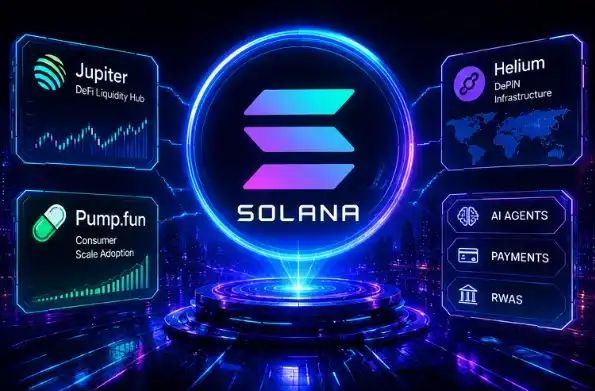
Grayscale's latest report, "Solana: Crypto's Financial Bazaar," signals a shift in how the market views Solana, moving beyond its high-performance and meme-centric reputation. The report frames Solana as an evolving application platform for large-scale economic activity, akin to a bustling digital marketplace. The analysis highlights that public chain competition has moved past raw throughput (TPS) to focus on genuine economic activity—daily users, transaction volume, and real revenue. Solana's metrics, such as over 1,000 dApps, 100M+ daily transactions, and ~4.3M daily active users, showcase this shift toward application-layer prosperity. The report identifies three key growth drivers: 1. **Jupiter**: Evolving from a DEX aggregator to a core liquidity hub and comprehensive financial platform for Solana's DeFi. 2. **Pump.fun**: Demonstrates Solana's capacity for consumer-scale applications, attracting millions of users and generating significant, sustainable revenue, validating network stability under high load. 3. **Helium & DePIN**: Represents expansion into real-world infrastructure, connecting blockchain to physical resources like wireless networks and positioning services, opening new long-term use cases. Solana Foundation's recent focus aligns with this broader vision, emphasizing AI Agents (for machine-to-machine transactions), payments, stablecoins, and Real-World Assets (RWA) to build a sustainable growth model beyond cyclical trends. While challenges remain—such as value capture for SOL and maintaining ecosystem sustainability beyond hot trends—institutional interest is growing due to Solana's maturing application business models, expanding payment/stablecoin ecosystem, and persistent developer activity. The competition is no longer about speed alone, but about which network can foster the most vibrant and valuable digital economy.

marsbit27 хв тому

Grayscale's Latest Research: What is Solana's Next Growth Engine?

marsbit27 хв тому

They Waited 7 Years for This Money

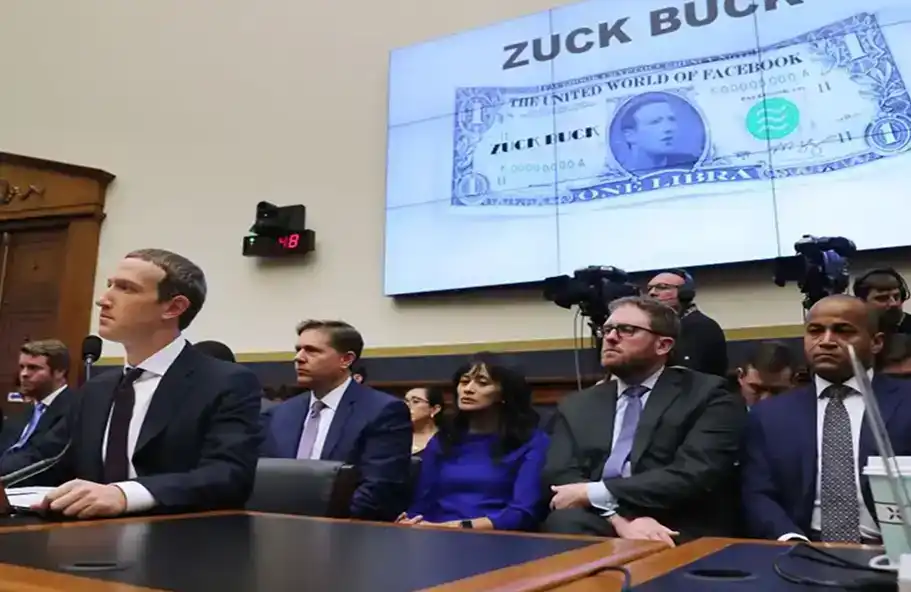
The article discusses the significant drop in share price of Circle, known as the "first stablecoin stock," triggered by the announcement of a new alliance including Visa, Stripe, Mastercard, Coinbase, BlackRock, Google, IBM, and Ripple. This alliance plans to launch Open USD, a USD stablecoin, later this year. Key to the market reaction is Open USD's plan to distribute reserve-generated profits to its adopters, directly challenging Circle's core revenue model from USDC's reserve interest. The piece draws a parallel to Facebook's 2019 Libra (later Diem) project, which involved many of the same companies. Libra failed due to regulatory pressure, its association with Facebook's controversial reputation, and overly ambitious global currency narratives. However, the underlying desire of these major financial and tech firms to create a new digital payment infrastructure persisted. Over seven years, the landscape changed: clearer US stablecoin regulations (GENIUS Act), mature blockchain infrastructure, and companies gaining practical experience with crypto payments. Open USD presents a more modest, compliance-focused narrative—a settlement tool and enterprise payment rail rather than a revolutionary global currency. While the new alliance poses a serious threat to Circle's profitability and exclusivity, it faces challenges typical of large consortia: slow decision-making and complex profit-sharing. USDC's established liquidity, trust, and integrations provide Circle with significant defenses. The market's reaction is seen partly as an emotional overreaction but also a necessary reevaluation of Circle's business model from a unique "stablecoin era ticket" to a "strong issuer" in a competitive commodity market. Ultimately, the core ambition from the Libra era remains: to digitize the movement of dollar value on the internet and capture the adjacent commercial opportunities. The lesson learned is to pursue this goal not as a high-profile, platform-led revolution, but as a quiet, utility-focused infrastructure play.

marsbit27 хв тому

They Waited 7 Years for This Money

marsbit27 хв тому

Торгівля

Спот
活动图片