Chainlink Creates Strategic LINK Reserve From Enterprise and On-Chain Revenue

ccn.comОпубліковано о 2025-08-03Востаннє оновлено о 2025-08-08

Key Takeaways
  • The Chainlink Reserve currently contains $1.2 million worth of LINK.
  • LINK is trading up 12.4% in the past 24 hours at $19.36 with a $13.11 billion market cap.
  • Strategic Bitcoin and altcoin reserves are a new and increasingly popular concept amongst private firms.

Chainlink has boldly launched an on-chain LINK reserve that will be funded through on- and off-chain revenue streams to further secure the token’s value.

The Reserve

Chainlink has created a strategic on-chain reserve for LINK tokens.

As announced , the Chainlink Reserve is a strategic fund designed to support the network’s long-term growth and sustainability by accumulating LINK tokens.

It’ll gather these tokens from off-chain revenues from large enterprises that have adopted Chainlink and on-chain service usage revenues.

The blog notes that demand for Chainlink has already yielded hundreds of millions of dollars in revenues, signaling a bright future for the reserve.
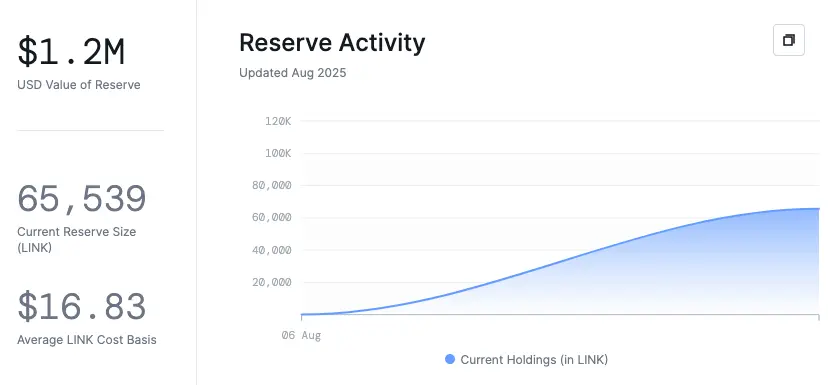
Humble beginning for the LINK Reserve. | Source: Chainlink Reserve.

So far, the reserve has stocked up 65,539 LINK, currently worth $1.2 million. Chainlink notes that it doesn’t expect “any withdrawals from the Reserve for multiple years,” and will continue to grow “over time.”

Powering this process is Payment Abstraction, which processes payments of various assets like stablecoins, gas, and utility tokens and converts them into LINK through its services or decentralized exchanges (DEXs).

The LINK token has responded positively to the news and is up 12.4% in the past 24 hours at $19.36 .

Crypto Reserves Rise

Bitcoin (BTC) has become a strategic reserve asset for companies and governments all around the world.

In the U.S., Michael Saylo’s’ Strategy (formerly MicroStrategy) dominates as the world’s leading Bitcoin behemoth. In Japan, Metaplanet and others pursue BTC just as aggressively.

El Salvador turned to Bitcoin earlier than most nations, Bhutan is actively mining BTC to increase its stash, and U.S. President Donald Trump officially established a Strategic Bitcoin reserve and Digital Asset Stockpile.

Evidently, it was only a matter of time before private firms and blockchain networks began considering the concept as a viable long-term investment.

Chainlink’s announcement arrives as institutional adoption reaches a fever pitch.

As  co-founder Sergey Nazarov points out,  the reserve is a “clear answer to how off-chain revenue and large-scale institutional adoption of the Chainlink standard will be connected back to the growth, security and sustainability for those standards.”


Was this Article helpful? Yes No

Трендові криптовалюти

Пов'язані матеріали

BIS Report Compliance Observations: The True Risks of Stablecoins Go Beyond 'De-pegging'

The BIS report, "Anchoring trust in money: innovation beyond stablecoins," highlights that the primary risks of stablecoins extend beyond potential de-pegging. It argues that the core challenge is whether stablecoins can be integrated into a financial system that is identifiable, monitorable, accountable, and regulatable. While acknowledging efficiency gains like faster payments and programmability, BIS emphasizes that money requires an institutional framework—including legal certainty, liquidity support, and financial integrity controls—which many stablecoins currently lack. The report details compliance risks, noting that while blockchain transactions are transparent, address visibility does not equate to identity or purpose clarity. This creates a systemic risk as pseudonymity, non-custodial wallets, and cross-chain bridges can undermine AML/CFT controls. Furthermore, these risks can spill over into the traditional financial system through on- and off-ramps. The future direction, per BIS, is not to prohibit innovation but to embed regulatory rules—such as identity verification and transaction screening—directly into the technological infrastructure of tokenized finance. The key takeaway for compliance is that any new financial instrument must clearly address questions of customer identification, transaction monitoring, accountability, and cross-border rule consistency to be viable as a mainstream payment tool.

marsbit1 год тому

BIS Report Compliance Observations: The True Risks of Stablecoins Go Beyond 'De-pegging'

marsbit1 год тому

When US Giants Collectively "Defect" to Chinese AI Models

When Silicon Valley Giants Turn to Chinese AI Models to Cut Costs A surprising trend is emerging: major U.S. tech companies are significantly reducing AI costs by switching to Chinese models. Coinbase, the largest U.S. cryptocurrency exchange, reportedly halved its AI spending after migrating to China's GLM-5.2 and Kimi 2.7 models, despite increasing usage. They achieved this through a sophisticated three-part strategy: implementing an automatic routing system to select the most cost-effective model per task, boosting cache hit rates from 5% to 60% to reuse computations, and employing "context engineering" to provide AI with more precise, less cluttered information. They are not alone. AI startup Lindy switched from Claude to DeepSeek, saving millions, while Snowflake's tests found GLM-5.2 solved 66% of coding tasks compared to Claude Opus's 67%—but at a fraction of the cost (output pricing is 5-7 times lower). While the top Western models may offer slightly better stability, the massive price differential is leading many businesses to reconsider their value proposition. This shift signals a deeper change in the AI industry, moving beyond pure performance benchmarks to a fierce cost competition. As pressure mounts, even OpenAI and Anthropic have begun slashing prices. For users, this means more choices, lower costs, and a crucial lesson: using multiple models based on task complexity, optimizing with caching, and keeping contexts lean are now key to leveraging AI efficiently and affordably.

marsbit1 год тому

When US Giants Collectively "Defect" to Chinese AI Models

marsbit1 год тому

Торгівля

Спот

Популярні статті

Як купити LINK

Ласкаво просимо до HTX.com! Ми зробили покупку ChainLink (LINK) простою та зручною. Дотримуйтесь нашої покрокової інструкції, щоб розпочати свою криптовалютну подорож.Крок 1: Створіть обліковий запис на HTXВикористовуйте свою електронну пошту або номер телефону, щоб зареєструвати обліковий запис на HTX безплатно. Пройдіть безпроблемну реєстрацію й отримайте доступ до всіх функцій.ЗареєструватисьКрок 2: Перейдіть до розділу Купити крипту і виберіть спосіб оплатиКредитна/дебетова картка: використовуйте вашу картку Visa або Mastercard, щоб миттєво купити ChainLink (LINK).Баланс: використовуйте кошти з балансу вашого рахунку HTX для безперешкодної торгівлі.Треті особи: ми додали популярні способи оплати, такі як Google Pay та Apple Pay, щоб підвищити зручність.P2P: Торгуйте безпосередньо з іншими користувачами на HTX.Позабіржова торгівля (OTC): ми пропонуємо індивідуальні послуги та конкурентні обмінні курси для трейдерів.Крок 3: Зберігайте свої ChainLink (LINK)Після придбання ChainLink (LINK) збережіть його у своєму обліковому записі на HTX. Крім того, ви можете відправити його в інше місце за допомогою блокчейн-переказу або використовувати його для торгівлі іншими криптовалютами.Крок 4: Торгівля ChainLink (LINK)Легко торгуйте ChainLink (LINK) на спотовому ринку HTX. Просто увійдіть до свого облікового запису, виберіть торгову пару, укладайте угоди та спостерігайте за ними в режимі реального часу. Ми пропонуємо зручний досвід як для початківців, так і для досвідчених трейдерів.

1.1k переглядів усьогоОпубліковано 2024.12.13Оновлено 2026.06.02

Як купити LINK

Обговорення

Ласкаво просимо до спільноти HTX. Тут ви можете бути в курсі останніх подій розвитку платформи та отримати доступ до професійної ринкової інформації. Нижче представлені думки користувачів щодо ціни LINK (LINK).

活动图片