“炒币养老”成真!特朗普拉全美国人民上”赌桌”

比推Опубліковано о 2025-08-07Востаннє оновлено о 2025-08-07

23d54303-2965-4ced-8936-ba33e8ff5999.png

2025年8月7日,一项注定在美国金融史上留下浓墨重彩的一笔悄然落下。

特朗普签署了一份行政命令,允许美国退休储蓄账户401(k)正式投资包括加密货币、私募股权和房地产在内的“另类资产”。从此,一个曾被主流金融体系排斥的边缘资产类别,被正式写入了美国近9万亿美元规模的退休金计划中。

这不仅是监管态度的一次关键转向,更可能是数字资产迈向真正主流化的临界点。

从边缘资产到主流渠道:一纸行政令的撬动效应

长期以来,美国401(k)计划——这项为9000万劳动者服务的退休储蓄工具——主要投资于传统资产:股票、债券、以及指数基金,如S&P500的ETF。另类资产,比如加密货币,虽然在市场上愈发活跃,却被长期排除在退休金系统之外,监管机构也始终抱持谨慎甚至敌意的态度。

但2025年,一切开始变化。华盛顿对数字资产释放出前所未有的善意,特朗普政府积极推动了一场“去监管化”浪潮,而加密资产成为这场浪潮中最受宠的角色之一。

特朗普的新行政令要求劳工部重新评估《员工退休收入保障法案》(ERISA)中的相关规定,为401(k)计划纳入数字资产和私募投资“提供路径”,也为监管机构“调试规则”预留空间。

据《金融时报》披露,特朗普与加密行业的深度绑定在其中发挥了作用:“如果只有私募股权,命令很可能无法推进,是加密货币让特朗普最终拍了板。”

能有多少配比?会带来多少资金?

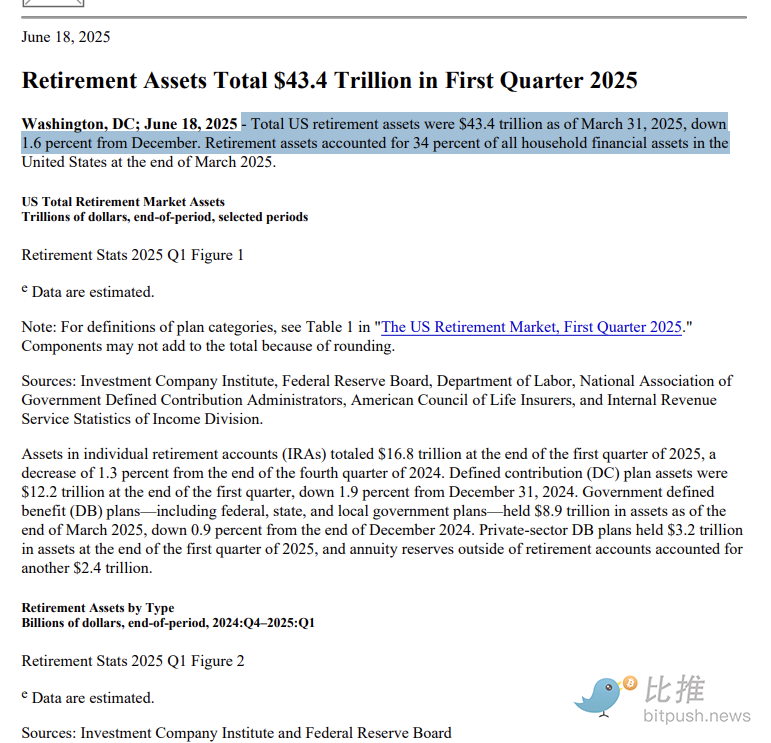
根据最新的数据,美国401(k)计划的市场规模极为庞大。截至2025年第一季度末,美国雇主提供的401(k)计划资产总额约为8.7万亿美元。整个美国退休市场(包括401(k)、IRA等)的资产总额更是高达43.4万亿美元

b5df99ce-2e6e-447c-9295-68e63874d221.png

那么,能够分配给加密货币的资金能有多少呢?目前还没有一个确切的数字。

Varys Capital风险投资总监Tom Dunleavy给出了一个假设:

“如果每个美国人的401(k)账户,将现有资产中的1%配置到加密货币,那么将有1200亿美元涌入加密市场。若是3%,就是3600亿;5%,则高达6000亿美元。”

4a0b0260-5def-4947-b0aa-91d9c0432e84.png

这是一种长期且稳定的资金流入路径:大多数美国人每两周从工资中提取一部分自动转入401(k),而一旦数字资产被纳入资产池,就意味着持续性的被动买入行为。

对于一个仍以波动性著称的市场,这不仅是资金,更是一种情绪托底。“这将为比特币和以太坊带来更稳定的价格支撑区间。”Dunleavy表示。

Bitwise研究主管Ryan Rasmussen则补充道:

“短期来看,这项行政令向市场传达了一个信号:加密资产已经从边缘走向制度性认同。”

ETF:最佳桥接方式

除了直接纳入401(k)资产池外,加密ETF成为最被看好的通道。

截至2025年中,比特币和以太坊相关ETF已吸引超过130亿美元的净流入。BlackRock推出的iShares Bitcoin Trust(IBIT)和VanEck的Ethereum ETF(ETHV)分别取得了20%和11%的年内回报。

ETF的好处显而易见:

  • 不需要开设加密钱包;

  • 无需操作去中心化交易所;

  • 由受监管基金公司发行;

  • 可与传统资产并列纳入投资组合。

就像买GLD黄金ETF远比购买实物金条方便一样,ETF成为退休投资者进场加密的首选工具。

真正执行还有多远?

特朗普行政命令可以释放方向信号,但从“写在纸上”到“出现在账户中”,中间隔着多个现实层面的障碍。这场加密资产进401(k)的改革,正处在“政策意图”与“执行现实”之间的落差中。

我们可以从三个维度来分析这条落地路径的复杂性:

法规障碍尚未彻底清除

虽然总统签署了行政命令,但该命令本身不具备立即改变法规的效力。它的作用是指令美国劳工部(DoL)、证券交易委员会(SEC)等机构“重新评估并修改”当前监管规则。

据CNBC报道,当前401(k)计划受《员工退休收入保障法》(ERISA)管辖,该法明确要求计划受托人遵循“审慎人标准”(prudent man rule),以最大限度保障参与者利益。但加密资产的高波动性、流动性差、估值不透明等特点,使其难以通过审慎性测试,2022年Fidelity曾推出401(k)比特币配置选项,结果立即遭到劳工部公开质疑并面临审查压力。尽管2025年政策方向转变,细则尚未发布,基金提供商若贸然行动,仍面临潜在合规诉讼风险。

计划提供商的现实顾虑:不想当“替罪羊”

401(k)计划大多由雇主与第三方服务商合作运营,涉及Vanguard、Fidelity、Empower等大型平台。但截至目前,很多平台对加密选项普遍持谨慎观望态度。

原因主要包括:

  • 法律责任重:若投资者亏损,基金管理人和雇主可能因“未尽受托责任”而遭到起诉。

  • 投资者教育缺失:大多数401(k)用户对加密资产缺乏理解,容易误判风险。

  • 技术集成成本高:引入新资产类别需要重新对接风控系统、报告逻辑、KYC流程,非小工程。

因此,短期内即便政策允许,多数加密投资仍需依托“自选券商窗口(Self-Directed Brokerage Window)”渠道进行,该机制目前主要存在于部分大型公司的401(k)计划中。这种方式通常只被少数对投资有深入了解的员工使用。而作为核心投资选项,最可能的载体将是现货比特币和以太坊ETF,因为这些产品相对成熟,且受监管程度更高。

加密市场自身的不确定性仍是最大变量

即使监管放松、执行意愿具备,加密市场是否真的准备好承接长期资本仍是未知数。

  • 比特币、以太坊年内反弹显著,但仍伴随30%以上的日内高波动;

  • 杠杆ETF、链上合约产品层出不穷,进一步放大散户风险;

  • FTX等平台的爆雷阴影仍未完全散去,投资者信任重建仍在进行;

  • 对许多监管者而言,加密资产仍然缺乏可预测性和稳定收益逻辑。

在CNBC的《ETF Edge》节目中,Teucrium Trading总裁Sal Gilbertie指出:“杠杆加密 ETF 是激进的产品,不适合退休投资组合——它们旨在进行日内交易”。

“从边缘到核心”,走了十六年

从2009年中本聪挖出第一枚比特币,到2025年它被纳入美国养老金系统,用了16年。

这场“从边缘到核心”的变革不是偶然,而是多重力量——政治动机、投资共识、市场逻辑、技术进步——交织而成的结果。

一个必须承认的事实是,特朗普家族及其核心圈层与加密货币行业存在密切的商业往来。公开数据显示,其家族资产中已有数十亿美元投资于加密货币及相关企业。加密货币从边缘走向主流的过程,既反映了监管态度的转变,也引发了关于权力与资本关系的讨论。

如今,随着加密货币被纳入401(k)养老金计划,它的角色已经发生了根本性变化——不再只是一种投机性资产,而是逐渐融入国家金融体系的组成部分。不过,这场变革才刚刚开始。加密货币能否真正成为养老金投资的可靠选择?目前看来,它仍需面对市场波动、监管框架和长期价值等多重考验。最终,这场实验不仅关乎投资回报,更可能重塑未来金融体系的格局。


Twitter:https://twitter.com/BitpushNewsCN

比推 TG 交流群:https://t.me/BitPushCommunity

比推 TG 订阅: https://t.me/bitpush

说明: 比推所有文章只代表作者观点,不构成投资建议

Пов'язані матеріали

Running MoE on Mobile Phones? Meta Proposes MobileMoE, Speeding Up iPhone 16 Pro by 3.8x

Meta's MobileMoE, a mobile-optimized Mixture-of-Experts (MoE) language model architecture, enables efficient on-device large language model (LLM) inference for the first time on commercial smartphones. Designed for decoder-only Transformers, it replaces dense feed-forward layers with MoE layers. Key design choices include 8 experts with granularity g=8, top-4 routing, and a shared expert. The model undergoes a four-stage training process: pre-training, intermediate training, supervised fine-tuning, and quantization-aware training. Results show MobileMoE models, with similar memory footprint, achieve equal or higher average accuracy across 14 foundational benchmarks while using only 1/2 to 1/4 of the FLOPs compared to dense baselines. After INT4 quantization, they remain competitive. Notably, on an iPhone 16 Pro, MobileMoE-S demonstrates significant speedups: up to 3.8x faster in the prompt phase and 2.2-3.4x faster in per-token generation compared to a dense counterpart, with lower peak memory usage. While MobileMoE establishes a new Pareto frontier for on-device LLMs in accuracy-compute trade-offs, particularly excelling in code and math tasks, it currently lags behind models like Qwen3.5 2B in advanced instruction following and knowledge reasoning. Future work includes improving post-training techniques, exploring NPU deployment, and managing the runtime memory sensitivity of MoE models to varying inputs.

marsbit4 хв тому

Running MoE on Mobile Phones? Meta Proposes MobileMoE, Speeding Up iPhone 16 Pro by 3.8x

marsbit4 хв тому

Bitcoin's Weak Rebound Fails to Mask Adjustment Trend, HYPE's Top Signal Warns of Short-Term Risks | Invited Analysis

**Title:** Bitcoin's Weak Rebound Fails to Mask Downtrend; HYPE Top Signal Alerts of Short-Term Risks | Exclusive Analysis **Abstract:** This weekly market analysis examines the current technical structures of Bitcoin and HYPE, outlining key trading strategies. Bitcoin's daily chart shows it has broken below the median line of its primary ascending channel, indicating structural weakness. It is currently experiencing a weak rebound within a short-term descending channel, targeting resistance at $75,000-$76,000. Failure to break above this zone could lead to a resumption of the downtrend, testing support at $69,500-$70,500. Trading strategies include positioning for a rebound rejection (Plan A) or a breakdown below key support (Plan B) with controlled short positions. For HYPE, the 4-hour chart reveals a potential seven-wave advance from the May 14 low, now showing signs of exhaustion. A bearish divergence (momentum weakening) has been observed, coupled with a top signal from the proprietary "Spread Trading Model" at potential endpoint 47. The key this week is to monitor if a confirmed top forms here, especially upon a breach of the $62.5-$64.57 support area. If broken, a larger corrective move towards $54-$56.30 is anticipated. The short-term strategy for HYPE focuses on cautious long entries only upon confirmed stabilization within the support zone. The report also details a successful short BTC trade from the previous week, yielding a ~5.07% profit, executed based on model signals and price action. Strict risk management rules, including dynamic stop-loss adjustments, are emphasized.

marsbit21 хв тому

Bitcoin's Weak Rebound Fails to Mask Adjustment Trend, HYPE's Top Signal Warns of Short-Term Risks | Invited Analysis

marsbit21 хв тому

Bitcoin's Weak Rebound Fails to Conceal Adjustment Trend; HYPE's Top Signals Warn of Short-Term Risks | Guest Analysis

Bitcoin's Weak Bounce Fails to Mask Correction Trend; HYPE Top Signals Warn of Short-Term Risks | Invited Analysis Core Weekly View: Bitcoin's daily chart structure has weakened. The key question is whether its short-term rebound can effectively break above the upper boundary of the descending channel. Has HYPE's seven-wave advance reached its conclusion? This analysis systematically examines the current market structure across multiple timeframes and outlines operational strategies for the week. **Bitcoin (BTC) Analysis:** The daily chart shows BTC trading within a long-term rising channel (yellow) since February but has recently broken below its midline, indicating structural weakness. It is currently confined within a short-term descending channel (blue) originating from the May 6 high. The ongoing bounce appears to be a weak technical correction targeting the blue channel's upper rail (approx. $75,000-$76,000). The 4-hour chart reveals a complex 10-segment corrective structure from the May high, containing two downward pivot zones (Central D and E). The current rebound (segment 36-37) is expected to face resistance in the $75,000-$76,000 area. A failure to break above could lead to a resumption of the downtrend, testing support at $69,500-$70,500 and potentially $65,000. **BTC Weekly Strategy:** The price is currently below the "Bull-Bear Channel," placing it in a technically weak zone. The core focus is on the test of the $75,000-$76,000 resistance and $69,500-$70,500 support. * *Medium-term*: Consider initiating short positions (up to 30% allocation) if the price rejects the $75,000-$76,000 area. Increase exposure to 60% if the long-term rising channel's lower support fails. * *Short-term (30% allocation)*: Two scenarios are outlined: * *Plan A (Sell on Rally)*: Short on rejection at $75,000-$76,000, with a stop-loss above $77,000. * *Plan B (Breakdown Sell)*: Short on a confirmed breakdown below $69,500-$70,500, with a stop-loss above $72,000. **HYPE Analysis:** The 4-hour chart shows HYPE has completed a seven-wave advance from its May 14 low, including a central consolidation zone. A bearish divergence was noted at the prior high (point 45), leading to a 13% correction. The current rally leg (46-47) shows weakening momentum compared to the initial leg (42-43), suggesting a potential momentum divergence. Furthermore, the proprietary "Spread Trading Model" has triggered a strong top warning signal at point 47. A confirmed top here, combined with the momentum divergence, could signal the end of the current uptrend. **HYPE Weekly Strategy:** The core is observing whether a confirmed top at point 47 coincides with the momentum divergence. * Monitor the key support zone of $62.5-$64.75. A hold and bounce from this area, supported by model buy signals, could allow for a light long position (<30% allocation). * A decisive break below this support would indicate a shift to a larger-degree correction, targeting the $54-$56.3 area. **Trade Review:** A previous short trade on BTC was executed at $77,449 based on model top signals (bearish candlestick pattern, spread model warning, momentum divergence) and closed at $73,519 for a 5.07% profit. **Risk Management Reminder:** Always set an initial stop-loss immediately upon entry. Move the stop-loss to breakeven once a 1% profit is achieved, and trail it upwards to lock in profits as the trade progresses. *Disclaimer: Market conditions change rapidly. All views, models, and strategies are for educational purposes and personal trading logs only, not investment advice. Trading carries significant risk.*

Odaily星球日报26 хв тому

Bitcoin's Weak Rebound Fails to Conceal Adjustment Trend; HYPE's Top Signals Warn of Short-Term Risks | Guest Analysis

Odaily星球日报26 хв тому

Торгівля

Спот
Ф'ючерси
活动图片