Ethereum Price Prediction 2025: ETH at Crossroads

ccn.comОпубліковано о 2025-07-27Востаннє оновлено о 2025-07-28

Анотація

On May 15, 2025, one wallet held more than 50% of ETH’s supply.

Key Takeaways

  • Ethereum (ETH) is the second-biggest cryptocurrency in the world.
  • Ethereum traded above $4,000 in December 2024 but has fallen since.
  • Our Ethereum price prediction suggests ETH could return above $3,000.

Ethereum launched the Pectra upgrade on May 7, its most significant upgrade since Dencun. This upgrade had the unintended consequence of making the ETH supply inflationary.


Pectra aims to remedy this by doubling the number of Blobs, which has already had a deflationary effect on the ETH supply.


Ethereum’s price has reacted positively to the upgrade, increasing by over 50%.


Let’s examine our price predictions for ETH, made on May 15, 2025. We will also examine the history of ETH prices and explain what ETH is and what it does.

Ethereum Price Prediction


Here are the Ethereum price predictions from CCN on May 15, 2025. The projections are made using the wave count method, while the minimum and maximum targets depend on the price movement during each specific year.


Minimum Ethereum Price Prediction Average Ethereum Price Prediction Maximum Ethereum Price Prediction 2025 $1,385 $2,600 $3,750 2026 $740 $1,100 $2,400 2030 $5,000 $7,230 $15,000


The most likely wave count suggests that Ethereum has completed a five-wave upward movement since 2016 and corrected inside a W-X-Y structure (red) since its all-time high in 2021.


If the count is accurate, Ethereum is in sub-wave B (black) of the final wave Y. Giving wave Y the same length as wave X leads to a low of $740.


The Fib Time Zone tool suggests ETH will reach the low in June 2026.


During this projected upward movement, the wave count method predicts an Ethereum price of $2,600 by the end of 2025.

Ethereum Prediction

ETH/USDT Weekly Chart | Credit: Valdrin Tahiri/TradingView Then, we will use the daily rate of increase for the past seven years to make an Ethereum price prediction for the end of 2026 and 2030.


Ethereum’s price has increased by 370% in the past seven years, for a daily rate of 0.225%. Projecting this rate of increase forward from the June 2026 low leads to prices of $1,100 and $7,230 for the end of 2026 and 2030, respectively.


Ethereum Price Prediction for 2025


The wave count method predicts that Ethereum’s price will range between $1,385 and $3,750 by the end of 2025.


Ethereum Price Prediction for 2026


The wave count method and the daily rate of increase predict that Ethereum’s price will range between $740 and $2,400 by the end of 2026.


Ethereum Price Prediction for 2030


The wave count method and the daily rate of increase predict that Ethereum’s price will range between $5,000 and $15,000 by the end of 2026.


Ethereum Price Analysis


Ethereum’s price has completed a five-wave upward movement with an unusually extended wave five since April 7.


While the movement became parabolic on May 10, it has lost some momentum this week, becoming much more gradual.


Furthermore, technical indicators are showing weakness. The Relative Strength Index (RSI) and Moving Average Convergence/Divergence (MACD) created bearish divergences, a characteristic of wave five tops.


If the analysis is accurate, the ETH price has started an A-B-C correction (red), which can end at three support levels.


An extremely shallow retracement would reach the $2,420 area, a Fibonacci and horizontal support.

ETH Wave Count

ETH/USDT Six-Hour Chart | Credit: Valdrin Tahiri/TradingView

A deeper retracement could bring the $2,220 and $2,060 levels into play, coinciding with an ascending parallel channel.

Because of the highly extended wave five, it is unlikely that Ethereum’s price will fall below $2,060 without invalidating the count.


Short-term ETH Price Prediction


The Ethereum price prediction for the next 24 hours is bearish. ETH will likely retrace toward $2,060 before eventually resuming its upward movement.


Ethereum Average True Range (ATR): ETH Volatility


The Average True Range (ATR) measures market volatility by averaging the largest of three values: The current high minus the current low, the absolute value of the current high minus the previous close, and the absolute value of the current low minus the previous close over a period, typically 14 days.


A rising ATR indicates increasing volatility, while a falling ATR indicates decreasing volatility.

ETH ATR

Ethereum ATR | Credit: Valdrin Tahiri/TradingView On Jan. 3, 2025, ETH’s ATR was 44, a sign of average volatility.


ETH Relative Strength Index (RSI): Is ETH Overbought or Oversold?


The Relative Strength Index (RSI) is a momentum indicator that traders use to determine whether an asset is overbought or oversold. Movements above 70 and below 30 show over- and undervaluation, respectively.


Movements above and below the 50 line indicate whether the trend is bullish or bearish.

Ethereum RSI

ETH Weekly RSI | Credit: Valdrin Tahiri/TradingView On May 15, 2025, Ethereum’s RSI was 52, suggesting a neutral trend gradually turning bullish.


ETH Market Cap to TVL Ratio


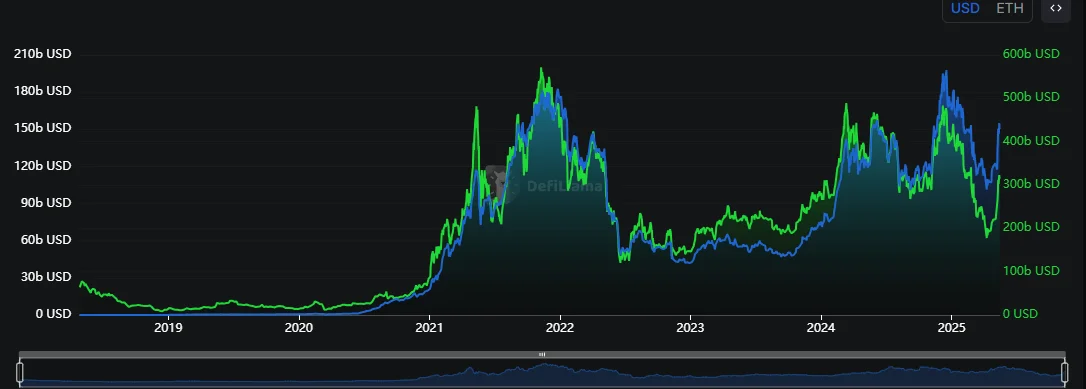
The Market Cap to Total Value Locked (TVL) ratio measures the valuation of a decentralized finance project by comparing its market capitalization to the total value of assets locked in its smart contracts. This ratio shows the project’s utilization and links the platform’s health to locked asset value.


A ratio above 1.0 indicates overvaluation because the market cap exceeds the value of assets used in the platform. A ratio below 1.0 indicates undervaluation because the market cap is lower than the value of locked assets.
Market Cap to TVL

ETH MCAP/TVL | Credit: DeFiLlama On May 15, 2025, the Ethereum TVL ratio was 2.12, indicating a slight overvaluation.


CCN Strength Index


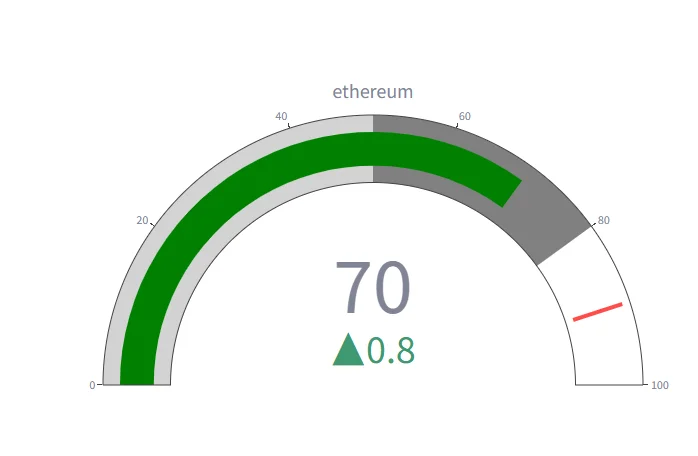
The CCN Strength Index combines an array of advanced market signals to measure the strength of individual cryptocurrencies over the last 30 days.
Every day, it assigns a strength score, ranging from 0 to 100, to the top 500 assets by market capitalization on CoinMarketCap, focusing on both trend direction and the intensity of price movements.

  • 0 to 24: Assets exhibit significant weakness, showing signs of sustained downtrend behavior.
  • 25 to 35: The price tends to move within stable bounds with minimal volatility.
  • 36 to 49: Assets begin a stable uptrend but without strong surges.
  • 50 to 59: Consistent growth with moderate price advances, building momentum.
  • 60+: Sharp price movements and high demand indicate more volatility and trend shifts.

The index dynamically adapts to rapid changes. For example, an asset experiencing a 100% increase within a short timeframe would see a sharp jump in its score to reflect the intensity of the rise.


However, should that asset stabilize at this new price level, the score will gradually taper down and align with the dampened momentum as the movement normalizes.
CCN Index

ETH CCN Index | Credit: CCN May 15, 2025, Ethereum scored 70 on the CCN Index, suggesting strong momentum.


Best Days and Months to Buy


We looked at the ETH price history and found the times when the price was at its lowest across certain days, months, quarters, and even weeks in the year, indicating the best times to buy Ethereum.


Time to Buy ETH Days, Weeks, Months, and Quarters Best Day Wednesday Best Week 33 Best Month January Best Quarter First


ETH Price Performance Comparison


Ethereum is a blockchain that deals with smart contracts, so let’s compare its performance with similar projects.


Current Price One Year Ago Price Change Ethereum $2,552 $3,035 -12.1% Solana $170.52 $158.01 +17.6% Cardano $0.77 $0.45 +76.9% Avalanche $23.79 $34.63 -27.8%
Advantages and Disadvantages


CCN’s Senior Research Analyst, Toghrul Aliyev, studied Ethereum in depth and found its advantages and disadvantages.


Advantages of Ethereum


Development

  • Ethereum ranks number one across multiple key development metrics: 112,535 repositories, 1,540 sub-ecosystems, 43,475 weekly commits, and 2,913 active developers. These numbers demonstrate Ethereum’s extensive range of applications and projects. The active development results in fewer bugs, faster issue resolution, and the ability to swiftly meet user demands and stay ahead of competitors.

Centralization and Decentralization

  • The 2016 The DAO hack led to the theft of 3.6 million ETH. In response, Ethereum implemented a hard fork to restore the stolen funds. Critics argue this decision contradicted Ethereum’s decentralized ethos. However, the hard fork demonstrated true decentralization only after achieving majority consensus through extensive community discussions and voting. With 14% of the total supply at risk and the ecosystem’s future in jeopardy, the move was not a bailout. In contrast, no hard fork was implemented when the Parity multi-signature wallet was exploited in 2017. Other critics compare The DAO hack to the Mt. Gox collapse, but this comparison misses key differences. When MtGox’s losses were revealed, the funds had already been widely dispersed, making a simple revert impossible. In the case of The DAO, the funds were locked for several weeks after the transfer, allowing for a different response.

Market Position

  • The approval of ETH ETFs makes Ethereum accessible to institutional investors like pension funds, mutual funds, and insurance companies. As a result, Ethereum is now part of traditional finance, which enhances its liquidity and price stability.
  • Ethereum ranks 1st in DEX trading volume, holding a 33.4% market share in the first quarter of 2024, with $144.2 billion in trades.


DEX Trading Volume

2024 Spot DEX Trading Volume Q1, 2024. Credit: CoinGecko

  • Ethereum leads in real-world asset tokenization. It has an almost 72% market share in tokenized US Treasuries. Ethereum also holds more than 98% of the commodities and more than 53% of the stablecoin supply on its network.

US Treasuries Stablecoins Commodities Ethereum $1384.49M $88604.92M $864.89M Stellar $433.27M $226.43M $9.83M Solana $47.96M $3199.73M – Mantle $39.72M – – Polygon $10.32M $361.26M – Arbitrum $5.22M $1309.82M – Gnosis $2.23M – – TRON – $61680.08M – BNB Smart Chain – $4994.37M – Base – $2,972.77 – Avalanche – $2185.47M – NEAR – $714.01M –

  • Positive: Ethereum dominates the DeFi sector by total value locked, holding more than 56% of the market share.

total Value Locked (TVL) all chains

Total Value Locked – All Chains. Source: DefiLlama Supply and Scalability

  • Positive: Users can stake Ethereum to earn rewards by participating in the network’s validation process.
  • Positive: Ethereum’s burning mechanism, introduced through the EIP-1559 upgrade, reduces the total supply of ETH over time. Each transaction on the Ethereum network includes a base fee, which gets burned, permanently removing that ETH from circulation. If the rate of ETH being burned is greater than the rate at which new ETH is created, the total supply of ETH decreases, leading to increased scarcity and potentially higher value per token.

Disadvantages of Ethereum


Development

  • When problems arise in the Ethereum network, solutions often involve outsourcing tasks to external organizations. This practice can compromise the protocol’s integrity because it relies on outside parties rather than the community or core developers. It creates a situation where external companies have significant influence over the network, leading to conflicts of interest and reducing the system’s trustworthiness.
  • Layer 2 solutions offer faster and cheaper transactions, causing users and developers to focus on them rather than the Ethereum network. As a result, developers prioritize creating and enhancing Layer 2 or Layer 3 solutions, shifting their innovation and development efforts away from Ethereum itself.
  • Ethereum developers focus on long-term solutions that take years to implement, mainly concentrating on Layer 2s and Layer 3s. Meanwhile, competitors are addressing Ethereum’s issues more quickly, thus attracting more users, developers, and investment. The dynamic leads to a loss of market share for Ethereum as other platforms offer immediate improvements and capture more of the market.

Centralization and Decentralization

  • Liquid staking lets users stake Ether and receive tokens representing their staked assets, which can be traded or used in other DeFi applications. However, it poses a risk to the protocol’s health. If too much Ether concentrates in liquid staking services, a few entities could gain significant control over the network. This is already a reality because Lido and Coinbase control over 40% of the market share in Ethereum’s staking. For proof-of-stake platforms, control by more than 33% of the stake is problematic because it increases the risk of collusion and potential network compromise.


Ethereum Stakers

Credit: Dune Analytics/Hildobby

  • As the hardware requirements for running a node on the Ethereum network increase, only entities with large data centers can afford to keep up. Smaller, individual node operators may find it too expensive to continue participating. This trend leads to a more centralized network, where a few large players dominate, reducing the network’s resilience and decentralization. As of July 2024, five ISPs—Amazon, Hetzner Online, OVH SAS, Comcast Cable, and Spectrum—are responsible for 1/3 of the network’s nodes out of 893 providers. The situation has improved since August 2022, when three ISPs hosted 2/3 of the nodes . However, this improvement still does not fully resolve the centralization issue.


Ethereum Node Distribution

Credit: Ethernodes.org

  • MEV refers to the profit miners can make by reordering, including, or excluding transactions within the blocks they produce. Instead of finding ways to solve this problem, Ethereum has started accommodating it by supporting proprietary MEV builders. The focus on MEV builders gives them precedence over local, smaller block producers, which can lead to a more centralized and unfair system.
  • Staking requires a minimum of 32 ETH, equivalent to $112,000 at an Ethereum price of $3,500, making it inaccessible for the average retail investor. The barrier reduces the level of decentralization, as fewer individuals can participate in securing the network.
  • Ethereum’s decision-making relies heavily on a small group of developers, which centralizes control and slows the decision-making process. The absence of on-chain governance means fewer community voices influence major updates, leading to less flexible responses to challenges. A centralized structure hampers Ethereum’s ability to adapt quickly and increases the risk of users and developers moving to more responsive platforms.

Market Position

  • Negative: Year-to-date inflows and outflows of Ethereum have resulted in a net outflow of $0.85 billion. More money leaving the chain than coming in indicates that investors and users prefer other chains over Ethereum, which could lead to decreased network activity and hinder its growth and development.

Inflows and Outflows

Inflows and outflows: Credit: Artemis.xyz Supply and Scalability

Ethereum Average Transaction Fee

ETH Average Transaction Fee. Source: Etherscan

  • Ethereum relies on Layer 2 solutions like Arbitrum and Optimism to handle more transactions. These help reduce congestion and fees but make Ethereum less viable as a standalone option. The significant market share of these Layer 2 platforms indicates a preference for alternatives. Although these solutions operate within the Ethereum ecosystem, relying on external chains instead of in-house solutions is not ideal. 
  • Due to congestion and inefficiency, Ethereum’s inability to scale results in a poor user experience. Additionally, fragmentation across Layer-2 solutions complicates dApp interoperability. It also complicates integrating new projects with existing ones, while reduced composability hampers innovation and growth within the ecosystem.
  • Ethereum’s focus on being a secure data availability layer for Layer 2 solutions highlights its scalability limitations. The mainnet remains less scalable, affecting the efficiency of the DA Layer. Meanwhile, scalable blockchains can process more transactions, capture higher revenue, and enhance security. This puts Ethereum at a competitive disadvantage as it struggles to match the performance and efficiency of more scalable blockchains.
  • Successful Layer 2 solutions may abandon Ethereum for more scalable Layer 1 blockchains. If Ethereum doesn’t provide sufficient revenue for these protocols to thrive, they will likely migrate to other platforms that offer better scalability and profitability, further weakening Ethereum’s ecosystem.
  • Due to scalability issues, congestion, and high fees, Ethereum’s DEX trading volume market share has been chipped away by other chains, mainly its Layer 2 solution, Arbitrum, and Ethereum’s biggest competition, Solana. In October 2023, Ethereum’s DEX trading volume market share was 56.49%, but by March 2024, it had dropped to 33.4%.
  • Recently, interest in Ethereum has dropped, leading to inflation exceeding the amount of ETH burned. Since April 2024, the net increase in ETH supply has been about 60,000 ETH monthly. If this trend continues, by Dec. 2024, the total supply of ETH could return to the levels seen at the time of the Merger.

Ethereum Price History


Now, look at some key dates in the ETH price history . While past performance is not an indicator of future results, knowing what the token has done can help provide context when making or interpreting an Ethereum price prediction.


Period Ethereum Price Last Week (May 8, 2025) $1,939 Last Month (April 15, 2025) $1,645 Three months ago (Feb. 15, 2025) $2,704 One year ago (May 15, 2024) $3,035 Five years ago (Jan. 3, 2020) $207.85 Launch price (Aug. 7, 2015) $2.83 All-time high (Nov. 16, 2021) $4,891 All-time low (Oct. 21, 2015) $0.42


Ethereum Market Cap


The market capitalization, or market cap, is the sum of the total ETH in circulation multiplied by its price.

Ethereum Market Cap

Ethereum market cap for the last 12 months | Credit: CoinMarketCap On May 15, 2025, Ethereum’s market cap was $306 billion, making it the second-largest crypto by that metric.
Who Owns the Most Ethereum (ETH)?
On May 15, 2025, one wallet held more than 50% of ETH’s supply.

Richest ETH Wallet Addresses


As of May 15, 2025, the five richest ETH wallets were

  • 0x00000000219ab540356cbb839cbe05303d7705fa. This wallet held 61,413,109 ETH, or 50.86% of the supply.
  • 0xc02aaa39b223fe8d0a0e5c4f27ead9083c756cc2. This wallet held 2,694,435 ETH, or 2.23% of the supply.
  • 0xbe0eb53f46cd790cd13851d5eff43d12404d33e8. This wallet, listed as Binance, held 1,996,008 ETH, or 1.65% of the supply.
  • 0x40b38765696e3d5d8d9d834d8aad4bb6e418e489. This wallet held 1,376,695 ETH, or 1.14% of the supply.
  • 0x49048044d57e1c92a77f79988d21fa8faf74e97e. This wallet held 1,107,296 ETH, or 0.92% of the supply.


Трендові криптовалюти

Пов'язані матеріали

CLARITY Act Countdown: How Will the Crypto Market Fare If It Doesn't Pass Before the August Recess?

The CLARITY Act, a major US crypto market structure bill, faces a tight deadline before the Senate's August 10 recess. It must overcome final hurdles—negotiations on ethics provisions and law enforcement concerns—to secure the 60 votes needed for passage. Analysts warn that missing this window significantly lowers its chances in 2026, with prediction markets giving only a 40% probability of success this year. If the act fails to pass by the recess, the market is expected to react not with a crash but with continued "slow bleeding," particularly in premium products like ETFs. June saw record net outflows from US Bitcoin spot ETFs, partly attributed to this legislative uncertainty. Assets like XRP, which would receive permanent commodity classification under the act, stand to lose a "regulatory premium" on further delays. Bitcoin and Ethereum, already classified as commodities by regulators, face less direct impact, but DeFi innovation and institutional capital inflows would remain stifled by regulatory ambiguity. The path forward includes passing before the recess (a major catalyst), postponement to 2027 (prolonging uncertainty), or failure, requiring the bill to be reintroduced in the next Congress. Despite the stalled negotiations, the bill's advancement this far signals the US is closer than ever to resolving crypto regulatory clarity.

marsbit17 хв тому

CLARITY Act Countdown: How Will the Crypto Market Fare If It Doesn't Pass Before the August Recess?

marsbit17 хв тому

The Impact of OUSD on Circle, Tether, and Paxos: Not a Simple Negative, but a More Complex Competitive Landscape

OUSD's Impact on Circle, Tether, and Paxos: A Nuanced Competitive Reshuffle The launch of OUSD, a new stablecoin initiative, has complex implications for the stablecoin market. For Circle (CRCL), the initial 15-20% stock drop reflects legitimate competitive concerns but is not a "death sentence." Circle retains deep liquidity, existing integrations, and first-mover advantages. A potential restructuring or termination of its Coinbase partnership could even double its net revenue in the short term, providing more competitive freedom. However, OUSD, backed by Stripe's engineering and product strengths, could become the default stablecoin within the Stripe ecosystem for new adopters, challenging USDC's position. OUSD does not solve the core barrier for corporate adoption: it remains a credit exposure to its issuer (likely a Bridge-related entity), which, like Circle, is not an investment-grade entity. Large banks and asset managers could still capture the most lucrative enterprise use cases. Circle must accelerate its payment/fintech product development and consider defensive M&A. For Tether, OUSD targets a different market segment. Tether will continue focusing on distribution channels not prioritized by Stripe or Circle. Its market share may decline over time, but within a significantly growing total market. Paxos faces the greatest pressure. OUSD undermines the key selling points of its USDG stablecoin, and Paxos's regulatory advantages may diminish as frameworks mature. This poses a more existential challenge, explaining Paxos's recent shift back to its brokerage-as-a-service business.

marsbit21 хв тому

The Impact of OUSD on Circle, Tether, and Paxos: Not a Simple Negative, but a More Complex Competitive Landscape

marsbit21 хв тому

OUSD's Impact on Circle, Tether, and Paxos: Not a Simple Negative, but a More Complex Competitive Reshuffle

This article analyzes the impact of the newly announced stablecoin OUSD, backed by a consortium including Stripe, on major incumbents like Circle (USDC), Tether (USDT), and Paxos (USDG). For Circle, the announcement is not a simple negative. While the initial market reaction was rational, it's not a "death sentence." Circle retains deep liquidity, existing integrations, and first-mover advantage. A potential restructuring or termination of its exclusive revenue-sharing deal with Coinbase could even near-double its net income in the short term, providing more competitive flexibility. However, within the Stripe ecosystem, OUSD, with its strong engineering and product focus, could become the default choice, displacing USDC for new integrations. Circle must accelerate its own fintech product development and consider defensive M&A. OUSD does not directly threaten Tether's core markets, which focus on different distribution channels. Tether's market share may decline over time but within a significantly growing overall market. Paxos faces the greatest pressure. OUSD undermines the primary value proposition of its USDG stablecoin, and Paxos's regulatory advantages may erode as frameworks mature, posing a more existential challenge. This explains Paxos's recent strategic pivot towards brokerage-as-a-service. A fundamental unresolved issue for enterprise adoption remains: if issued by a Bridge-related entity, OUSD, like USDC, still represents a credit exposure to a non-investment-grade issuer, unless a parent company guarantee is provided. Large banks and asset managers entering the space later could still compete for the most lucrative enterprise use cases.

链捕手22 хв тому

OUSD's Impact on Circle, Tether, and Paxos: Not a Simple Negative, but a More Complex Competitive Reshuffle

链捕手22 хв тому

Торгівля

Спот

Популярні статті

Що таке ETH 2.0

ETH 2.0: Нова ера для Ethereum Вступ ETH 2.0, широко відомий як Ethereum 2.0, є величезним оновленням для блокчейну Ethereum. Ця трансформація не є лише косметичною зміною; вона має на меті фундаментально покращити масштабованість, безпеку та сталий розвиток мережі. З переходом від енергомісткого механізму консенсусу Proof of Work (PoW) до більш ефективного Proof of Stake (PoS), ETH 2.0 обіцяє трансформаційний підхід до екосистеми блокчейнів. Що таке ETH 2.0? ETH 2.0 — це збірка особливих, взаємопов’язаних оновлень, спрямованих на оптимізацію можливостей та продуктивності Ethereum. Це перетворення розроблене для вирішення критичних викликів, з якими стикалося існуюче механізм Ethereum, зокрема щодо швидкості транзакцій та заторів у мережі. Мета ETH 2.0 Основні цілі ETH 2.0 зосереджені на покращенні трьох ключових аспектів: Масштабованість: Мета — значно підвищити кількість транзакцій, які мережа може обробити за секунду; ETH 2.0 прагне вийти за межі поточного обмеження приблизно в 15 транзакцій на секунду, потенційно досягнувши тисяч. Безпека: Підвищені заходи безпеки є невід’ємною частиною ETH 2.0, зокрема через покращену стійкість до кібератак і збереження децентралізованої етики Ethereum. Сталий розвиток: Новий механізм PoS розроблений не тільки для підвищення ефективності, але й для різкого зменшення споживання енергії, що узгоджує операційну структуру Ethereum з екологічними міркуваннями. Хто є творцем ETH 2.0? Створення ETH 2.0 можна віднести до Ethereum Foundation. Ця неприбуткова організація, яка відіграє важливу роль у підтримці розвитку Ethereum, очолюється відомим співавтором Віталіком Бутеріним. Його бачення більш масштабованого та стійкого Ethereum стало рушійною силою цього оновлення, залучаючи внески зі всього світу від розробників і ентузіастів, які прагнуть покращити протокол. Хто є інвесторами ETH 2.0? Хоча подробиці про інвесторів ETH 2.0 не були оприлюднені, відомо, що Ethereum Foundation отримує підтримку від різних організацій та осіб у сфері блокчейну та технологій. Ці партнери включають венчурні капітальні компанії, технологічні компанії та філантропічні організації, які мають спільний інтерес у підтримці розвитку децентралізованих технологій та інфраструктури блокчейну. Як працює ETH 2.0? ETH 2.0 відзначається введенням низки ключових функцій, які відрізняють його від попередника. Proof of Stake (PoS) Перехід до механізму консенсусу PoS є одним із знакових змін ETH 2.0. На відміну від PoW, який покладається на енергомісткий видобуток для перевірки транзакцій, PoS дозволяє користувачам підтверджувати транзакції та створювати нові блоки відповідно до кількості ETH, яку вони ставлять у мережі. Це призводить до підвищення енергоефективності, зменшуючи споживання приблизно на 99,95%, завдяки чому Ethereum 2.0 стає значно більш екологічною альтернативою. Шардові ланцюги Шардові ланцюги є ще одним ключовим нововведенням ETH 2.0. Ці менші ланцюги працюють паралельно з основним ланцюгом Ethereum, що дозволяє обробляти кілька транзакцій одночасно. Це підходи покращує загальну ємність мережі, усуваючи проблеми масштабованості, які переслідували Ethereum. Beacon Chain У центрі ETH 2.0 знаходиться Beacon Chain, яка координує мережу і управляє протоколом PoS. Вона виконує роль організатора: контролює валідаторів, забезпечує з’єднання шард з мережею і моніторить загальний стан екосистеми блокчейнів. Хронологія ETH 2.0 Шлях ETH 2.0 характеризується кількома ключовими етапами, які відображають еволюцію цього значного оновлення: Грудень 2020: Запуск Beacon Chain ознаменував введення PoS, проклавши шлях до міграції на ETH 2.0. Вересень 2022: Завершення "Злиття" є знаковим моментом, коли мережа Ethereum успішно перейшла з PoW на PoS, відкриваючи нову еру для Ethereum. 2023: Очікуване розгортання шардових ланцюгів має на меті подальше покращення масштабованості мережі Ethereum, закріплюючи ETH 2.0 як надійну платформу для децентралізованих додатків і послуг. Ключові особливості та переваги Покращена масштабованість Однією з найзначніших переваг ETH 2.0 є його покращена масштабованість. Поєднання PoS та шардових ланцюгів дозволяє мережі розширити свою ємність, що дозволяє їй обробляти набагато більший обсяг транзакцій в порівнянні з класичною системою. Енергоефективність Запровадження PoS є величезним кроком до енергоефективності в технології блокчейн. Значно зменшуючи споживання енергії, ETH 2.0 не тільки знижує операційні витрати, але також ближче узгоджується з глобальними цілями сталого розвитку. Підвищена безпека Оновлені механізми ETH 2.0 сприяють підвищенню безпеки по всій мережі. Впровадження PoS, поряд з інноваційними контрольними заходами, встановленими через шардові ланцюги та Beacon Chain, забезпечує вищий рівень захисту від потенційних загроз. Зниження витрат для користувачів З покращенням масштабованості вплив на витрати на транзакції також стане очевидним. Збільшена ємність і зменшені затори, як очікується, призведуть до зниження зборів для користувачів, що зробить Ethereum більш доступним для повсякденних транзакцій. Висновок ETH 2.0 є значною еволюцією в екосистемі блокчейну Ethereum. Оскільки він вирішує важливі питання, такі як масштабованість, споживання енергії, ефективність транзакцій і загальна безпека, важливість цього оновлення не можна недооцінювати. Перехід до Proof of Stake, введення шардових ланцюгів і фундаментальна робота Beacon Chain свідчать про майбутнє, в якому Ethereum може задовольнити зростаючі вимоги децентралізованого ринку. В індустрії, що рухається вперед завдяки інноваціям та прогресу, ETH 2.0 є підтвердженням можливостей технології блокчейн у прокладенні шляху до більш сталого та ефективного цифрового економіки.

182 переглядів усьогоОпубліковано 2024.04.04Оновлено 2024.12.03

Що таке ETH 2.0

Що таке ETH 3.0

ETH3.0 та $eth 3.0: Глибоке дослідження майбутнього Ethereum Вступ У швидко змінюваному світі криптовалют та технології блокчейн, ETH3.0, часто позначуваний як $eth 3.0, став темою значного інтересу та спекуляцій. Цей термін охоплює два основні концепти, які потребують уточнення: Ethereum 3.0: Це потенційне майбутнє оновлення, яке має на меті покращення можливостей існуючого блокчейну Ethereum, зокрема, фокусуючись на поліпшенні масштабованості та продуктивності. ETH3.0 Мем Токен: Цей окремий криптовалютний проект прагне використовувати блокчейн Ethereum для створення екосистеми, орієнтованої на меми, сприяючи залученню до криптовалютної громади. Розуміння цих аспектів ETH3.0 є важливим не лише для криптоентузіастів, але й для тих, хто спостерігає за широкими технологічними тенденціями у цифровому просторі. Що таке ETH3.0? Ethereum 3.0 Ethereum 3.0 пропонується як оновлення вже існуючої мережі Ethereum, яка стала основою багатьох децентралізованих додатків (dApps) та смарт-контрактів з моменту свого виникнення. Передбачувані удосконалення зосереджені в основному на масштабованості — інтегруючи передові технології, такі як шардінг та нульові знання (zk-докази). Ці технологічні нововведення націлені на забезпечення безпрецедентної кількості транзакцій на секунду (TPS), потенційно досягаючи мільйонів, тим самим вирішуючи одну з найзначніших обмежень, з якими стикається сучасна технологія блокчейн. Покращення є не лише технічним, а й стратегічним; воно спрямоване на підготовку мережі Ethereum до широкого прийняття та корисності в майбутньому, позначеному збільшеним попитом на децентралізовані рішення. ETH3.0 Мем Токен На відміну від Ethereum 3.0, ETH3.0 Мем Токен пропонує легшу та грайливішу домену, поєднуючи культуру інтернет-мемів із динамікою криптовалют. Цей проект дозволяє користувачам купувати, продавати та обмінювати меми на блокчейні Ethereum, надаючи платформу, яка сприяє залученню громади через креативність та спільні інтереси. ETH3.0 Мем Токен має на меті продемонструвати, як технологія блокчейн може перетинатися з цифровою культурою, створюючи випадки використання, які є водночас розважальними та фінансово життєздатними. Хто є творцем ETH3.0? Ethereum 3.0 Ініціатива щодо Ethereum 3.0 переважно підтримується консорціумом розробників та дослідників у межах громади Ethereum, зокрема, до складу якого входить Джастін Дрейк. Відомий своїми думками та внеском у розвиток Ethereum, Дрейк є помітною особистістю в обговореннях щодо переходу Ethereum на новий рівень консенсусу, який називається «Beam Chain». Цей колабораційний підхід до розробки свідчить про те, що Ethereum 3.0 не є продуктом єдиного творця, а скоріше втіленням колективної винахідливості, спрямованої на просування технології блокчейн. ETH3.0 Мем Токен Деталі про творця ETH3.0 Мем Токена наразі не відстежуються. Природа мем-токенів часто призводить до більш децентралізованої та громартової структури, що може пояснити відсутність специфічної атрибуції. Це узгоджується з етикою ширшої крипто-спільноти, де інновації часто виникають з колективних, а не індивідуальних зусиль. Хто є інвесторами ETH3.0? Ethereum 3.0 Підтримка Ethereum 3.0 переважно надходить від Фонду Ethereum поряд з ентузіастичною спільнотою розробників та інвесторів. Це базове співробітництво надає значний градус легітимності та підвищує ймовірність успішної реалізації, оскільки воно використовує довіру та авторитет, накопичені за роки роботи мережі. У швидко змінюваному кліматі криптовалют підтримка громади займає важливу роль у розвитку та прийнятті, позиціонуючи Ethereum 3.0 як серйозного конкурента для майбутніх блокчейн-інновацій. ETH3.0 Мем Токен Хоча наразі доступні джерела не надають явної інформації щодо інвестиційних фондів або організацій, що підтримують ETH3.0 Мем Токен, це свідчить про типову модель фінансування для мем-токенів, яка часто спирається на підтримку знизу та залучення громади. Інвестори в такі проекти зазвичай складаються з осіб, які мотивовані потенціалом інновацій, що керуються спільнотою, та духом співпраці, притаманним крипто-спільноті. Як працює ETH3.0? Ethereum 3.0 Відмінні риси Ethereum 3.0 полягають у його запропонованій реалізації технології шардінгу та zk-proof. Шардінг — це метод розподілу блокчейну на менші, керовані частини чи «шарди», які можуть обробляти транзакції одночасно, а не послідовно. Це децентралізоване оброблення допомагає запобігти заторам та забезпечити оперативність мережі навіть під великим навантаженням. Технологія нульових доказів (zk-proof) надає ще один рівень складності, дозволяючи валідацію транзакцій без розкриття підпорядкованих даних. Цей аспект не лише підвищує конфіденційність, а й збільшує загальну ефективність мережі. Також обговорюється включення нульової Ефірної віртуальної машини (zkEVM) в це оновлення, що ще більше підвищить можливості та корисність мережі. ETH3.0 Мем Токен ETH3.0 Мем Токен виділяється завдяки використанню популярності культури мемів. Він створює ринок, на якому користувачі можуть брати участь у торгівлі мемами не лише для розваги, але й для потенційного економічного вигоди. Інтегруючи функції, такі як стейкінг, забезпечення ліквідності та механізми управління, проект сприяє створенню середовища, яке заохочує взаємодію та участь громади. Пропонуючи унікальне поєднання розваг та економічних можливостей, ETH3.0 Мем Токен прагне залучити різну аудиторію, яка охоплює від криптоентузіастів до casual-консумерів мемів. Хронологія ETH3.0 Ethereum 3.0 11 листопада 2024: Джастін Дрейк натякає на майбутнє оновлення ETH 3.0, яке зосереджене на поліпшеннях масштабованості. Це оголошення означає початок формальних обговорень щодо майбутньої архітектури Ethereum. 12 листопада 2024: Очікується, що запропоновану пропозицію для Ethereum 3.0 буде представлено на Devcon у Бангкоку, що готує ґрунт для більш широкого зворотного зв'язку від громади та потенційних наступних кроків у розвитку. ETH3.0 Мем Токен 21 березня 2024: ETH3.0 Мем Токен офіційно потрапляє у список на CoinMarketCap, що означає його дебют у публічному крипто-просторі та підвищує видимість для його меморієнтованої екосистеми. Ключові моменти На завершення, Ethereum 3.0 представляє значну еволюцію в межах мережі Ethereum, зосереджуючись на подоланні обмежень щодо масштабованості та продуктивності через передові технології. Його запропоновані оновлення відображають проактивний підхід до майбутніх вимог і корисності. Натомість ETH3.0 Мем Токен втілює суть культури, керованої громадою, у сфері криптовалют, використовуючи культуру мемів для створення привабливих платформ, які заохочують творчість і участь користувачів. Розуміння окремих цілей і функцій ETH3.0 та $eth 3.0 є надзвичайно важливим для кожного, хто цікавиться поточними подіями в крипто-просторі. З обома ініціативами, які прокладають унікальні шляхи, вони разом підкреслюють динамічну та багатогранну природу інновацій у блокчейн-технологіях.

179 переглядів усьогоОпубліковано 2024.04.04Оновлено 2024.12.03

Що таке ETH 3.0

Як купити ETH

Ласкаво просимо до HTX.com! Ми зробили покупку Ethereum (ETH) простою та зручною. Дотримуйтесь нашої покрокової інструкції, щоб розпочати свою криптовалютну подорож.Крок 1: Створіть обліковий запис на HTXВикористовуйте свою електронну пошту або номер телефону, щоб зареєструвати обліковий запис на HTX безплатно. Пройдіть безпроблемну реєстрацію й отримайте доступ до всіх функцій.ЗареєструватисьКрок 2: Перейдіть до розділу Купити крипту і виберіть спосіб оплатиКредитна/дебетова картка: використовуйте вашу картку Visa або Mastercard, щоб миттєво купити Ethereum (ETH).Баланс: використовуйте кошти з балансу вашого рахунку HTX для безперешкодної торгівлі.Треті особи: ми додали популярні способи оплати, такі як Google Pay та Apple Pay, щоб підвищити зручність.P2P: Торгуйте безпосередньо з іншими користувачами на HTX.Позабіржова торгівля (OTC): ми пропонуємо індивідуальні послуги та конкурентні обмінні курси для трейдерів.Крок 3: Зберігайте свої Ethereum (ETH)Після придбання Ethereum (ETH) збережіть його у своєму обліковому записі на HTX. Крім того, ви можете відправити його в інше місце за допомогою блокчейн-переказу або використовувати його для торгівлі іншими криптовалютами.Крок 4: Торгівля Ethereum (ETH)Легко торгуйте Ethereum (ETH) на спотовому ринку HTX. Просто увійдіть до свого облікового запису, виберіть торгову пару, укладайте угоди та спостерігайте за ними в режимі реального часу. Ми пропонуємо зручний досвід як для початківців, так і для досвідчених трейдерів.

3.2k переглядів усьогоОпубліковано 2024.12.10Оновлено 2026.06.02

Як купити ETH

Обговорення

Ласкаво просимо до спільноти HTX. Тут ви можете бути в курсі останніх подій розвитку платформи та отримати доступ до професійної ринкової інформації. Нижче представлені думки користувачів щодо ціни ETH (ETH).

活动图片