Altcoin Season Index Points To Possible Bottom Despite Bitcoin Dominance

bitcoinistОпубліковано о 2025-07-08Востаннє оновлено о 2025-07-08

Анотація

Altcoin season has remained elusive despite expectations that it would have begun early in 2025. This has led to calls...

Trusted Editorial content, reviewed by leading industry experts and seasoned editors. Ad Disclosure

Altcoin season has remained elusive despite expectations that it would have begun early in 2025. This has led to calls that there has been a change in the cycle and perhaps the concept of an altcoin season no longer applies. The Bitcoin dominance has also remained quite high during this time, with altcoins falling rapidly with each decline. However, the Altcoin Season Index is currently pointing to a possible bottom for altcoins.

Altcoin Season Index Bounces From Low Score Of 11

The Altcoin Season Index is an index which ranks the performance of the top 50 altcoins against the performance of Bitcoin on a scale of 1-100. In the case where the top 50 coins are performing better than Bitcoin on a 90-day period, it is considered altcoin season. Whereas in the case where the Bitcoin price is still outperforming the top 50 altcoins, excluding stablecoins and asset-backed tokens, then it is considered a Bitcoin season.

Presently, the Bitcoin price is still well ahead of the top 50 altcoins, as shown by its dominance still ranging above 65%. This has significantly reduced the chances of an alt season as the focus is still heavily on Bitcoin during this time. Even more concerning is the fact that the Bitcoin price has continued to outperform Ethereum, which is often the leader of the altcoin season.

According to data from Blockchain Center, the Altcoin Season Index is currently sitting at a low score of 27 at the time of this writing. This remains quite low but has been a major step-up from the low score of 11 that was recorded back in June following the market crash.
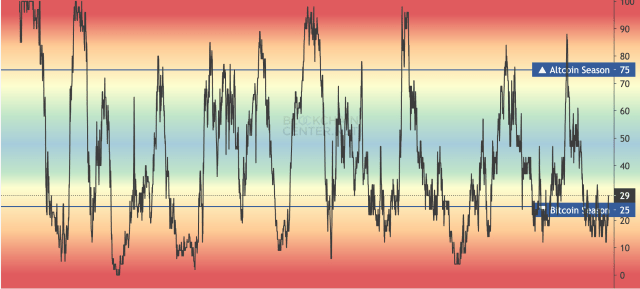
Altcoin Season Index
Source: Blockchain Center

Usually, when the index is this low, it often signals that the end of the downtrend is close and the bottom could be in. However, there could still be some ways to go, given that historically, the index has bottomed below 10 before the alt season begins.

This is seen throughout the history of the market, where the altcoin index had fallen below 8 back in 2020 before the legendary altcoin season of 2021. Then again, bottoming at a score of 4 back in 2023 before the 2024 rally.

Nevertheless, the index being this low does suggest that the bottom is either in or will be in soon. The next step would be a decline in the Bitcoin dominance, likely toward the 40% territory, and Ethereum outperforming the Bitcoin price to fully signal the entrance of the altcoin season.

Altcoins market chart from TradingView.com
Altcoins view for another recovery | Source: Crypto Total Market Cap Excluding BTC on TradingView.com
Featured image from Dall.E, chart from TradingView.com
Editorial Process for bitcoinist is centered on delivering thoroughly researched, accurate, and unbiased content. We uphold strict sourcing standards, and each page undergoes diligent review by our team of top technology experts and seasoned editors. This process ensures the integrity, relevance, and value of our content for our readers.

Scott Matherson is a leading crypto writer at Bitcoinist, who possesses a sharp analytical mind and a deep understanding of the digital currency landscape. Scott has earned a reputation for delivering thought-provoking and well-researched articles that resonate with both newcomers and seasoned crypto enthusiasts. Outside of his writing, Scott is passionate about promoting crypto literacy and often works to educate the public on the potential of blockchain.

Пов'язані матеріали

MSTR Discloses Sale of 3,588 Bitcoins, Stock Price Drops Over 5% at One Point During Trading

MicroStrategy, the world's largest corporate holder of Bitcoin, has significantly shifted its business model. Between June 29 and July 5, the company sold 3,588 bitcoins for approximately $216 million to fund quarterly dividends for its preferred stock. This marks its largest-ever Bitcoin sale and signals a strategic pivot: Bitcoin is transitioning from a "buy-and-hold" reserve asset to a liquidity management tool for the company. This move follows a recent authorization allowing Bitcoin sales when equity fundraising is less attractive. The announcement contributed to a more than 5% intraday drop in MicroStrategy's stock price, while Bitcoin fell to around $61,800—below the company's average holding cost of roughly $75,700. The sale represents a major departure from MicroStrategy's long-standing "never sell" commitment, which saw its first minor breach in May with a $2.5 million sale. The latest, hundred-times-larger transaction underscores growing financial pressures. Analysts note the company faces about $1.5 billion in annual preferred dividend obligations, far exceeding cash flow from its software business. As of July 5, MicroStrategy holds 843,775 bitcoins. Its current operational logic involves buying Bitcoin during favorable financing conditions and selling portions to cover dividends when needed, creating a flexible capital management cycle amidst a challenging market environment.

华尔街日报5 год тому

MSTR Discloses Sale of 3,588 Bitcoins, Stock Price Drops Over 5% at One Point During Trading

华尔街日报5 год тому

Q-Day Countdown: Will Quantum Computing End Cryptocurrencies?

Quantum Computing's Threat to Cryptocurrency: A Countdown to Q-Day Quantum computing, specifically Shor's algorithm, poses a fundamental threat to the public-key cryptography (e.g., ECDSA, RSA) that secures blockchain networks like Bitcoin and Ethereum. This critical juncture, known as Q-Day, is estimated to occur potentially within the next 5-15 years. The core vulnerability stems from the public and immutable nature of blockchains. Assets in addresses where the public key is already exposed on-chain (e.g., spent outputs) are at direct risk, as a sufficiently powerful quantum computer could derive the private key. This threatens the very trust model of cryptocurrencies. The response lies in Post-Quantum Cryptography (PQC)—algorithms like lattice-based ML-DSA and hash-based SLH-DSA, which are resistant to quantum attacks. NIST has standardized key PQC algorithms (FIPS 203, 204, 205), providing a migration path. However, the primary challenge is not technical but socio-economic and involves complex governance: * **Bitcoin's** path is constrained by its conservative ethos. Migrating requires a soft-fork to new address types, facing hurdles like significantly larger signature sizes and, most critically, the divisive governance question of how to handle at-risk legacy UTXOs without violating core principles. * **Ethereum** is pursuing a "cryptographic agility" strategy, with a multi-layered roadmap. It leverages account abstraction for user accounts and is developing compressed hash-based signatures (e.g., leanXMSS) for its consensus layer, aiming for a full-stack upgrade over time. In conclusion, quantum computing does not spell an instant end for cryptocurrency but initiates a critical countdown. The industry has a limited "engineering comfort window" to orchestrate a coordinated, ecosystem-wide migration to PQC. The ultimate bottlenecks are the immense coordination efforts and governance decisions required for this foundational transition.

marsbit6 год тому

Q-Day Countdown: Will Quantum Computing End Cryptocurrencies?

marsbit6 год тому

Trump, the President Who Knows Best How to 'Trade Stocks'

Former US President Donald Trump reported a record-breaking $2.2 billion in personal income for 2025, the highest annual income ever disclosed by a sitting president. This figure, from a 927-page government ethics filing, represented a 3.5-fold increase from his $600 million income in 2024 and boosted his net worth to $6.5 billion. The primary drivers were cryptocurrency (64% of income, approximately $1.4 billion) and real estate (26%, approximately $575 million). His crypto earnings stemmed largely from the launch of his personal meme coin, $TRUMP, generating over $600 million in licensing fees, and substantial profits from the WLFI token and its parent company. Despite a sluggish property market, his Mar-a-Lago resort and associated golf clubs saw revenue surges of 50% and 27%, respectively, attributed to their use as venues for presidential events. Trump's financial disclosure also revealed an unprecedented level of stock market activity, with over 22,000 trades executed in 2025, averaging 87 trades per market day. Media analyses noted several instances where significant trading coincided with major policy announcements, such as proposed tariffs, raising questions about potential conflicts of interest. While the White House stated these trades were handled by a family-managed trust fund and not Trump directly, critics highlighted this as a departure from the blind trusts traditionally used by presidents post-Watergate. The report has intensified debate over the commercialization of the presidency. Supporters view it as a success story of a businessman-president, while critics argue it demonstrates an unprecedented conversion of public influence into private wealth, with policy decisions potentially linked to personal financial gains. The controversy centers on whether Trump's earnings represent innovative entrepreneurship or a fundamental conflict of interest, sparking renewed calls for stricter ethics reforms in US governance.

marsbit6 год тому

Trump, the President Who Knows Best How to 'Trade Stocks'

marsbit6 год тому

Торгівля

Спот
活动图片