Best Wallet Now WalletConnect Certified – Self-Custody Just Got a Major Upgrade

bitcoinistОпубліковано о 2025-07-03Востаннє оновлено о 2025-07-03

Анотація

Best Wallet, a top-tier self-custodial wallet, just got a major stamp of approval: It’s now officially WalletConnect certified. Such certification...

Trusted Editorial content, reviewed by leading industry experts and seasoned editors. Ad Disclosure

Best Wallet, a top-tier self-custodial wallet, just got a major stamp of approval: It’s now officially WalletConnect certified.

Such certification demonstrates that Best Wallet has seamless dApp integration, intuitive-enough design, and rock-solid infrastructure crypto inter-connectivity and trading.
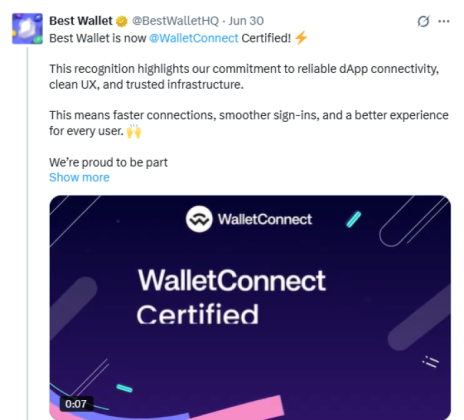
Best Wallet WalletConnect certification
Source: X (Best Wallet)

Highlighting the significance of this achievement, it places Best Wallet alongside some of the most trusted and reputable names in the crypto industry.

Major industry giants – MetaMask, Trust Wallet, Ledger, Uniswap, and 1inch – are certified by WalletConnect.

The latest additions to receive such verification, however, include BitPay, Bitcoin.com, and Blockchain.com.

To get WalletConnect’s nod of approval, crypto wallets must be among the top 50 in terms of usage and fully integrated with major blockchain networks, such as Bitcoin and Ethereum.

Of course, Best Wallet takes that step further by supporting other major chains, such as BNB Chain, Base, and Polygon, too. It aims to support 60 chains in the near future.

Best Wallet Stands Out With No-KYC & User Experience

Best Wallet doesn’t just meet top standards; it seeks to redefine them.

It’s ranked as a #1 anonymous crypto wallet due to the fact that it doesn’t require Know-Your-Client (KYC) verification to make an account.

Additionally, it gives you complete self-custody over your private keys (for extra security), so you don’t need to worry about third-party control, frozen funds, or losing access to your assets.

Built for easy and accessible crypto management on mobile, this wallet goes far beyond just buying, selling, and managing over 1K tokens.

Designed for modern users, it combines clean UX with powerful tools, like multi-wallet management, in-app staking, and cross-chain swaps.
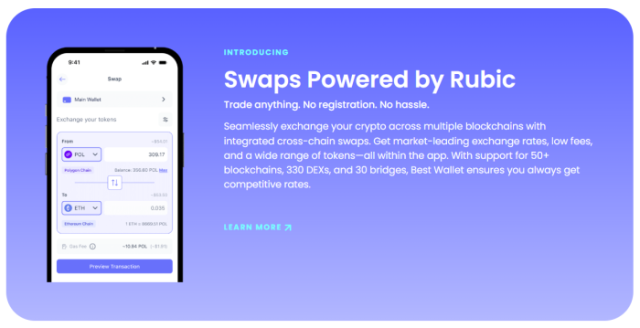
Best Wallet cross-chain swaps
Source: Best Wallet

That, coupled with its unique project directory for discovering and investing in crypto presales, makes it one of the best crypto wallets.

And it has numerous exciting developments in the pipeline, including a powerful crypto wallet portfolio management feature.

Soon, you’ll be able to track real-time profits and losses, import or create wallets, and organize your holdings with customized labels.

Also in development is Best Card, a seamless crypto debit card that’ll enable you to spend your Best Wallet holdings while on the move.

$BEST Unlocks Cheaper Gas Fees & Governance Rights

To get the most out of Best Wallet, you’ll want to hold $BEST, its native token which has already raised over $13.6M on presale.

$BEST is the key to unlocking premium features in the Best Wallet ecosystem. This includes early access to presales, reduced transaction fees, higher staking rewards (currently at a 101% APY, not to be sneezed at), and governance rights.
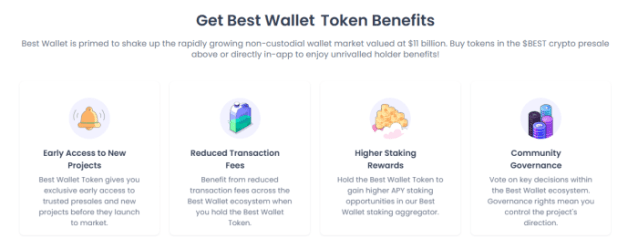
Best Wallet token benefits
Source: Best Wallet Token

Having the ability to vote on the project’s future is a major boon, as you can actively vote on Best Wallet’s upcoming features, token utility, and the long-term direction of the platform.

It also demonstrates that the Best Wallet ecosystem genuinely has the community’s best interests at heart.

Buy $BEST Now for Possible 184% Gains

Best Wallet goes beyond being just another self-custodial solution; it’s quickly establishing itself as a leader in crypto wallets.

From its WalletConnect certification and cross-chain capabilities to its sleek mobile experience and upcoming features, it’s clear that Best Wallet is built for serious growth.

To get the most out of the Best Wallet ecosystem, you can buy $BEST on presale for just $0.025275.

Driven by new app developments, it’s anticipated to reach $0.072, making now the perfect time to join the presale for potential gains of over 184%.

Still, as with all crypto investments, make sure you DYOR and don’t invest more than you’d be sad to lose. After being listed on exchanges, crypto prices can fluctuate as quickly as they rise.

Editorial Process for bitcoinist is centered on delivering thoroughly researched, accurate, and unbiased content. We uphold strict sourcing standards, and each page undergoes diligent review by our team of top technology experts and seasoned editors. This process ensures the integrity, relevance, and value of our content for our readers.

Leah is a British journalist with a BA in Journalism, Media, and Communications and nearly a decade of content writing experience. Over the last four years, her focus has primarily been on Web3 technologies, driven by her genuine enthusiasm for decentralization and the latest technological advancements. She has contributed to leading crypto and NFT publications – Cointelegraph, Coinbound, Crypto News, NFT Plazas, Bitcolumnist, Techreport, and NFT Lately – which has elevated her to a senior role in crypto journalism. Whether crafting breaking news or in-depth reviews, she strives to engage her readers with the latest insights and information. Her articles often span the hottest cryptos, exchanges, and evolving regulations. As part of her ploy to attract crypto newbies into Web3, she explains even the most complex topics in an easily understandable and engaging way. Further underscoring her dynamic journalism background, she has written for various sectors, including software testing (TEST Magazine), travel (Travel Off Path), and music (Mixmag). When she's not deep into a crypto rabbit hole, she's probably island-hopping (with the Galapagos and Hainan being her go-to's). Or perhaps sketching chalk pencil drawings while listening to the Pixies, her all-time favorite band.

Пов'язані матеріали

Examining the Open USD Partner Lineup: Follow Who's Joining to See Where the Money Flows

**Title: Deciphering the Open USD Partner Roster: Following the Money** The launch of Open USD is notable less for the stablecoin itself and more for its expansive list of over 140 founding partners, which reads like a "who's who" of global finance and tech. This coalition, including asset managers like BlackRock, card networks Visa and Mastercard, banks (BNY Mellon, Standard Chartered, etc.), tech giants (Google, IBM), merchants (Shopify), and crypto firms (Coinbase, Ripple, Aave, MetaMask), signals a strategic shift. The diverse membership reveals that stablecoins are increasingly viewed not as products to compete over, but as shared infrastructure too critical to be left to any single entity. Each partner category has distinct motives. Asset managers like BlackRock seek to manage the large, sticky cash reserves, a lucrative fee-generating opportunity. Merchants like Shopify aim for lower-cost settlement and potential yield on balances. Banks join defensively to retain custody and settlement roles, fearing deposit outflows to stablecoins. Tech companies bet on programmable money for future machine-to-machine commerce. Crypto firms gain mainstream legitimacy and distribution channels. Remarkably, the consortium includes direct competitors (Visa vs. Mastercard, Coinbase vs. Ripple), indicating that the fear of exclusion from this emerging financial layer outweighs competitive rivalries. However, this shared governance could also lead to slow decision-making. The roster's composition is the real message: it represents a collective bet that a widely accepted, consortium-owned stablecoin is preferable to proprietary versions or having none at all. For incumbents like Circle and Tether, this alliance poses a significant threat, as potential clients have collectively chosen to build their own alternative. The absence of major U.S. retail banks (busy with their own tokenized deposit networks) is equally telling. In essence, the partner list maps where the industry believes value and risk will flow in a tokenized dollar future, marking stablecoin's evolution from a product to a utility.

Foresight News23 хв тому

Examining the Open USD Partner Lineup: Follow Who's Joining to See Where the Money Flows

Foresight News23 хв тому

IOSG: Q-Day Countdown, Will Quantum Computing End Cryptocurrency?

IOSG: The Q-Day Countdown – Will Quantum Computing End Cryptocurrency? This analysis explores the looming threat quantum computing poses to blockchain technology. Quantum computers, leveraging Shor's algorithm, could theoretically break the elliptic curve cryptography (ECC) underpinning cryptocurrencies like Bitcoin and Ethereum. The article outlines a hypothetical "Q-Day" scenario where exposed public keys from dormant assets are compromised, leading to fund theft and a deep governance crisis. The core risk is not the complete erasure of blockchains but a systemic reset of public-key cryptography. Bitcoin faces significant challenges due to its "code-is-law" ethos and the immense social consensus required for migration. Its primary vulnerability lies in legacy UTXOs with publicly exposed keys. Ethereum's path involves a more complex, full-stack cryptographic agility upgrade across execution, consensus, and data layers. The industry has a limited "engineering comfort window" of 5-8 years to coordinate a migration to post-quantum cryptography (PQC), such as lattice-based or hash-based signatures. While the existential threat is often overstated, the real bottleneck is the immense coordination required across protocol developers, node operators, wallet providers, exchanges, and custodians. Market repricing of crypto assets may occur well before an actual Q-Day if quantum hardware roadmaps accelerate or regulatory pressure mounts. The article concludes that quantum computing is not a doomsday weapon but a severe stress test for blockchain's foundational security model and governance structures.

marsbit52 хв тому

IOSG: Q-Day Countdown, Will Quantum Computing End Cryptocurrency?

marsbit52 хв тому

Why 2026 could redefine Ethereum, Solana, Base and Avalanche

Blockchain infrastructure is undergoing a major coordinated transformation, driven by institutional demand for reliability, compliance, and predictable settlement. Over $30 billion in Real-World Assets (RWA) on-chain has exposed network weaknesses. Major blockchains are responding with foundational upgrades, moving beyond incremental speed improvements. Ethereum's "Glamsterdam" upgrade, planned for H1 2026, will significantly increase gas limits and introduce features like PBS (pre-blocked state) for enhanced settlement and parallel execution. Solana's "Alpenglow," targeting a mainnet launch in H2 2026, focuses on reducing finality time dramatically and freeing network resources to improve reliability. Beyond speed, compliance is critical. Base's "Beryl" upgrade in Q3 2026 will introduce a standardized, regulatory-compliant token framework (B20). Avalanche's "Octane" upgrade aims to boost transaction processing and reduce costs for enterprise applications. Even Bitcoin is evolving with the potential activation of OP_CAT by late 2026/early 2027. The competition is shifting. While technical upgrades are widespread, institutions will ultimately allocate capital based on proven execution, operational resilience, and regulatory compatibility during market stress. Ethereum currently leads in tokenized assets, while networks like Base and Solana are strengthening their institutional offerings. The blockchain that best delivers reliable, compliant, and uninterrupted service is poised to attract the greatest share of future institutional capital.

ambcrypto1 год тому

Why 2026 could redefine Ethereum, Solana, Base and Avalanche

ambcrypto1 год тому

Торгівля

Спот
活动图片