XRP Profit-Taking From 300% Green Whales Has Paused—But For How Long?

bitcoinistОпубліковано о 2025-06-21Востаннє оновлено о 2025-06-21

Анотація

On-chain data shows the XRP investors with more than 300% in profits took part in a significant amount of selling...

Trusted Editorial content, reviewed by leading industry experts and seasoned editors. Ad Disclosure

On-chain data shows the XRP investors with more than 300% in profits took part in a significant amount of selling earlier in the month.

XRP Whales With Over 300% Gains Are Calm For Now

In a new post on X, the on-chain analytics firm Glassnode has talked about the trend in the Realized Profit for a specific part of the Bitcoin network. The “Realized Profit” refers to a metric that measures, as its name already implies, the total amount of profit that the BTC investors as a whole are realizing through their selling.

The indicator works by going through the transaction history of each token being sold on the blockchain to see what price it was moved at prior to this. If this previous selling price for any coin is less than the spot price that it’s now being sold at, then that particular token’s sale is leading to a realization of some net profit equal to the difference between the two values.

The Realized Profit takes this difference for all profit-taking transactions and calculates their total sum to determine the situation for the network as a whole. Another indicator known as the Realized Loss tracks the sales of the opposite type.

In the context of the current topic, the Realized Loss for the entire market isn’t of interest, but rather that of only a very specific portion of it: the XRP investors carrying gains of more than 300%.

The only holders who would be in a profit of this level are those that bought the cryptocurrency prior to the asset’s explosion in November 2024. Thus, the Realized Profit of the cohort tells us about the level of profit-taking that these early buyers are participating in.

Now, here is a chart that shows the trend in the indicator over the last couple of years:
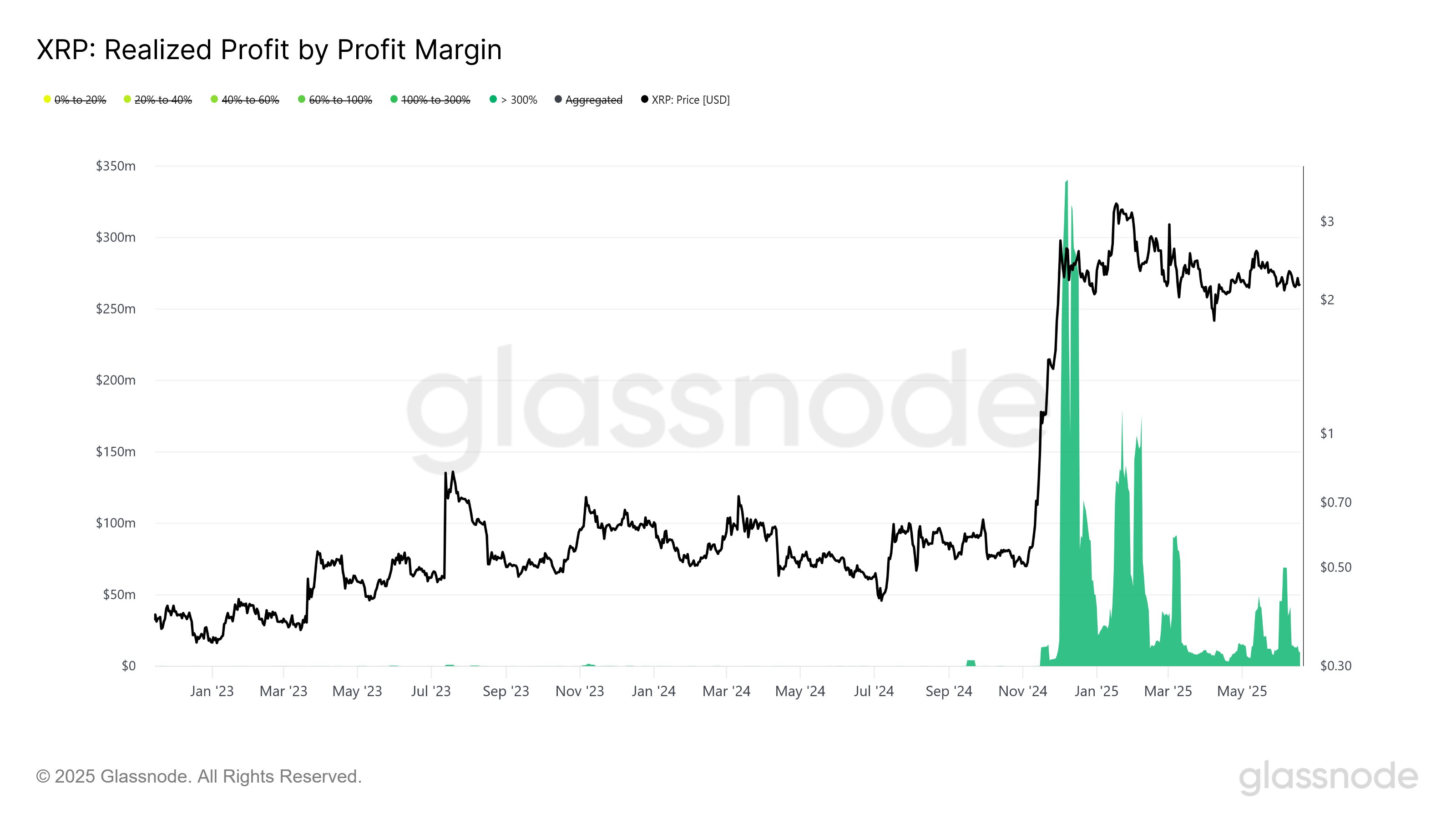
XRP Realized Profit

Looks like the value of the metric has been relatively low in recent days | Source: Glassnode on X

As displayed in the above graph, the XRP Realized Profit associated with investors carrying a profit margin of more than 300% saw a very sharp spike just after the initial price rally. This suggests that many of these early buyers didn’t wait too much to harvest their gains.

Profit-taking from the group continued in early parts of 2025, although the spikes that the indicator witnessed were of a significantly smaller scale. After March, though, selling from these investors finally calmed down.

From the chart, it’s apparent that this calm continued until this month, but the cohort ended up breaking its silence. “In early June, they began realizing profits at a pace of $68.8M per day (7D-SMA), signaling a wave of distribution by early holders,” notes Glassnode.

So far since this selling spree, things have calmed down for the XRP Realized Profit of the cohort once more, but considering that these holders have taken part in selling on a few occasions already, it’s uncertain whether this means selling pressure has become exhausted or not.

XRP Price

XRP has faced a drop of more than 2% in the last 24 hours that has brought its price back to the $2.1 level.

XRP Price Chart

The trend in the asset's price during the past five days | Source: XRPUSDT on TradingView
Featured image from Dall-E, Glassnode.com, chart from TradingView.com
Editorial Process for bitcoinist is centered on delivering thoroughly researched, accurate, and unbiased content. We uphold strict sourcing standards, and each page undergoes diligent review by our team of top technology experts and seasoned editors. This process ensures the integrity, relevance, and value of our content for our readers.

Keshav is a Physics graduate who has been employed as a writer with Bitcoinist since June 2021. He is passionate about writing and through the years, he has gained experience working in a variety of niches. Keshav holds an active interest in the cryptocurrency market, with on-chain analysis being an area he particularly likes to research and write about.

Пов'язані матеріали

Nearly a Hundred Players Rush into Embodied Data: With 4.47 Billion Yuan in Financing in One Year, Who Can Really Make Money by 'Selling Data'?

The domestic embodied AI data industry has attracted nearly 100 players, with 70 focused on data collection and 27 on data infrastructure. In the past year, 15 independent embodied data service providers raised approximately 4.47 billion yuan. Despite this growth, the sector remains early-stage, fragmented, and faces significant challenges. Data collection methods are diverse, categorized into four main routes: teleoperation of real robots, human demonstration without a robot (using motion capture, exoskeletons, etc.), simulation synthesis, and distillation from internet videos. Most companies (43%) adopt hybrid approaches, combining multiple routes, as no single method can meet all training needs. Teleoperation alone is pursued by 31% of players, often by state-owned platforms and robot companies, while newer firms favor asset-light, no-hardware human demonstration. Independent data service providers now form the largest player group (40%), indicating the emergence of a distinct industry segment rather than just a subsidiary function for robot makers. Two-thirds of all players are "embodied-native" startups, while one-third are companies that pivoted from fields like AI data annotation, which are more prevalent in the data infrastructure layer. Current annual industry capacity is estimated at 1.6-1.8 million hours plus 70-80 million data points, with a short-term goal to increase this 15-20 fold within 1-3 years. Data collection factories are spread across 20 provinces in China, concentrated in the Yangtze River Delta, Beijing-Tianjin-Hebei, and Pearl River Delta regions. Financially, the 4.47 billion yuan raised in the past year pales compared to the 43.8 billion yuan raised by the broader embodied intelligence sector in just the first half of 2026, highlighting that data remains a less "sexy" bet for investors. The 15 funded independent providers show clear stratification: a top tier led by a unicorn (Lightwheel Intelligence, 3.1 billion yuan), a middle tier of 11 firms raising tens to hundreds of millions, and an early-stage tier of 3 companies. Sixty-nine investment institutions have participated, but none have made concentrated bets, reflecting uncertainty about viable business models. Over half of these funded companies are less than a year old, most are at pre-A or A rounds, and profitability remains largely unproven. In summary, the embodied data industry has become an independent track creating jobs and local economic activity. However, it is still nascent, with unformed consensus, unsolved problems, and unproven business models. The coming 1-2 years will be a critical validation window to see if companies can build sustainable, profitable businesses purely by "selling data."

marsbit2 год тому

Nearly a Hundred Players Rush into Embodied Data: With 4.47 Billion Yuan in Financing in One Year, Who Can Really Make Money by 'Selling Data'?

marsbit2 год тому

Dialogue with Multicoin Partner: The Crypto Market Has Bottomed Out, Favoring Three Cryptocurrencies in This Cycle

In a recent interview, Multicoin Capital managing partner Tushar Jain shared his views on the crypto market. He believes the market has bottomed and is at an inflection point, citing that negative news no longer causes significant price declines and application adoption continues to grow. Jain remains highly bullish on Solana, viewing it as the correct architectural choice for internet capital markets, particularly for spot and tokenized security trading. He is also positive on Hyperliquid, noting its leadership in decentralized derivatives trading. His investment approach focuses on concentrating capital in top convictions rather than equal allocation. A distinct opportunity he highlights is Zcash (ZEC), which he sees as a return to the industry's cypherpunk ethos and a potential top-five asset by market cap. For assets like Zcash without cash flows, his valuation framework is based on relative market cap ranking. Regarding investment strategy, Jain employs a "three-part" entry method to avoid timing pitfalls and emphasizes long-term "active management" over "active trading." He outlines four sources of investment edge: informational, analytical, behavioral/psychological, and structural. On portfolio management, the fund uses Bitcoin as its "cash," selling assets into Bitcoin during market euphoria to reduce beta risk and using Bitcoin to buy dips. Sales occur only if a better opportunity arises, the investment thesis breaks, or valuations become excessively overheated. While respectful of Ethereum's resilience, he questions its unclear scaling roadmap. Finally, Jain reaffirms his commitment to the thesis that blockchains will form the foundational architecture for future capital markets.

marsbit3 год тому

Dialogue with Multicoin Partner: The Crypto Market Has Bottomed Out, Favoring Three Cryptocurrencies in This Cycle

marsbit3 год тому

Торгівля

Спот
活动图片