Pi Network Price Soars 35% to $1.29 in Last 24 Hours

TheCryptoTimesОпубліковано о 2025-05-14Востаннє оновлено о 2025-05-14

Анотація

Whale moves 90M Pi coins spark a 278% volume spike, driving Pi Network’s price surge and retail interest to over $1 billion in trading.

The crypto market has been shocked by the dramatic 35% surge of Pi Network, which managed to recoup the $1 level and peak at $1.29. As a result of the rally, Pi’s total market value surpassed $8 billion, surpassing Litecoin (LTC) and Bitcoin Cash (BCH), according to CoinMarketCap.

Underlying this surge is a wave of large coin movements by whales. One whale moved 70 million Pi coins off exchanges, resulting in the first surge, and another 20 million Pi were moved from OKX shortly after.
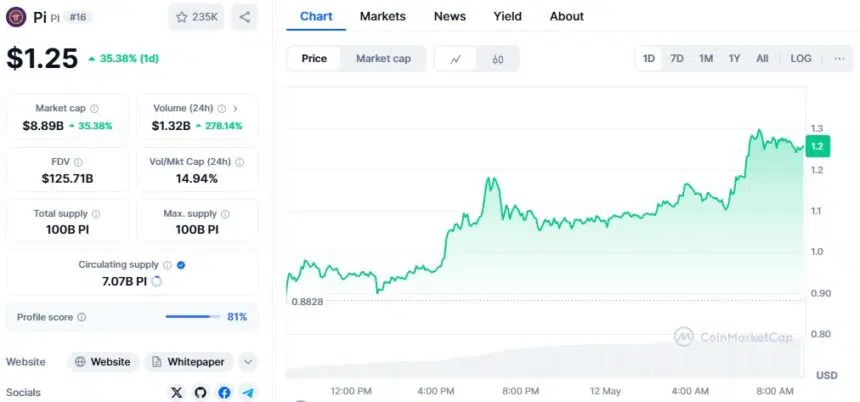
Due to these massive transfers, retail interest skyrocketed, sending trading volumes over $1 billion, a 278% increase in activity. Pi Coin, on the other hand, appreciated greatly, while Litecoin and Bitcoin Cash only increased moderately, highlighting Pi’s extraordinary growth. Pi has jumped to 14th rank following the surge, and if this momentum continues, it can even enter the top 10 ranking by CoinMarketCap.

Traders are focusing on the mid-May Consensus Summit because it could become a pivotal point for launching a long-term Pi rally.

In turn, the Pi Core Team is aggressively buying Pi from the exchanges to help stabilize the price following the latest token distribution. An expectation of a major announcement on May 14 is driving up investor excitement.

There are rumors flying around about a potential Binance listing, triggered by so-called test transactions. While fundamentals are strong and investor confidence increases, Pi Coin’s momentum continues unabated.


Пов'язані матеріали

OpenAI Partners with PE Firms, Investing $4 Billion. Let's Talk About Silicon Valley's Hottest New Role: FDE.

The hottest new role in Silicon Valley is the Forward Deployment Engineer (FDE), a hybrid of engineer and business consultant whose core mission is to transform AI demos into native, practical workflows within client organizations. The recent surge in demand is driven by a strategic shift from leading AI companies. OpenAI, partnering with 19 private equity firms in a $4 billion investment, formed a Deployment Company and acquired Tomoro along with its 150 FDEs. Anthropic also announced a $1.5 billion joint venture with financial institutions like Blackstone. The article, based on interviews with industry experts Jove (FDE lead at Cresta) and Oliver (VP at Invisible Technologies, ex-McKinsey), explores the FDE role and the rise of deployment-focused companies. Key insights include: **The FDE Role:** Jove describes an FDE as a "Forward Deployed CTO"—a technically strong engineer who works intimately with clients to implement AI solutions, learn from the process, and feed those insights back to improve the core product. They require expertise in AI agents, client-facing experience, resilience, and the ability to handle complex, imperfect systems. While AI tools enhance their efficiency, the role's complexity makes full automation a distant prospect. **Industry Shift:** Model companies are moving beyond selling tools to ensuring real-world adoption. This blurs the line between model and application companies. Collaborations with private equity (PE) firms are key, providing access to large portfolios of traditional businesses needing AI transformation. For PE firms, these partnerships offer signal value to LPs, create tangible value in portfolio companies, and provide exposure to high-growth AI assets. **Consulting & Transformation:** AI deployment involves deep, customized workflow redesign, moving beyond simple tool augmentation. Companies like Invisible Technologies build modular platforms to create bespoke, AI-native workflows for clients. While traditional consulting will see growth in helping businesses rethink their models for AI, the real value is captured by firms that leave behind transformed, operational systems. Critical success factors include building robust data foundations and strategically deciding which workflow steps should be deterministic versus AI-driven. The ultimate goal shifts from pure cost-cutting to unlocking new revenue opportunities previously impossible without AI-scale capabilities.

marsbit10 хв тому

OpenAI Partners with PE Firms, Investing $4 Billion. Let's Talk About Silicon Valley's Hottest New Role: FDE.

marsbit10 хв тому

Why Is DeFi Insurance Unpopular?

The article explores the core reasons why DeFi insurance remains largely unutilized despite its potential to eliminate traditional insurance inefficiencies and malicious claim denials through automated smart contracts. Key points include: 1. **Low Adoption & Minimal Payouts:** Leading provider Nexus Mutual has paid only ~$18M in claims since 2019, dwarfed by single hack losses (e.g., Kelp DAO's $292M loss). 2. **High Correlation Risk:** Unlike traditional insurance (e.g., house fires), DeFi risks (oracle failures, bridge hacks) are systemic and can simultaneously impact multiple protocols, threatening to drain entire insurance pools. 3. **Prohibitive Cost vs. Reward:** For many protocols (Aave, Morpho, Compound), insurance premiums (1.5%-6%) consume a significant portion or even all of the native yield (3%-4%), leaving investors with meager returns. In some cases (Maple Finance, Ethena), premiums can even result in net-negative yields. 4. **Inadequate Capacity:** The total DeFi insurance pool (e.g., Nexus Mutual's $81.56M) is minuscule compared to the hundreds of billions in total value locked (TVL), creating a massive supply-demand gap. 5. **Structural Flaws:** The claims assessment model (e.g., Nexus Mutual's member voting) creates a conflict of interest, as voters bear the loss if a claim is paid. There is also no regulatory mandate forcing DeFi protocols to obtain insurance. The industry is adapting by focusing on preventative measures (e.g., bug bounty coverage) and seeking external capital via reinsurance. However, the fundamental issues of small pool size, correlated risk, and misaligned economic incentives persist. The article concludes that DeFi insurance, like a public lighthouse, provides shared security benefits, but if everyone relies on others to pay for it, no one will, leaving the ecosystem vulnerable.

Foresight News24 хв тому

Why Is DeFi Insurance Unpopular?

Foresight News24 хв тому

Торгівля

Спот
Ф'ючерси
活动图片