Ripple Strengthens Grip in Growing Middle Eastern Crypto Industry

TheCryptoTimesОпубліковано о 2025-05-01Востаннє оновлено о 2025-05-01

Ripple is tightening its hold on the fast-growing crypto industry in the Middle East. This year, the company became the first blockchain payments provider to receive a license from the Dubai Financial Services Authority (DFSA). 

This license enables Ripple to offer its Ripple Payments service to businesses in the UAE. The firm generally wants to offer transparent cross-border payments in one of the world’s biggest trade and remittance markets, according to a recently posted blog post

Meanwhile, the Middle East is now the world’s seventh-largest crypto economy. Ripple started growing in the region when it opened an office in Dubai in 2020. Now, 20% of Ripple’s total customers are in the Middle East.

This regain has a great success when it comes to crypto thanks to its strong regulation, youthful tech-savvy population, and high interest from both startups and major institutions.

“This licensing milestone helps legitimize real-world applications of digital assets in the Middle East,” Ripple said. The firm now offers tools such as stablecoins, custody, and trusted payments to support the growth of digital assets.

In a recent tweet on X, Reece Merrick, Ripple’s Managing Director for Middle East and Africa said that he’s “grateful to be leading this incredible region for Ripple.” In a video posted by the company, he confirmed that both regions are “one of the most promising regions in the world for crypto development and adoption.”
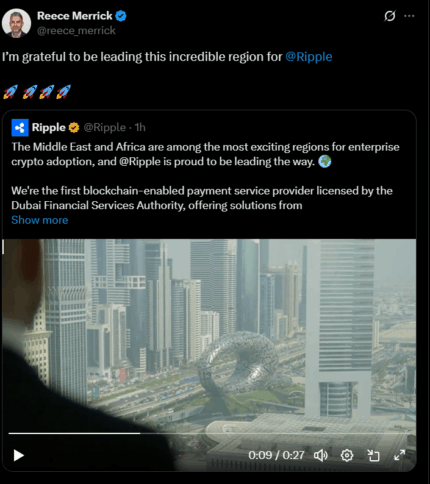
Ripple Is Stepping Up In The Middle East And Africa
Ripple is stepping up in the Middle East and Africa | Source: x.com/reece_merrick

Moveover, about 85% of finance and enterprise businesses say that they are more confident in digital assets now than they were six months ago. Also, 97% believe that digital assets will be an important part of their business in three years’ time.

Already, 40% of firms in the Middle East and Africa use digital asset custody solutions. Another 56% plan to use them soon. Ripple also launched RLUSD, a stablecoin made for secure payments and use in DeFi projects.

Furthermore, after building momentum in the Middle East, Ripple now has its eyes on the UK. The British government is working on new crypto rules, and Ripple sees this as a big opportunity. 

Cassie Craddock, Ripple’s UK, and Europe Managing Director, also said, “The UK has the chance to lead – now’s the time to move at pace..” She praised the UK’s approach as “flexible” and “globally competitive.” Ripple already has an office in London and believes smart rules can help the UK become a crypto leader.

Also Read: Tether Reports $1B Profit and $120B in U.S. Treasury for Q1 2025


Пов'язані матеріали

Breaking: OpenAI Undergoes Major Reorganization, President Brockman Assumes Command

OpenAI has announced a major internal reorganization just months before its anticipated IPO. The company is merging its three flagship product lines—ChatGPT, Codex, and the API platform—into a single, unified product organization. The most significant leadership change involves co-founder and President Greg Brockman moving from a background technical role to take full, permanent control over all product strategy. This follows the indefinite medical leave of AGI Deployment CEO Fidji Simo. Additionally, ChatGPT's longtime lead, Nick Turley, has been reassigned to enterprise products, with former Instagram executive Ashley Alexander taking over consumer offerings. The consolidation, internally framed as a strategic move towards an "Agentic Future," aims to break down internal silos and create a cohesive "Super App." This planned desktop application would integrate ChatGPT's conversational abilities, Codex's coding power, and a rumored internal web browser named "Atlas" to autonomously perform complex user tasks. The reorganization occurs amid significant internal and external pressures. OpenAI has recently seen a wave of high-profile departures, including Sora co-lead Bill Peebles and other senior technical leaders, leading to concerns about a thinning executive bench. Externally, rival Anthropic recently secured funding at a staggering $900 billion valuation, surpassing OpenAI's own. Google's upcoming I/O developer conference also poses a competitive threat. Analysts suggest the dramatic restructure is a pre-IPO move to present a clearer, more focused narrative to Wall Street—streamlining operations and demonstrating decisive leadership under Brockman to counter internal turbulence and intense market competition.

marsbit1 год тому

Breaking: OpenAI Undergoes Major Reorganization, President Brockman Assumes Command

marsbit1 год тому

Two Survival Structures of Market Makers and Arbitrageurs

Market makers and arbitrageurs represent two distinct survival structures in high-frequency trading. Market makers primarily use limit orders (makers) to profit from the bid-ask spread, enjoying high capital efficiency (nominally 100%) but bearing inventory risk. This "inventory risk" arises from passive, fragmented, and discontinuous order fills in the limit order book (LOB). This risk, while a potential cost, can also contribute to excess profit if managed within control boundaries, allowing for mean reversion. Market makers essentially sell "time" (uncertainty over execution timing) to the market for price control and low fees. In contrast, cross-exchange arbitrageurs typically use market orders (takers) to exploit price differences or funding rates, resulting in lower nominal capital efficiency (requiring capital on both exchanges) and higher transaction costs. Their risk exposure stems from asymmetries in exchange rules (e.g., minimum order sizes), execution latency, and infrastructure risks (e.g., ADL, oracle drift). These exposures are active, exogenous gaps that primarily erode profits rather than contribute to them. Arbitrageurs essentially sell "space" (capital sunk across venues) for localized, immediate certainty. Both strategies engage in a trade-off between execution friction and residual risk. Optimal systems allow for temporary, controlled risk exposure rather than enforcing zero exposure at all costs. Their evolution converges towards hybrid models: arbitrageurs may use maker orders to reduce costs, while market makers may use taker orders or hedges for risk management. Ultimately, both use different forms of risk exposure—market makers exposing inventory, arbitrageurs immobilizing capital—to extract marginal, hard-won certainty from the market.

链捕手1 год тому

Two Survival Structures of Market Makers and Arbitrageurs

链捕手1 год тому

Who Will Define the Rules of the AI Era? Anthropic Discusses the 2028 US-China AI Landscape

This article, based on Anthropic's analysis, outlines the intensifying systemic competition between the U.S./allies and China for AI leadership by 2028. It argues that access to advanced computing power ("compute") is the critical bottleneck, where the U.S. currently holds a significant advantage through chip export controls and allied innovation. However, China's AI labs remain competitive by exploiting policy loopholes—via chip smuggling, overseas data center access, and "model distillation" attacks to copy U.S. model capabilities—keeping them close to the frontier. The piece presents two contrasting scenarios for 2028. In the first, decisive U.S. action to tighten compute controls and curb distillation locks in a 12-24 month AI capability lead, cementing democratic influence over global AI norms, security, and economic infrastructure. In the second, policy inaction allows China to achieve near-parity through continued access to U.S. technology, enabling Beijing to promote its AI stack globally and integrate advanced AI into its military and governance systems, altering the strategic balance. Anthropic contends that maintaining a decisive U.S. lead is essential for shaping safe AI development and governance. The core recommendation is for U.S. policymakers to urgently close compute and model access loopholes while promoting global adoption of the U.S. AI technology stack to secure a lasting strategic advantage.

marsbit3 год тому

Who Will Define the Rules of the AI Era? Anthropic Discusses the 2028 US-China AI Landscape

marsbit3 год тому

Торгівля

Спот
Ф'ючерси
活动图片