Dogwifhat отказывается от рекламы на Las Vegas Sphere – начат возврат средств

cryptonews.ruОпубліковано о 2022-08-02Востаннє оновлено о 2025-04-02

Команда Dogwifhat официально свернула свой громкий план по запуску рекламы на гигантском экране Las Vegas Sphere. Почти год холдеры токена ждали зрелищного шоу, а в итоге – ничего. Теперь организаторы готовятся вернуть собранные на это дело $700K, а комьюнити, кажется, просто вздохнуло с облегчением.

Поздно вечером в понедельник один из инициаторов проекта, известный под ником GamesMasterFlex (он же Edward), заявил в X (Twitter), что вся эпопея с размещением WIF на Sphere закрыта. По его словам, команда планирует начать массовые возвраты средств уже во вторник. Официальный аккаунт Dogwifhat тут же сделал репост, подтверждая новость.
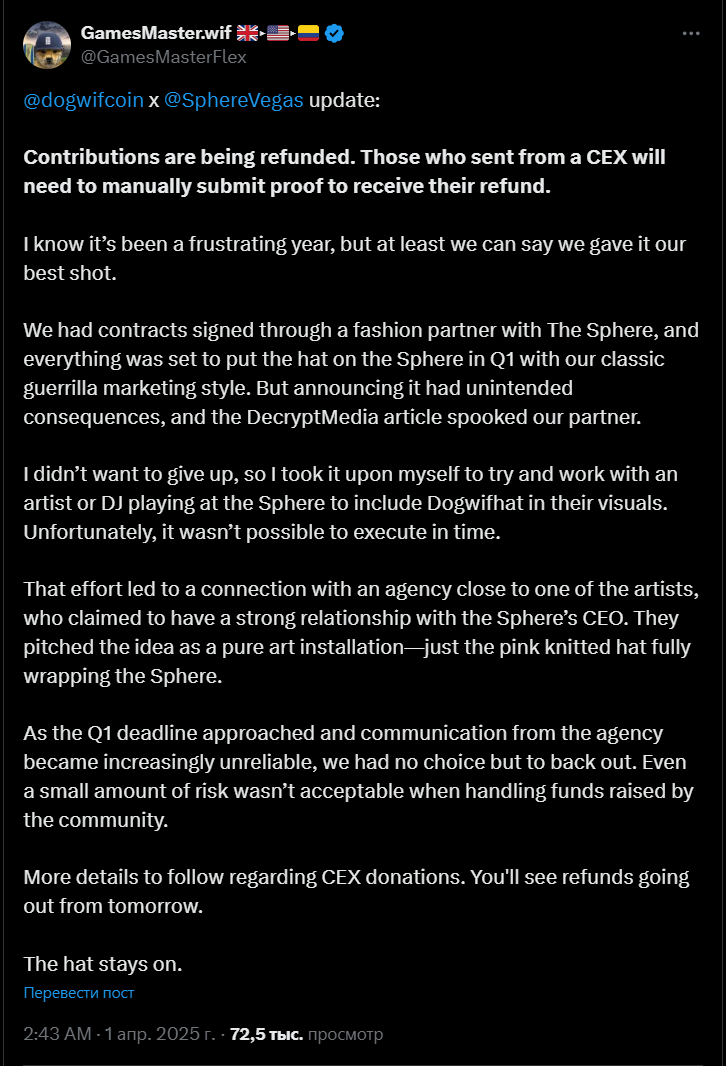
Edward рассказал, что сначала у команды якобы был договор с неким «модным брендом», который должен был разместить логотип Dogwifhat на знаменитом куполе. Именно поэтому ранее в соцсетях звучали заявления, что «пёс появится на экране в первом квартале 2025 года«. Однако после неожиданного заявления представителей Sphere в январе, где они чётко дали понять, что не работают с мемкоинами, бренд резко соскочил с темы.

«Мы никогда не договаривались с Dogwifhat»

Вот где начались настоящие качели. Представитель Sphere в январе заявил, что компания не подписывала никаких контрактов с Dogwifhat и вообще не работает с рекламой криптовалют, кроме биткоина.

«Мы никогда не заключали сделку с Dogwifhat, а наше агентство вело лишь одну поверхностную беседу на эту тему ещё в начале прошлого года», – заявили в компании. «Сейчас никаких планов по размещению Dogwifhat на экране нет, и нас крайне беспокоит, что они используют наше имя в сомнительных целях».

Edward признался, что это заявление сильно напугало их потенциального рекламного партнёра. По его словам, особенно тревожно на них подействовали слова «обеспокоены» и «мошеннические цели«. Вскоре после этого партнёр начал сомневаться в безопасности сотрудничества, ведь любая связь с манипуляциями ценой токена могла бы вызвать вопросы у SEC. В итоге сделка развалилась.

WIF обвалился на 18%, но теперь отскакивает

После заявления Sphere токен WIF моментально просел на 18%. Это стало последней каплей: команда решила свернуть кампанию, но пыталась спасти ситуацию, договариваясь с музыкантом, который должен был выступать на Sphere и вписать Dogwifhat в свои визуальные эффекты. Но этот план тоже не сработал.

Один из источников, знакомых с политикой Sphere, подтвердил, что на экране разрешена только реклама крупных бирж и биткоина. Любой другой контент про крипту (даже Ethereum) просто не пропустили бы.

Деньги целы – их скоро вернут

Несмотря на длительную неразбериху и шквал обвинений в мошенничестве, деньги инвесторов не пропали. Все $697,800, собранные в марте 2024 года, так и лежат в мультиподписном кошельке Solana, доступ к которому есть у нескольких организаторов.

Некоторые хейтеры утверждали, что команда могла слить средства, но всё это легко проверяется в блокчейне. Единственное движение – средства временно переводились на другой кошелёк, когда команда была уверена, что контракт подписан. Однако после провала сделки их вернули обратно.

Теперь возвраты стартуют уже во вторник. Edward уточнил, что за процесс отвечает организатор по имени Mihir. Те, кто отправлял средства напрямую с централизованных бирж, скорее всего, столкнутся с небольшими трудностями – им придётся вручную подавать заявки на возврат.

Итог: комьюнити расколото, но рынок уже идёт вверх

Пока рынок, похоже, переваривает ситуацию, один из участников мультиподписного кошелька, известный под ником Quasi, решил ответить на критику.

«WIF на Sphere мог бы стать серьёзным бустом для всего сегмента мемкоинов», – написал он в X (Twitter). «Но вместо поддержки комьюнити просто разорвало нас в клочья и назвало скамерами – при том, что деньги всегда были в открытом доступе».

«Печально», – добавил он.

А вот рынок настроен оптимистично: WIF уже поднялся на 5.7% после новости, а комьюнити, похоже, просто хочет забыть этот долгий и мучительный период.
Пов'язані матеріали

Foundation Steps Back, Ethlabs Steps Forward: Ethereum Undergoes Its Largest Restructuring in History

On June 23rd, the Ethereum ecosystem witnessed two major shifts, signaling a significant governance realignment. First, former Ethereum Foundation researchers established Ethlabs, a new independent non-profit. Backed by major ETH holders like Bitmine and SharpLink, Ethlabs aims to address practical needs for institutional adoption, including faster settlement, native asset issuance, cross-chain transactions, and mainnet scaling. Secondly, the Ethereum Foundation announced a major restructuring, laying off 54 employees (20% of its staff) to become a leaner entity focused on protocol governance and maintenance rather than being the primary builder. This move represents a pivotal correction. Criticisms had mounted over the Foundation's perceived slowness, lack of clear strategy, and over-reliance on Vitalik Buterin's influence. Ethlabs emerges as a more execution-oriented, "industrialized" layer focused on market adoption—bridging the gap between research and real-world use. Notably, Vitalik Buterin is absent from its list of supporters, interpreted as an intentional step to avoid excessive personal endorsement and allow the organization to build independent credibility. The Ethereum Foundation's downsizing and redefinition mark a retreat from its former central coordinating role. It now aims to share the "privilege of stewarding Ethereum" with other emerging groups like Ethlabs, the Ethereum Applications Guild, and The Ethereum Economic Zone. Analysts frame this dual shift as the Foundation ensuring Ethereum remains "correct" (credibly neutral), while Ethlabs must prove it remains "effective" (competitive and attractive for capital and adoption). This addresses community "shareholder-like anxiety" about ETH's market performance. While risks exist—such as concerns over shifting from Foundation centrality to large-holder influence—the consensus is that the greater risk for Ethereum was inaction, caught between technical idealism and organizational inertia. These steps aim to create a more multi-stakeholder, execution-driven future for the network.

链捕手1 год тому

Foundation Steps Back, Ethlabs Steps Forward: Ethereum Undergoes Its Largest Restructuring in History

链捕手1 год тому

Second Half of U.S. Crypto Policy: The Clarity Act Aims for 60 Votes, CFTC's "One-Person Commission" Becomes Biggest Variable

In a pivotal year for US crypto policy, the "CLARITY Act" is advancing in the Senate but faces a high hurdle, needing 60 votes to pass. Key challenges include bridging partisan divides on ethics and swaying undecided Republican senators within a tight legislative calendar of only about 40 working days. The policy "second half" involves intense negotiations on a broader framework for Web3 and DeFi, including crypto tax reforms and the Blockchain Regulatory Certainty Act. A significant uncertainty is the understaffed CFTC, operating with four commissioner vacancies, which complicates regulatory clarity. Meanwhile, the departure of key "crypto champions"—SEC Commissioner Hester Peirce and Senator Cynthia Lummis—will impact ongoing policy efforts. Industry experts are cautiously optimistic but realistic. Sara K. Weed notes that while progress is being made, CLARITY is unlikely to pass this Congress, pushing agencies like the SEC and CFTC to provide more guidance. Sulolit Mukherjee suggests meaningful crypto tax legislation is more likely to be attached to larger must-pass bills. Rashan Colbert discusses the jurisdictional debate over prediction markets, emphasizing the need for a regulatory framework that fosters their development as financial tools rather than treating them broadly as gambling. The clock is ticking, but opportunities remain for substantive progress through continued bipartisan dialogue and pragmatic efforts.

marsbit4 год тому

Second Half of U.S. Crypto Policy: The Clarity Act Aims for 60 Votes, CFTC's "One-Person Commission" Becomes Biggest Variable

marsbit4 год тому

Dan Koe's New Essay: Escaping the Fate of the Wage Slave, How to Survive the AI Replacement Wave?

Dan Koe argues that the true threat in the AI era isn't technology itself, but a reliance on others for one's livelihood and happiness. The core problem is "wage slavery"—spending life on unfulfilling work. To survive and thrive, one must escape this by building their own enterprise. The key is developing five elements: Agency (initiative), Taste (discernment), Persuasion, Persistence, and Iteration. These boil down to problem-solving skills and experiential knowledge, which cannot be learned passively but only through doing your own projects. The solution is to become "unemployable" by shifting your identity. This requires: 1) Radically changing your environment to force growth, 2) Choosing a medium (like content creation) that provides real feedback through trial and error, and 3) Mastering either code or, preferably, media (content). Content creation is more valuable because its subjective nature and need for human perspective create a durable advantage over generic AI output. To start, define your life's work by answering foundational questions about your innate knowledge, unique abilities, and contrarian beliefs. Then, immediately act by publishing your first piece of content. The cycle of creating, receiving feedback, and iterating is the essential path to developing the skills needed for an independent, meaningful career and financial resilience.

marsbit5 год тому

Dan Koe's New Essay: Escaping the Fate of the Wage Slave, How to Survive the AI Replacement Wave?

marsbit5 год тому

Research Report Analysis: Morgan Stanley Details SanDisk SNDK, The Truth About Cloud Data Center Pricing Power and AI Inference Benefits

Morgan Stanley raised its price target for SanDisk (SNDK) from $1100 to $1750 on June 22, maintaining an Overweight rating. The upgrade is driven by AI inference demand reshaping the NAND market, particularly for KV Cache and context window storage in cloud data centers. These cloud clients exhibit price inelasticity and sign long-term contracts, granting SanDisk significant pricing power. SanDisk's New Business Model (NBM) agreements, covering over one-third of FY27 bit shipments with 3-5 year terms and fixed price/price collar structures, are crucial. They are projected to sustain gross margins around 80% even at floor prices, providing a buffer against cyclical downturns. Morgan Stanley forecasts gross margins to surge from 30.3% in FY25 to 86.7% in FY27e. With NAND supply expected to remain tight into 2026/2027 and cloud/data centers becoming the largest end-market, SanDisk holds supply-side pricing power. The company targets 15-19% bit growth via technology transitions, not capacity expansion. Revenue is projected to grow ~6.6x from FY25 to FY27, with EPS rising from $2.74 to $14.73, driven by high-margin cloud business. Key upside catalysts include faster enterprise SSD adoption and edge AI growth. Downside risks involve slower industry growth, competitor capex increases, market share loss, and competition from Chinese players like YMTC. The investment thesis rests on AI-driven structural demand, NBM's margin protection, and sustained supply tightness. The $1750 target implies ~28x FY27e P/E.

marsbit5 год тому

Research Report Analysis: Morgan Stanley Details SanDisk SNDK, The Truth About Cloud Data Center Pricing Power and AI Inference Benefits

marsbit5 год тому

Торгівля

Спот
Ф'ючерси
活动图片