VIRTUAL enters consolidation phase: Assessing recovery potential

AmbcryptoОпубліковано о 2025-03-11Востаннє оновлено о 2025-03-11

Анотація

Virtual shows signs of stabilization after a volatile period, with increasing volume and technical indicators hinting at a breakout.

VIRTUAL entered a consolidation phase following a sharp decline.

Most investors (over 66%) were out of the money at press time.

Virtual Protocol’s [VIRTUAL] market movements have remained highly dynamic, characterized by rapid price swings and shifting volume trends.

The cryptocurrency experienced significant volatility over recent months, with notable fluctuations in its 30-day high and low levels.

Investor sentiment appeared to be shifting, with an increase in trading activity suggesting a potential breakout or further consolidation.

VIRTUAL volatility and volume correlation

VIRTUAL entered a consolidation phase following a sharp decline.

A closer analysis of its volatility trends revealed significant fluctuations, with a 30-day high of 186.20% recorded on the 3rd of March, and a low of 146.76% on the 19th of February.

This 39.44% range suggested erratic price behavior, indicating active trading participation.
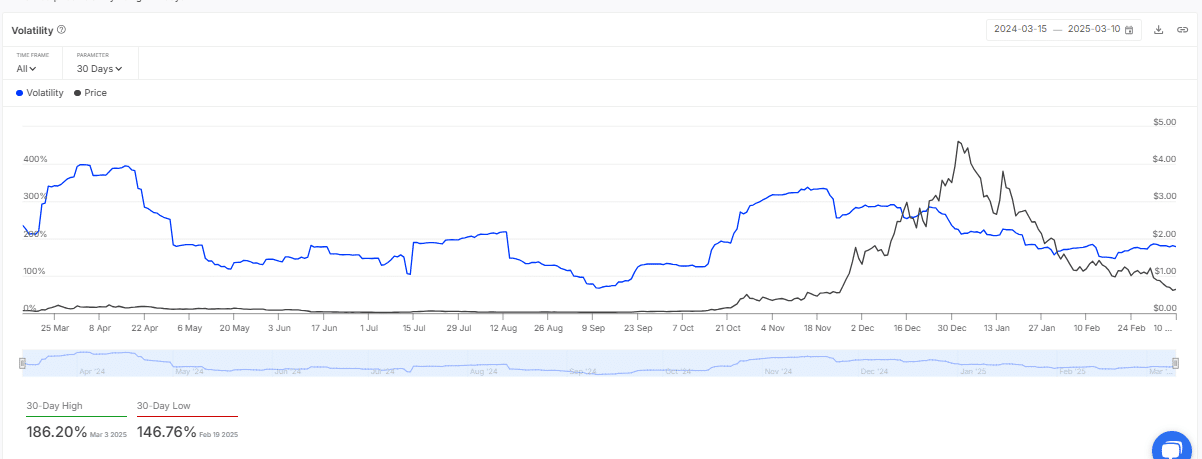
Trading volume surged by 53.18%, reflecting renewed investor interest. Historically, VIRTUAL’s volatility peaked at 400% in late March 2024 before dropping to 100% by mid-2024, stabilizing near 200% in early 2025.

The latest surge in volatility, paired with a volume increase, hinted at speculative trading. The spike to 186.20% aligned with a rise in volume, suggesting strong buying pressure.

Conversely, the dip to 146.76% coincided with reduced volume, indicating waning momentum.

If the current volume increase sustains above 20.83M, it could drive a renewed volatility spike, potentially pushing Virtual’s price to $0.6367.

A decline in volume below 20M, however, could lead to decreased volatility, trapping prices in a range.

Long-term stability may depend on continued volume growth, which could help VIRTUAL consolidate at higher price levels.

Assessing Virtual’s potential rebound

VIRTUAL’s price action displayed signs of consolidation following a downtrend. Analyzing the 1-hour price chart, it was trading at $0.64458.

The Moving Average Convergence Divergence (MACD) indicator suggested an impending bullish crossover, with the signal line at 0.0135 nearing the MACD line at 0.023.
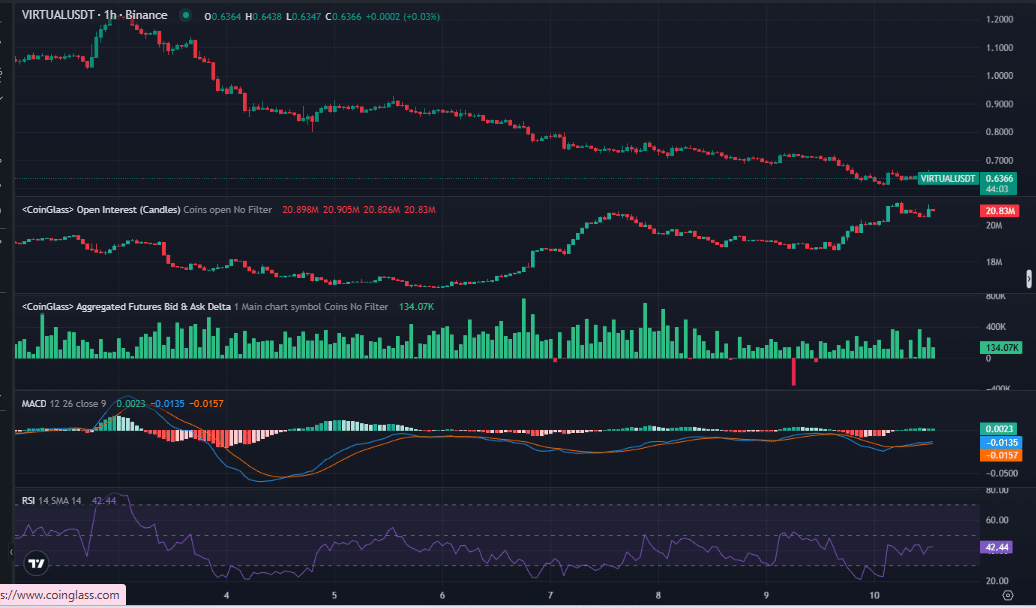
The Relative Strength Index (RSI) stood at 42.44, approaching oversold territory below 30. Additionally, Open Interest remained steady at 20.83M, indicating traders were positioning for a breakout.

The candlestick pattern revealed a recent low of $0.6366 and a high of $0.6438. The MACD’s alignment at 0.0135 and 0.023 suggested a potential price reversal.

The RSI nearing oversold levels reinforced the likelihood of an upward move. Open Interest stability at 20.83M mirrored past recoveries, further supporting the bullish case.

A successful MACD crossover above 0.023 could trigger a price increase toward $0.6438 and beyond. If resistance at $0.6366 fails to hold, Virtual’s price could decline toward $0.6000, prompting further sell-offs.

Looking ahead, a sustained MACD crossover and RSI drop below 30 could support a push toward $1.00.

Gauging profitability and market sentiment

Data revealed that in-the-money positions totaled 160.78M VIRTUAL (32.61%), while out-of-the-money positions accounted for 329.36M VIRTUAL (66.79%).

Meanwhile, at-the-money positions stood at 2.96M VIRTUAL (0.60%).
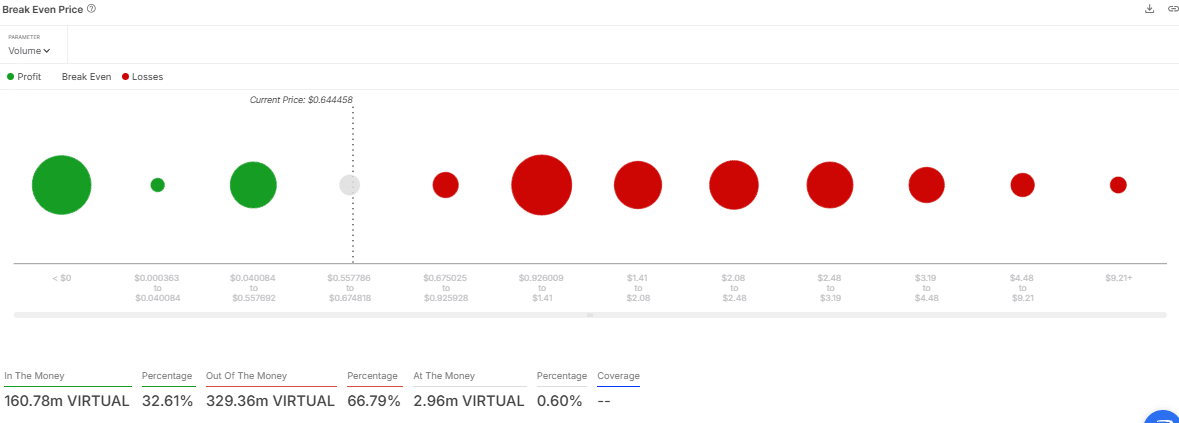
Break-even price levels ranged between $0.000383 and $9.21+, with notable clusters at $1.41 for profitable positions and $2.48 for loss-making positions.

The 32.61% share of in-the-money holdings suggested that many traders had acquired VIRTUAL at lower prices and were currently seeing gains.

However, the 66.79% share of out-of-the-money holdings indicated that a significant number of traders were facing losses, which could lead to selling pressure if the price dropped further.

A breakout above $1.41 could reduce out-of-the-money positions, potentially pushing prices toward $2.48. Conversely, if VIRTUAL’s price fell below $0.64458, losses could increase, driving a decline to $0.6000.

Over the long term, shifting more out-of-the-money positions into profitability could help stabilize Virtual above $2.48.


Пов'язані матеріали

China's AI Fronts: From Yan'an to Midway

This article analyzes the competitive landscape of China's AI industry through a dual-front war analogy: the "Eastern Front" of business model competition and the "Western Front" of global strategic positioning. **The Eastern Front: The Scramble for Supply Lines and Monetization** The "Eastern Front" examines the contrasting strategies of three Chinese tech giants—Tencent, Alibaba, and ByteDance—in the face of AI's high marginal costs. Tencent integrates AI as a catalyst within its existing ecosystems (advertising, gaming, cloud) for monetization, prioritizing high-value scenarios over user growth. Alibaba bets on a full-stack, self-developed approach from chips to applications, aiming to control costs and ecosystem, though this requires immense patience and resources. ByteDance, with Doubao as its flagship, pursues a traditional traffic-driven, "super app" strategy but faces severe monetization challenges as its massive user base incurs unsustainable operational costs. The central challenge for all is building a reliable "supply line" (sustainable funding/profit) and achieving efficient monetization, moving beyond being mere "token factories." **The Western Front: "Preserving Land" vs. "Preserving People"** The "Western Front" frames a global strategic divergence. The U.S. model ("preserving land") focuses on closed-source, high-premium models (e.g., Anthropic) targeting lucrative enterprise markets. China's strategy ("preserving people") leverages open-source models (e.g., Alibaba's Qwen, DeepSeek) and extremely low pricing to attract global developers and capture long-tail markets, akin to a "surround the cities from the countryside" approach. The goal is to make Chinese models the default infrastructure, locking in future ecosystem value. However, the critical test is whether this open-source ecosystem can achieve a commercial闭环, converting developer adoption into tangible revenue (e.g., via cloud services), and bridging the monetization gap with Western models that charge for value, not just tokens. **Conclusion: The Long March from Factory to Brand** The article concludes that China's AI industry possesses technology, users, and scenarios but must integrate them to create and capture value. Its ultimate success depends on navigating both fronts: companies must establish sustainable monetization on the Eastern Front, while the industry's Western strategy must evolve from simply "preserving people" (developer adoption) to truly "preserving both people and land" — transforming open-source ecosystem dominance into commercial success and premium brand value. This journey from being a "token factory" to a "value highland" will require strategic patience and the ability to outlast competitors in a prolonged contest.

marsbit1 хв тому

China's AI Fronts: From Yan'an to Midway

marsbit1 хв тому

A History of Technological Evolution Powered by Electricity: Aluminum, Bitcoin, and AI

The journey from the Rockdale aluminum smelter in Texas to space-based data centers illustrates a core economic principle: whoever controls the cheapest electricity dictates the use of computing power. The evolution is clear. Old industrial sites with pre-existing, high-capacity power grids are being repurposed. In Rockdale, a former Alcoa plant now houses vast Bitcoin mining rigs, which are increasingly being replaced by AMD chips for AI training. The logic is purely financial: while smelting aluminum yields $0.17–0.27 per kWh and Bitcoin mining $0.05–0.11, AI inference on H100 GPUs generates $1.27–3.67 per kWh. Recent deals confirm the rush for power infrastructure. Riot Platforms leases space to AMD; TeraWulf bought an old Kentucky aluminum plant for its grid; NYDIG secured a New York site for its cheap hydropower to mine Bitcoin. As AI giants like Anthropic, Microsoft, Google, and Amazon aggressively expand, they now directly compete with crypto miners for the same industrial power resources, often outbidding them. This has led to a decline in Bitcoin's global hash rate and a wave of miner conversions to AI data centers. This "digital resource curse" extends globally. Gulf nations, long offering subsidized power to attract heavy industry like aluminum, are now pivoting to become AI and cloud computing hubs—exporting computational power instead of physical commodities. Similarly, Bhutan halted its sovereign Bitcoin mining to sell hydropower directly to India for a steadier return. The frontier is space. Projects like Starcloud plan orbital solar-powered data centers, leveraging constant sunlight and natural cooling, with Bitcoin mining as a secondary use for surplus power. Even consumer brands are transforming; Allbirds shifted from footwear to AI infrastructure, causing its stock to surge. Meanwhile, crypto projects like Bittensor, Render, and Akash propose a decentralized alternative, creating markets to aggregate distributed, idle computing resources from individual hardware. The underlying infrastructure—the power grid—remains constant. As profit margins shift, the facilities built upon it will continue to evolve, from aluminum to Bitcoin to AI and beyond, always chasing the highest yield per kilowatt-hour, whether in Texas, Abu Dhabi, or low Earth orbit.

marsbit11 хв тому

A History of Technological Evolution Powered by Electricity: Aluminum, Bitcoin, and AI

marsbit11 хв тому

Conquering is easy, governing is hard: Polymarket must bow to regulations to plant its flag globally

Polymarket, a decentralized prediction market platform, faces significant regulatory hurdles in its global expansion. Its "permissionless" model, which bypasses traditional identity and financial controls, has led to widespread crackdowns. India recently blocked the site, categorizing it as illegal online gambling under new 2025 laws. Brazil also banned it and similar platforms, though it simultaneously authorized a regulated, investor-only version on its national exchange. Across Europe, countries like France, Portugal, and the Netherlands are enforcing bans based on existing gambling and financial regulations. To enter key markets, Polymarket is adopting a pragmatic, compliant approach. In the U.S., it paid a $1.12 million fine, acquired a CFTC-licensed exchange, and now operates a regulated, KYC-mandatory platform for American users. It also secured a major investment from Intercontinental Exchange (ICE), which will distribute its prediction data to institutional investors. In Japan, where gambling laws are strict, Polymarket has begun a long-term lobbying effort, aiming for legalization by 2030 through building institutional partnerships and community presence. Despite these challenges, the prediction market industry is booming, with global volume projected to surge from $51 billion to potentially $1 trillion by 2030. Polymarket's core dilemma remains: adapting its decentralized, anonymous model to fit within sovereign regulatory frameworks focused on licensing, consumer protection, and anti-money laundering rules. Its survival in each market depends on navigating this complex political and legal landscape.

marsbit14 хв тому

Conquering is easy, governing is hard: Polymarket must bow to regulations to plant its flag globally

marsbit14 хв тому

It's Easier to Conquer than to Govern: Polymarket Must Bend to Every Rule to Plant Its Flag Globally

Polymarket, a decentralized prediction market platform, is facing significant regulatory hurdles as it expands globally, illustrating the tension between permissionless, crypto-native platforms and national legal frameworks. The platform, which allows users to bet on event outcomes, was recently blocked in India under new online gambling laws and faces similar outright bans in Brazil and Ukraine, the latter citing moral objections to wagering on active war events. In Europe, countries like France, the Netherlands, and the UK are restricting access by enforcing existing gambling and financial derivatives regulations, forcing Polymarket to geo-block users or operate in view-only modes. To navigate this complex landscape, Polymarket is adopting a market-by-market, compliant strategy. In the U.S., it paid a $1.4 million CFTC fine, acquired a licensed exchange (QCEX) for $112 million, and now operates a regulated U.S. entity with strict KYC, abandoning anonymity. It also secured a major investment from Intercontinental Exchange (ICE), which will distribute its prediction data to institutional investors. In Japan, a high-potential market, it has begun a long-term lobbying effort aiming for legalization by 2030, acknowledging the country's strict anti-gambling laws and slow regulatory processes. The article concludes that while the global prediction market is growing rapidly—projected to reach $2.4 trillion by 2030—Polymarket's core challenge is transforming its decentralized model to fit sovereign regulatory systems built on licensing, consumer protection, and anti-money laundering rules. Its survival depends on proving its legitimacy in each jurisdiction.

链捕手18 хв тому

It's Easier to Conquer than to Govern: Polymarket Must Bend to Every Rule to Plant Its Flag Globally

链捕手18 хв тому

Торгівля

Спот
Ф'ючерси

Популярні статті

Як купити VIRTUAL

Ласкаво просимо до HTX.com! Ми зробили покупку Virtuals Protocol (VIRTUAL) простою та зручною. Дотримуйтесь нашої покрокової інструкції, щоб розпочати свою криптовалютну подорож.Крок 1: Створіть обліковий запис на HTXВикористовуйте свою електронну пошту або номер телефону, щоб зареєструвати обліковий запис на HTX безплатно. Пройдіть безпроблемну реєстрацію й отримайте доступ до всіх функцій.ЗареєструватисьКрок 2: Перейдіть до розділу Купити крипту і виберіть спосіб оплатиКредитна/дебетова картка: використовуйте вашу картку Visa або Mastercard, щоб миттєво купити Virtuals Protocol (VIRTUAL).Баланс: використовуйте кошти з балансу вашого рахунку HTX для безперешкодної торгівлі.Треті особи: ми додали популярні способи оплати, такі як Google Pay та Apple Pay, щоб підвищити зручність.P2P: Торгуйте безпосередньо з іншими користувачами на HTX.Позабіржова торгівля (OTC): ми пропонуємо індивідуальні послуги та конкурентні обмінні курси для трейдерів.Крок 3: Зберігайте свої Virtuals Protocol (VIRTUAL)Після придбання Virtuals Protocol (VIRTUAL) збережіть його у своєму обліковому записі на HTX. Крім того, ви можете відправити його в інше місце за допомогою блокчейн-переказу або використовувати його для торгівлі іншими криптовалютами.Крок 4: Торгівля Virtuals Protocol (VIRTUAL)Легко торгуйте Virtuals Protocol (VIRTUAL) на спотовому ринку HTX. Просто увійдіть до свого облікового запису, виберіть торгову пару, укладайте угоди та спостерігайте за ними в режимі реального часу. Ми пропонуємо зручний досвід як для початківців, так і для досвідчених трейдерів.

397 переглядів усьогоОпубліковано 2024.12.23Оновлено 2025.03.21

Як купити VIRTUAL

Обговорення

Ласкаво просимо до спільноти HTX. Тут ви можете бути в курсі останніх подій розвитку платформи та отримати доступ до професійної ринкової інформації. Нижче представлені думки користувачів щодо ціни VIRTUAL (VIRTUAL).

活动图片