Только 4% населения мира владеют биткоинами в 2025 году

cryptonews.ruОпубліковано о 2024-06-10Востаннє оновлено о 2025-03-10

В настоящее время биткоинами владеют только 4% населения мира, при этом самая высокая концентрация владения приходится на Соединенные Штаты, где, по оценкам, 14% людей владеют BTC.

Согласно исследовательскому отчету River, компании по финансовым услугам BTC, Северная Америка остается континентом с самым высоким уровнем принятия среди частных лиц и учреждений, в то время как Африка в настоящее время имеет самый низкий показатель — всего 1,6%.

В целом, принятие BTC, как правило, было выше в более развитых регионах, чем в развивающихся. River оценивает, что BTC достиг только 3% от своего максимального потенциала принятия, что свидетельствует о том, что цифровая валюта все еще находится на ранних стадиях глобального принятия.
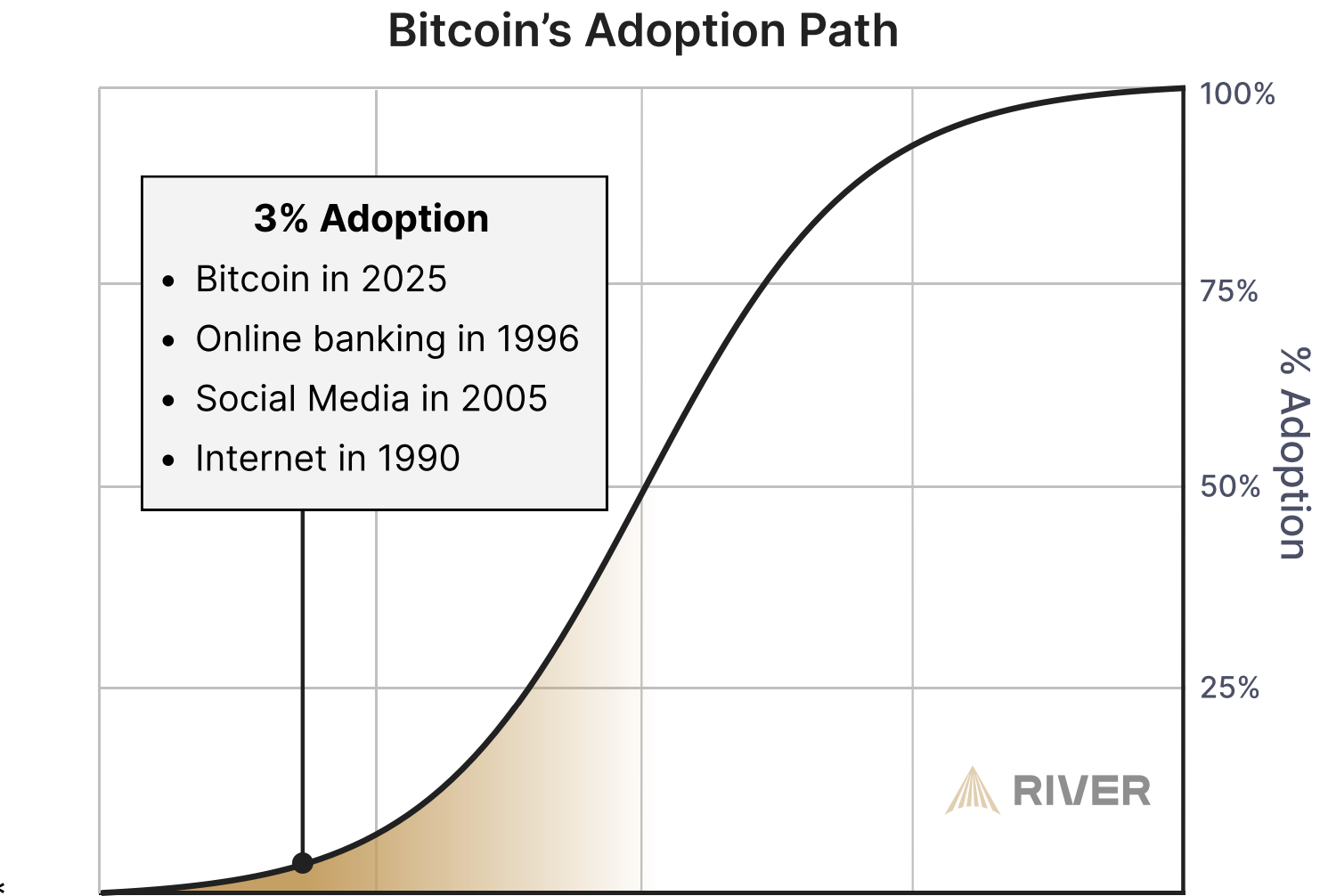

Путь принятия биткоина пройден всего на 3%. Источник: River

Финансовая компания пришла к цифре 3%, рассчитав общий адресный рынок биткоина, который включает правительства, корпорации и учреждения — всего 1%.

River также учла институциональное недораспределение и индивидуальные ставки владения, чтобы прийти к метрике 3%.

Хотя биткоин прошел долгий путь с первых дней шифропанка, недавно став резервным активом правительства США, на пути массового принятия биткоина в мировом масштабе стоит несколько препятствий.
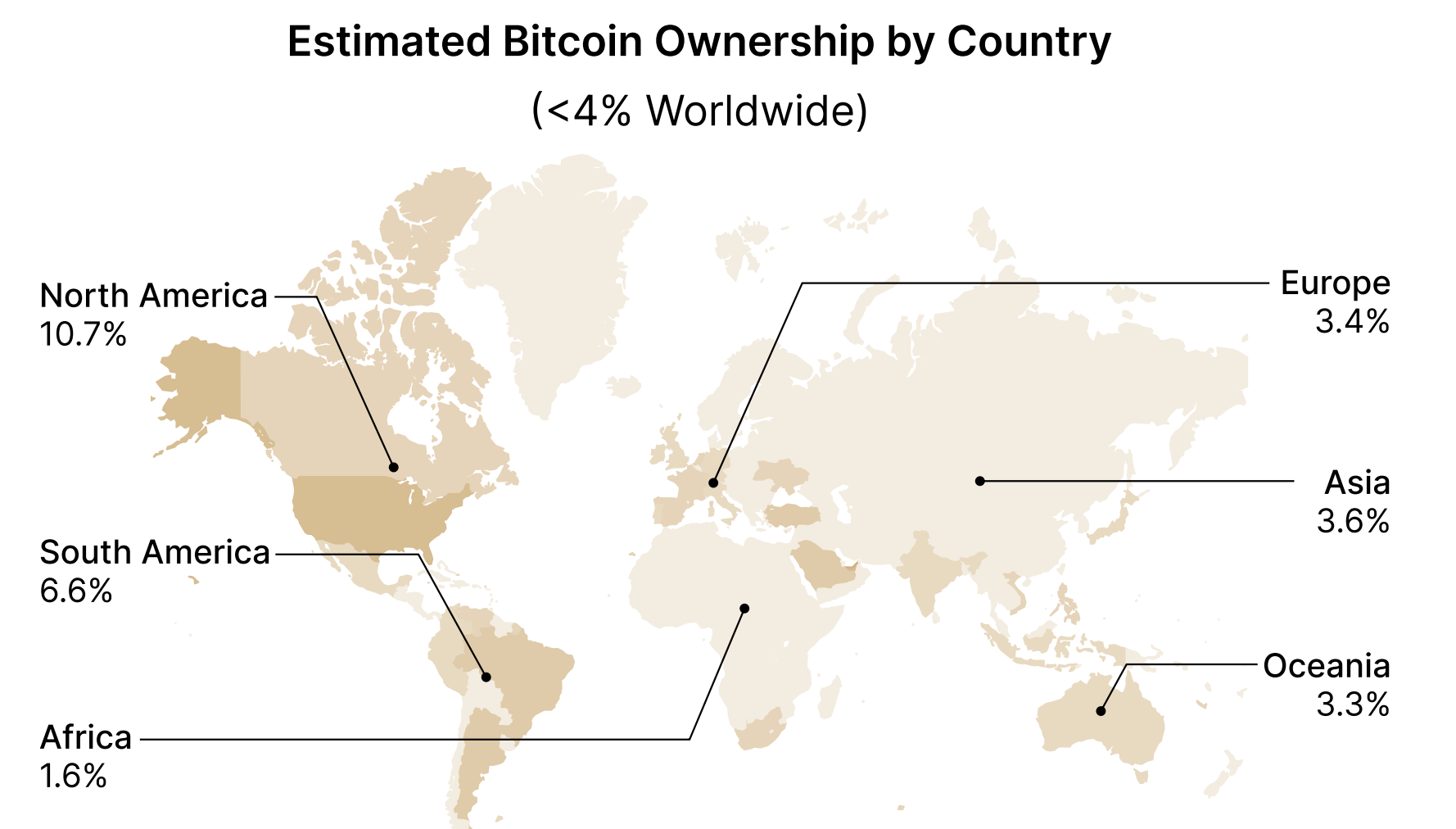

Оценочное владение биткоинами по географическим регионам. Источник: River

Что мешает массовому принятию?

Биткоин находится на стыке технологий и финансов — двух тем, которые сами по себе достаточно плотные, не говоря уже о совокупности.

Самая большая проблема, с которой сталкивается массовое принятие биткоина, — это отсутствие финансового и технического образования, что подпитывает заблуждения о BTC, включая идею о том, что это мошенничество или финансовая пирамида.

Цифровые активы также печально известны своей высокой волатильностью — это друг краткосрочного трейдера, но враг любого, кто использует BTC в качестве средства обмена или хранилища ценности.
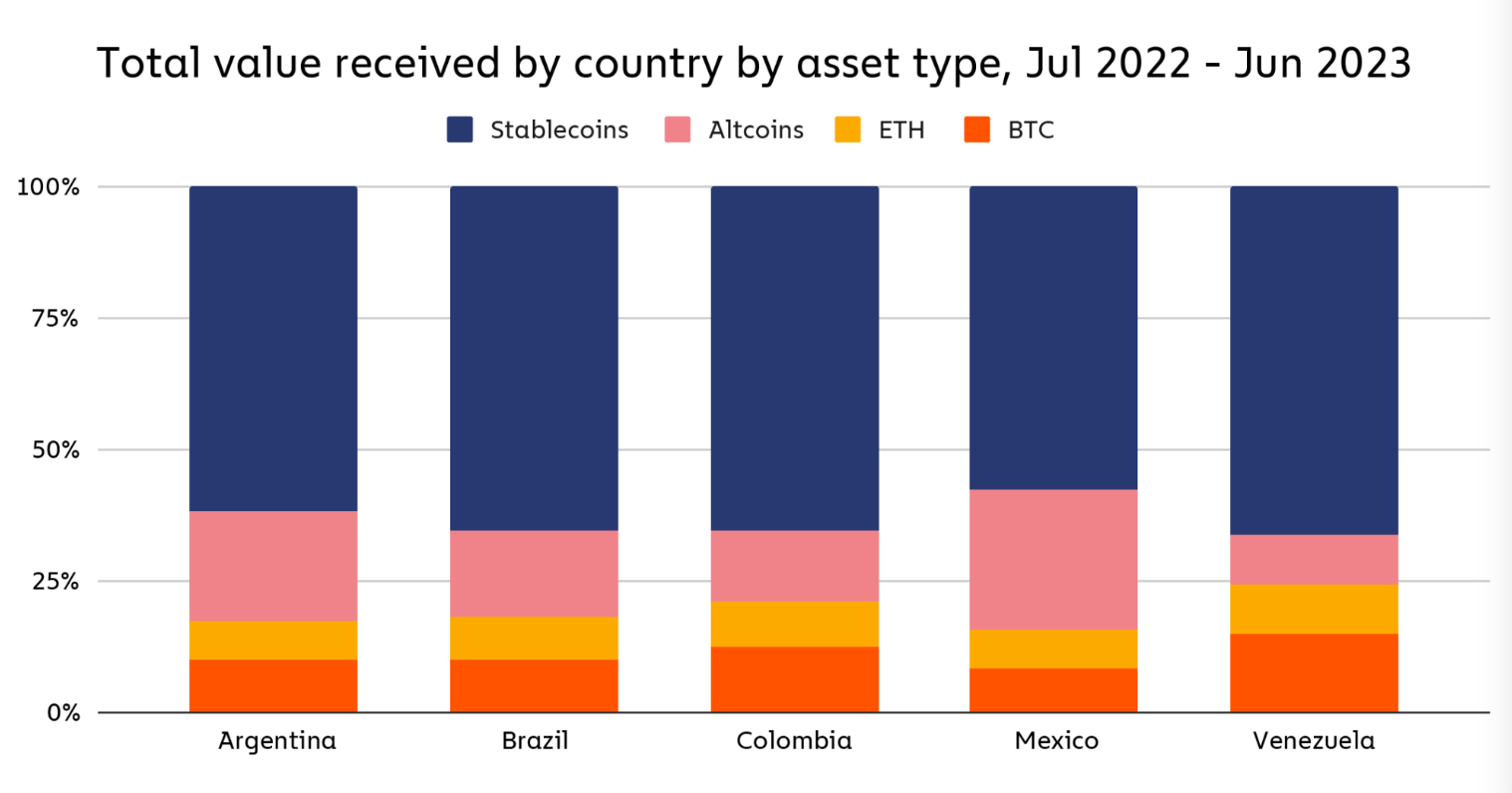

Отчет Chainalysis за 2023 год показал, что стейблкоины были наиболее широко передаваемым цифровым активом в странах Латинской Америки. Источник: Chainalysis

Высокая непропорциональность волатильности влияет на жителей развивающихся стран, которые обратились к стейблкоинам доллара США в качестве цифрового хранилища ценности из-за их низких комиссий за транзакции и относительной стабильности по сравнению с другими криптовалютами.

Во время недавнего саммита по криптовалютам в Белом доме 7 марта министр финансов США Скотт Бессент объявил, что США будут использовать стейблкоины для обеспечения гегемонии доллара США и защиты его статуса мировой резервной валюты.

Пов'язані матеріали

Countdown to Q-Day: Will Quantum Computing End Cryptocurrencies?

The article explores the existential threat quantum computing poses to cryptocurrencies and the urgent need for "post-quantum" migration. It outlines that quantum computers, through Shor's algorithm, could break the elliptic-curve cryptography (ECC) underlying blockchain security, potentially allowing private keys to be derived from public keys. The core challenge is not a lack of post-quantum cryptography (PQC) standards—like NIST's ML-KEM and ML-DSA—but the immense complexity of upgrading entire ecosystems before "Q-Day" (when quantum computers become capable of such attacks, estimated around 2035-2045). Key points include: * **Bitcoin's** risk is concentrated in legacy UTXOs with exposed public keys (e.g., early P2PK outputs). Migration faces massive hurdles: PQC signatures are much larger, increasing transaction size and cost, and the governance dilemma of handling un-migrated assets threatens its "code is law" ethos. * **Ethereum's** strategy focuses on "cryptographic agility," using Account Abstraction for user accounts and developing compressed hash-based signatures (like leanXMSS with SNARK aggregation) for consensus. Its migration is a complex, full-stack overhaul of execution, consensus, and data layers. * The "security debt" is enormous. The comfortable engineering window for a coordinated, ecosystem-wide upgrade is only 5-8 years. High-value infrastructure (exchanges, bridges) may face pressure before mainnet protocols. In conclusion, quantum computing is not an instant "doomsday" event but a forcing function for systemic change. Bitcoin's ultimate test is social consensus and property rights governance, while Ethereum's is technical complexity. Failure to migrate in time could lead to a fundamental re-pricing of crypto assets.

链捕手4 хв тому

Countdown to Q-Day: Will Quantum Computing End Cryptocurrencies?

链捕手4 хв тому

Losing $55 Million to Sell Bitcoin, MicroStrategy's Faith Reaches Its Interest Payment Day

On July 6th, Michael Saylor's MicroStrategy announced the sale of 3,588 BTC for approximately $216 million, incurring a realized loss of around $55.45 million compared to its average cost basis. This move, contradicting Saylor's long-standing "never sell" Bitcoin philosophy, was executed to pay dividends on its digital credit securities. The article traces this shift from a small "desensitization test" sale of 32 BTC in late May to the board's authorization on June 30th to sell up to $1.25 billion in Bitcoin for corporate purposes like dividends and buybacks. Analysis reveals that MicroStrategy's previous growth "flywheel"—using stock premiums to fund more Bitcoin purchases—has stalled. With its stock trading near a critical threshold (1.22x its Bitcoin NAV), issuing new shares would dilute value. Simultaneously, its financing channels (preferred stock, common stock ATM, convertible notes) are constrained while facing rigid annual dividend/interest obligations of roughly $1.76 billion. Consequently, selling Bitcoin became the calculated "optimal solution" under its own financial model. This transforms MicroStrategy from crypto's most prominent steady buyer into a predictable seller, creating a potential overhead of ~2,400 BTC in monthly selling pressure if obligations are fully covered by sales. This shift challenges the valuation models of the entire Digital Asset Treasury (DAT) sector that emulated MicroStrategy. The company's path forward now hinges on Bitcoin's price recovery, which would allow its preferred stock to trade at par and reopen its financing flywheel, creating a cyclical dependency between the firm's financial model and the asset it holds.

链捕手32 хв тому

Losing $55 Million to Sell Bitcoin, MicroStrategy's Faith Reaches Its Interest Payment Day

链捕手32 хв тому

OUSD Fake Partnership Controversy? Stablecoins and the Credit Game of Giant Endorsements

Author: Chloe, ChainCatcher Last week, Open Standard launched the dollar stablecoin OpenUSD (OUSD) with a list of over 140 supposedly supporting companies, including major names like Visa, Mastercard, Stripe, American Express, BlackRock, BNY, Standard Chartered, Google, Shopify, Samsung, Coinbase, Solana, and Ripple. The announcement initially impacted Circle's stock price, but doubts about the list quickly emerged. Several Korean firms named, including Samsung Electronics, Shinhan Financial Group, Dunamu (Upbit's parent), and K Bank, clarified they had not formally agreed to join the alliance. Some stated they were only approached for potential interest or learned of their inclusion from news reports, expressing surprise. Similar concerns were raised by U.S. entities, suggesting the list may be misleading. OUSD, led by Zach Abrams of Bridge (acquired by Stripe in 2024), promotes zero-fee minting/redemption, no transaction limits, and sharing reserve asset yields with partners instead of keeping profits. However, this model makes listed partnership imply economic benefits, turning it into a serious credibility issue. This incident reflects a common crypto marketing tactic of leveraging big names. A Chainstory analysis found over 62% of crypto press releases in late 2025 were high-risk or scams. The situation recalls Facebook's Libra (later Diem), which collapsed in 2022 after initial heavyweight backers like Visa and PayPal withdrew under regulatory pressure. Circle CEO Jeremy Allaire welcomed the competition but highlighted the challenges. He argued stablecoin success relies on network effects and real usage, not just alliances. He criticized OUSD's "free" model and full revenue sharing as potentially starving infrastructure development. Noting the dominance of USDT (~$1.84T) and USDC (~$730B) in the ~$2.91T stablecoin market, he suggested many new entrants lack real utility despite inflated circulation from incentives. In conclusion, while OUSD has genuine backing and a distinct model, its future depends on actual adoption in B2B payments, settlements, and cross-border transactions, not just a prestigious partner list. The market will determine if it is a credible challenger or merely another marketing promise.

链捕手35 хв тому

OUSD Fake Partnership Controversy? Stablecoins and the Credit Game of Giant Endorsements

链捕手35 хв тому

Торгівля

Спот
活动图片