Trump Pushes DOGE Redistribution—20% Back To Americans

bitcoinistОпубліковано о 2025-02-21Востаннє оновлено о 2025-02-21

Анотація

Donald Trump, the President of the United States, is thinking of a bold idea that might directly put money in...

Donald Trump, the President of the United States, is thinking of a bold idea that might directly put money in the pockets of American people.

According to multiple reports, under the concept referred to as the “DOGE Dividend,” 20% of government savings from efficiency cuts is being considered to be returned to taxpayers. This unusual strategy has generated an equal measure of enthusiasm and doubt.
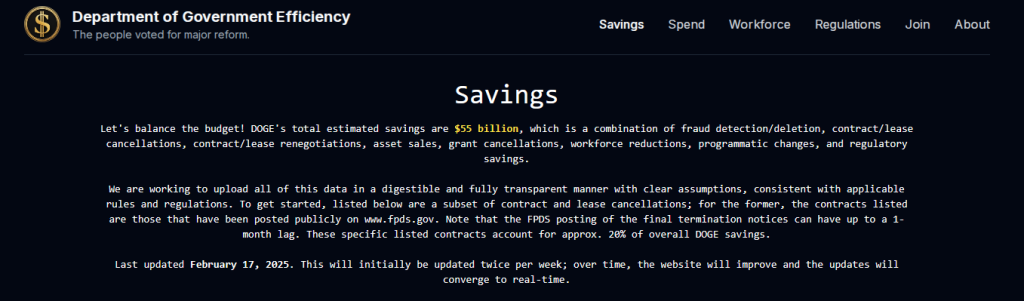
Source: Department of Government Efficiency 

The $55 Billion Savings Claim

At the heart of this proposal is the Department of Government Efficiency (DOGE), an initiative backed by billionaire Elon Musk. By cutting unnecessary expenditure, renegotiating contracts, and streamlining bureaucracy, the agency has reportedly saved the government about $55 billion.

If the dividend plan moves forward, a fifth of these savings—approximately $11 billion—would be distributed to citizens.

However, these figures remain under scrutiny. While proponents of the plan champion it as a taxpayer-friendly move, critics argue that verifying the true extent of these savings is difficult. Questions also remain about how the government would handle payouts and who would be eligible to receive them.

A Plan With Political And Legal Hurdles

Though Trump seems receptive to the concept, applying the DOGE Dividend would not be easy. Congress owns the purse, hence legislators would have to authorize any such payment. Given Washington’s political divide, implementing a new financial plan on this kind of magnitude would not be a walk in the park.

DOGE market cap currently at $37 billion. Chart: TradingView.com

Legal professionals also point up possible difficulties. The DOGE Dividend is linked to government cost-cutting policies unlike stimulus cheques, which are distributed during economic crises or downturns. This difference can generate constitutional and policy questions, thereby making the passage of the proposal more difficult.

Cutting The National Debt—But At What Cost?

Beyond distributing money to citizens, the plan includes another key component—using an additional 20% of DOGE savings to reduce the national debt. That would amount to another $11 billion set aside for debt payments.

Trump and Musk with the Dogecoin logo. Image: Illustration: Andrés Tapia; Source: Shutterstock

Although lowering national debt is generally considered to be advantageous, some contend that $11 billion is little compared to the US debt, which right now stands at $34 trillion. Others fear that excessive cost-cutting could affect government services, therefore compromising the same efficiency improvements DOGE promises to bring about.

The Road Ahead For The DOGE Dividend

Despite the challenges, the idea of a taxpayer dividend is gaining traction in political and economic circles. Businessman James Fishback, who initially proposed the concept, compared it to private-sector customer rebates, where companies return savings to their clients.

For now, the DOGE Dividend remains a discussion rather than a concrete policy. But with Trump signaling interest, it could become a major talking point in the coming months.

Whether it turns into actual financial relief or fades into political rhetoric is a question that only time—and Congress—can answer.

Featured image from ABG Australia, chart from TradingView

Christian Encila

Christian Encila

Christian, a journalist and editor with leadership roles in Philippine and Canadian media, is fueled by his love for writing and cryptocurrency. Off-screen, he's a cook and cinephile who's constantly intrigued by the size of the universe.

Пов'язані матеріали

DeFi Has Reached Its Most Dangerous Moment: The Real Vulnerabilities Are Not in the Code

DeFi in Peril: The Real Vulnerability Isn't in the Code April 2026 marked a paradigm shift in DeFi security, with over $625 million lost across 30 incidents—the worst month in crypto history by event count. Crucially, none of the major exploits (Drift Protocol: $285M, KelpDAO: $292M, Wasabi Protocol: $4.5M) resulted from smart contract vulnerabilities. Instead, failures occurred in the operational "plumbing": social engineering to compromise multi-signature councils, a single-point-of-failure 1-of-1 bridge validator, and stolen admin private keys. These events expose a fundamental misalignment: the industry's security model has long focused on code audits, while the actual attack surface has shifted to privileged access points and off-chain infrastructure. The article introduces the term "OpenFi" to describe this reality: permissionless, on-chain, yet operationally dependent on trusted third parties (admins, validators, oracles) at key junctures. The KelpDAO exploit vividly demonstrated asymmetric "contagion risk." A configuration error in a smaller protocol triggered a panic, causing approximately $13.2 billion in outflows from larger, unaffected protocols like Aave within 48 hours, as users fled uncertain collateral. The core dilemma is the double-edged sword of centralization. Operational levers like emergency councils (e.g., Arbitrum freezing stolen funds post-KelpDAO) enable crisis response but also create catastrophic attack surfaces if compromised (e.g., Drift). The path forward demands radical honesty: protocols must clearly disclose their trust assumptions, operational levers, and failure modes. The industry must treat operational security (key management, configurations, incident response) with the same rigor as code security. Survival depends on building systems whose risks can be understood, priced, and insured, moving beyond the outdated "code is law" mantra to a mature model of disclosed and managed trust.

链捕手3 год тому

DeFi Has Reached Its Most Dangerous Moment: The Real Vulnerabilities Are Not in the Code

链捕手3 год тому

Vitalik's Article Emphasizes Ethereum Must Be 'Amazing', But Foundation Is Not the Center

Vitalik Buterin has published a lengthy response to recent community criticism directed at the Ethereum Foundation (EF). Acknowledging a sense of "unease," he addresses concerns about the EF's strategic direction, its perceived disconnect from ETH's price performance, and calls for its reduced central role. Vitalik rejects the notion that the EF should be the central governing body of Ethereum, framing it instead as one "node with a clear mandate" among many within the ecosystem. He highlights the EF's limited ETH holdings (≈0.16% of supply) compared to other blockchain foundations and states it will no longer sell significant amounts of ETH. Its future focus will be on long-term, critical projects that align with Ethereum's core values of censorship-resistance and decentralization, which might not otherwise happen. A core argument is that Ethereum must be "amazing," but not by merely chasing higher transaction speeds at the cost of decentralization. He proposes focusing on the "CROPS" dimensions: creating a Cryptographically provable, Reliable, Open, Private, and Secure network. This includes pursuing goals like a formally verifiable, bug-free Ethereum client and minimizing protocol-level reliance on intermediaries. The article concludes by noting that while Vitalik clarifies the EF's refocused role, he does not directly address community suggestions for creating a new organization explicitly aligned with ETH's economic interests. This "alignment gap" is presented as a key challenge for Ethereum's future.

链捕手3 год тому

Vitalik's Article Emphasizes Ethereum Must Be 'Amazing', But Foundation Is Not the Center

链捕手3 год тому

Galxe: How a Quest Platform Evolved into Web3's Growth Infrastructure

Galxe, once perceived as a simple Web3 quest platform, has evolved into a core growth infrastructure within the Web3 ecosystem. It addresses a fundamental Web3 growth dilemma: the lack of a mature, systematic user acquisition and retention system akin to Web2's advertising and analytics platforms. While users complete quests (social tasks, on-chain interactions) for rewards, Galxe's true innovation lies in transforming these fragmented, one-off actions into lasting, verifiable identity credentials. This process of *behavioral assetization* creates a persistent record of a user's activities across projects and chains. For users, their wallet accumulates a valuable history that can unlock future access and rewards, fostering a "profile-building" mentality. For projects, Galxe provides a pre-screened user pool with rich behavioral data, enabling targeted outreach to users based on their specific on-chain history and community engagement. Galxe employs a gamefied growth path, guiding users from low-friction social tasks into deeper, valuable on-chain interactions through a structured progression of quests. This solves the incentive-behavior mismatch common in Web3, filtering users by their willingness to engage. Beyond quests, products like Passport (identity verification) and Starboard (community analytics) position Galxe as a comprehensive growth operating system. The platform's defensible advantage is its self-reinforcing data and network flywheel: more projects attract more users, enriching behavioral data; richer data enables better user targeting, attracting more projects. Ultimately, Galxe is shifting Web3's growth logic from short-term "reward-driven" traffic towards a long-term "identity-driven" relationship model, where a user's accumulated on-chain履历 becomes a core asset.

marsbit3 год тому

Galxe: How a Quest Platform Evolved into Web3's Growth Infrastructure

marsbit3 год тому

Торгівля

Спот
Ф'ючерси
活动图片