Директор Ripple насмехается над грустными владельцами биткоинов

cryptonews.ruОпубліковано о 2024-06-27Востаннє оновлено о 2025-01-27

Глава Ripple Брэд Гарлингхаус подтрунивает над биткоинерами, топчущимися на одном месте из-за затишья на рынке BTC.

Скучные выходные, что-нибудь интересное происходит? — написал Гарлингхаус.

Биткоинеры восприняли на свой счёт слова Брэда, судя по всему, из-за того, что на выходных установился штиль, и курс BTC практически не менялся. Однако в понедельник на место флэта пришла нисходящая тенденция, и монета уже подешевела на 4,5%. При этом стоимость актива практически опустилась до барьера поддержки, расположенного на отметке $100,000.
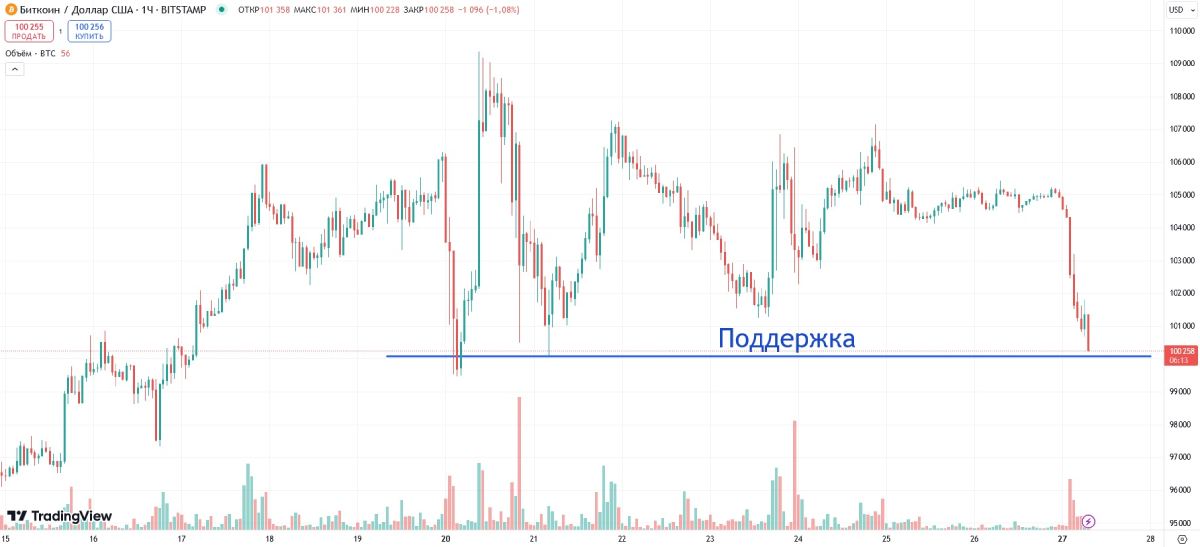
btc-price-drop-27-january

Падение курса биткоина

Ну, знаете ли вы такого персонажа по фамилии Гарлингхаус, который создал XRP и подарил себе 50% монет? Хуже всего то, что он ежемесячно продаёт 10 млн токенов [XRP], чтобы купить себе новый Porsche, — ответил Брэду блокчейн-энтузиаст под псевдонимом Si Fry, очевидно, поддерживающий биткоинеров.

Вражда между сторонниками биткоина и приверженцами XRP началась в минувшую пятницу, когда руководитель майнинговой компании Riot Platforms Пьер Рошар обвинил Ripple в попытке помешать созданию биткоин-фонда в США. Биткоинер и директор криптокомпании Strike Джек Маллерс пояснил, что эмитент XRP тратит миллионы долларов на борьбу с претворением в жизнь идеи основания резервного BTC-фонда.

Гарлингхаус не подтвердил, но и не опроверг эту информацию. От отметил, что его фирма лоббирует создание мультивалютного фонда цифровых активов, в который будут входить альткоины наряду с биткоином. Ни для кого не секрет, что Ripple сильно выиграет от включения XRP в список цифровых активов, представленных в государственном запасе США, анонсированном президентом страны Дональдом Трампом.

Пов'язані матеріали

From 'Word Unit' to 'Symbol Unit': The Debate Over the Chinese Translation of 'Token' and Its Underlying AI Cognitive Implications

Recent discussions have emerged regarding the official Chinese translation of the AI term "Token," which has been recommended as “词元” (Cíyuán, meaning "word unit") by the National Committee for Terminology in Science and Technology. While this translation is argued to align with historical usage in natural language processing (NLP) and is considered concise and communicable, this article presents a critical counterview advocating for “符元” (Fúyuán, meaning "symbol unit") as a more structurally accurate and future-proof alternative. The author argues that defining Token based on its origin in NLP—as a linguistic semantic unit—overlooks its evolution into a general-purpose, discrete symbolic unit used across multimodal systems (text, image, audio, etc.). Using “词元” ties the concept too narrowly to language, causing cognitive misalignment and semantic drift when applied in non-linguistic contexts. By contrast, “符元” reflects Token’s fundamental role as a symbol in information theory and computation, independent of modality. The article further critiques the reliance on metaphorical extensions (e.g., comparing image patches to “words”) as insufficient for rigorous terminology. It highlights risks including confusion with existing linguistic terms like Lemma (also translated as “词元”), poor cross-lingual reversibility (e.g., difficult back-translation to English), and systemic misunderstanding among non-expert audiences. In conclusion, the author emphasizes that terminology should align with computational essence—not historical usage or explanatory convenience—to ensure conceptual clarity and scalability in AI’s multidisciplinary future. “符元” is proposed as a more neutral, stable, and structurally coherent translation for Token.

marsbit11 хв тому

From 'Word Unit' to 'Symbol Unit': The Debate Over the Chinese Translation of 'Token' and Its Underlying AI Cognitive Implications

marsbit11 хв тому

Aave Mired in a Crisis of Confidence: Service Providers Exit En Masse, Failures in Technology, Governance, and Risk Control

Aave, a leading DeFi lending protocol, is facing a severe internal crisis marked by the departure of key service providers, raising concerns about its governance, security, and future direction. The crisis began when Chaos Labs, the protocol's long-time risk management provider, terminated its relationship with Aave. The firm cited financial losses, the exit of other major contributors, and fundamental disagreements over the risk architecture of the upcoming Aave V4. Aave Labs declined Chaos Labs' demands for a significant fee increase and exclusive control over key functions like risk management and oracle services. This exit followed the departure of two other critical partners. BGD Labs, the primary technical contributor to Aave V3, accused Aave Labs of forcing an aggressive transition to V4 by limiting V3 development and devaluing its work. Subsequently, the Aave Chan Initiative (ACI), a major governance service provider, announced its planned exit, criticizing Aave Labs for centralizing power and controlling a large portion of voting tokens. The conflict highlights a central paradox within DAOs: the tension between founder-led vision and decentralized governance, and between long-term protocol health and short-term capital interests. Aave Labs is pushing for a more integrated and efficient "Aave Will Win" model with V4, arguing it is necessary for competing at an institutional level. However, critics warn this centralization comes at the cost of the protocol's decentralized credibility and increases systemic risk. The immediate impacts include a potential security downgrade, a loss of institutional knowledge, and damaged community trust. While Aave Labs views this as a painful but necessary transition, the market is watching cautiously as the protocol navigates this period of significant internal turmoil.

marsbit41 хв тому

Aave Mired in a Crisis of Confidence: Service Providers Exit En Masse, Failures in Technology, Governance, and Risk Control

marsbit41 хв тому

Торгівля

Спот
Ф'ючерси
活动图片