估算Pump.fun入账单:发一个币官方收入68美元,用户7成利润或交手续费

Odaily星球日报Опубліковано о 2025-01-22Востаннє оновлено о 2025-01-22

Анотація

在玩家贡献了大量手续费和交互量的背后,谁才是Pump.fun最大的赢家?

原文作者:Frank,PANews

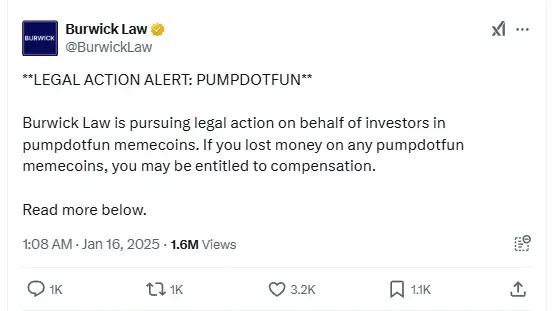
Pump.fun 最近引起了舆论危机,美国律所 Burwick Law 代表在该平台上亏损的投资者向 Pump.fun 及欺诈的项目方提起诉讼。Burwick Law 表示这一公告时与投资者合作数月后发布的,同时也呼吁更多受害者填写登记信息。加上一周前社交媒体上关于 Pump.fun 盈利超过 1 万美元的地址仅为 5.5 万个也引发了诸多讨论,Pump.fun 创始人 Alon 不得不站出来回应数据不准。似乎,在玩家贡献了大量手续费和交互量的背后,谁才是 Pump.fun 最大的赢家成为当前大家更关心的话题。

自由的赌场还是阴谋家的温床?

关于 Burwick Law 对 Pump.fun 采取法律行动的消息,不少加密 KOL 也加入了讨论,知名的链上侦探 ZachXBT 表示:“堕落的赌徒自愿选择在微型市值的 MEME 代币当中赌博,不是实际的受害者或投资者”。
估算Pump.fun入账单:发一个币官方收入68美元,用户7成利润或交手续费

对此,Burwick Law 贴出其合伙人 Max Burwick 的观点:“在赌场一样,受监管的赌博是由规则和不可更改的统计数据定义的。想象一下,如果你去一个赌场,发牌员可以将一场纸牌游戏“rug pull”,你会提出和这里一样的论点吗?”

实际上,ZachXBT 和 Max Burwick 的观点基本上代表了对于起诉 Pump.fun 这件事大众的两种态度。一部分人认为,在 Pump.fun 上交易是用户自愿的,起诉纯粹是玩不起的表现,而且从机制上来看 Pump.fun 还减少了很多 MEME 当中的欺诈风险。另一部分则认为,Pump.fun 收取了大量的手续费,却放任一些地址操纵市场,对内容没有审查,因而应该被起诉。

当然,Pump.fun 是否违反相关法规,以及这场诉讼将是投资者的胜利还是演变为一场闹剧目前我们都无从得知。

Pump.fun 上的赢家到底有多少?

但除此之外,Pump.fun 上的用户有多少盈利?谁才是 Pump.fun 最大的获利者?这些信息可能对普通用户更有意义。PANews 对 Pump.fun 长期以来的数据做了一些总结分析。

实际上,早在 1 月 11 日,社交媒体上关于 Pump.fun 上盈利超过 1 万美元的地址数仅为 5.5 万个(占比 0.408% )的讨论就引起一阵喧嚣,Pump.fun 创始人 Alon 对此还特意作出回应,认为这个统计数据不准确。原因在于 1、没有计入已与 Raydium 绑定的代币购买,大部分收益是在代币绑定后产生。2、没有考虑未实现利润。3、超 1300 万交易者有许多是机器人和 AI 代理。约 30% 钱包只进行过一次交易,这些钱包不可能为真实人类。

这里 Alon 指的是由@adam_tehc 在 Dune 上创建的“Pump.Fun Alpha Wallets”的数据表。需要说明的是,这里关于@adam_tehc 的数据,Alon 并未表示这些数据失真,而是认为这些数据不够完整,不足以说明 Pump.fun 用户的盈利情况。

PANews 在后续的分析当中,也会部分采用@adam_tehc 创建的几个 Dune 仪表盘上的数据,不过只选择采用其中的基础统计数据,如总地址数、交易量、累计收益等。另外,由于没有直接的用户盈亏分析数据,在下述的分析当中采用的是用已有确定的数据进行分析、估算、推断的方式进行分析,这样的分析方法不一定非常精准,但希望能够从某些角度说明一些问题。

由于用到的数据类别较多,先将一些基础数据列出在此(数据截至 1 月 16 日):

Pump.fun 累计收入: 416810737 美元(4.168 亿美元)

Pump.fun 累计发行代币: 6, 096, 526 (609.6 万)

Pump.fun 累计用户地址数: 14, 130, 923 (1413 万)

过去 30 天 Pump.fun 的收入: 105182383 (1.05 亿美元,这个数据偏高,主要是因为 1 月份 Pump.fun 做了几次其他 DEX 上的收入归集)。

统计累计交易总量: 36030577862 (360 亿美元,注:该数据是 2024 年 4 月 22 日到 2025 年 1 月 6 日,按照 4 月 22 日的累计收入约为 965 万美元,根据 1% 的手续费反向推算在此之前的的总交易量约为 9.65 亿,因此估算累计交易总量约为 370 亿美元)

毕业代币占比平均值为 1.42% 。

以上数据来自@adam_tehc 在 Dune 上的 Pump.Fun 数据。

过去 30 天 Pump.fun 的交易笔数: 113540000 (1.13 亿笔)

过去 30 天的 Pump.fun 的活跃地址数: 7795520 (779 万)

以上数据来源于 Solana 浏览器 Pump.fun Program 数据。

此外,PANews 还随机统计了 7 个 Pump.fun 上即将打满的代币 1 月 16 日的 5252 笔交易,通过进行交易行为分析,其中有 36 个机器人地址, 909 个真实用户。

每发一个代币官方可收入 68 美元

根据以上的统计数据,PANews 对一些数据进行计算后得出以下分析结果:

代币的数据:

根据总发币数量和总收入数据,我们得到了平均每个代币官方获得费用收入为 68 美元。

根据总交易量和总代币发行量,我们计算得出平均每个代币的交易量约为 6074 美元。

用户的数据:

根据总收入和总用户量,可以计算出平均每个用户给官方贡献的费用约为 29.49 美元。

根据过去 30 天的总收入和 30 天的交易总笔数,能够计算出每笔交易贡献的收入约为 0.92 美元,再根据 1% 的费率水平,可估算出过去 30 天用户平均单笔交易规模约为 92.63 美元。

根据过去 30 天的数据,我们得到过去 30 天平均每个用户进行了 14.56 笔交易,每个地址贡献了 13.49 美元费用,再根据总体用户贡献 29.49 美元费用。推算出平均每个地址的交易笔数约为 31.8 笔。

到这里,我们再次梳理一下以上我们得到的数据:平均单个地址进行了 31.8 笔交易,平均的交易规模约为 92.63 美元。

结合代币的基础数据,我们能够计算得出平均每个代币产生的交易笔数约为 65.5 笔交易,平均用户参与一个代币的交易笔数约为 5.5 次。平均每个代币参与的地址数约为 11.79 个地址。

用户利润的 7 成被官方拿走?

接下来,我们估算以下这种理想情况。假设所有用户都有几率买中毕业的代币,当这些代币上线 Raydium 后所有用户每次都能以翻倍的利润卖出,每次买中时的交易规模也就是平均的交易规模。当然,在这个过程中,为了便于理解,我们将假设有一个所有数据都正好是平均值的用户,名为“平均者”。

根据上述计算的结果,我们知道 Pump.fun 上代币的毕业率为 1.42% ,也就是这个“平均者”玩家的胜率约为 1.42% 。这个“平均者”玩家的交易规模每次都是 92.63 美元,而他从开始到如今共计进行了 31.8 次买卖。根据这个数据,我们能计算出,这个“平均者”一共买中了 0.45 次毕业代币,翻倍卖出后获得了 41.88 美元的收益。

而在这个过程中,这位“平均者”花费了 29.49 美元的手续费,当然,这里只计算了他的手续费,而没有计算他因个人操作亏损的金额,我们假设他每次在内盘交易时都很幸运,即便没能买到毕业的代币,也每次都能平进平出,没有亏损。

按照以上的算法,我们能够看到,在极端理想的状态下(不考虑亏损),用户平均能够得到约 41.88 美元的利润,但需要支付的手续费就高达 29.49 美元,也就是在这种较为理想的收入情况下,Pump.fun 基本拿走了用户 70% 的利润。

如果这样的计算符合实际,或许也就不难解释为什么会有众多投资者将矛头指向 Pump.fun 官方。

当然,这里的计算有可能与现实产生一些偏离,比如内盘的玩家或许在上 Raydium 后整体上的利润率大于 1 倍。不过,这种情况可能性不大,绝大多数代币上线 Raydium 后也都是迅速归零,以 1 月 17 日数据为例, 24 小时内 Pump.fun 上共发行 48631 个代币,同时段内毕业的代币为 697 个,而在同时段新上线 Raydium 且市值大于 8.1 万美元(毕业市值),交易笔数大于 100 笔的代币数量剩下为 214 个,也就是上线 Raydium 后也只有 30% 的代币能维持毕业市值。

最后,以上的数据计算方法属于估算与推算,并不能完全代表事实。不过,从整体的数据来看,无论如何 Pump.fun 的团队都是这场 MEME 热潮的最大受益者,早日拿出一份官方的数据,才更能够为用户提供指导和依据也更能说明问题。

Трендові криптовалюти

Пов'язані матеріали

Dialogue with Multicoin Partner: The Crypto Market Has Bottomed Out, Favoring Three Cryptocurrencies in This Cycle

In a recent interview, Multicoin Capital managing partner Tushar Jain shared his views on the crypto market. He believes the market has bottomed and is at an inflection point, citing that negative news no longer causes significant price declines and application adoption continues to grow. Jain remains highly bullish on Solana, viewing it as the correct architectural choice for internet capital markets, particularly for spot and tokenized security trading. He is also positive on Hyperliquid, noting its leadership in decentralized derivatives trading. His investment approach focuses on concentrating capital in top convictions rather than equal allocation. A distinct opportunity he highlights is Zcash (ZEC), which he sees as a return to the industry's cypherpunk ethos and a potential top-five asset by market cap. For assets like Zcash without cash flows, his valuation framework is based on relative market cap ranking. Regarding investment strategy, Jain employs a "three-part" entry method to avoid timing pitfalls and emphasizes long-term "active management" over "active trading." He outlines four sources of investment edge: informational, analytical, behavioral/psychological, and structural. On portfolio management, the fund uses Bitcoin as its "cash," selling assets into Bitcoin during market euphoria to reduce beta risk and using Bitcoin to buy dips. Sales occur only if a better opportunity arises, the investment thesis breaks, or valuations become excessively overheated. While respectful of Ethereum's resilience, he questions its unclear scaling roadmap. Finally, Jain reaffirms his commitment to the thesis that blockchains will form the foundational architecture for future capital markets.

marsbit24 хв тому

Dialogue with Multicoin Partner: The Crypto Market Has Bottomed Out, Favoring Three Cryptocurrencies in This Cycle

marsbit24 хв тому

Behind Robinhood's Chain Launch and Tokenized Stocks: No Equity Rights, How Far Can This Packaging Game Go?

Robinhood is launching its own Layer 2 blockchain (Robinhood Chain) and "tokenized stocks," but these are not actual equity shares. The tokens are legally structured as debt securities or derivatives, offering economic exposure to a reference stock without granting voting rights or direct ownership. This move represents Robinhood's strategy to expand from a traditional brokerage into a "financial super app," building a user-friendly, programmable financial interface on top of complex, legally compliant, and jurisdiction-specific backend structures. The company's existing business remains strong, driven by options, event contracts, and stock trading. The new blockchain and tokenization efforts are an ambitious layer of infrastructure built atop this core, aiming to make financial products more portable and globally accessible via crypto rails. Key components include the Robinhood Wallet, Bitstamp acquisition (for institutional reach), the Lighter perpetual contracts platform, and Robinhood Earn (DeFi yield). The central challenge is the "brokerage chain paradox": maintaining a simple, intuitive user experience while the underlying assets are highly structured, regulated, and legally distinct from direct ownership. The success of this strategy depends on users, developers, and regulators accepting this model. If the complexity is misunderstood or deemed misleading, it could create product liability issues and stall expansion. The initiative is a significant infrastructure play, but its long-term viability hinges on navigating this fundamental tension between simplicity and legal reality.

marsbit1 год тому

Behind Robinhood's Chain Launch and Tokenized Stocks: No Equity Rights, How Far Can This Packaging Game Go?

marsbit1 год тому

Zhipu, Afraid of Becoming the Next MiniMax

Title: Zhipu, Fearing to Become the Next MiniMax In July 2026, amid the success of its coding-focused AI, Zhipu's founder, Tang Jie, issued an internal letter titled "The Giant Wave Has Come." It notably avoided celebrating recent triumphs, such as Zhipu's trillion-HKD market cap and booming MaaS revenue driven by its GLM-5.2 model in coding applications. Instead, the letter pivoted the narrative to future-oriented concepts like Long Horizon Task, Autonomous Agents, Self-Evolving systems, and AGI. This strategic shift in messaging followed the sharp devaluation of its competitor, MiniMax. After its lock-up period expired, MiniMax's stock plummeted as the market began evaluating it with traditional SaaS metrics like ARR and user growth, rather than as a frontier AI pioneer. Seeing this, Tang Jie aimed to preempt a similar revaluation of Zhipu. He fears that if the market starts viewing Zhipu primarily as a profitable "AI coding company," its valuation would become anchored to conventional financial metrics, losing the premium associated with AGI potential. Therefore, the letter reframed Zhipu's mission. While acknowledging that coding was the current commercial driver, Tang positioned Zhipu on the "infrastructure path," akin to OpenAI and Anthropic. The new focus is on developing agents capable of complex, long-term planning and autonomous operation—moving from assisting individuals (OPC: One Person Company) to automating entire organizations (NPC: No People Company). This "Touch High" plan explicitly prioritizes long-term AGI research over short-term monetization. The article frames this as a critical divergence in China's AI landscape: the "commercialization path" (exemplified by MiniMax) versus the "infrastructure path" (chosen by Zhipu). The former risks being judged harshly by internet-era metrics once growth slows, while the latter risks failing if technological breakthroughs stall. Tang Jie's letter is thus a calculated move to secure Zhipu's identity as an AGI contender, buying time before the inevitable market demand for commercial proof. The core question remains: can Zhipu's "mo gao" (reach high) plan achieve genuine technological leaps fast enough to outpace the market's diminishing patience for stories over substance?

marsbit1 год тому

Zhipu, Afraid of Becoming the Next MiniMax

marsbit1 год тому

Торгівля

Спот

Популярні статті

Як купити PUMP

Ласкаво просимо до HTX.com! Ми зробили покупку Big Pump (PUMP) простою та зручною. Дотримуйтесь нашої покрокової інструкції, щоб розпочати свою криптовалютну подорож.Крок 1: Створіть обліковий запис на HTXВикористовуйте свою електронну пошту або номер телефону, щоб зареєструвати обліковий запис на HTX безплатно. Пройдіть безпроблемну реєстрацію й отримайте доступ до всіх функцій.ЗареєструватисьКрок 2: Перейдіть до розділу Купити крипту і виберіть спосіб оплатиКредитна/дебетова картка: використовуйте вашу картку Visa або Mastercard, щоб миттєво купити Big Pump (PUMP).Баланс: використовуйте кошти з балансу вашого рахунку HTX для безперешкодної торгівлі.Треті особи: ми додали популярні способи оплати, такі як Google Pay та Apple Pay, щоб підвищити зручність.P2P: Торгуйте безпосередньо з іншими користувачами на HTX.Позабіржова торгівля (OTC): ми пропонуємо індивідуальні послуги та конкурентні обмінні курси для трейдерів.Крок 3: Зберігайте свої Big Pump (PUMP)Після придбання Big Pump (PUMP) збережіть його у своєму обліковому записі на HTX. Крім того, ви можете відправити його в інше місце за допомогою блокчейн-переказу або використовувати його для торгівлі іншими криптовалютами.Крок 4: Торгівля Big Pump (PUMP)Легко торгуйте Big Pump (PUMP) на спотовому ринку HTX. Просто увійдіть до свого облікового запису, виберіть торгову пару, укладайте угоди та спостерігайте за ними в режимі реального часу. Ми пропонуємо зручний досвід як для початківців, так і для досвідчених трейдерів.

335 переглядів усьогоОпубліковано 2024.12.12Оновлено 2026.06.02

Як купити PUMP

Обговорення

Ласкаво просимо до спільноти HTX. Тут ви можете бути в курсі останніх подій розвитку платформи та отримати доступ до професійної ринкової інформації. Нижче представлені думки користувачів щодо ціни PUMP (PUMP).

活动图片