Dogecoin Price Reaches An RSI Of 59 After Dropping To $0.31, Here’s What Happened The Last Time

bitcoinistОпубліковано о 2024-12-28Востаннє оновлено о 2024-12-29

Анотація

The Dogecoin price has continued its decline over the past two weeks into the last 24 hours. Particularly, Dogecoin has...

The Dogecoin price has continued its decline over the past two weeks into the last 24 hours. Particularly, Dogecoin has yet to start a notable momentum above the $0.30 threshold, although it has largely held up above $0.31. Amidst this price decline, the Relative Strength Index (RSI) indicator has relayed a similar decline, which was noted on social media platform X by crypto analyst KrissPax. He points to Dogecoin’s RSI reaching 59, a level associated with bullish potential in the current market cycle.

Dogecoin RSI At 59: Historical Context

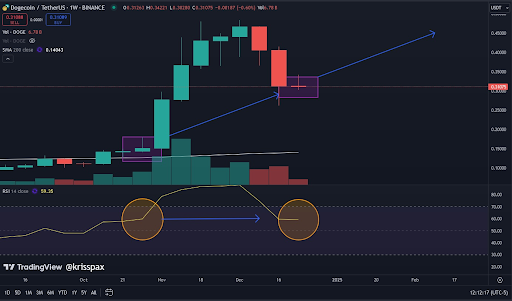
According to crypto analyst KrissPax on social media platform X, Dogecoin’s RSI at 59 is a key technical signal. Notably, the technical analysis is based on the Dogecoin weekly timeframe chart. According to the chart, Dogecoin’s weekly RSI has been in a downward trajectory since early December, following a peak above 90.

During this time, the meme coin was under extreme buying pressure, leading to overbought conditions. From here, Dogecoin experienced a sharp decline in the RSI triggered by intense selling pressure from holders, which caused Dogecoin’s price to drop significantly. The correction pushed the RSI below the 70 and 60 levels, reinforcing bearish sentiment during this period.

Interestingly, Dogecoin’s weekly RSI has now stabilized at 59 and has been holding around this level since December 16. While this stabilization might suggest a temporary pause in selling pressure, it could also signify something more significant for Dogecoin’s price trajectory. Historical data shared by KrissPax underscores this possibility.

The last time Dogecoin’s weekly RSI hovered at 59 was on October 29, when the meme coin was priced at approximately $0.15. What followed was a remarkable rally. Dogecoin’s price surged over the subsequent weeks, culminating in a peak of $0.475. 

Bullish Breakout Potential Amid Bearish Sentiment

Dogecoin’s weekly RSI at 59 suggests that Dogecoin could be gearing up for another surge in the coming weeks. As KrissPax speculated, this suggests that the Dogecoin price could break out from here up to $0.6.However, the unpredictable nature of the crypto market also points to the possibility of a retracement after hitting this peak to cause a retest around $0.45 before resuming its upward trajectory.
Dogecoin price RSI
Source: X

At the time of writing, Dogecoin is trading at $0.316, and a rally to $0.60 would mark an impressive 90% increase from the current price. Interestingly, Dogecoin has shown resilience at $0.31, bouncing back from this level multiple times over the past 24 hours.

However, it has yet to display the strong upward momentum needed to initiate an upward move. If Dogecoin struggles to surpass $0.316, it risks experiencing another short-term decline. In terms of support, $0.31 and $0.30 are the two major levels to keep an eye on. Resistance levels are around $0.33, $0.35, and $0.40.

Dogecoin price chart from Tradingview.com
DOGE price recovers from low | Source: DOGEUSDT on Tradingview.com
Featured image created with Dall.E, chart from Tradingview.com
Scott Matherson

Scott Matherson

Scott Matherson is a leading crypto writer at Bitcoinist, who possesses a sharp analytical mind and a deep understanding of the digital currency landscape. Scott has earned a reputation for delivering thought-provoking and well-researched articles that resonate with both newcomers and seasoned crypto enthusiasts. Outside of his writing, Scott is passionate about promoting crypto literacy and often works to educate the public on the potential of blockchain.

Пов'язані матеріали

Why Did Zhipu Surge Nearly 30% in a Single Day?

"Global AI Model Unicorn" Zhipu's stock surged nearly 30% in a single day, reaching a new market cap high. The catalyst was the launch of its GLM-5.1-highspeed API, boasting a generation speed of **400 tokens per second**, setting a new global benchmark. This speed, roughly 3-5 times faster than industry leaders like OpenAI's GPT-4o and Anthropic's Claude, is achieved **without compromising the full-scale model's capabilities**. In the era of AI Agents requiring dozens of self-calls, such latency reduction is critical, transforming speed from a system metric into a determinant of intelligence limits. The breakthrough stems from a three-layer technical overhaul: 1. **TileRT Inference Engine**: Compiles the entire model into a continuous, always-on computation pipeline using "Warp Specialization," minimizing GPU idle time by having different processor groups handle data loading, computation, and communication in parallel. 2. **Heterogeneous Parallelism for MLA**: To efficiently run the GLM-5.1 model using the MLA attention mechanism, TileRT employs a heterogeneous strategy. One GPU handles sparse indexing/routing, while the others perform dense computation, optimizing for MLA's unique workflow. 3. **ZCube Network Architecture**: Replaces the standard Spine-Leaf (ROFT) network topology with a flat, dual-group interconnect. This design creates a single optimal path between any two GPUs, eliminating network congestion at scale and reducing latency. The business impact is significant: a 15% increase in cluster throughput (free extra capacity), a 40.6% reduction in tail latency (improved stability), and a one-third cut in networking hardware costs. Long-term, this innovation challenges the dominance of NVIDIA's integrated hardware-software stack (GPU+NVLink+InfiniBand), potentially benefiting manufacturers of high-density Leaf switches and optical modules while lowering the software barrier for domestic AI chips like Huawei's Ascend. The innovation proves that more can be achieved with the same compute, reshaping the infrastructure beyond just GPUs.

marsbit16 хв тому

Why Did Zhipu Surge Nearly 30% in a Single Day?

marsbit16 хв тому

Bidding Farewell to the 'Gray Gambling Game'! Polymarket Charges into the Compliance Track—How Will This Impact the Entire Crypto Industry?

From Gray to Regulated: How Polymarket’s Compliance Journey Reshapes Crypto The evolution of Polymarket, a decentralized prediction market platform, illustrates a critical trend in crypto: innovative, high-value sectors ultimately integrate into regulatory frameworks. Founded in 2020, Polymarket quickly gained traction by leveraging low-cost Layer 2 blockchain technology for event-based trading, notably during the 2024 US presidential election where its markets outperformed traditional polls. However, its "build first, comply later" approach led to a 2022 CFTC enforcement action, resulting in a $1.4 million fine and a ban from the US market. A pivotal shift occurred in 2025 under a new US administration. Polymarket strategically acquired CFTC-licensed derivatives exchange QCX for $112 million, securing a regulated pathway back into the US. This move coincided with a regulatory reversal, as the CFTC withdrew a prior proposal to ban political event contracts. The platform’s successful "regulatory acquisition" strategy, avoiding a lengthy independent licensing process, highlights a viable compliance path for crypto-native projects. Its journey from regulatory target to a CFTC-recognized entity—bolstered by a major data partnership and investment from Intercontinental Exchange (ICE)—signals the maturation of prediction markets from a "crypto novelty" into acknowledged financial infrastructure. The story underscores that genuine utility provides negotiating power with regulators and that embracing compliance does not necessarily mean sacrificing core technological advantages.

marsbit33 хв тому

Bidding Farewell to the 'Gray Gambling Game'! Polymarket Charges into the Compliance Track—How Will This Impact the Entire Crypto Industry?

marsbit33 хв тому

Торгівля

Спот
Ф'ючерси
活动图片