Dogecoin Price Analysis: Why A Red Close Below $0.465 This Week Is A Good Thing For Price

bitcoinistОпубліковано о 2024-12-15Востаннє оновлено о 2024-12-15

Анотація

Dogecoin’s price action is still drawing attention with its ongoing consolidation holding up above $0.4. At the time of writing,...

Dogecoin’s price action is still drawing attention with its ongoing consolidation holding up above $0.4. At the time of writing, Dogecoin is trading around $0.409, down 14% from its recent December high of $0.4757. While this dip might appear concerning to some, crypto analyst Master Kenobi believes it is a natural and necessary phase in Dogecoin’s journey toward another bullish breakout. 

According to his analysis shared on social media platform X, Dogecoin needs to close below $0.465 in the weekly timeframe. Although it sounds bearish at the get-go, it is actually based off a very bullish price outlook for the meme coin.

Dogecoin’s Consolidation Resembles Its 2020 Post-Halving Behavior

Kenobi’s outlook is not rooted in immediate bearishness but in a broader perspective comparing Dogecoin’s current price consolidation to its behavior during late 2020, right before the crazy rally in 2021. 

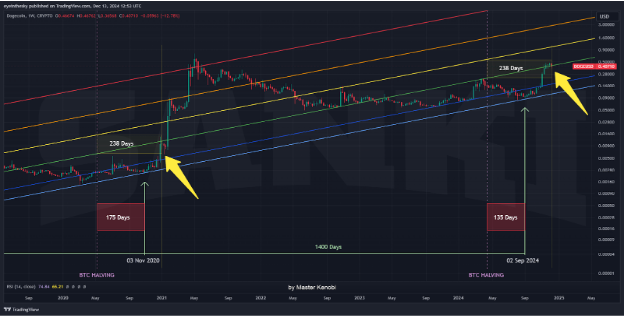
Cryptocurrencies are known to exhibit similar price performances in cycles. Interestingly, Dogecoin’s recent price performance is reminiscent of its price action in 2020 following the Bitcoin halving earlier that year. Analysis of the Dogecoin weekly candlestick price chart shows that the Dogecoin price rallied in late 2020, entered a consolidation phase, and subsequently exploded during the 2021 bull market. 

The parallels between those movements and Dogecoin’s current trajectory are very notable, with 2024’s Bitcoin halving earlier this year setting the stage for a similar cyclical pattern. As it stands, the Dogecoin price is now consolidating after a notable rally in October and November 2024, much like the 2020 movement. 
The Importance Of Closing Below $0.465 This Week

Although the current consolidation might be slowing down bullish sentiment, it might not be over yet. Crypto analyst Master Kenobi expects this consolidation to continue in order for the current Dogecoin price action to completely mirror that of the 2020/2021 movement, suggesting a repeat of 2021’s dramatic rally could occur by 2025.

DOGE now trading at $0.39. Chart: TradingView

To fully replicate its 2020-2021 cycle, Dogecoin needs to close this week in the red, with a price below $0.465. Particularly, the analyst noted that this is necessary for the Dogecoin price in order to continue healthy consolidation. At the time of writing, the Dogecoin price is trading at $0.409, meaning it is well on track to close the week below $0.465. 

If Dogecoin’s current price action continues to align with the patterns observed in 2020, it may be on track for another parabolic surge next year. In another technical analysis, Master Kenobi noted that the ongoing red week falls exactly 238 days after the last halving, perfectly aligning with the previous cycle.

Based on this pattern, he predicts that a red weekly close will be followed by two consecutive green weeks, paving the way for a significant price surge to begin in the third week, around December 30th. 

Featured image from AP News, chart from TradingView

Scott Matherson

Scott Matherson

Scott Matherson is a leading crypto writer at Bitcoinist, who possesses a sharp analytical mind and a deep understanding of the digital currency landscape. Scott has earned a reputation for delivering thought-provoking and well-researched articles that resonate with both newcomers and seasoned crypto enthusiasts. Outside of his writing, Scott is passionate about promoting crypto literacy and often works to educate the public on the potential of blockchain.

Пов'язані матеріали

Fantasy's Closing Notes: After Two and a Half Years of Trial and Error in SocialFi, What Have We Learned?

"Fantasy Shutdown Notes: Two and a Half Years of SocialFi Trial, What Have We Learned?" Fantasy, a SocialFi/crypto card game, is shutting down. The team is refunding 100% of investments to angel/seed round backers, as operational costs were fully covered by revenue. Over 2.5 years, the project returned approximately $20M to its community. The core reason for failure was building crypto economics on a foundation not designed for it. Traditional card games (Magic, Pokémon) succeed by prioritizing gameplay; financial value is a secondary outcome. Crypto card games invert this, attracting speculators first, not genuine players. This financialization trapped the team into managing a financial instrument instead of developing a game. This is a sector-wide issue. Embedding tokenomics into social products or creator-fan relationships often attracts short-term traders over genuine users, undermining the core value. The article also critiques premature token launches. Most tokens fail because they're issued before product-market fit is proven, diverting team and community focus to price speculation instead of building. Successful examples like Hyperliquid or Jupiter built sustainable businesses first. Fantasy's journey highlights key crypto pitfalls: the distorting effect of upfront financialization in gaming/social apps, and the dangers of launching tokens too early. The team hopes sharing these lessons helps future builders avoid the same traps.

marsbit31 хв тому

Fantasy's Closing Notes: After Two and a Half Years of Trial and Error in SocialFi, What Have We Learned?

marsbit31 хв тому

Two Companies Capture 90% of AI Startup's $80 Billion ARR

The AI startup landscape is highly concentrated, with OpenAI and Anthropic capturing 89% of an estimated $80 billion in annualized revenue among 34 leading companies. OpenAI, with $24-25B in revenue, primarily drives growth through ChatGPT's consumer subscriptions, while Anthropic, exceeding $30B, focuses on enterprise API integration and has rapidly grown its U.S. enterprise market share from under 1% to 34.4% in under two years. The remaining 32 companies share just 11% of the revenue, facing intense pressure as resources, talent, and market attention consolidate around the two giants. This creates a self-reinforcing cycle where higher revenue fuels greater compute investment and model improvement. Despite their dominance, both leaders face challenges. OpenAI is navigating significant legal disputes and partnership tensions, while Anthropic operates under the high expectations of its massive backers like Amazon. Historical parallels in tech infrastructure (e.g., search engines, mobile OS) suggest such oligopolistic tendencies are common due to scale, network effects, and high switching costs, indicating the market could become even more concentrated. However, the rapid pace of AI innovation leaves room for disruption. For other players, the strategic path forward is not direct competition with the giants but specialization in vertical domains where general-purpose models fall short—such as legal, medical, or industrial applications—building indispensable, niche solutions.

marsbit40 хв тому

Two Companies Capture 90% of AI Startup's $80 Billion ARR

marsbit40 хв тому

Торгівля

Спот
Ф'ючерси
活动图片