Chainalysis: российские криптосервисы процветают на фоне санкций

cryptonews.ruОпубліковано о 2022-07-01Востаннє оновлено о 2024-11-01

Как показывает последний отчёт аналитической платформы Chainalysis, несмотря на санкции, российские криптосервисы активно развиваются и даже привлекают зарубежных пользователей.
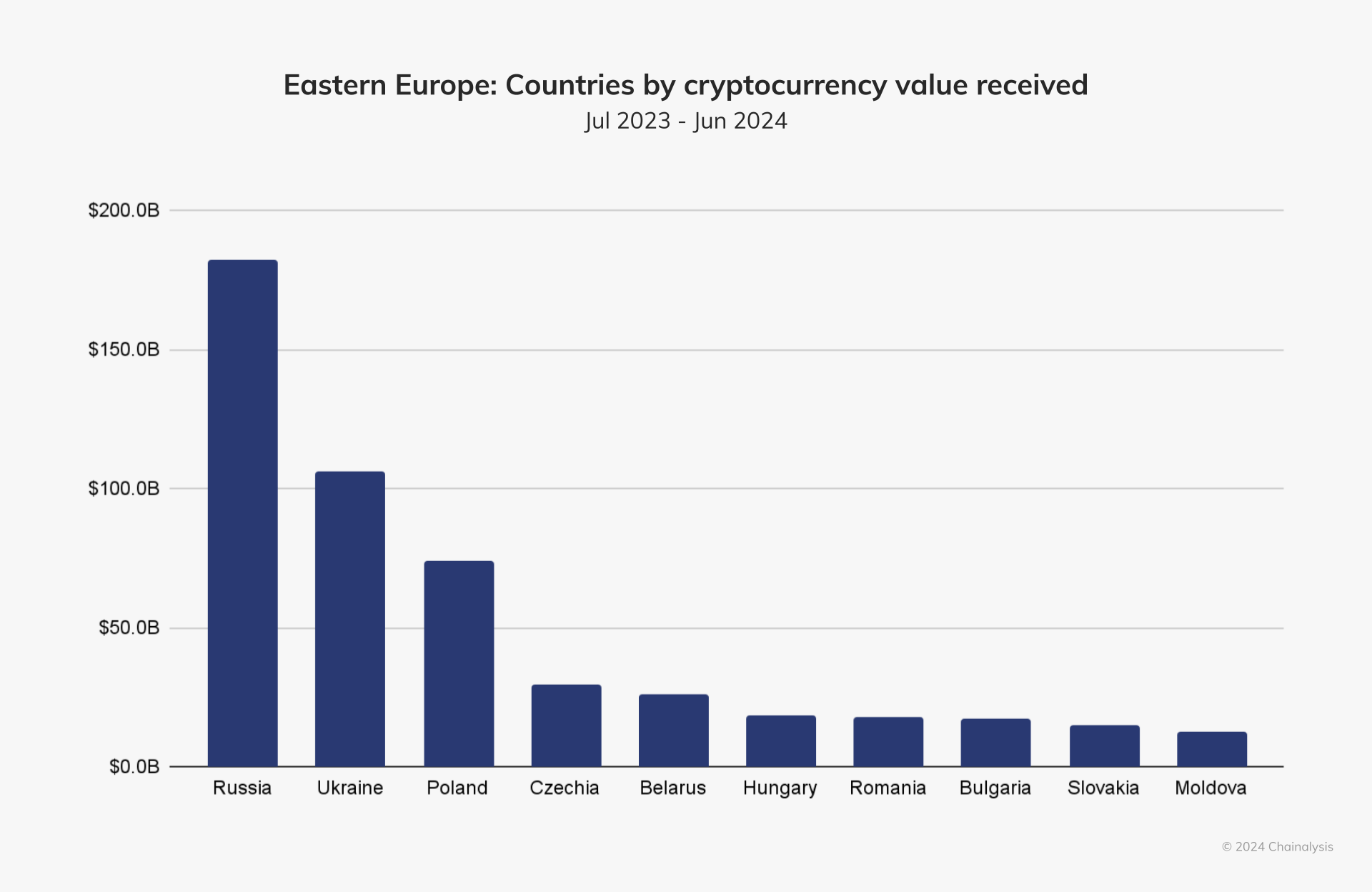
eastern-europe-countries-by-cryptocurrency-value-received


Восточная Европа: страны по объему полученной криптовалюты.

За последнее время резко увеличилась доля трафика, направленного на криптовалютные площадки за пределами России, которые работают без соблюдения процедуры «Знай своего клиента».

Как считают в Chainalysis, эта тенденция обусловлена тем, что против РФ ввели масштабные финансовые санкции. Именно поэтому частные лица стали чаще обращаться к российским площадкам, где они могут обменять криптовалюты.
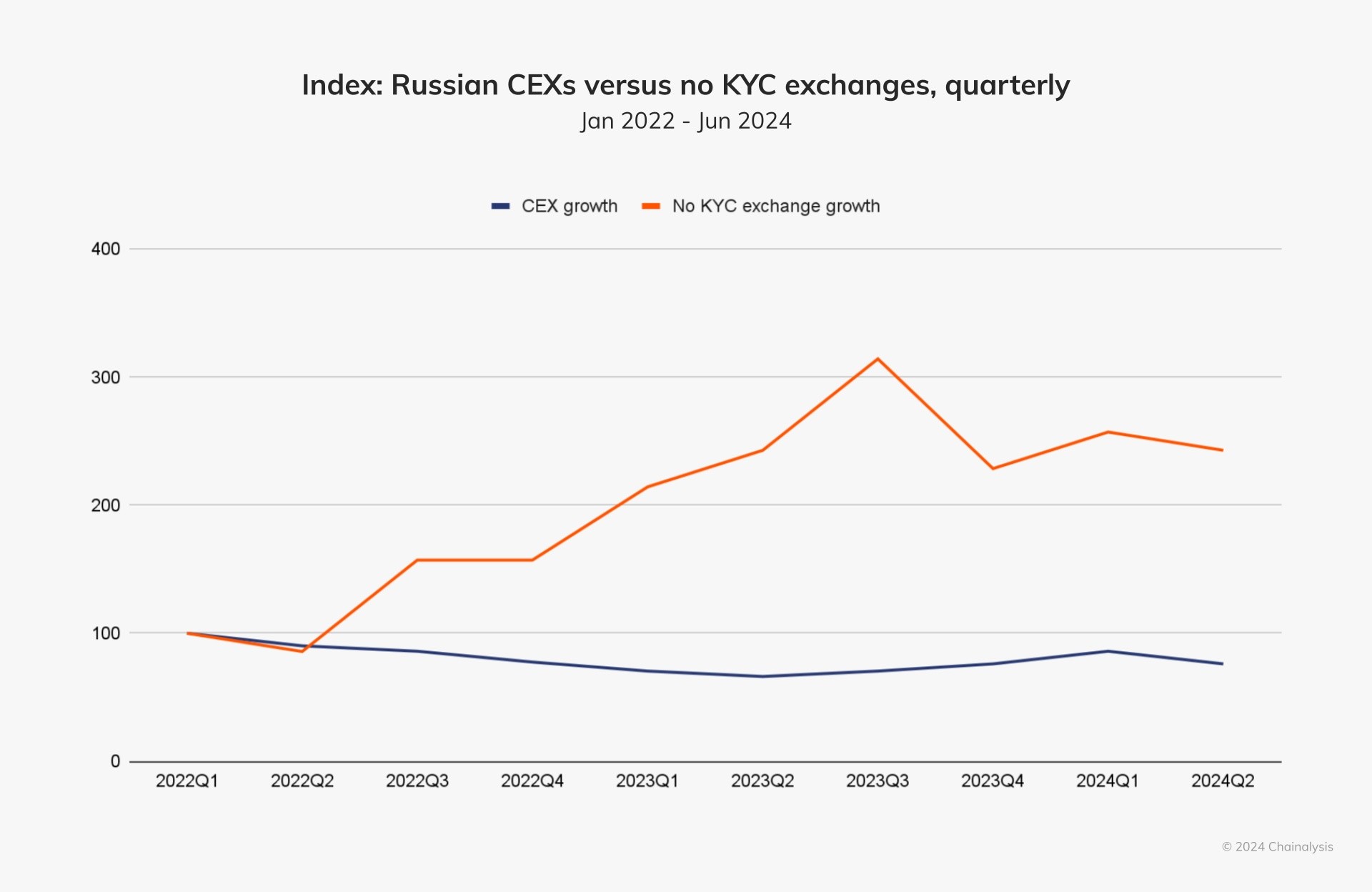
index-russian-cexs-versus-no-kyc-exchanges-quarterly

Российские центральные биржи и биржи без KYC

Возможно, благодаря этому Россия смогла подняться в мировом индексе принятия цифровых активов и теперь занимает шестое место, невзирая на экономическое давление и рост инфляции.

В течение последних двух месяцев РФ смогла обойти по этому показателю несколько стран Восточной Европы, в том числе и Украину.

Институциональные и профессиональные криптотранзакции на Украине набирают обороты, поскольку многие стремятся к финансовой стабильности, а криптовалюты считаются более безопасной альтернативой. На эту тенденцию влияют такие глобальные факторы, как волатильность рынка, инфляция и санкции, а также растущий институциональный интерес к биткоин-ETF, — заявляют аналитики Chainalysis.

Таким образом, можно констатировать, что санкции не оказали существенного влияния на российскую экономику, по крайней мере, на её крипторынок.


Пов'язані матеріали

A Threefold Performance Leap! NEAR Achieves 200ms Physical Block Time Limit with SPICE

NEAR's core development team, Near One, has announced its next major protocol evolution: SPICE (Separation of Consensus and Execution). Currently in development, SPICE represents the most significant upgrade before the full implementation of Nightshade 3.0. Its core innovation is decoupling the consensus layer, responsible for ordering transactions, from the execution layer, which processes them. This allows the consensus layer to run at full speed without waiting for transaction execution to complete. Once deployed, SPICE is projected to triple NEAR's block production speed, achieving a 200ms block time, which is considered the physical limit due to the speed of light and network latency. This leap will dramatically reduce transaction latency and finality, with transactions confirming in roughly 0.4 seconds—faster than a typical card payment. The upgrade also enables more complex, long-running transactions and significantly improves user experience for applications like NEAR Intents and near.com. Beyond raw speed, SPICE enhances network scalability and security. It enables deeper parallelism, efficiently distributing workload across shards and improving resource utilization. The simpler block structure and lighter contracts also facilitate formal verification and security auditing. Furthermore, SPICE lays the critical groundwork for future Nightshade 3.0 features, most notably atomic cross-shard transactions, which would simplify complex contract logic and eliminate development hurdles caused by asynchronous execution. The Near One team is actively developing SPICE, targeting deployment in the coming months.

Foresight News1 год тому

A Threefold Performance Leap! NEAR Achieves 200ms Physical Block Time Limit with SPICE

Foresight News1 год тому

Deep Insight: Decentralized Inference is Not Hype, but a Key Track for AI to Break Through Centralized Monopoly

Decentralized Reasoning: Beyond the Hype, a Key to Breaking AI's Centralized Monopoly A future scenario where a powerful AI model is banned by a major government illustrates the core value proposition of decentralized AI: resistance to censorship. The core bet of decentralized inference networks is mitigating this risk, with other benefits like cost being secondary. The path is extremely difficult, involving four key challenges: 1. **Running Massive Models:** Distributing a single model across a decentralized GPU swarm requires sophisticated techniques like pipeline and speculative decoding to overcome crippling network latency, aiming for usable speeds (e.g., 30-40 tokens/second). 2. **Proving Model Integrity:** Verifying that a node runs the correct model is critical. Solutions range from cryptographically secure but slow ZKML to faster, economically-secure methods like statistical fingerprints, deterministic re-execution, or live-weight proofs, each involving trade-offs between integrity, latency, and cost. 3. **Ensuring Prompt Privacy:** Simply sharding a model does not protect user inputs from nodes. Robust solutions currently require trusted hardware (TEEs) or advanced cryptography (FHE), which are not yet widely deployed in consumer swarms. 4. **Building a Real Market:** Identifying the ideal customer is tough. Beyond speculative AI agents, the viable market currently consists of startups embedding AI and projects needing batch processing (e.g., synthetic data generation), where decentralized aggregation can be an advantage over low-latency needs. The article analyzes several projects tackling these problems, such as Dolphin Network (live-weight proofs), Inference.net (statistical verification), Morpheus (TEE-based), and Darkbloom (Apple Secure Enclave). It provides a framework: decentralization is a "tax" for latency-sensitive applications (e.g., chat) but a potential supply-side advantage for throughput-oriented tasks (e.g., batch processing). The long-term vision is a closed data loop where decentralized inference generates valuable data (traces, preferences) to feed decentralized training networks, which in turn produce better open-weight models for the inference networks. A due diligence checklist advises focusing on projects that: are truly decentralized at specific layers; have a credible integrity method; offer real cost benefits; ensure genuine privacy; handle node reliability; have paying users; and are built by teams with deep AI expertise. The ultimate goal should be products that appeal beyond the crypto-native audience, using crypto mechanisms invisibly to deliver better cost, performance, or privacy.

Foresight News1 год тому

Deep Insight: Decentralized Inference is Not Hype, but a Key Track for AI to Break Through Centralized Monopoly

Foresight News1 год тому

Торгівля

Спот
Ф'ючерси
活动图片