Криптотитаны поддерживают иск компании по производству одежды против «неписаных» правил SEC

cryptonews.ruОпубліковано о 2021-02-01Востаннє оновлено о 2024-11-01

Криптофирмы и организации подали краткие записки в поддержку иска техасской компании по производству одежды и DeFi Education Fund (DEF) против Комиссии по ценным бумагам и биржам США по поводу классификации криптоактивов и отсутствия правил.

Криптокомпании и компании венчурного капитала, включая Coinbase, Andreessen Horowitz, Multicoin Capital, Paradigm, Union Square Ventures и Variant, поддержали техасскую компанию Beba и иск DeFi Education Fund в краткой записке, поданной 28 октября.

«SEC ошибается, игнорируя вред, который такие компании, как Beba, терпят от угрозы принудительного исполнения и отсутствия четких инструкций», — говорится в записке.

«SEC сделала эту угрозу «достоверной», возбудив по меньшей мере четыре иска о принудительном исполнении, утверждая, что аирдропы цифровых активов представляют собой «инвестиционные контракты» и, следовательно, сделки с ценными бумагами».

В иске, поданном в марте, содержится просьба о превентивном заявлении о том, что SEC не может обеспечить соблюдение своей «неписаной политики» о том, что большинство сделок с цифровыми активами являются операциями с ценными бумагами.

В нем конкретно упоминается бесплатная раздача или аирдроп цифрового токена швейной компании Beba, которые SEC назвала «инвестиционными контрактами» в нарушение Закона о ценных бумагах 1933 года.

В июле SEC обратилась в суд с просьбой отклонить иск, заявив, что он «преждевременен и основан на фантомной политике» и что Beba не определила правило или приказ, касающиеся политики, против которой возражает комиссия.

В заключении amicus сделано заключение, что истцы адекватно заявили о «реальной угрозе принудительного исполнения и осознаваемом вреде», а аргументы SEC об обратном должны быть отклонены, а ее ходатайство об отклонении иска отклонено.
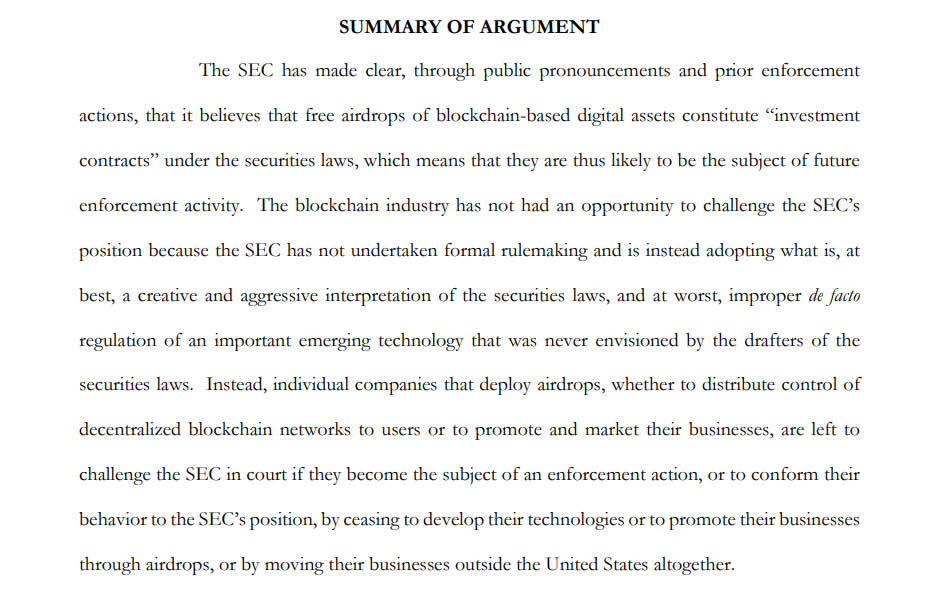

Фрагмент из заключения amicus. Источник: Law360.

Совет по блокчейну Техаса и сеть Investor Choice Advocates Network привели аналогичные аргументы в своем заключении amicus, заявив, что SEC «занимается этим непрерывным рядом мер принудительного исполнения, отказываясь при этом предоставлять общественности критически необходимые рекомендации в процессе нормотворчества».

Аналитический центр по политике в области криптовалют Coin Center, который подал отдельное заключение 22 октября, выступил в защиту спонсора Beba, DeFi Education Fund, который подал иск против SEC из-за расходов, понесенных в связи с позицией регулятора в отношении криптовалют.

«Когда такое агентство, как SEC, отказывается участвовать в разработке правил или предоставлять реальный механизм для участия заинтересованных сторон в процессе регулирования и предпочитает вместо этого доказывать свой выбор государственной политики в судах, оно не оставляет таким организациям, как DEF, никаких политических возможностей для решения своих проблем, кроме как в этих самых судах», — говорится в нем.

Пов'язані матеріали

CPU Makes a Comeback to the Table, A $170 Billion "Power Seizure" Drama Begins

A new era is dawning for the server CPU (Central Processing Unit), driven by the shift from AI model training to large-scale reasoning and the rise of Agentic AI. This article explores how the CPU is reclaiming a central role in the AI data center. For years, the focus has been on the GPU (Graphics Processing Unit) for AI training. However, as AI moves to the inference and Agent phase—where tasks involve complex, multi-step reasoning, tool calls, and data management—the workload balance is flipping. Studies show CPUs now handle over 70% of the workload in Agentic AI, up from 10-30% in training. This is because Agent tasks generate massive intermediate data (KV Cache) that exceeds GPU memory, forcing it to be offloaded to the CPU's larger, more scalable memory pools. This increased importance is translating into market changes. Major players are taking note: NVIDIA launched its first standalone CPU line, Vera, based on ARM architecture and optimized for Agent performance. AMD doubled its server CPU market forecast to over $1200 billion by 2030. Analyst reports project the total server CPU market could reach $1700 billion by 2030, with AI-driven demand being a primary driver. Furthermore, the classic ratio of CPUs to GPUs in AI servers is rapidly changing, converging from 1:8 toward 1:1 for Agent deployments. This surge in demand has led to a rare industry-wide price increase of 10-15% for server CPUs from Intel and AMD, breaking a decade-long trend of "more performance for the same price." Demand is bifurcating into high-core-count CPUs for in-rack GPU support and moderate-core CPUs for standalone Agent task orchestration. In China, this global trend presents an opportunity for domestic CPU manufacturers like Hygon (海光信息) and Huawei Kunpeng, who are bolstered by both growing AI infrastructure needs and national policies promoting technological self-reliance ("xin chuang"). The maturity of their software ecosystems is also accelerating, evidenced by faster adaptation to new AI models. In conclusion, the narrative is shifting from a GPU-centric view to one where CPU-GPU synergy is critical. The CPU is no longer a peripheral component but a performance-defining bottleneck and a key growth driver in the AI hardware stack, opening a massive new market estimated in the hundreds of billions of dollars.

marsbit8 год тому

CPU Makes a Comeback to the Table, A $170 Billion "Power Seizure" Drama Begins

marsbit8 год тому

TechFlow Intelligence: AMD AI Director Publicly Criticizes Claude Code for "Becoming Dumber and Lazier", Trump Claims Full Ceasefire in Hormuz But Strait Still Has 80 Unexploded Mines

TechFlow Intelligence Report: This daily digest covers key developments in AI, crypto, hardware, and geopolitics. In AI, SK Telecom faces US export control scrutiny over its partnership with Anthropic, while a Gemini user reports being misled in a scam scenario, sparking safety debates. China's Z.AI launches the GLM-5.2 model, rivaling Claude Opus without NVIDIA chips. In crypto, Bithumb lists ReProtocol, and Upbit delists KernelDAO. On the hardware front, MIT researchers build a custom OS to study chips, ASML denies US claims its advanced lithography machines are in China, and Amazon considers selling its in-house AI chips. Apple's future A21 Pro chip may use TSMC's latest N2P process. Major tech issues include 10,000 GitHub repositories distributing malware and Apple patching a critical eavesdropping flaw in Beats earbuds. US stocks rise, led by semiconductors, with Intel surging 10.6%, while SpaceX falls 3.5%. Geopolitically, despite a US-Iran deal, the Strait of Hormuz remains risky with ~80 uncleared mines, stalling 80M barrels of oil on standby tankers. Iran postpones Switzerland talks, and Trump calls the agreement an "unconditional surrender." The report highlights a contrast: temporary geopolitical calm versus the ongoing, fundamental restructuring of tech supply chains and chip independence.

marsbit8 год тому

TechFlow Intelligence: AMD AI Director Publicly Criticizes Claude Code for "Becoming Dumber and Lazier", Trump Claims Full Ceasefire in Hormuz But Strait Still Has 80 Unexploded Mines

marsbit8 год тому

Торгівля

Спот
Ф'ючерси
活动图片