В 2025 году токен-мем Dogecoin может подорожать на 500%

cryptonews.ruОпубліковано о 2019-11-30Востаннє оновлено о 2024-10-31

Согласно индикаторам технического анализа, в следующем году Dogecoin (DOGE) может подорожать на 500% и более. Сейчас самый популярный мемкоин выходит из трёхлетнего симметричного треугольника, который формировался более трёх лет, начиная с апреля 2021 года.
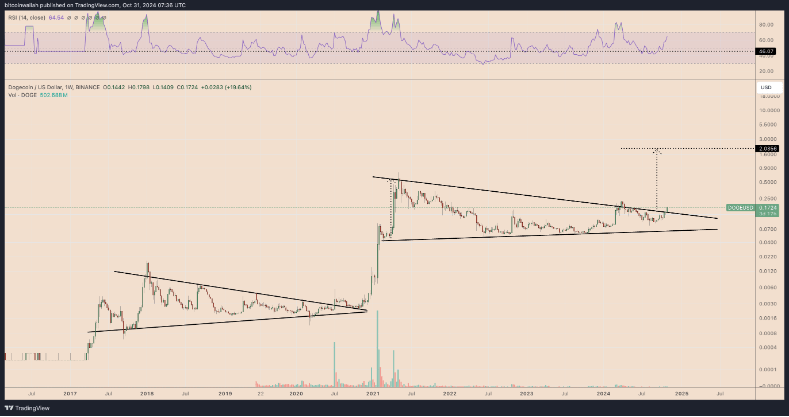
рис 1

График DOGE/USD

В техническом анализе симметричные треугольники — это модели продолжения тренда, которые обычно разворачиваются в направлении предыдущего тренда, поднимаясь на максимальное расстояние между верхней и нижней линиями треугольника.

В период с 2020 по 2021 год цена Dogecoin продемонстрировала симметричный прорыв треугольника, когда в октябре 2020 года она преодолела верхнюю линию и затем выросла на рекордные 31 375%.

По состоянию на октябрь 2024 года цена DOGE, по-видимому, достигла аналогичной точки прорыва. Если так и произойдёт, то в 2025 году токен-мем может вырасти на 500% до $1, а затем подорожать до $2.

Ещё одним важным показателем, поддерживающим бычий прогноз, является недельный индекс относительной силы Dogecoin (RSI), который в июле отскочил от зоны поддержки на уровне около 46. Исторически такие отскоки RSI часто приводили к устойчивому росту, что повышает вероятность достижения ценовой цели в $1–2.

В октябре цена DOGE выросла более чем на 75% и достигла $0,172, что стало самым высоким показателем с мая 2024 года.

Пов'язані матеріали

How Singapore's Retail Giant Masters the Gold Trade: Selling Thousands of Pounds Monthly Without Betting on Price, Gold Leasing Inspires RWA Income Design on Chain

A Singapore retail giant, Mustafa Centre, sells around 1,100 pounds of gold jewelry monthly, holding nearly a ton of inventory valued over $100 million, yet avoids gold price speculation. They achieve this by maintaining a constant inventory—buying back the exact amount of gold sold each day, earning only from sales margins, not price movements. This practice is enabled by the century-old gold leasing market. Retailers borrow physical gold to meet inventory needs without tying up capital or bearing price risk, paying a lease rate. Lenders earn yield on otherwise idle gold. This real-economy demand, driven by operational needs rather than speculation, provides a stable income stream. The article highlights how this traditional leasing model inspires on-chain Real World Asset (RWA) protocols like thUSD and thGOLD. These protocols channel gold lease yields—generated from borrowers like Mustafa—to token holders. The key challenge has been access, not yield availability. Platforms like Libeara, with institutional backing (e.g., SC Ventures), facilitate this by tokenizing funds (e.g., the MG 999 Gold Fund) that lend to vetted commercial borrowers, making this off-chain yield accessible on-chain. Thus, gold leasing demonstrates a proven, non-speculative revenue source for crypto protocols seeking sustainable "real yield," connecting physical trade finance to decentralized finance.

marsbit10 хв тому

How Singapore's Retail Giant Masters the Gold Trade: Selling Thousands of Pounds Monthly Without Betting on Price, Gold Leasing Inspires RWA Income Design on Chain

marsbit10 хв тому

Artemis: A Review of Figma's Q2 Earnings, Optimistic About Current Market Pricing

**Summary of "Artemis: Figma Q2 Earnings Review, Bullish on Current Market Pricing"** Following Figma's strong Q2'26 earnings report (revenue of $370.1M, up 48% YoY), the stock price fell 17%. The article argues this market reaction is mistaken, as it underestimates Figma's transformation from a tool for designers to the foundational design layer for all software creation in the AI era. Key supporting arguments are: 1. **Rise of the "Product Engineer":** AI is lowering coding barriers, leading to the emergence of hybrid "product engineers" who handle both engineering and design. As engineering teams are historically larger than design teams, this role significantly expands Figma's potential user base. 2. **AI Agents as Users:** The future SaaS model will charge not only for human users ("seats") but also for the work done by AI agents on their behalf. These agents will consume computational resources within Figma (e.g., editing components, converting designs to code), creating a new revenue stream. 3. **Margin Expansion:** While AI inference initially pressured gross margins, Figma's introduction of paid credits for AI usage (like Figma Make) has allowed its non-GAAP gross margin to recover to 85% in Q2'26. Monetizing its AI products further will likely drive continued margin improvement. The article acknowledges the long-term risk that AI tools like Claude could bypass the "design-to-code" workflow entirely. However, Figma's established customer base, integrated workflows, and embedded design systems act as strong moats for the foreseeable future. The author contends the market is mispricing Figma by viewing it as just a design software company. With sustained high growth (40%+ YoY revenue growth), strong Net Dollar Retention (136%), and its strategic positioning for the AI-driven future, Figma's Total Addressable Market (TAM) is much larger than currently priced. The future narrative involves more creators using Figma, more AI agents operating on its platform, and effective monetization of that AI usage.

marsbit18 хв тому

Artemis: A Review of Figma's Q2 Earnings, Optimistic About Current Market Pricing

marsbit18 хв тому

When POAP Also Reaches Its End: The Crypto Industry's 'Closure Wave' Hits, How Should Ordinary Users Cope?

The crypto industry is currently experiencing a wave of project shutdowns and closures. Notable examples include long-standing entities like the BitMEX exchange and the POAP (Proof of Attendance Protocol) project. This trend highlights a key shift: beyond major hacks or scams, many projects with real users and functional products are failing due to an inability to find sustainable business models. This signifies a structural correction, moving away from growth fueled by speculation and incentives toward projects with genuine, revenue-generating utility. For ordinary users, this "slowdown" presents new risks. The principle of "Not your keys, not your coins" addresses control but not the complete picture of asset safety. Assets in a self-custodied wallet can represent different things: native assets (e.g., ETH), protocol deposit tokens, LP tokens, or bridged/wrapped assets. If the underlying protocol, bridge, or even blockchain shuts down, the ability to redeem or exit these assets can be lost, even with the private key. The article outlines three key considerations for users: 1. **Understanding Exit Rights:** Evaluate if you can withdraw funds directly via smart contracts if a project's front-end shuts down (as with dYdX v3). 2. **Distinguishing Assets from Claims:** Recognize that tokens like renBTC are claims on assets held elsewhere; their value depends on the solvency and operation of the issuing bridge or protocol. 3. **Assessing Network Viability:** If an entire L1/L2 blockchain halts, private keys alone cannot facilitate transactions. To navigate this environment, users are advised to look beyond token prices and monitor: * **Financial Sustainability:** Is there real, non-incentivized demand and protocol revenue? * **Project Activity:** Is development active (GitHub), or is the project only maintained on social media? * **Exit Channels:** Know the exact nature, location (chain, contract), and redemption process for your holdings. In conclusion, while project lifecycles ending is a sign of industry maturation, users must develop a more nuanced understanding of self-custody. It involves not just holding private keys but also critically assessing what an asset truly represents and ensuring a viable path to exit, independent of any single project's continued operation.

marsbit21 хв тому

When POAP Also Reaches Its End: The Crypto Industry's 'Closure Wave' Hits, How Should Ordinary Users Cope?

marsbit21 хв тому

Торгівля

Спот
活动图片