Аналитики предсказывают бум GameFi к 2030 году

cryptonews.ruОпубліковано о 2023-08-28Востаннє оновлено о 2024-10-28

Рынок GameFi может вырасти до $301,5 млрд к 2030 году благодаря стремительному развитию компьютерных ролевых игр и появлению высокобюджетных проектов. К такому выводу пришли аналитики Nansen — платформы, специализирующейся на анализе блокчейн-данных и криптовалютных рынков. По данным специалистов, среднегодовой темп роста отрасли составит 68%.

Согласно последнему отчету Nansen, компьютерные ролевые игры (RPG) занимают особое место в экосистеме GameFi, составляя 22% рынка. Их успех во многом связан с возможностью децентрализованного владения внутриигровыми активами в формате NFT, включая персонажей и редкие предметы. Такой подход позволяет игрокам торговать своими достижениями, придавая им реальную ценность.
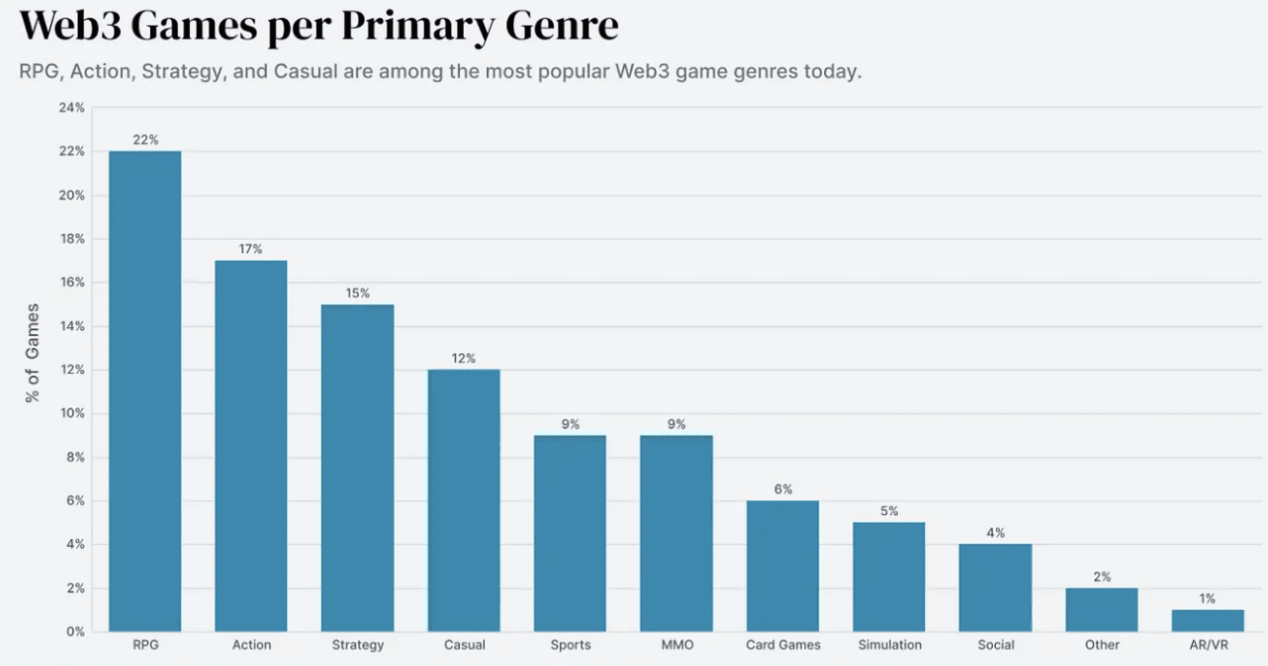
Высокобюджетные игры категории AAA и AA также укрепляют позиции в сфере Web3 GameFi, занимая 6% сектора по сравнению с 4% в традиционных Web2-играх на платформах вроде Steam. При минимальном финансировании в $25 млн и поддержке издателей, AAA-проекты демонстрируют беспрецедентное качество в сфере блокчейн-игр.

Ключевые показатели успеха GameFi

В отчете подчеркивается важность низких комиссий, высокой пропускной способности и надежной безопасности для устойчивого развития GameFi-проектов. Среди основных блокчейн-сетей OpBNB демонстрирует наиболее привлекательную для геймеров медианную комиссию в $0,0001. За ним следуют Ronin с показателем $0,00179 и Polygon PoS с комиссией $0,00293. Особняком стоит Immutable X, предлагающий бесплатное создание и передачу NFT.

Что касается скорости обработки транзакций, OpBNB в среднем обрабатывает 97 TPS при максимальной мощности в 10 000 TPS (TPS или Transactions Per Second — это количество транзакций, которые блокчейн-сеть способна обработать за одну секунду. Этот показатель является одним из ключевых параметров производительности блокчейна). Показатели других сетей скромнее: Ronin работает на уровне 20 TPS, Polygon PoS справляется с 33 TPS, а Immutable X обрабатывает 0,02 TPS. Аналитики отмечают, что текущие низкие показатели TPS свидетельствуют об отсутствии проблем масштабируемости, однако дальнейшее развитие игровой индустрии и внедрение технологии Account Abstraction потребуют существенного увеличения пропускной способности сетей.

Пов'язані матеріали

"King of Pump Calls" Arthur Hayes Strikes Again, This Time Targeting Deribit

On June 29, BitMEX co-founder Arthur Hayes purchased approximately 6.16 million SYN tokens via OTC platform Flowdesk for around $2.2 million. Hayes subsequently declared on X that SYN represents one of the most asymmetric investments he has seen since HYPE, stating it's time for an options DEX to challenge the dominant platform Deribit, and identifying Hypercall as that challenger. SYN's price surged over 40% following his comments, with a tenfold increase in June 2026 alone, bringing its FDV to roughly $110 million. The article details Synapse Protocol's evolution from a cross-chain messaging and liquidity network into the chain-based options trading protocol Hypercall. Hypercall, built on the Hyperliquid ecosystem's HyperEVM, aims to be a universal options exchange supporting any asset size with capped loss (limited to premium paid) and no forced liquidations. Deribit, established in 2016, remains the centralized leader in crypto options with an estimated 85% market share in BTC and ETH options and $3.588 billion in assets. Its strengths include deep liquidity and professional tools, but it faces criticisms over custody risk, KYC requirements, and regulatory uncertainty. The analysis positions Hypercall not as an immediate replacement for Deribit's entrenched network effects, but as a potential complementary and differentiated competitor, particularly for DeFi-native assets and new asset classes like RWA. The article concludes by noting Hayes's recent mixed "call" record, including fully exiting and later re-buying HYPE, and the controversial price target for CARDS from his family office Maelstrom, which was followed by a significant price drop.

marsbit16 хв тому

"King of Pump Calls" Arthur Hayes Strikes Again, This Time Targeting Deribit

marsbit16 хв тому

AI is Sweeping the Globe, So Why is Crypto + AI in a Slump?

AI Booms, But Crypto + AI Remains Sluggish: A Demand-Side Analysis Despite the AI industry's explosive growth and massive investment, the convergence of blockchain and AI (Crypto + AI) has seen limited traction. The core issue is a severe supply-demand mismatch, not a flawed premise. Analyzing four key sub-sectors reveals specific gaps: 1. **Decentralized Compute/Storage:** Offer logical benefits like data sovereignty and cost savings but lack a decisive technical advantage over entrenched cloud giants (AWS, GCP). Enterprises prioritize performance and stability and are unwilling to bear the switching risk and uncertainty of decentralized networks. 2. **Model Verification/Privacy (e.g., ZKML):** Address important long-term issues like auditability and data privacy, but these are not urgent operational pain points for most businesses today. Widespread demand will likely follow regulatory mandates (like the EU AI Act), not precede them. 3. **AI Agent Infrastructure:** Projects are building infrastructure for a future of autonomous, interacting agents. However, the current market focus is on internal process automation within corporate firewalls. The technology is ahead of market readiness. 4. **AI Agent Payments:** This is the only sub-sector where blockchain is on a level playing field with traditional finance. Both are trying to solve the unsolved problem of real-time, micro-transactions for machines, making it the most immediately competitive area. The overarching problem is that the AI industry invests heavily in solutions that solve immediate bottlenecks (e.g., faster memory, more power). Most Crypto + AI solutions target secondary, longer-term concerns (decentralization, transparency) and often come with performance trade-offs. The lack of a flagship, large-scale commercial success case further hinders mainstream capital inflow. The path forward requires either aligning more closely with the current industry's performance demands or patiently building the foundational infrastructure for the next phase of AI.

Foresight News26 хв тому

AI is Sweeping the Globe, So Why is Crypto + AI in a Slump?

Foresight News26 хв тому

Continuous Net Outflows from ETFs, Are Institutions Exiting?

US spot Bitcoin ETFs have experienced approximately $6 billion in net outflows over the past six weeks, marking the longest consecutive weekly withdrawal streak since their launch in 2024. The iShares Bitcoin Trust (IBIT) from BlackRock has been particularly affected, accounting for over 70% of recent outflows. On-chain analysis indicates that long-term Bitcoin holders (holding for over 155 days), who control about 83% of the circulating supply, remain steadfast. The selling pressure is primarily coming from allocators who entered through ETF brokerage accounts. This represents the first major collective capitulation since Bitcoin gained mainstream Wall Street recognition, driven more by risk-off portfolio adjustments than a fundamental rejection of the asset. Factors such as rising inflation, a hawkish shift in Federal Reserve policy, massive capital inflows into AI infrastructure, and attractive IPO opportunities have redirected speculative funds. Bitcoin, treated as a high-beta risk asset, was among the first to be sold. While the pace of outflows has slowed significantly—from $1.72 billion in early June to $226.8 million mid-month—the structural issue remains. IBIT's large size means its outflows alone exert substantial market pressure. With spot market volume thin, new capital inflows absent, and ETF buying muted, the market lacks sufficient buying support to absorb this selling. The coming sessions are critical. If IBIT outflows decelerate and Bitcoin reclaims $60,000, this phase could be seen as a healthy reset. However, if heavy IBIT redemptions resume and the price falls below $58,000, it would signal a more sustained institutional exit, requiring non-ETF buyers to shoulder the entire selling pressure alone. The ETF, while lowering entry barriers, has not removed Bitcoin's inherent volatility.

marsbit1 год тому

Continuous Net Outflows from ETFs, Are Institutions Exiting?

marsbit1 год тому

Introduction to the Concept of World Models: A Story from Psychology to the Main Battlefield of AI

**World Models: From Psychology to AI's Core Concept** "World model" is a trending but often confusing term in AI, describing a system that allows machines to internally simulate, predict, and rehearse potential outcomes before taking real-world action—like a mental "sandbox." While definitions vary—Yann LeCun emphasizes physical understanding, OpenAI's Sora is a video-based "world simulator," Google DeepMind's Genie 3 creates interactive 3D environments, and companies like Alibaba and Tesla focus on practical applications—the core goal is consistent: reduce reliance on vast real-world data by creating an internal, predictive model for safer and more efficient AI. The concept has deep roots, tracing back to psychologist Kenneth Craik (1943). In AI, it was revitalized by researchers like David Ha and Jürgen Schmidhuber (2018). Major technical approaches include: 1) generative video models (e.g., Sora) for visual realism; 2) abstract predictive models (e.g., LeCun's JEPA) for efficiency and physical reasoning; and 3) explicit 3D simulators (e.g., NVIDIA Omniverse) for precision. Fei-Fei Li proposes a classification based on the AI action loop: renderers (output observations), simulators (output world states), and planners (output actions). The emerging "World Action Model" (WAM) paradigm aims to unify future prediction and action generation. An industry framework is forming: upstream (data, compute, sensors), midstream (general and vertical platforms), and downstream applications (autonomous driving, robotics, gaming, etc.). Autonomous driving is currently the most mature use case. The current lack of a unified definition reflects the field's early, dynamic stage, similar to past tech revolutions. Different approaches—focusing on pixels, physics, or behavior—represent parallel explorations of how best to compress and understand the world. This diversity, while seemingly chaotic, signals that world models have moved from an academic idea to a critical industrial battleground, ultimately aiming to give machines the ability to understand, imagine, and reason about the world.

marsbit1 год тому

Introduction to the Concept of World Models: A Story from Psychology to the Main Battlefield of AI

marsbit1 год тому

Building the Bright Path While Secretly Crossing Chencang: Is Walsh Paving the Way for a September "Rate Cut"?

The title "Building the Plank Road Openly While Secretly Crossing at Chencang: Is Walsh Paving the Way for a September 'Rate Cut'?" suggests Federal Reserve Chair Kevin Walsh's hawkish stance may be a deliberate smokescreen. Academy Securities analyst Peter Tchir argues in a report that markets, currently pricing a 75% chance of a September hike, are missing a potential path to a September rate cut that Walsh himself might be quietly preparing. Tchir posits that Walsh's hawkish rhetoric aims to suppress long-term yield risks (with the 10-year Treasury yield falling recently) while creating room for a narrative shift based on upcoming data. The potential political endgame, according to this view, could be rate cuts in September and October, ahead of the midterm elections. This hinges on a political logic where the Trump administration's preference for lower rates remains unchanged. A core part of Tchir's argument involves redefining inflation metrics. He contends the Fed under Walsh may deprioritize the PCE index, criticizing its lagging components like Owners' Equivalent Rent (OER). Instead, he points to alternative, more real-time indicators like the New Tenant Repeat Rent Index (NTRR) and the Truflation daily index, which shows core inflation around 1.45%. He suggests the Fed could shift its data narrative to justify policy easing. Furthermore, Tchir downplays AI-driven inflation fears. He argues that consumer price sensitivity, evidenced by negative market reactions to price hikes (e.g., Apple), contradicts persistent inflation narratives. He also separates AI/data center spending—which he sees as relatively rate-insensitive—from broader consumer affordability issues, implying rate hikes are misdirected. Based on this analysis, Tchir sees a re-pricing of rate cut expectations as likely, creating opportunities in short-duration Treasuries. He maintains a neutral-to-slightly-bullish view on the long end of the yield curve. For equities, he recommends a significant overweight in energy (especially global nuclear assets) and, within defense/security themes, an overweight in biotech/pharma versus an underweight in semiconductors, expressing caution on AI/data center valuations.

marsbit1 год тому

Building the Bright Path While Secretly Crossing Chencang: Is Walsh Paving the Way for a September "Rate Cut"?

marsbit1 год тому

Торгівля

Спот
活动图片