PrimeXBT: Why did the hype of “Uptober” catch traders off guard?

bitcoinistОпубліковано о 2024-10-21Востаннє оновлено о 2024-10-21

Анотація

By Matthew Hayward, Senior Market Analyst at PrimeXBT October has historically been a strong month for cryptocurrencies, especially Bitcoin. However,...

By Matthew Hayward, Senior Market Analyst at PrimeXBT

October has historically been a strong month for cryptocurrencies, especially Bitcoin. However, we have yet to witness the impressive gains we’ve seen in previous years. Currently, Bitcoin is up over 6% for the month, which is somewhat encouraging. Given how “Uptober” began, it seemed likely that the month would end either flat or with minimal returns. So, what caused this, and why haven’t we seen the significant gains expected? If we look back to the start of October, several announcements and developments during that time contributed to Bitcoin’s initial slump earlier in the month.
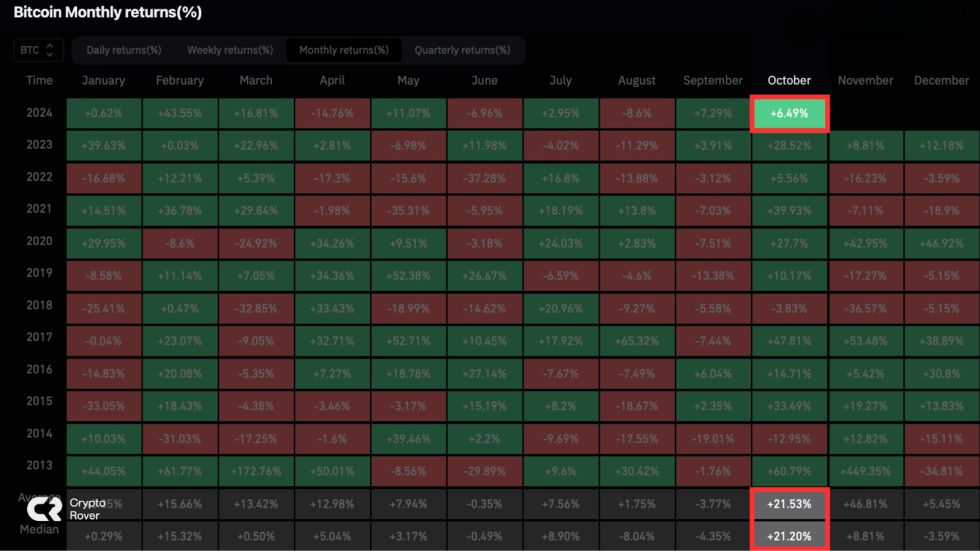
Source: Crypto Rover

Is a potential recession on the horizon?

Historically, Bitcoin and the broader cryptocurrency market have never experienced an extended period of significant uncertainty. Since Bitcoin’s creation in the late 2000s, it has only existed in the post-2008 Financial Crisis era. This raises the question: what would happen if a “Black Swan” event were to occur? How would it impact price movements and the so-called “cycle theories”?

Source: Vanity Fair


Political instability affecting current price action

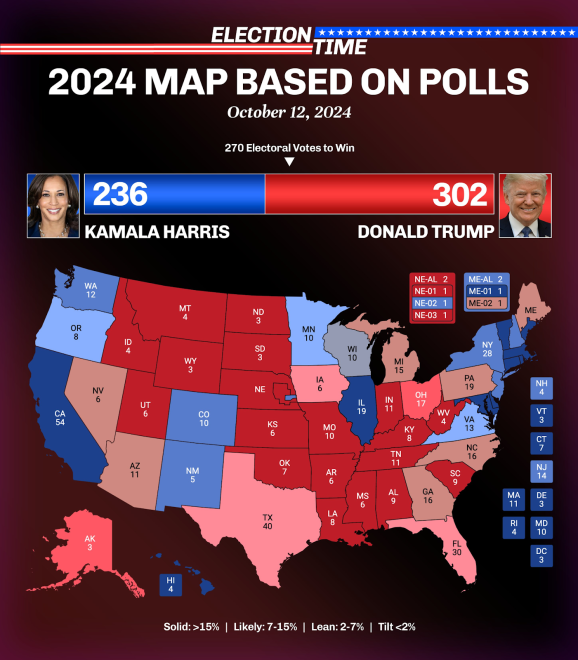
Key events we need to consider during these times come from both political and economic perspectives. Politically, the U.S. elections are just around the corner, and current polls show Trump leading in popularity. While the actual outcome will only be known on election day, history has shown that Trump’s candidacy has previously led to positive momentum for both traditional and cryptocurrency markets. He has also made clear statements supporting the adoption of cryptocurrency if re-elected, which raises the question: could this lead to greater adoption in the space? Only time will tell.
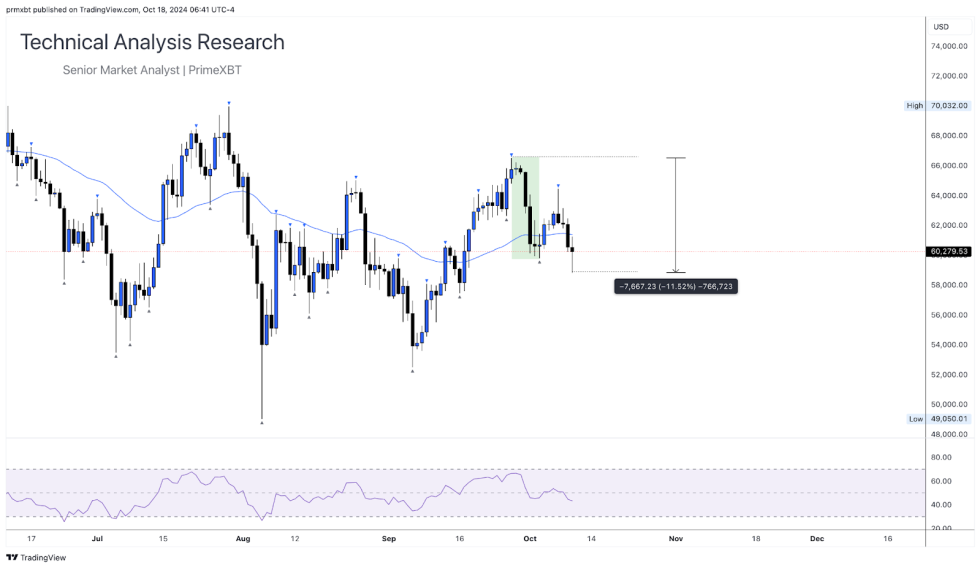
Another significant political factor affecting both traditional and cryptocurrency markets is the ongoing tensions in the Middle East. At the start of October, we saw how these developments impacted prices, with Bitcoin dropping over 11%. This decline could be a key reason why the “greater” returns many traders and analysts anticipated for October have not materialised as of yet.
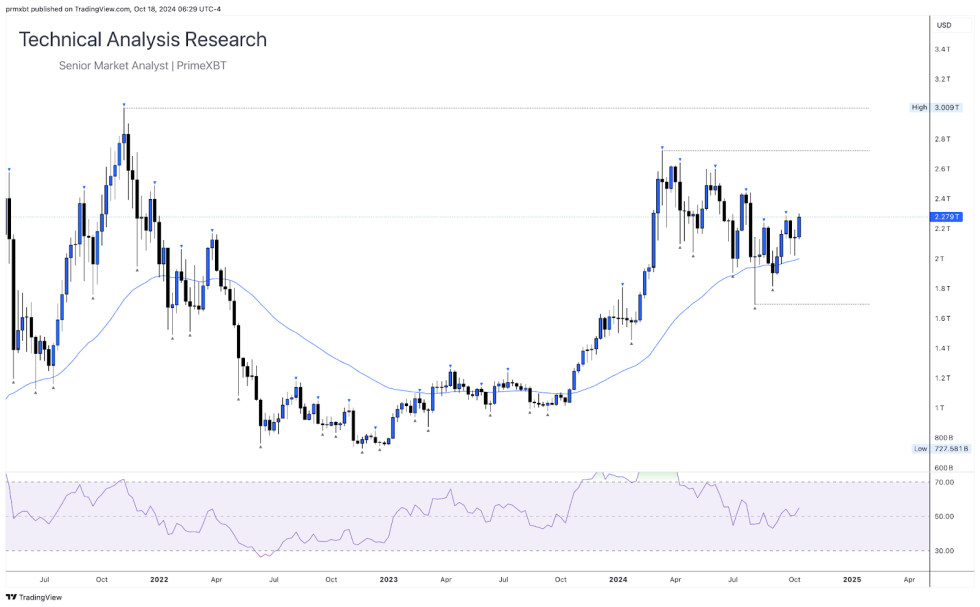
At present, the total market capitalization of the crypto market appears poised for an extended push into new areas of interest. However, these political events could have short- or long-term impacts on prices, depending on their outcomes. Additionally, there are some intriguing economic data points that continue to surprise and perplex market participants.
Continued Marco-economic uncertainty

In September, the Federal Reserve announced a significant 0.5% interest rate cut, a notable move given that rates had remained unchanged for an extended period. The last time they made such an aggressive rate cut, it coincided with the stock market collapse and the onset of the 2008 financial crisis.
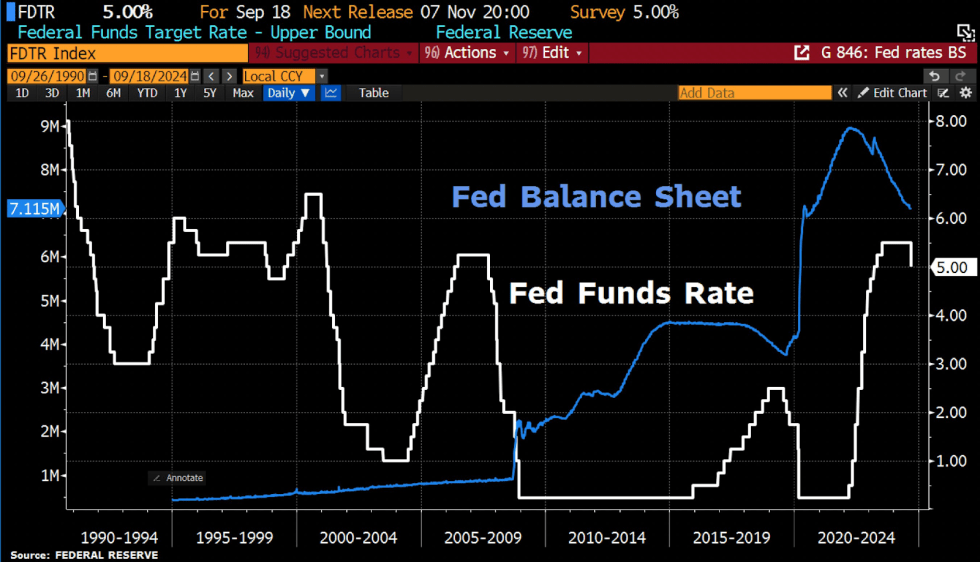
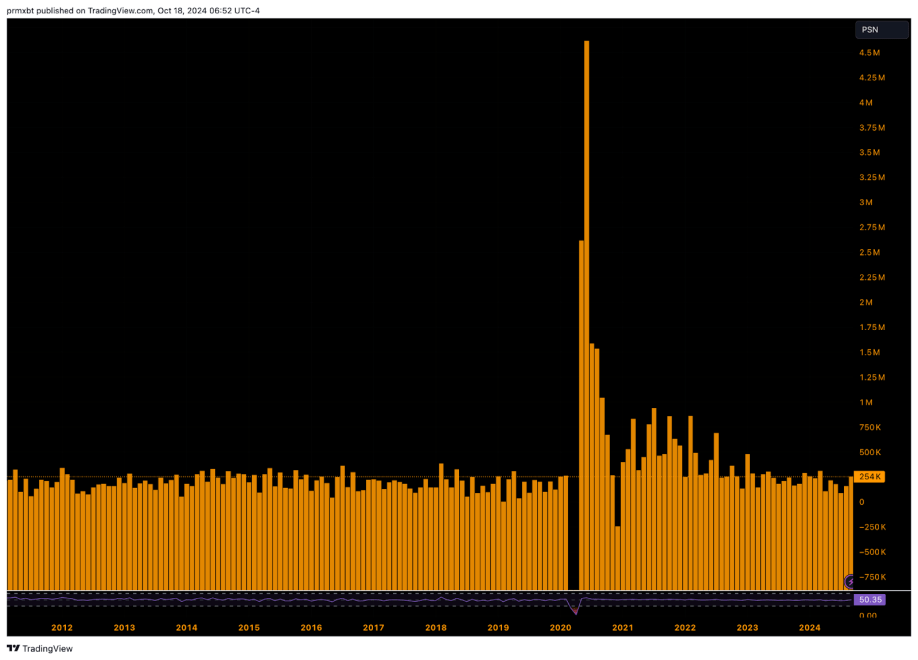
Following the announcement of the interest rate decision, Non-Farm Payroll data came in significantly higher than expected, contrasting with previous reports. The Federal Reserve had previously emphasised its intent to support the labour market, and as the elections approach, it appears to be succeeding. However, the question remains: how substantial will next year’s revisions be if these results are indeed inflated?
Source: Reuters

Is there a risk of inflation continuing to print higher?

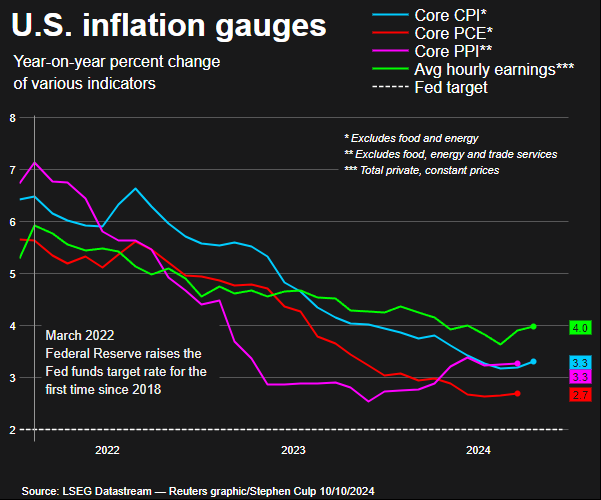
Following the Federal Reserve’s 0.5% interest rate cut and the stronger-than-expected jobs data, the focus shifted to inflation. The Fed reaffirmed its commitment to bringing inflation back to its 2% target, but traders were wary of the risk that inflation could rise after the rate cut. The latest CPI data came in slightly higher than expected at 2.4%, though just below the previous month’s figure of 2.5%. If inflation trends upward and U.S. GDP data remains flat or declines, there is a risk of “stagflation.”
So how do these events affect Cryptocurrency and markets in general?

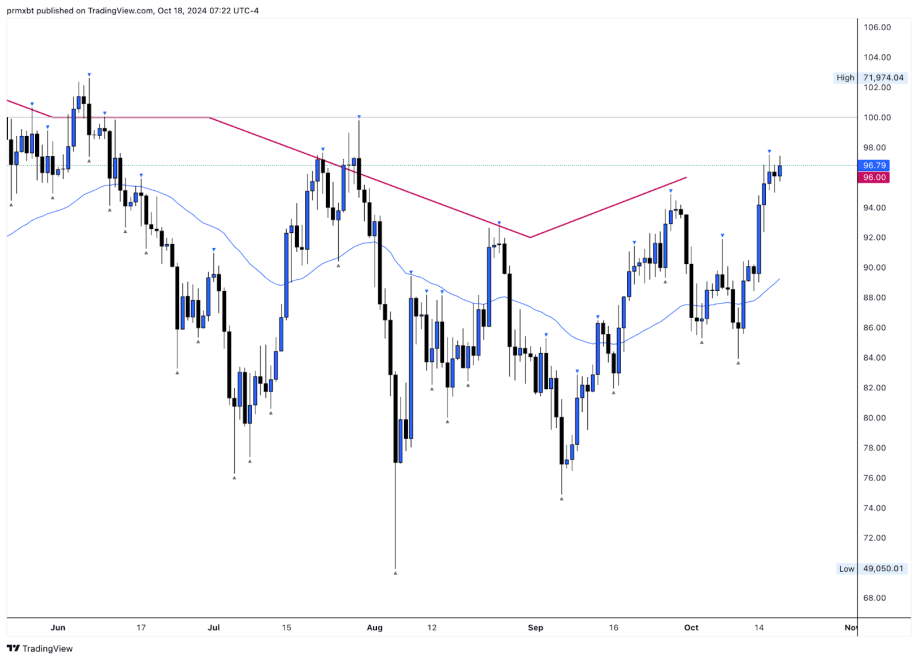
As cryptocurrency adoption becomes more widespread and larger institutional players enter the market, we can expect traditional indicators to increasingly influence how risk assets like cryptocurrencies are traded. The chart below illustrates how the slight increase in CPI results (red line) coincided with a decline in Bitcoin’s price. This highlights the importance of considering key global events when forecasting and interpreting current price movements in Bitcoin and altcoins more generally.
How to trade key upcoming events with Prime XBT

As these economic uncertainties intensify, potential trading opportunities may arise. PrimeXBT  is a leading cryptocurrency and CFD broker that provides a comprehensive trading platform for buying, selling, and storing Cryptocurrencies. The platform also offers access to over 100 popular markets, including Crypto Futures, Copy Trading, and CFDs on Cryptocurrencies, Forex, Indices, and Commodities. Users can trade using both fiat and cryptocurrency funds, making it a versatile choice for navigating the evolving macro landscape.

PrimeXBT enables investing by reducing barriers to entry and offering secure, user-friendly access to financial markets. The platform is designed to provide industry-leading trading conditions and innovative tools, making it easier for both new and experienced traders to engage with a wide range of investment opportunities.

Trade economic events with PrimeXBT

Disclaimer: The content provided here is for informational purposes only and is not intended as personal investment advice. Past performance is not a reliable indicator of future results. The financial products offered by the Company are complex and come with a high risk of losing money rapidly due to leverage. Virtual assets are inherently volatile and subject to significant value fluctuations, which could result in substantial gains or losses. These products may not be suitable for all investors. Before engaging, you should consider whether you understand how these leveraged products work and whether you can afford the high risk of losing your money. PrimeXBT does not accept clients from Restricted Jurisdictions as indicated in its website. 


Bitcoinist

Bitcoinist

Bitcoinist is the ultimate news and review site for the crypto currency community!

Пов'язані матеріали

Xing Bo Strikes Again: Last Time 'Critiquing' World Models, This Time It's Agents' Turn

Xing Bo, President of MBZUAI and professor at Carnegie Mellon University, along with co-authors Mingkai Deng and Jinyu Hou, has released a new paper, "Critique of Agent Model," critiquing the current state of artificial intelligence agents. The paper draws a crucial distinction between "agentic" systems, which rely on external toolchains, prompts, and workflows, and truly "agentive" systems capable of genuine autonomy driven by internal decision-making structures. To illustrate this, it references a real-world incident where an AI programming assistant, following an external prompt but lacking internalized judgment, caused a catastrophic data deletion. The authors propose a detailed analysis and a new framework, "Goal-Identity-Configurator" (GIC), for building truly autonomous agents. This framework systematically addresses five key dimensions where current "Agent" designs fall short: 1. **Goal:** Moving from step-by-step human instruction to a system capable of autonomously decomposing a single long-term goal and adapting sub-goals based on new information. 2. **Identity:** Evolving self-assessment updated by experience, rather than a static description in a system prompt. 3. **Decision Making:** Replacing textual Chain-of-Thought reasoning with "simulative reasoning" that uses a dedicated world model to predict real-world consequences before selecting actions. 4. **Cognitive Control:** Introducing a separate "System III" metacognitive module that dynamically decides when to deliberate, stick to a plan, or act quickly. 5. **Learning:** Enabling "continual autonomous learning," where the agent itself decides when to act, practice in simulation, or update its world model and self-perception. The GIC architecture integrates six components—a belief encoder, goal decomposer, identity evolver, configurator (System III), simulation-based planner (System II), and executor (System I)—to embody these principles. The paper argues that a growth path akin to pilot training (ground theory, simulator practice, real deployment) should be underpinned by a unified cognitive architecture, not separate workflows. On safety, the authors contend that the GIC framework's modular, explicit design enhances inspectability, allowing problematic behavior to be traced to specific components (e.g., flawed goal or poorly trained module) rather than emerging opaquely. However, they acknowledge that ultimate safety depends on correctly training these modules in the first place. In conclusion, the paper challenges the loose application of the term "Agent," asserting that task completion alone does not equal true autonomy. True autonomy requires goals, identity, and judgment to be genuinely internalized within the agent's architecture, not merely enforced by external scripts.

marsbit5 хв тому

Xing Bo Strikes Again: Last Time 'Critiquing' World Models, This Time It's Agents' Turn

marsbit5 хв тому

How Collector Crypt Uses 'Recirculating Buybacks' to Create an Illusion of Growth

Title: How Collector Crypt Creates a Growth Illusion with "Buyback Loops" Key Findings: Collector Crypt's (CC) net take rate has halved from 11.2% in Q3 2025 to 5.6% in Q2 2026, while GMV grew 4.7x. This growth is driven by higher-tier card packs ($250, $1,000, $2,500) which have lower platform dollar retention rates. The newly launched $2,500 Mythic tier captured 36.7% of June GMV within 13 days. Growth is fueled by a small cohort of high-spending, high-frequency wallets rather than broad user base expansion. The economic model faces pressure from three key areas: 1) **Shifting GMV Mix**: Pushing users towards larger, lower-retention card packs increases GMV but reduces overall profitability. 2) **Physical Redemptions**: Card redemptions for physical items remove reusable inventory from the system, creating costly replenishment needs. In May, redemptions consumed 41.6% of pre-redemption net income. Only 75 wallets drove redemptions in June. 3) **B2B/API Strategy**: Partner revenue remains negligible (cumulatively $1.83M) and dependent on CC for inventory, vaulting, and buyback services, failing to create a scalable, asset-light recurring revenue stream. The core product is a repetitive pack-buyback loop with limited secondary market activity and token value accrual. Sensitive modeling shows CC's economics turn negative when any two of the following pressures coincide: replenishment costs near market price, redemption rates exceeding 9%, or high-tier buyback rates around 93%. While CC operates in a large and growing collectibles market, its current growth levers—bigger packs, high buyback rates, and capital recycling by a few wallets—create a volume illusion without demonstrating sustainable collector engagement, deep secondary markets, or a viable path to improved margins. Future proof points include broadening collector participation, deepening secondary trading, and developing true asset-light B2B revenue channels.

Foresight News28 хв тому

How Collector Crypt Uses 'Recirculating Buybacks' to Create an Illusion of Growth

Foresight News28 хв тому

Grayscale's Latest Research: What is Solana's Next Growth Engine?

Grayscale's latest report, "Solana: Crypto's Financial Bazaar," signals a shift in how the market views Solana, moving beyond its high-performance and meme-centric reputation. The report frames Solana as an evolving application platform for large-scale economic activity, akin to a bustling digital marketplace. The analysis highlights that public chain competition has moved past raw throughput (TPS) to focus on genuine economic activity—daily users, transaction volume, and real revenue. Solana's metrics, such as over 1,000 dApps, 100M+ daily transactions, and ~4.3M daily active users, showcase this shift toward application-layer prosperity. The report identifies three key growth drivers: 1. **Jupiter**: Evolving from a DEX aggregator to a core liquidity hub and comprehensive financial platform for Solana's DeFi. 2. **Pump.fun**: Demonstrates Solana's capacity for consumer-scale applications, attracting millions of users and generating significant, sustainable revenue, validating network stability under high load. 3. **Helium & DePIN**: Represents expansion into real-world infrastructure, connecting blockchain to physical resources like wireless networks and positioning services, opening new long-term use cases. Solana Foundation's recent focus aligns with this broader vision, emphasizing AI Agents (for machine-to-machine transactions), payments, stablecoins, and Real-World Assets (RWA) to build a sustainable growth model beyond cyclical trends. While challenges remain—such as value capture for SOL and maintaining ecosystem sustainability beyond hot trends—institutional interest is growing due to Solana's maturing application business models, expanding payment/stablecoin ecosystem, and persistent developer activity. The competition is no longer about speed alone, but about which network can foster the most vibrant and valuable digital economy.

marsbit49 хв тому

Grayscale's Latest Research: What is Solana's Next Growth Engine?

marsbit49 хв тому

Торгівля

Спот
活动图片