Что ждет мемкоины: взлет или крах. Аналитики не уверены

cryptonews.ruОпубліковано о 2022-10-14Востаннє оновлено о 2024-10-14

Мемкоины продолжают быть одним из самых успешных нарративов 2024 года. Их рыночная капитализация превысила $58 млрд, и это вызывает разные мнения среди опытных инвесторов

Аналитики не могут сойтись во мнении относительно того, стоят ли мемкоины на пороге суперцикла или их ожидает серьезная коррекция.

Мнение 1: мемкоины уперлись в потолок

Инвестор Майлз Дойчер считает, что широкое обсуждение мемных монет в социальных сетях, от YouTube до X, — тревожный сигнал. По данным Kaito, доля внимания к ним достигла нового максимума — 27,32%. Доля внимания — это метрика, показывающая, какую часть внимания сообщества привлекает тема.

«Как я уже говорил, практически весь криптотвиттер продвигает нарратив о мемкоинах. Доля внимания достигла исторического максимума, но одних только обсуждений в соцсетях недостаточно для поддержания безумного роста цен, который мы видели. И по мере увеличения рыночной капитализации требуется больше капитала для поддержания импульса. Так что либо мемы сейчас перейдут в розничный сегмент, либо мы увидим локальный пик на некоторое время и дадим вещам время остыть. Лично я верю в последнее», — написал Майлз Дойчер.
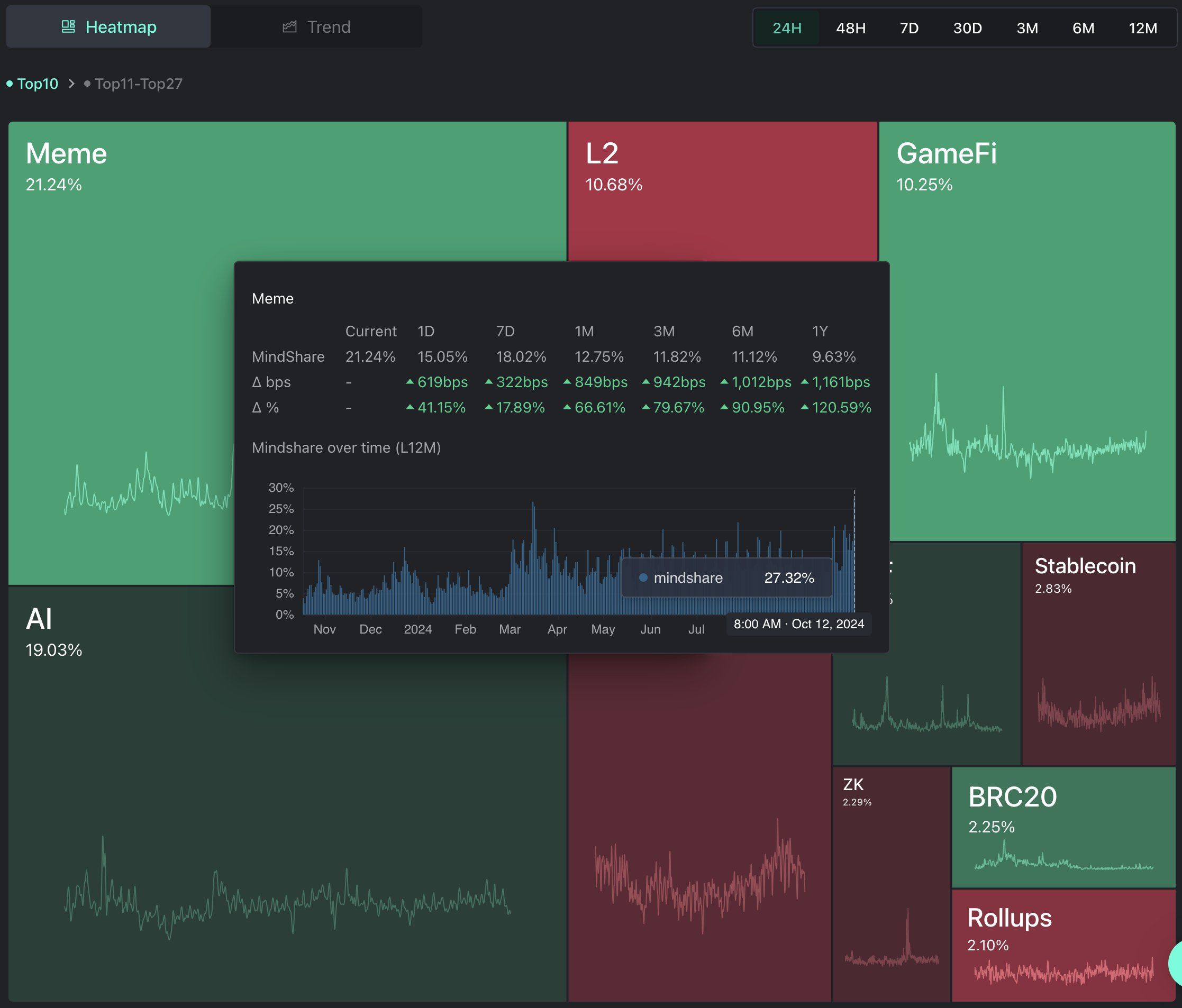
Доля внимания к мемкоинам. Источник: Kaito.

Хотя Дойчер признает долгосрочные перспективы мемных токенов, он уверен, что они стоят на распутье. Это значит, что они либо обрушатся, либо проведут коррекцию, когда хайп утихнет.

К тому же, он утверждает, что продавать альткоины сейчас, чтобы купить мемкоины, может быть не лучшей стратегией. Он рекомендует инвесторам тщательно обдумывать свои шаги перед тем, как поддаваться ажиотажу.

CrediBULL Crypto представляет менее распространенную точку зрения, подчеркивая связь между биткоином и альткоинами. Он отмечает, что взлет малокапитализированных мемкоинов на фоне стагнации монет с большой капитализацией свидетельствует о завершении цикла хайпа.

«Когда прежние лидеры среди мемных монет распродаются, капитал перетекает в менее известные мемкоины, после чего начинается общее падение. Так же, как большой сезон альткоинов начинается после достижения пика биткоином, так и большой сезон мемкоинов начинается после прохождения пика крупных мемкоинов. Это не начало вашего «суперцикла мемкоинов», это его конец», — прокомментировал CrediBULL Crypto.

Читайте также: Мемкоины становятся популярнее биткоина

Мнение 2: мемкоины входят в суперцикл

Впрочем, оптимистичные прогнозы по-прежнему не менее популярны. Например, аналитик Murad отмечает успехи за последний месяц:

«Мемкоины растут как на Solana, так и на Ethereum. Мы находимся на раннем этапе суперцикла мемкоинов», — сказал он.
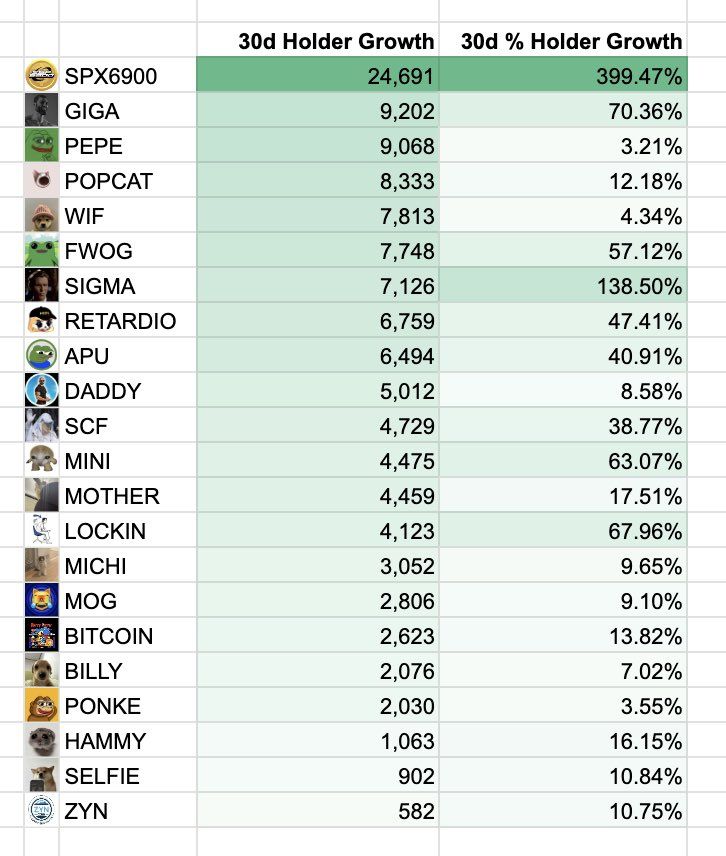
Показатели мемкоинов за прошлый месяц. Источник: Мурад

К тому же, по данным Google Trends интерес к мемкоинам остается на высоком уровне — между 75 и 100 баллами в октябре. Это говорит о том, что мемкоины продолжают привлекать новых инвесторов на рынок.
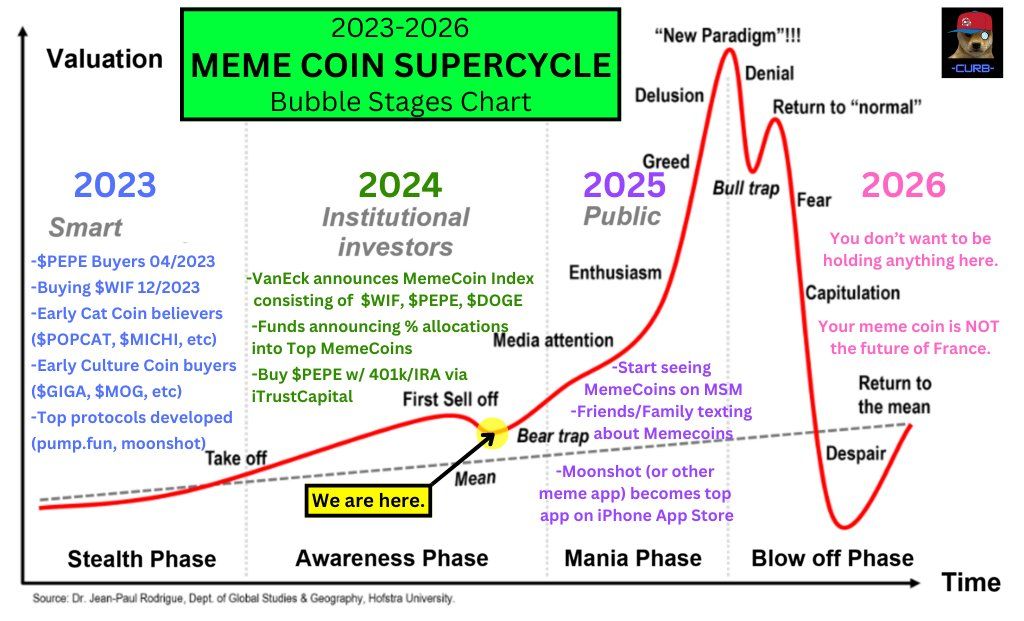
Суперцикл мемкоинов. Источник: Curb

Инвестор Curb использует модель роста пузыря и на ее основании предсказывает, что мемкоины только начинают свой цикл. На момент написания статьи рыночная капитализация этого сегмента крипторынка достигла $58,3 млрд, увеличившись на 2,8% за последние 24 часа, согласно данным Coingecko.


Пов'язані матеріали

Super Spiral Mega-Boom, Micron's Earnings Report Rekindles the Semiconductor Bull Run

On June 25, 2026, Micron Technology released its blockbuster Q3 FY2026 results, significantly exceeding market expectations and reigniting confidence in the semiconductor bull market. Revenue soared to $41.456 billion (vs. ~$35.4B expected), up 346% year-over-year, while GAAP net profit surged nearly 15 times to $28.243 billion. Guidance for Q4 was even more striking, with projected revenue of approximately $50 billion, far surpassing prior estimates. The report highlighted that the AI boom is now fueling growth across Micron's entire product stack, not just HBM. Cloud memory, core data center, SSD, mobile, and automotive businesses all saw revenue growth exceeding 250-600%, with margins hovering around 80%. While HBM4 is already in volume shipment and 2026 capacity is sold out, AI-driven demand is also tightening supply for traditional DRAM and NAND, sustaining a strong pricing cycle. A pivotal development is Micron's shift toward a "demand-first" model. The company disclosed 16 long-term strategic customer agreements (SCAs), most spanning 5 years to 2030, covering about 20% of DRAM and one-third of NAND shipments. These are take-or-pay contracts, with 14 agreements already securing roughly $100 billion in guaranteed future revenue and $22 billion in customer performance assurances. To fulfill this locked-in demand, Micron plans substantial capacity expansion, with Q4 capital expenditure projected at ~$10 billion. This investment, backed by concrete long-term orders rather than cyclical speculation, marks a historic change for the memory industry. Following the earnings release, Micron's stock surged 16% after-hours, lifting the broader semiconductor sector globally. The report served as a powerful signal that AI infrastructure build-out is accelerating, with memory positioned as a central protagonist in the ongoing narrative.

Odaily星球日报11 хв тому

Super Spiral Mega-Boom, Micron's Earnings Report Rekindles the Semiconductor Bull Run

Odaily星球日报11 хв тому

Deciphering the Ethereum Foundation's New Structure: Reaffirming Self-Sovereignty Amid Institutionalization Trends

Summary: The Ethereum Foundation (EF) has announced a major restructuring, laying off 20% of its staff and introducing a new five-layer operational framework. This move aims to clarify the EF's mission and reaffirm Ethereum's core principle of self-sovereignty amidst growing institutionalization in the crypto space. The five layers are: 1. **Protocol Layer**: Focuses on maintaining Ethereum's foundational "CROPS" values—Censorship-resistant, Robust, Open, Private, and Secure. This involves core technical work like secure hard forks and mitigating toxic MEV. 2. **Access Layer**: Ensures users can practically exercise self-sovereignty through actions like reading the chain and making transactions. A key principle is the "zero option," meaning a trusted, non-intermediated path must always exist as an alternative to any centralized service. 3. **User Layer**: Bridges the protocol and access layers by grounding EF's work in the real needs of users and organizations. This is seen as crucial for moving beyond a purely research-driven approach and ensuring development effectively serves the ecosystem. 4. **Community Layer**: Responsible for building and maintaining consensus around Ethereum's core values both internally and externally. This involves guarding against centralization, upholding technological neutrality, and preventing short-term commercial interests from undermining CROPS principles. 5. **Institutional Layer**: Manages EF's engagement with institutions, but with the precondition of self-sovereignty. The goal is not to make it easier for institutions to control users, but to demonstrate how Ethereum's technology can enable better integrations. The article argues that while institutional adoption brings legitimacy, it also risks diluting crypto's foundational ethos of decentralization. The new structure represents EF's effort to navigate this tension, upholding its core mission while actively engaging with a broader, more complex ecosystem.

marsbit29 хв тому

Deciphering the Ethereum Foundation's New Structure: Reaffirming Self-Sovereignty Amid Institutionalization Trends

marsbit29 хв тому

OpenRouter: How Did This 'AI Model Relay Station' Achieve a $10 Billion Valuation?

OpenRouter: The Model Router Building a $10B+ Company This article explores OpenRouter, a platform that aggregates access to over 400 AI models from 70+ providers (like OpenAI, Claude, Gemini) through a single API. It has grown into a unicorn with a $1.3B valuation by 2026, processing massive scale—reaching 100 trillion tokens monthly. Its core value isn't just being a "model supermarket." For developers building real-world AI applications, managing multiple models for different tasks (e.g., cheap models for titles, powerful ones for long articles) is complex. OpenRouter acts as a critical "model scheduling layer," handling routing, failover between providers, cost optimization, and enterprise features like zero-data-retention policies and budget controls. OpenRouter's business model is a "toll fee": it charges a small platform fee (5.5%) on purchased credits while passing model costs directly to users. Its revenue scales with the tokens flowing through its system, which saw explosive growth as AI apps evolved. Key growth drivers include: 1) The explosion of specialized models, increasing choice complexity; 2) AI apps shifting focus from performance to cost optimization; 3) The rise of AI agents that require more reliable, multi-step model calls. However, risks remain. Large enterprises or cloud providers (AWS, Google Cloud) could build similar internal gateways. Its position between model suppliers and developers could also create future tension over pricing and data control. To stay ahead, OpenRouter must deepen its enterprise features and prove it's more than just a request forwarder.

marsbit48 хв тому

OpenRouter: How Did This 'AI Model Relay Station' Achieve a $10 Billion Valuation?

marsbit48 хв тому

Bitcoin Falls Below $60,000 Again; After 20 Months, We've Reached a New Low

Bitcoin Drops Below $60,000, Hitting a 20-Month Low Bitcoin fell below the key $60,000 psychological level again, reaching a low of $59,023—its lowest point in approximately 20 months, dating back to October 2024. While it later recovered slightly to around $60,600, this marks its third significant breach of $60,000 this year. The downturn is attributed to two primary factors. First, U.S. spot Bitcoin ETFs are experiencing their longest streak of net outflows since launch, with nearly $5.94 billion withdrawn over 30 days. This creates sustained selling pressure as Authorized Participants sell Bitcoin to meet redemptions. Second, shifting macroeconomic expectations are adding pressure. Strong U.S. job data and hawkish remarks from Fed officials have increased market pricing for potential rate hikes, reversing the earlier liquidity-driven bullish sentiment and prompting a shift away from risk assets like Bitcoin. Analyst views are mixed. 21Shares maintains a bullish long-term outlook, expecting prices to recover towards $100,000, citing historical post-halving cycles and substantial ETF holdings as a base. In contrast, Arthur Hayes predicts a potential bottom around $40,000 within six months due to persistent Fed hawkishness. CryptoQuant suggests, based on on-chain data, that the market may not find a bottom until prices fall below the average investor cost basis around $53,000, potentially extending the bearish phase into late 2026 or early 2027. The immediate focus is on upcoming U.S. inflation data and Fed signals. Lower-than-expected CPI could offer relief, but confirmation of sticky inflation or continued ETF outflows may lead to further downside pressure. Bitcoin's ability to hold above $60,000 remains a critical test for the near-term market direction.

Odaily星球日报1 год тому

Bitcoin Falls Below $60,000 Again; After 20 Months, We've Reached a New Low

Odaily星球日报1 год тому

Торгівля

Спот
Ф'ючерси
活动图片