一文盘点比特币生态的 「Pump.fun」

Odaily星球日报Опубліковано о 2024-10-08Востаннє оновлено о 2024-10-08

Анотація

比特币生态也有「Pump.fun」?

原文作者:shaofaye 123 ,Foresight news

2024 年回报率最高的投资是什么?毫无疑问当属 Memecoin。从 Base 的 Degen 到 Solana 的 Bome,千万倍神话在 Memecoin 上接连诞生。大小写 Neiro 之争,河马引发的动物园热潮,Memecoin 似乎从不缺炒作角度,不断带来新的财富效应,吸引各链纷纷入局。Sunpump 拉高 TRX 前高,Vista 带领 ETH Gas 回暖,在今年仅有的 42 个表现优于 BTC 的项目中,Memecoin 就占有 15 个之多。如今各链 Pump.fun 仿盘已是百花齐放,作为加密货币真正的黄金,比特币生态和 「Pump.fun」 结合,又会有什么样的火花?

本文将带你盘点那些比特币生态下的 「Pump.fun」。

BounceBit

BounceBit Club

BounceBit 是 BTC 原生再质押链,主要为不同的再质押产品提供基础层。BounceBit Club 是 BounceBit Chain 上的生态系统。它集成了交易、AI、GameFi、DeFi Farm 等元素。同时也提供 Memecoin 的创建和发行。相比于其他发行平台,BounceBit Club 上的 Memecoin 发行平台则更系统更简洁。同时,BounceClub 还宣布将加入现有的 Memecoin 社区,来促进 BounceBit 原生 Memecoin 的发展,其发射阶段采用与 Pump.fun 类似的 Bonding curve,市值达到 72000 个 BB 后将加池子,销毁全部 LP 底池。

一文盘点比特币生态的 「Pump.fun」

Fractal Bitcoin

Satspump.fun

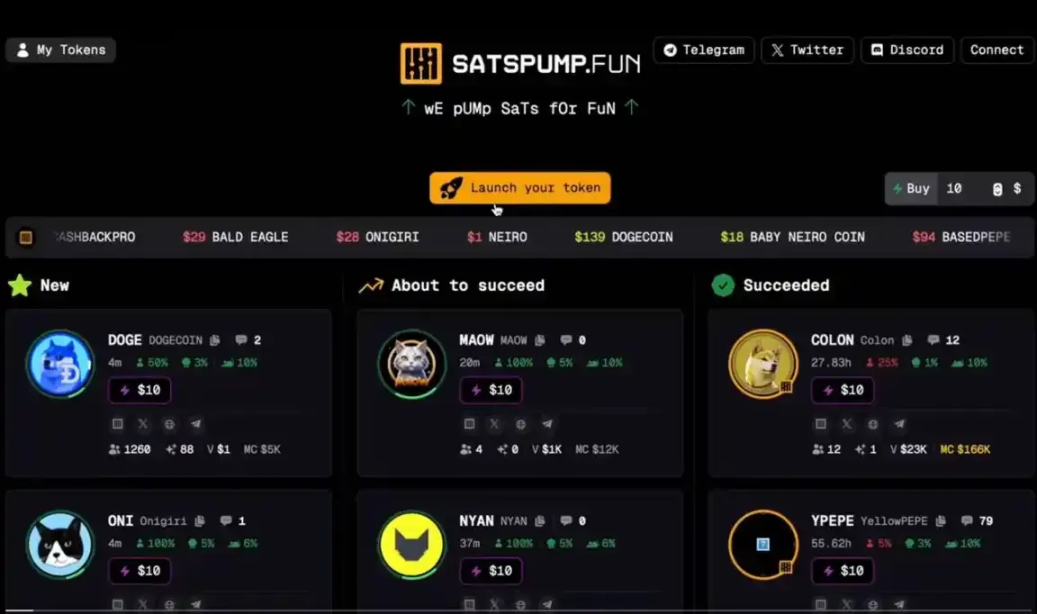
Satspump.fun 是比特币扩展网络 Fractal Bitcoin 上的 Memecoin 发行平台,目前该平台已与比特币生态链游基础设施 UniWorlds、Nodino BTC 等平台达成合作。官方曾于 8 月 9 日宣布进行一次 BRC-20 空投,凡在钱包中持有价值 300 美元的白名单 BRC-20 代币(ORDI、SATS、PIZZA、SHNT、WZRD、HONK、RATS)或 3 个位图的用户均有资格获得本次空投。Satspump.fun 声称采用了 CAT_ 20 技术,在代币市值达到联合曲线目标后将把流动性迁移至 DotSwap V3 AMM Swap 进行交易。
一文盘点比特币生态的 「Pump.fun」

Lightning Network

Lnpump.fun

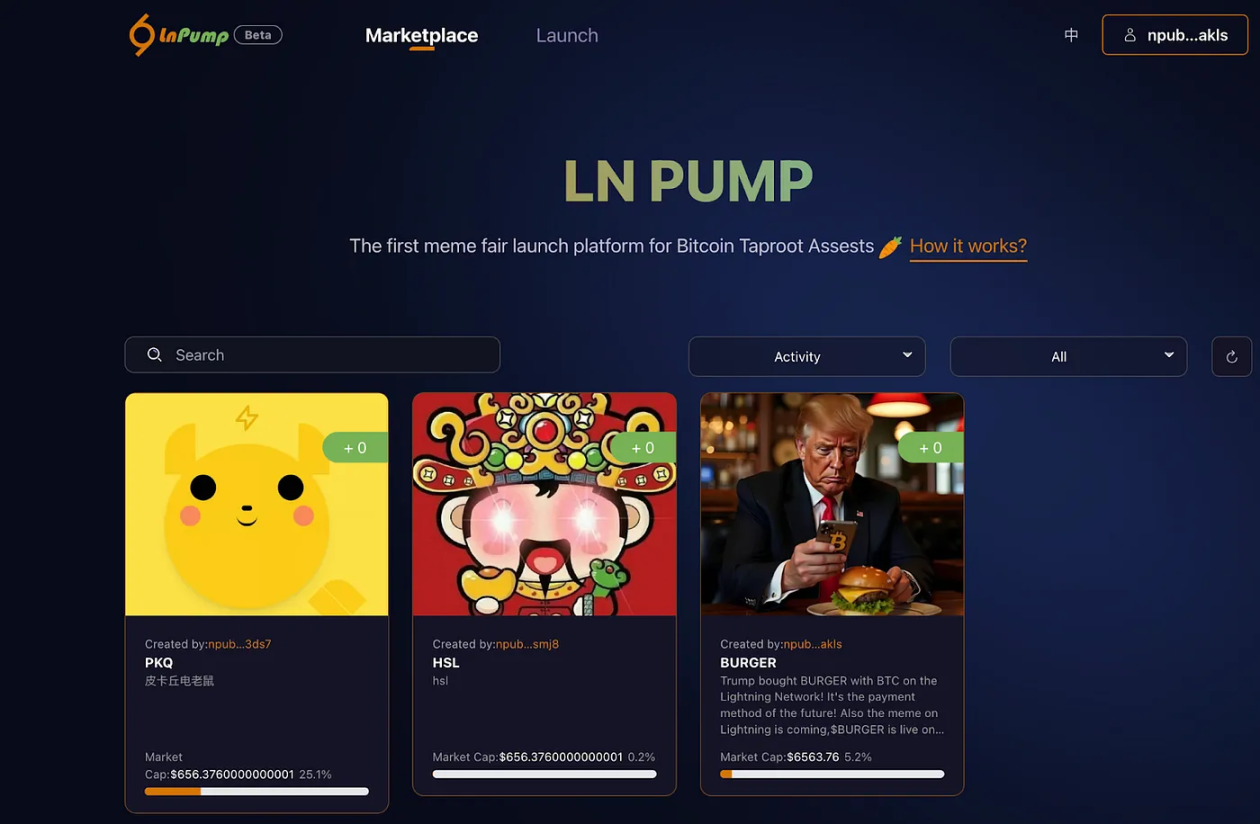
2023 年 10 月,Lightning Labs 发布了 Taproot Assets 协议。Taproot Assets 支持在比特币和闪电网络上发行稳定币和其他资产,且这类资产基于比特币 Script 脚本可编程特性控制发行,完全去中心化,并最终通过闪电网络落地应用。Lnpump.meme 是在闪电网络的 Meme 发行平台。相较于 pump.fun,Lnpump 采用的是相同价格公平发射铸造的方式分发代币,避免内池 PVP。发射完毕后,所有铸造费用进入底池,用涨价拍卖的方式回购已铸造的代币,当底池价格与拍卖价格持平后拍卖结束,开始公开交易。(该项目处于极其早期阶段,随时有 RUG 风险。)
一文盘点比特币生态的 「Pump.fun」

Botanix

Bitzy.app

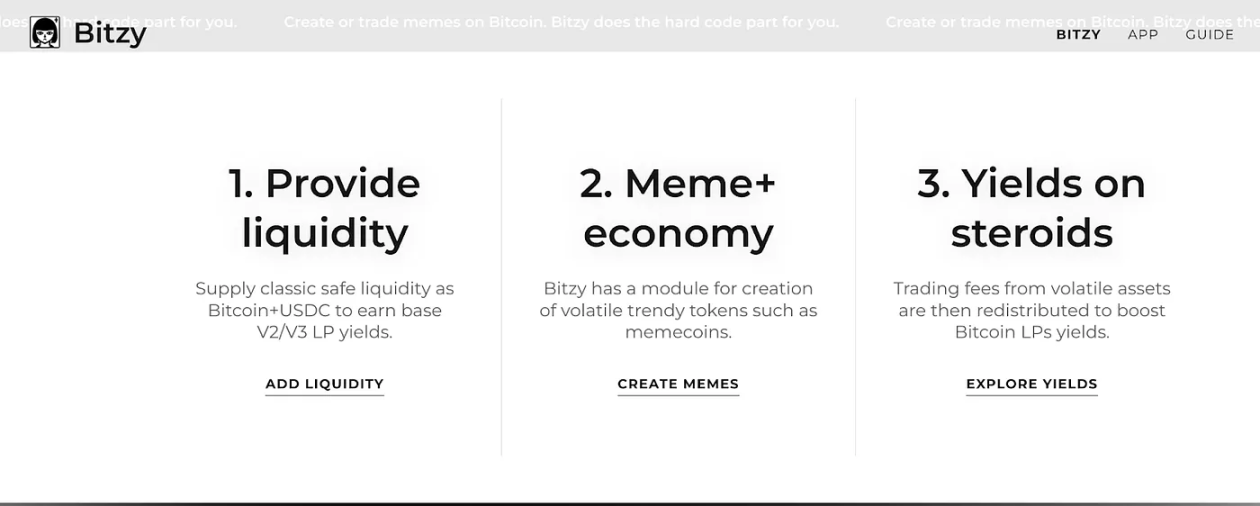
Botanix 是比特币上去中心化的 2 层 EVM,将比特币的安全性和去中心化与 EVM 的易用性和多功能性结合,目前已经上线测试网。该生态的 Meme 发行平台是 Bitzy.app,其宣称「点击两次和零代码」创建代币,有一定空投预期。
一文盘点比特币生态的 「Pump.fun」

CORE

Cpump.fun

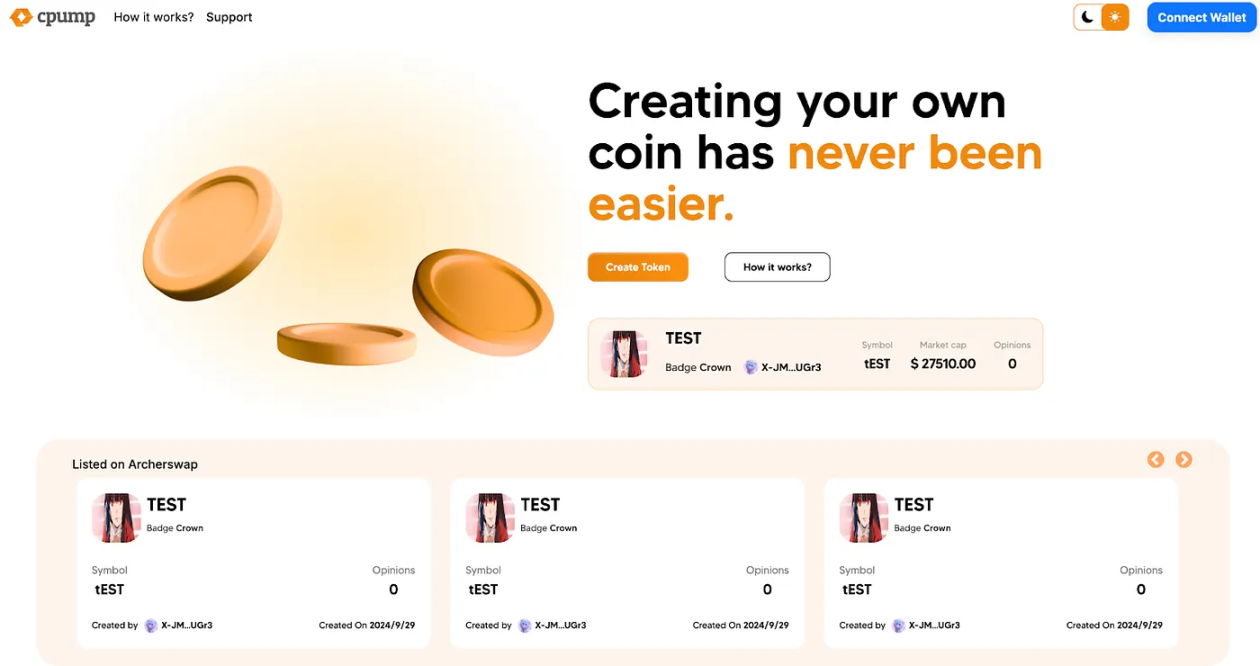
CORE 在宣布进军比特币生态以后,主链代币一个月内达 6 倍涨幅,其下生态也相对丰富。Cpump.fun 作为基于 CORE 链的的 Meme 发射平台,基本玩法与 Pump.fun 类似,初始阶段按照 Bonding curve 进行交易。相比于 Pump.fun,Cpump.fun 在市值达到 23 K 就可以加底池进行流动性迁移,将迁移至 Archerswap 进行交易。
一文盘点比特币生态的 「Pump.fun」

Stacks

Stx.city

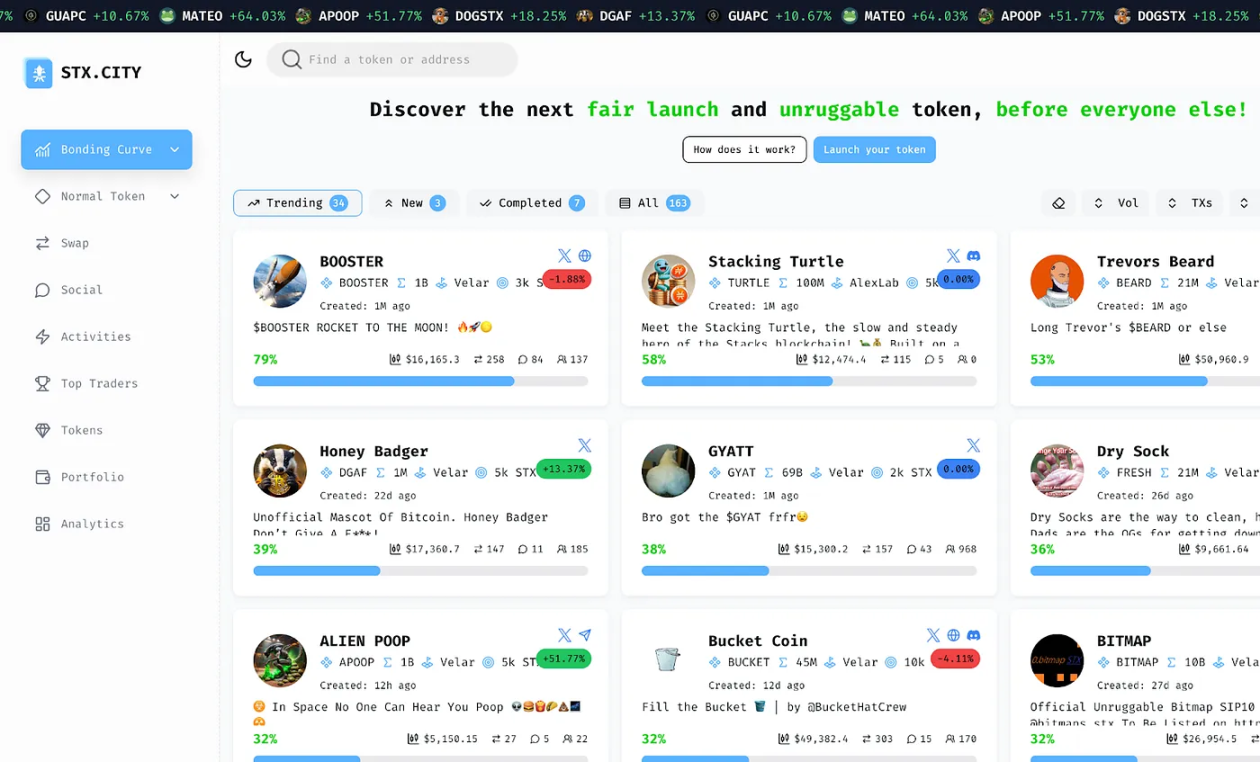
Stacks 是比特币 L2,采用金字塔方法,在底部有基础结算层,可添加智能合约和可编程性层。Stx.city 是该链 Meme 发射平台。在原有的 Bonding curve 交易完成之后,合约会燃烧剩余代币的 20% ,并与收到的 STX 配对添加初始流动性,底池 LP 全部销毁。在销毁代币和 LP 双重利好加持下,早期更易推高代币价格。
一文盘点比特币生态的 「Pump.fun」

结语

在加密用户呼唤公平发射和厌倦了 VC 币的社区情绪下,Meme 发行平台已成为每条公链传统标配四件套(稳定币、跨链桥、Swap、借贷)后新增的「第五件套」。从铭文和符文来看,比特币生态存在并且需要 Memecoin,但似乎并不一定建立在 Pump.fun 上,比特币生态需要自己独特的 Memecoin 发行方式。

本文特别感谢: 1783 DAO.eth

Пов'язані матеріали

In the Era of Agent Users, Where Does Crypto Value Flow?

Title: Who Makes Money from Agents? The rise of AI Agents as potential blockchain users raises a crucial question: if they become the next billion users, who will capture the value? Traditional crypto value capture theories—like "fat protocols" (where value accrues to the base layer) and "fat applications" (where value accrues to user-facing apps)—assume human users who value UX, brand, and convenience. Agents, however, operate differently: they interact via APIs, have no brand loyalty, and can switch services with near-zero cost. This shift could disrupt existing value flows. Applications might become "headless," offering their routing and infrastructure as APIs to Agents. Alternatively, Agents might bypass intermediaries entirely, allowing protocols to regain value capture ("fat protocols" reborn). A more extreme scenario is that Agents, being purely rational and cost-sensitive, could commoditize the entire stack, compressing margins toward marginal cost and turning crypto into a low-margin utility. However, Agents may not just amplify existing activities; they could enable entirely new ones—like continuous, sub-penny portfolio rebalancing, machine-to-machine commerce, and new market types only viable at automated speeds. This expands the economic pie rather than just redistributing it. Ultimately, the key question for builders is: what will make an Agent return to your service instead of a cheaper alternative? The answer may not be UX but factors like liquidity, latency, settlement guarantees, or a yet-unnamed business model. As humans and Agents will coexist as users, value capture may split: "fat apps" for human-facing services, and a new, evolving model for the Agent-dominated layer.

marsbitЩойно

In the Era of Agent Users, Where Does Crypto Value Flow?

marsbitЩойно

Base MCP, The Next Step for x402

Base has officially launched Base MCP, allowing users to connect their Base Account to AI Agents to perform actions like swaps, transfers, portfolio tracking, and transaction history queries through conversational commands. This move aligns with Base's strategic focus on AI, driven by the broader competition in the emerging Agent-to-Agent payment sector. The evolution of Agent payments has accelerated. In late 2024, the primary method involved insecure browser automation. By 2025, solutions like Coinbase's x402 (providing crypto wallets for Agents), Google's AP2, and Visa's token-based system emerged. x402 has since processed 176 million transactions totaling over $70 million, with a median value between $0.01 and $0.10. Stablecoins, particularly USDC, dominate these settlements due to their negligible transaction costs compared to traditional payment fees, which are prohibitive for micro-payments. Coinbase faces competition from Stripe, which has built a comparable infrastructure for Agent payments with its Tempo blockchain, Privy wallets, Bridge routing (acquired for $1.1B), and the recently launched MPP protocol. Both companies are now competing at the application layer. The core reason AI is central to Base's strategy is to expand the scenarios for Agent payments, ensuring more transactions occur on its network. By securing a dominant position and scale advantage in this nascent field, Coinbase aims to capture the future commercial potential of Agent-driven payments. The launch of Base MCP is thus a strategic step in this larger ambition.

marsbit6 хв тому

Base MCP, The Next Step for x402

marsbit6 хв тому

Reframing Ethereum's Valuation: Why the Fee Model is Wrong, and the 'Treasury Logic' is the Future?

"Rethinking Ethereum's Value: The 'Vault Logic' Framework" Traditional valuation models incorrectly treat Ethereum as a company, valuing ETH based on transaction fees ("revenue"). This is flawed. Fees are network friction; a successful network aims to reduce them to zero. Ethereum's average fee has dropped from over $50 in 2021 to around $0.20 today, while transaction volume has tripled. Instead, view Ethereum as a digital vault securing ~$250 billion in on-chain assets (stablecoins, RWAs, L2 bridged funds, wBTC, etc.). Post-merge, Ethereum's security is directly purchased with its own asset: ETH. To attack the network, an attacker must acquire and control staked ETH. Therefore, the vault's security level is intrinsically tied to ETH's market value. Currently, the value of all staked ETH is only ~$72B, protecting ~$250B in assets—a dangerous imbalance. For robust security, the staked ETH securing the network should be valued significantly *higher* than the total value it protects. Applying a conservative security multiplier suggests ETH's fair value should be closer to ~$6,900 (vs. ~$2,070 currently). As on-chain asset value grows into the trillions, ETH's price must rise proportionally to maintain this security budget. Comparisons to free infrastructure like Linux or low-margin utilities like the DTCC are misguided. Their security is provided externally (community, law, banks). Ethereum's security is internal and must be purchased in the open market using ETH. ETH is not the clearinghouse; it is the collateral backing it. The model is not a short-term price predictor but a structural framework. The economic force for ETH appreciation grows monotonically with the adoption of Ethereum for settling value. The narrative that high fees are good is backwards; low fees enable more activity, which increases the value needing protection, thus demanding a more valuable ETH.

marsbit12 хв тому

Reframing Ethereum's Valuation: Why the Fee Model is Wrong, and the 'Treasury Logic' is the Future?

marsbit12 хв тому

Justin Sun’s Interview with Hurun Report: A New Order and Certainty for Value Flow in the Era of Transformation

In an interview with *Hurun Report*, Justin Sun, founder of TRON, discussed the evolution of the Web3 industry as it moves from initial exploration to large-scale adoption. He emphasized that the core value of blockchain lies in building an open and inclusive internet of value, enabling anyone globally to transfer and use funds efficiently and at low cost, regardless of location or access to banking. Sun highlighted that projects with lasting impact are those built on genuine demand and real-world usage. He pointed to the stablecoin payment ecosystem as the most mature and scalable application currently, noting that TRON has rapidly become one of the world's largest stablecoin networks. The circulation of USDT on TRON has surpassed $86.3 billion, driven by actual use cases such as cross-border transfers and daily payments, demonstrating strong network effects. Regarding strategy, Sun outlined a methodology combining data-driven iteration, rapid execution, and user-centric focus. He cited the decision to partner with Tether to launch TRC-20 USDT as a key strategic move, based on an assessment of market trends and long-term potential, which has become a significant growth engine for the TRON ecosystem. On globalization, Sun stressed the importance of local compliance and cultural adaptation, noting that success in different markets depends on deep understanding and local partnerships. He also addressed the convergence of AI and blockchain, describing it as a transformative direction where blockchain provides decentralized infrastructure for AI, while AI enhances the intelligence and user experience of blockchain systems. For industry participants and young entrepreneurs, Sun advised continuous learning and adaptability in a fast-changing environment, focusing on building irreplaceable core strengths rather than spreading resources too thinly. Through infrastructure development, global strategy, and technological foresight, TRON aims to advance the practical implementation and evolution of the value internet.

marsbit44 хв тому

Justin Sun’s Interview with Hurun Report: A New Order and Certainty for Value Flow in the Era of Transformation

marsbit44 хв тому

Samsung Leverages Technology Cycles, SK Hynix Relies on HBM, What Enabled Micron to Win a Trillion-Dollar Market Cap?

Micron Technology, the Idaho-based memory chip maker, recently saw its market cap surpass $1 trillion, securing its position as one of the top three DRAM manufacturers alongside Samsung and SK Hynix. Its survival and growth story is marked by a unique combination of political maneuvering and hard-won manufacturing efficiency, but also strategic missteps that now challenge its future. Founded in 1978 in Boise without significant government or capital backing, Micron repeatedly turned to Washington for survival during critical junctures. In the 1980s, it filed anti-dumping complaints against Japanese firms, leading to the U.S.-Japan Semiconductor Agreement. Ironically, this created an opening for Samsung, which Micron had earlier licensed its 64K DRAM technology to. In 2002, Micron avoided heavy fines in a price-fixing investigation by acting as a whistleblower against its competitors, cementing its reputation as a "political opportunist." A major strategic error occurred in 2013 with its $2.5 billion acquisition of bankrupt Japanese firm Elpida. This deal burdened Micron with integrating incompatible manufacturing processes just as the industry was pivoting toward HBM (High Bandwidth Memory), a critical technology for AI. SK Hynix had launched its first HBM chip that same year. By the time AI demand exploded with ChatGPT in 2022, SK Hynix commanded about 85% of the HBM3 market, while Micron, playing catch-up, held only around 3%. In 2017, Micron employed similar tactics against a new competitor, Chinese startup Fujian Jinhua, by alleging intellectual property theft, which led to U.S. sanctions effectively crippling the firm. However, this strategy backfired in 2023 when China banned Micron's products from its critical infrastructure, causing its revenue share from China to plummet from 14% in FY2023 to just 7.1% by FY2025. Today, Micron faces a triple squeeze: it lags in the high-margin HBM race, faces pricing pressure in low-end DRAM from Chinese manufacturers like CXMT, and has lost crucial access to the booming Chinese AI server market. Despite its political strategies, Micron's core strength is its exceptional manufacturing cost control, achieved through decades of engineering. Its DRAM chips have a smaller cell area than its rivals, yielding more chips per wafer. This efficiency has been vital for weathering industry downturns. However, this advantage cannot compensate for the decade lost in HBM development. Micron is now racing to ramp up production of its HBM3E, certified by NVIDIA, and develop HBM4. Its future hinges on whether it can close this technological "time debt" through relentless R&D and execution, in a marathon where its competitors, having started earlier, are not slowing down.

marsbit1 год тому

Samsung Leverages Technology Cycles, SK Hynix Relies on HBM, What Enabled Micron to Win a Trillion-Dollar Market Cap?

marsbit1 год тому

Торгівля

Спот
Ф'ючерси

Популярні статті

Як купити PUMP

Ласкаво просимо до HTX.com! Ми зробили покупку Big Pump (PUMP) простою та зручною. Дотримуйтесь нашої покрокової інструкції, щоб розпочати свою криптовалютну подорож.Крок 1: Створіть обліковий запис на HTXВикористовуйте свою електронну пошту або номер телефону, щоб зареєструвати обліковий запис на HTX безплатно. Пройдіть безпроблемну реєстрацію й отримайте доступ до всіх функцій.ЗареєструватисьКрок 2: Перейдіть до розділу Купити крипту і виберіть спосіб оплатиКредитна/дебетова картка: використовуйте вашу картку Visa або Mastercard, щоб миттєво купити Big Pump (PUMP).Баланс: використовуйте кошти з балансу вашого рахунку HTX для безперешкодної торгівлі.Треті особи: ми додали популярні способи оплати, такі як Google Pay та Apple Pay, щоб підвищити зручність.P2P: Торгуйте безпосередньо з іншими користувачами на HTX.Позабіржова торгівля (OTC): ми пропонуємо індивідуальні послуги та конкурентні обмінні курси для трейдерів.Крок 3: Зберігайте свої Big Pump (PUMP)Після придбання Big Pump (PUMP) збережіть його у своєму обліковому записі на HTX. Крім того, ви можете відправити його в інше місце за допомогою блокчейн-переказу або використовувати його для торгівлі іншими криптовалютами.Крок 4: Торгівля Big Pump (PUMP)Легко торгуйте Big Pump (PUMP) на спотовому ринку HTX. Просто увійдіть до свого облікового запису, виберіть торгову пару, укладайте угоди та спостерігайте за ними в режимі реального часу. Ми пропонуємо зручний досвід як для початківців, так і для досвідчених трейдерів.

313 переглядів усьогоОпубліковано 2024.12.12Оновлено 2025.03.21

Як купити PUMP

Обговорення

Ласкаво просимо до спільноти HTX. Тут ви можете бути в курсі останніх подій розвитку платформи та отримати доступ до професійної ринкової інформації. Нижче представлені думки користувачів щодо ціни PUMP (PUMP).

活动图片