Джесси Коломбо: Биткоин не оправдывает звание «тихой гавани» для инвесторов

cryptonews.ruОпубліковано о 2024-02-03Востаннє оновлено о 2024-10-03

Экономический аналитик и автор Forbes Джесси Коломбо заявил, что биткоин не оправдывает звание «тихой гавани» для инвесторов в период глобальных международных потрясений.

Джесси Коломбо (Jesse Colombo) отметил, что на фоне обострения международной ситуации и открытого противостояния Израиля и Ирана, биткоин, в отличие от золота, в очередной раз разочаровал инвесторов, которые использовали первую криптовалюту для хеджирования рисков.

«Биткоин не является безопасным убежищем для инвесторов и его ценовая парадигма скорее соответствует поведению рискового актива, чем настоящей тихой гавани. Если бы биткоин был действительно “цифровым золотом”, то в периоды геополитических потрясений он должен был бы расти, а не снижаться», — заявил Коломбо.

Он добавил, что контрастные движения золота и биткоина не являются аномалией, а демонстрируют ожидаемую реакцию рынка на геополитические потрясения. Например, аналогичная картина наблюдалась во время иранских ударов по Израилю в апреле. Более того, такое же ценовое поведение золота и биткоина было отмечено после нападения со стороны Сектора Газа на Израиль 7 октября 2023 года.

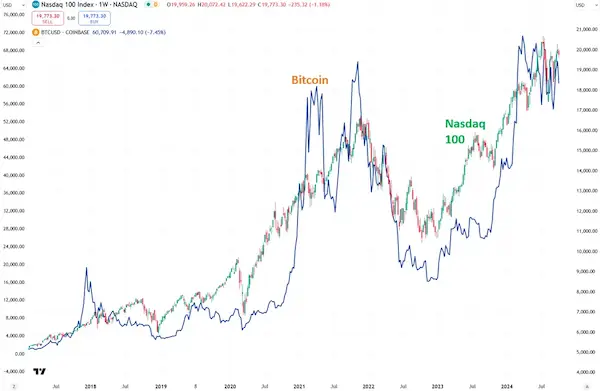
«Биткоин ведет себя как спекулятивный высокорисковый актив, похожий на акции “горячих” технологических компаний, а не как актив-убежище. Это очевидно из того, насколько тесно график движения цены биткоина отслеживает технологичный индекс Nasdaq 100. Данные показывают поразительный коэффициент корреляции 0,88 (из 1) между биткоином и Nasdaq 100 за последние пять лет, что подтверждает их прочную связь», — заявил Коломбо.
295.png

Эксперт предположил, что сильная корреляция между биткоином и акциями технологических компаний, вероятно, обусловлена значительным совпадением инвесторов — тех, кто очарован и чрезмерно уверен в современных технологиях.

Однако, существует множество показателей, указывающих на то, что беспрецедентная накачка и стимулирование технологических компаний со стороны Федеральной резервной системы (ФРС) США привели к формированию огромного пузыря Nasdaq 100 из-за сильно раздутого соотношения цены к продажам. Как и все пузыри, Nasdaq 100 обязательно лопнет, и когда это произойдет, биткоин, скорее всего, будет утянут за собой из-за их тесной корреляции, полагает Коломбо.

Ранее эксперты JPMorgan предположили, что вложение 1% активов в биткоин может стать оптимальным способом хеджирования рисков, связанных с волатильностью традиционных классов активов, таких как акции, облигации или сырьевые товары.


Пов'язані матеріали

Bitwise Chief Investment Officer: STRC Plunge is a Bottom Signal, Bull Market to Start in Autumn

Bitwise CIO: STRC's Plunge Signals Market Bottom, Bull Run Likely This Fall Bitwise CIO Matt Hougan analyzes the recent sharp decline of Strategy's perpetual preferred shares (STRC) and its implications for the bitcoin market. STRC, a product designed for stable, high-yield income, fell dramatically from its $100 target to $75 amid concerns about Strategy's ability to maintain dividends as bitcoin prices dropped. While Strategy's overall balance sheet remains strong, with ample assets to cover liabilities, market panic stemmed from its right to suspend STRC dividends. In response, Strategy introduced a new framework, committing to sell bitcoin as needed to fund dividends and allowing STRC to float freely, abandoning the $100 peg mechanism. This shift marks a change in Strategy's role from a consistent net buyer to a more dynamic participant in the bitcoin market. Hougan views the STRC volatility and related sell-off in MicroStrategy (MSTR) stock as classic late-cycle behavior, where mismatched leverage is being purged from the system. He draws parallels to the GBTC premium unwind after the 2021 bull market. This necessary deleveraging, he argues, is a precursor to finding a market bottom. Key bottoming signals to watch include MSTR trading at a discount to its net asset value (NAV), crypto fear & greed indices hitting extreme lows, and sustained negative bitcoin funding rates. Hougan concludes that as excess leverage is cleared, the market is nearing its bottom, setting the stage for a new bull cycle to begin in the autumn. The next major wave of buyers, he believes, will be institutional investors like banks, asset managers, and pension funds.

marsbit22 хв тому

Bitwise Chief Investment Officer: STRC Plunge is a Bottom Signal, Bull Market to Start in Autumn

marsbit22 хв тому

The Largest Upgrade Since The Merge? How Glamsterdam Will Affect Ethereum?

Ethereum's next major upgrade, Glamsterdam (combining consensus layer "Gloas" and execution layer "Amsterdam"), is scheduled for late 2026 and considered the most significant overhaul since The Merge. It aims to fundamentally enhance L1 performance and architecture to prepare for substantial capacity increases. The upgrade centers on three core changes: 1. **Enshrined PBS (ePBS - EIP-7732):** Integrates the Proposer-Builder Separation directly into the protocol, eliminating reliance on external relays. This extends the window for processing execution payloads, allowing nodes more time to handle larger blocks and more data, paving the way for a higher Gas Limit. 2. **Block-Level Access Lists (BALs - EIP-7928):** Provides a pre-declared "map" in the block header of all state data (accounts, storage) that transactions will access and modify. This enables potential parallel transaction processing and faster state synchronization for nodes. 3. **Gas Repricing (EIP-8037):** Overhauls the gas model to more accurately reflect the real resource costs for nodes. It separates computation costs from state storage costs, making operations that create permanent state data (like new accounts) more expensive, while computation-heavy operations become relatively cheaper. These changes work together to solve the trilemma of scaling: giving nodes more time to process larger blocks (ePBS), reducing execution bottlenecks (BALs), and controlling unsustainable state growth (Gas Repricing). The goal is a credible path to a higher Gas Limit (e.g., 200M gas) without compromising decentralization by overburdening node hardware. For users: * Transaction fees for simple transfers may decrease and become more stable due to increased block space, but state-intensive operations (contract deployment) may cost more. * Gas estimation by wallets will improve in accuracy. * L2 data posting costs could become more stable long-term due to increased Blob capacity. * EIP-7708 will standardize logs for ETH transfers, improving tracking for wallets and exchanges. Node operators must upgrade clients, but ETH holders need take no action. In essence, Glamsterdam doesn't just raise the block size limit; it re-engineers Ethereum's core block production, execution, and economic models to enable sustainable, decentralized scaling.

marsbit1 год тому

The Largest Upgrade Since The Merge? How Glamsterdam Will Affect Ethereum?

marsbit1 год тому

Торгівля

Спот
活动图片