Over $32 Million Gone As Crypto Robberies Surge Across Europe: Blockchain Investigator

bitcoinistОпубліковано о 2024-09-30Востаннє оновлено о 2024-09-30

Анотація

Crypto thefts are hitting new highs, and the latest incident underscores this alarming trend. Recently, hackers stole a staggering $32.4...

Crypto thefts are hitting new highs, and the latest incident underscores this alarming trend. Recently, hackers stole a staggering $32.4 million worth of spWETH, a token tied to staked Wrapped Ether.

This crime is just one of several that have occurred in Europe in recent months, as fraudsters focus more on digital assets. With the value of cryptocurrencies increasing, it appears that these attacks are becoming more regular and profitable.

Blockchain Sleuth Notes Increase In Crypto Crimes

Crypto detective ZachXBT has noticed the growing number of physical robberies directed against individuals working or operating in the cryptocurrency space.

Those are armed robberies wherein usually, a hostage is held at gunpoint and forced to hand over his/her digital assets. In this sense, the growing cases only point out to the increasing danger that players in the crypto world face, especially professional traders and other personalities in this field.
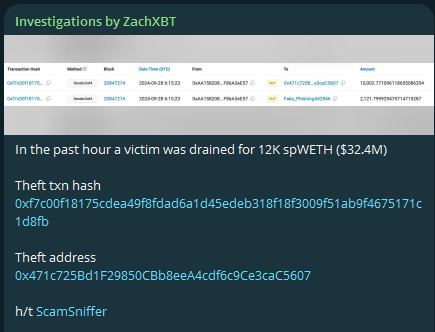
ZachXBT noted that Western Europe has recently turned out to be a hotspot for such violent robberies, with multiple known bitcoin traders getting robbed. That being said, there have even been shootings during the robberies in the past couple of months.

As of today, the market cap of cryptocurrencies stood at $2.19 trillion. Chart: TradingView.com

The Rising Tide Of Cybercrime

According to a TRM Labs research, hackers stole almost $1.4 billion in cryptocurrencies in the first half of 2024 alone—twice the amount stolen during the same period last year.

But most striking is that average amounts stolen in an attack have gone up by 150%. Centralized finance platforms have been very popular, accounting for an astonishing 70% of all losses. The trend is such that with climbing crypto values comes an increasing number of hackers looking to cash out.

The largest heists this year include DMM Bitcoin, which lost over 4,500 bitcoins worth around $305 million. Large-scale thefts are not isolated incidents; they are the result of a deliberate strategy by cybercriminals to exploit flaws in centralized systems. The methods employed frequently involve compromising private keys or exploiting flaws in smart contracts.

A Shift In Tactics

It is very interesting that, as the year continues, decentralized banking systems were later on attacked while the focus had shifted to centralized exchanges. Such a development holds the view that attackers are tailoring their operations based on where they see the most opportunity. Recently, attacks have made people sit and ask what security procedures these platforms use.

Germany’s law enforcement has taken significant steps to combat this issue by seizing 47 digital currency exchanges believed to be facilitating money laundering for cybercriminals. The trades were anonymous, which allowed the users to engage in the activities with a low risk of being uncovered. Officials claimed that they will continue with the tracking of transactions and gathering of information from these sites and will use it in punishing the culprits.

Featured image from GV Wire, chart from TradingView

Christian Encila

Christian Encila

Christian, a journalist and editor with leadership roles in Philippine and Canadian media, is fueled by his love for writing and cryptocurrency. Off-screen, he's a cook and cinephile who's constantly intrigued by the size of the universe.

Пов'язані матеріали

In the AI Era, What's Left for Bitcoin?

As Bitcoin falls below $60,000, the author reflects on the relationship between AI and Bitcoin, seeing them as two sides of the same coin. In the AI era, the cost of generating content has plummeted, making fake text, images, and videos increasingly easy and cheap to produce. This has led to a fundamental shift: while AI dramatically lowers the cost of information production, it also undermines trust and authenticity online. What becomes truly valuable is not more content, but the ability to verify what is real—"verifiability." This perspective offers a new lens for Bitcoin. Its massive energy consumption, often criticized as wasteful, is reinterpreted. While AI burns energy to enhance "capability" and efficiency, Bitcoin burns energy to produce "verifiability." Its purpose is not to be trusted but to enable a system where no trust in intermediaries—banks, platforms, or developers—is needed. Every transaction and the entire ledger's history is secured by cryptography and a decentralized network of nodes, making it independently verifiable. AI cannot forge a transaction on the Bitcoin network because the system is designed for proof, not generation. The author draws a historical parallel to the Renaissance: the printing press drastically reduced the cost of copying knowledge, while double-entry bookkeeping reduced the cost of trust in commerce. Today, AI is the new printing press, reducing content creation costs to near zero. Blockchain, and Bitcoin as its pioneer, may be the modern equivalent of double-entry bookkeeping—a foundational technology for verifying digital asset ownership and historical records without centralized authorities. Thus, AI and blockchain are not competitors. AI lowers the cost of creation; blockchain lowers the cost of verification. In an age where AI can generate anything, true scarcity may lie not in more content, but in independently verifiable facts. Whether the market will reprice Bitcoin accordingly remains uncertain, but its core value proposition as a "machine for producing verifiability" becomes strikingly relevant.

marsbit1 год тому

In the AI Era, What's Left for Bitcoin?

marsbit1 год тому

In the Age of AI, What's Left for Bitcoin?

Author: Sevclub, Seven Research Amid Bitcoin's recent drop below $60k, the author reflects on a growing sense that AI and Bitcoin are two sides of the same coin. Today, encountering any content triggers a new default question: "Was this made by AI?" The cost of generating convincing text, images, and video is now negligible. While the internet lowered information *distribution* costs, AI is crashing information *production* costs to near zero. The consequence is a flood of content where truth and falsehood are increasingly indistinguishable. In this environment, what becomes truly valuable is not more information, but the ability to verify what is real—"verifiability." This reframes the common criticism that Bitcoin "wastes electricity." AI consumes power to produce "capability" (e.g., more powerful models). Bitcoin consumes power to produce something else: "verifiability." Bitcoin's core purpose isn't about belief or trust in any institution, developer, or even its creator. It's about enabling independent verification. Every bitcoin's origin, every transaction, and the integrity of the entire ledger are secured by mathematics, cryptography, and a global network of nodes. AI can fabricate convincing media, but it cannot falsify a transaction on the Bitcoin network. The expended energy makes篡改历史 (tampering with history) prohibitively expensive, purchasing a globally verifiable ledger. The author draws a historical parallel to the Renaissance. The printing press drastically reduced the cost of copying knowledge, while double-entry bookkeeping reduced the cost of trust in commerce—one enabled creation, the other verification. Today, AI is the new printing press, driving content production costs toward zero. The question becomes: what is this era's "double-entry bookkeeping"? Blockchain appears to be the leading candidate. It doesn't verify which news is true or which image is real, but it provides a foundational layer for independently verifying asset ownership and historical records in the digital realm without centralized authorities. Therefore, AI and blockchain are not in competition. AI lowers the cost of *generation*. Blockchain (and Bitcoin as a prime example) lowers the cost of *verification*. One creates, the other proves. Whether Bitcoin ultimately succeeds remains uncertain, facing potential challenges from quantum computing, regulation, and technical evolution. However, the author now sees it less as a "machine for making bitcoin" and more as a "machine for making verifiability." In an age where AI can generate anything, true scarcity may no longer be "more content," but "more independently verifiable facts." Whether the market will price this accordingly is a separate question.

链捕手1 год тому

In the Age of AI, What's Left for Bitcoin?

链捕手1 год тому

Торгівля

Спот
活动图片