Эксперты BlackRock провели детальный анализ Биткоина. Стоит ли инвестировать в криптовалюту во время кризиса?

cryptonews.ruОпубліковано о 2024-02-29Востаннє оновлено о 2024-09-29

Крупнейшая инвестиционная компания мира BlackRock выпустила отчёт о роли Биткоина как инструмента для диверсификации портфеля. В целом инвестиционный гигант выделил четыре ключевых фактора для актива в данном контексте. Знакомство с ними позволит лучше понять криптовалюту и заодно увидеть её восприятие легендой индустрии вложения капитала.

Главные свойства и проблемы Биткоина

Как отметили эксперты, во-первых, важно анализировать BTC по отношению к традиционным финансовым инструментам, учитывая его фундаментальные свойства. Речь идёт о банальном отсутствии «квартальных отчётов о доходах или генерального директора».

Во-вторых, высокая волатильность Биткоина может восприниматься как признак «рискованного» актива. Ещё BTC в целом в состоянии рассматриваться как актив-убежище на время кризиса из-за его ограниченного предложения, децентрализации и отсутствия привязки к государствам.

Наконец, аналитики BlackRock отметили, что долгосрочное принятие Биткоина может быть связано с глобальной нестабильностью.

Дориан Накамото, которого часто изображают как создателя Биткоина Сатоши Накамото

Волатильность Биткоина продолжает снижаться со временем, что указывает на рост его стабильности. В первые годы существования криптовалюты этот показатель превышал уровень 200 процентов, но с развитием рынка волатильность приходит к балансу. Например, с 2018 года она не превышает линию 100 процентов.

Падение волатильности и рост ликвидности через финансовые инструменты по типу спотовых и фьючерсных ETF способны привлечь более опытных инвесторов. Это также стало возможным благодаря недавнему одобрению Комиссией по ценным бумагам и биржам (SEC) опционов с физической поставкой, привязанных к спотовому Биткоин-ETF от BlackRock.
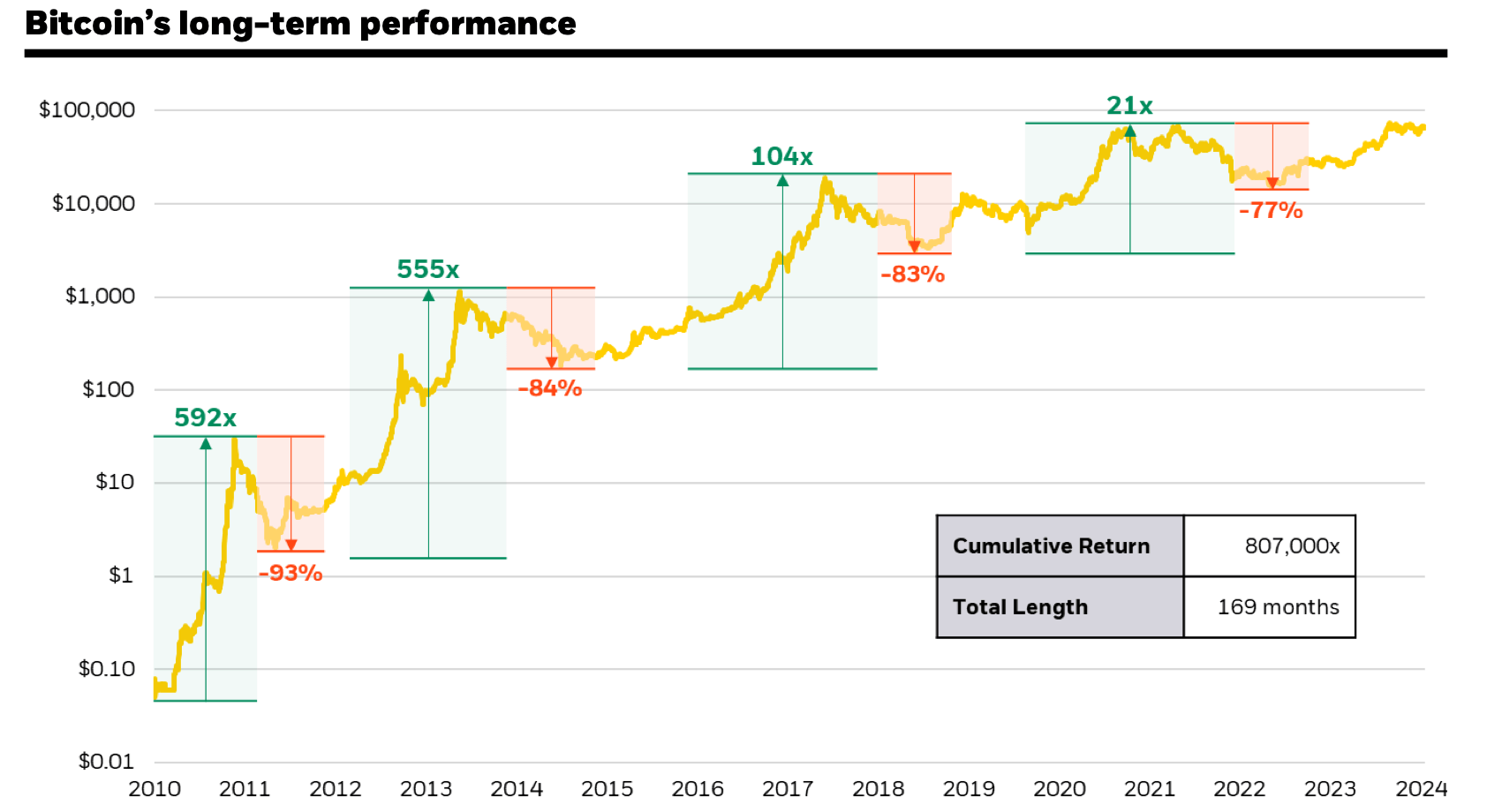
Долгосрочный рост Биткоина

Согласно данным источников CoinDesk, аналитики BlackRock также задались вопросом о том, является ли Биткоин рискованным выбором или же безопасным убежищем для капитала во время кризиса. В краткосрочной перспективе первая теория выглядит более правдоподобно, однако на долгий срок именно главная криптовалюта доказывает свою надёжность.

К примеру, по данным платформы Unchained, около 99 процентов держателей BTC получают прибыль, если удерживали актив в течение как минимум трёх лет. До сегодняшнего дня абсолютно все инвесторы уже получили доход по своему вложению в биткоины, если хранили цифровые активы как минимум пять лет.

Но и тут есть свои подводные камни. Любители цифровых активов должны помнить, что долгосрочное хранение остаётся надёжным разве что в случае использования холодных кошельков. Всё же хранить монеты на протяжении как минимум пяти лет на бирже — очень опасное занятие для вашего капитала.


Доказательствами этого утверждения является платформа FTX, которая в своё время считалась одной из самых популярных бирж в США и в мире в целом, однако в ноябре 2022 года стала банкротом. Как выяснилось позже, руководство биржи использовало средства своих клиентов на личные потребности по типу покупки недвижимости и финансирования политических кампаний.

На этой неделе вердикт по своему делу услышала Кэролайн Эллисон, бывшая руководительница Alameda Research и бывшая девушка руководителя FTX Сэма Банкмана-Фрида. Её приговорили к двум годам лишения свободы за её роль в крахе торговой платформы. Она пошла на сделку со следствием, в результате чего многие эксперты и вовсе не ждали, что Эллисон отправится в тюрьму. Хотя в итоге немало любителей крипты посчитало такое наказание слишком мягким за участие в краже монет клиентов на 8 миллиардов долларов.

Бывшая руководительница Alameda Research Кэролайн Эллисон

Гипотеза о долгосрочной прибыльности BTC подтверждена данными экспертов Glassnode. Они заявляют, что более 65 процентов всего оборота монет не перемещались более года. Этот тренд говорит о том, что многие инвесторы склонны держать Биткоин как долгосрочный актив, считая его средством сбережения капитала. И это несмотря на то, что цена BTC пережила несколько коррекций глубиной более 20 процентов в 2024 году.

В BlackRock также отметили, что у Биткоина очень низкая корреляция с акциями фондового рынка США. В частности, на графике ниже показана скользящая 6-месячная корреляция между BTC и индексом S&P 500 – c 2015 года средняя величина показателя составляет 0.2 пункта. Напомним, чем ближе значение метрики к нулю, тем менее заметной является связь между парой активов.
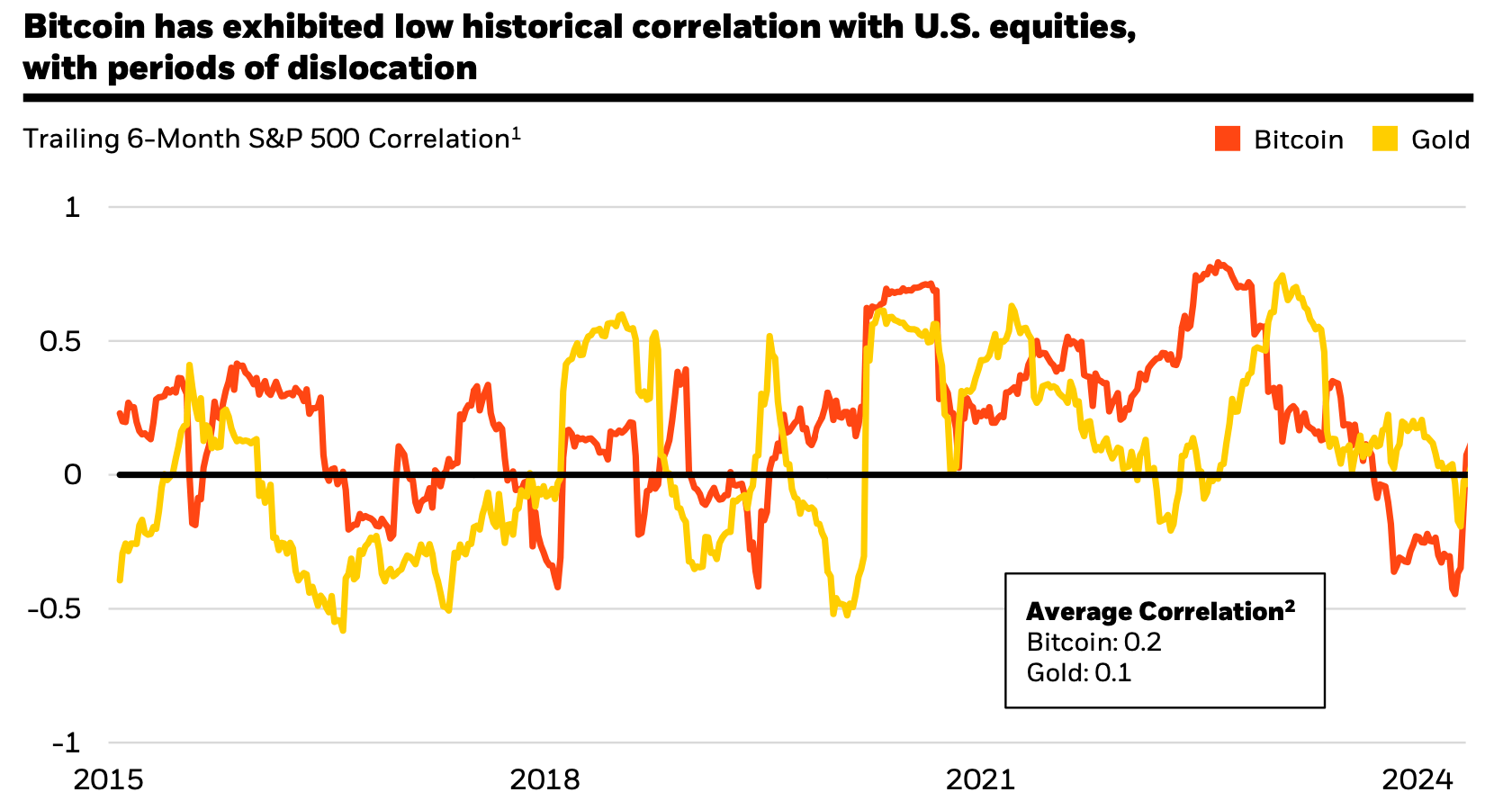
Корреляция фондового индекса с Биткоином и золотом

В продолжение темы долгосрочных перспектив аналитики BlackRock добавили, что BTC отличается тенденцией превосходить по доходности другие активы с высоким риском спустя 60 дней после значимых геополитических событий.

Например, после эскалации конфликта между США и Ираном в 2020 году Биткоин принёс 20 процентов прибыли спустя 60 дней, опередив золото и S&P 500. Такая же картина наблюдалась во время пандемии COVID-19, после выборов в США в 2020 году, после вторжения РФ в Украину и во время банковского кризиса в США.
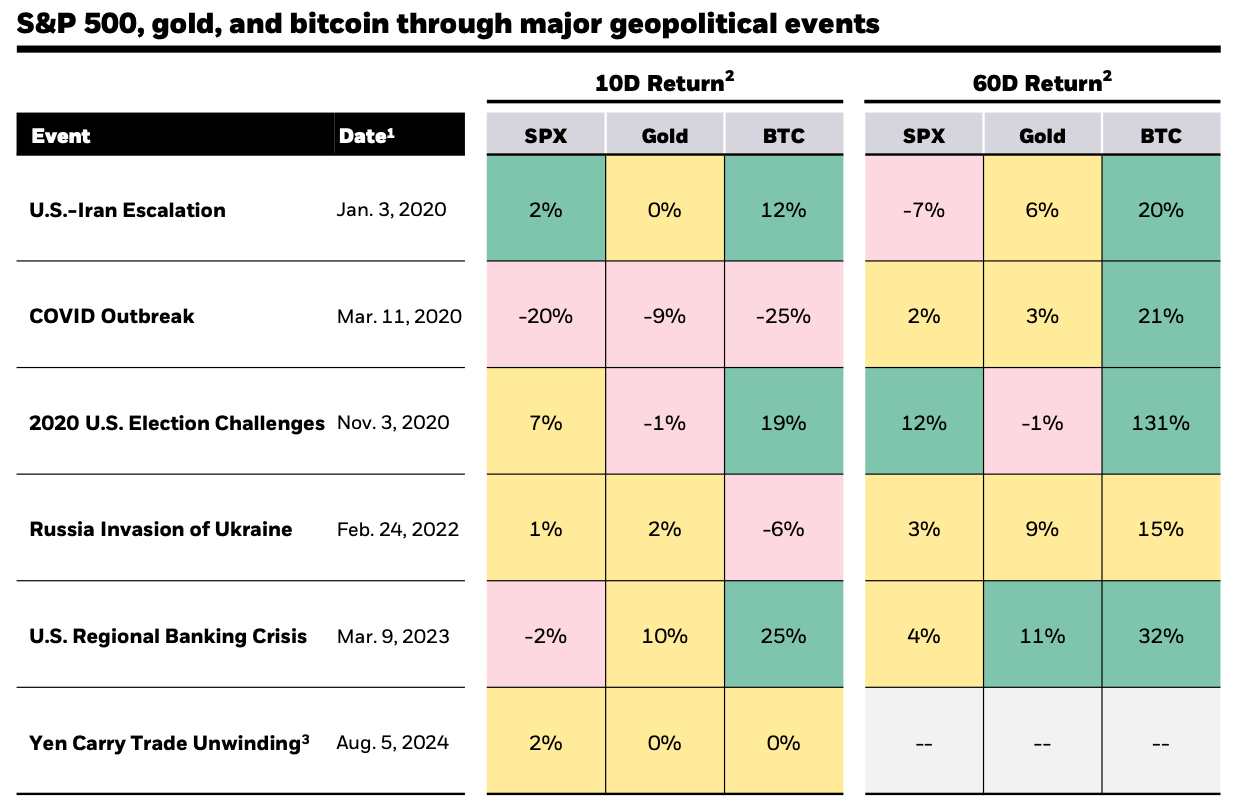
Доходность активов после ключевых событий

В целом у Биткоина есть потенциал для того, чтобы быть как «рискованным», так и «безрисковым» активом в зависимости от временного горизонта инвесторов. Хотя краткосрочные колебания могут казаться опасными, данные показывают, что долгосрочные держатели BTC почти всегда получают прибыль.

Это подтверждается тем фактом, что значительная часть монет остаётся невостребованной в течение года или более, указывая на восприятие BTC как инструмента сохранения стоимости в долгосрочной перспективе.


Ну а само исследование BlackRock подтверждает важность Биткоина. Вдобавок оно показывает, как сильно развилась ниша крипты за последний год. Ключевым событием здесь, конечно же, стал запуск спотовых ETF на первую криптовалюту в США, общий приток в которые уже превышает отметку в 18 миллиардов долларов.


Пов'язані матеріали

Lost 10 Billion, Yet Valued at 46.7 Billion? The True Value Revelation of Japan's Crypto Exchange 'Doomsday License'

**Summary: The Priceless "Doomsday License" – Why Japan's SBI Paid $289M for a Losing Exchange** In mid-2026, Japanese financial giant SBI Holdings acquired cryptocurrency exchange Bitbank for ¥46.7 billion (~$289 million). This valuation is puzzling on paper: Bitbank, while a long-established, licensed exchange, reported a ¥970 million loss in 2025 on shrinking revenues. The key lies not in profitability, but in a regulatory "franchise scale." SBI's purchase was for Bitbank's scarce, irreplaceable assets: its Japanese FSA license, 960,000 user accounts, and a fully compliant yen on-ramp. This acquisition came just two weeks after Japan passed a landmark amendment reclassifying crypto assets as "financial instruments" under stricter laws, dramatically raising penalties for unlicensed operations. Analysts predict up to half of Japan's ~30 licensed exchanges may exit, transforming existing licenses into non-renewable strategic resources. The deal's ~8x revenue multiple mirrors a global trend of "compliance arbitrage," where acquiring regulated entities is faster and cheaper than navigating complex, years-long licensing processes. The Japanese narrative is part of a worldwide pattern. In 2026 alone, the crypto sector saw $11.8 billion in M&A, with giants like Mastercard and Bullish acquiring regulated digital asset firms. As jurisdictions like the US, Singapore, and Hong Kong solidify frameworks, regulatory compliance shifts from a cost center to the most durable moat. The core lesson is that in maturing markets, the true value shifts from trading volume to "licensed scale." For early, compliant platforms, stringent regulation becomes a defensive asset, not a constraint. SBI's strategy of consolidating licensed Japanese exchanges illustrates this. The window to acquire such "tickets to the future financial world" at a reasonable cost is rapidly closing as global capital recognizes that in the regulated era, the license itself is the ultimate prize.

marsbit6 хв тому

Lost 10 Billion, Yet Valued at 46.7 Billion? The True Value Revelation of Japan's Crypto Exchange 'Doomsday License'

marsbit6 хв тому

Interpreting the Latest Report from the Ethereum Foundation: Why Are Governments and Giants Focusing on Ethereum?

Decoding the Ethereum Foundation's Latest Report: Why Governments and Giants Are Eyeing Ethereum? Authored by Lanhu Notes, this piece unpacks a key report from the Ethereum Foundation's global policy team. The report, released on July 2, makes a case for why governments and institutions should view Ethereum as the optimal platform for deployment. It highlights Ethereum's unique position as the closest existing platform to a "digital public infrastructure" – a neutral, open, and uncontrolled protocol for handling value, contracts, and coordination, akin to TCP/IP for the internet. The core arguments are: 1. **Maximal Neutrality & No Single Control Point**: Ethereum has no central owner, backdoor, or kill switch. It's maintained by thousands of independent nodes and hundreds of thousands of validators globally, making it resistant to unilateral control by any single entity—a critical feature for sovereign and institutional users. 2. **Proven Resilience & Unmatched Security**: Since its 2015 launch, Ethereum has maintained a perfect uptime record. Its security is backed by approximately $76 billion in staked ETH (as of March 2026), making any attack economically irrational and prohibitively expensive (estimated over $50 billion). 3. **Large-Scale Real-World Adoption**: The network hosts over $159 billion in stablecoins. Major financial institutions like BlackRock and JPMorgan are already using it for real-world asset (RWA) tokenization. Governments, including Bhutan and India, are deploying it for applications like national digital identity and tamper-proof land registries. 4. **Comparative Advantages**: Ethereum offers greater transparency and lower costs than traditional intermediaries. It is more open and neutral than permissioned/private chains. Compared to other public blockchains, it boasts superior maturity, the largest developer ecosystem, the biggest economy, and the highest proven security. In summary, the report positions Ethereum, backed by data, real-world use cases, and clear comparisons, as the emerging neutral public layer for global value settlement and coordination.

marsbit7 хв тому

Interpreting the Latest Report from the Ethereum Foundation: Why Are Governments and Giants Focusing on Ethereum?

marsbit7 хв тому

Aave V4 to Move Wall Street Securities Financing On-Chain: Composability Layer Transforms from Risk Point to Backbone

Aave V4 aims to bring Wall Street securities financing on-chain, targeting the massive traditional markets for repo, securities lending, and margin financing. It proposes three core products: securities-backed loans, atomic repo settlements, and securities lending. This shifts the narrative from "RWA as collateral" to building foundational "on-chain securities finance infrastructure." The key innovation lies in its third-layer approach: composability. V4 doesn't alter underlying asset credit but systematically connects all on-chain assets to leverage and liquidation mechanisms, making composability the system's backbone instead of just a risk point. Aave's dominant market share and its relatively prudent engineering for its Horizon institutional RWA lending market support this ambition. However, a critical design choice introduces a new risk dimension. The "centralized liquidity Hub + multiple Spoke" architecture and Horizon's shared liquidity pools prioritize capital efficiency by allowing new assets instant access to deep liquidity. The trade-off is the loss of risk isolation: a problem with one collateral type in a stress period can draw from the same stablecoin pool backing all others, spreading risk across the entire market. This risk is not theoretical, as demonstrated by a 2026 incident where compromised collateral from a bridge attack created bad debt on Aave. As the system scales—with Horizon targeting over $1B—it remains untested in a genuine credit or liquidity crisis. The first significant bad debt or forced liquidation in RWA markets will likely be triggered by a price/net asset value dislocation of a tokenized asset during stress, not by an underlying default. The implications are clear: institutions providing collateral must account for potential NAV-price gaps; liquidity providers must understand they are exposed to all collateral in a shared pool; and protocols must explicitly choose between risk isolation and capital efficiency. The market still focuses primarily on credit risk, while tokenization continues to concentrate new risks in the liquidity and composability layers.

marsbit11 хв тому

Aave V4 to Move Wall Street Securities Financing On-Chain: Composability Layer Transforms from Risk Point to Backbone

marsbit11 хв тому

Ethereum Forms Three Major Power Centers, Commercial Lifeline Held in the Hands of Major ETH Holders

Ethereon has established a new tripartite power structure to separate its core protocol development from commercialization efforts. The Ethereum Foundation, having lost several executives, now focuses solely on maintaining protocol principles like neutrality and censorship resistance. To handle business outreach and technical advancement, two new independent entities have been formed: Ethereum Institutional, which is dedicated to promoting Ethereum's tokenization and stablecoin use to major banks and asset managers, and Ethlabs, a research group focused on improving on-chain settlement and strengthening ETH's monetary narrative. Both organizations are funded by major ETH holders Bitmine and Sharplink, who collectively control over 5.4% of ETH's circulating supply. This structure aims to resolve the conflict between the Foundation's neutral stance and the need for aggressive commercialization. The success of this model is tied directly to ETH's price performance. Bullish prospects rely on Ethereum's dominant position in stablecoins, DeFi, and tokenized assets, with potential growth fueled by institutional adoption facilitated by the new entities. Bearish risks highlight ETH's price volatility and the dependency of the new organizations on their funders' financial health, which is itself linked to ETH's value. The future trajectory of this institutional framework will be largely determined by which of these market trends prevails.

Foresight News12 хв тому

Ethereum Forms Three Major Power Centers, Commercial Lifeline Held in the Hands of Major ETH Holders

Foresight News12 хв тому

Торгівля

Спот
活动图片