Сколько заработали пользователи CoinEx на листинге токена Hamster Combat

investing.ruОпубліковано о 2024-09-28Востаннє оновлено о 2024-09-28

Happycoin.club - Учитывая полный драматизма ажиотаж вокруг токена известной игры-кликера Hamster Combat, многие крупные криптобиржи пообещали провести листинг HMSTR. Аналогичное решение приняла команда торговой криптоплатформы CoinEx, поэтому 26 сентября альткоин появился на площадке.

Реализуя свою стратегию по добавлению наиболее популярных в криптосообществе криптоактивов, 20 сентября CoinEx также интегрировала не менее востребованный токен Catizen.

Если листинг игрового токена Catizen прошёл более или менее штатно, то с Hamster Combat многое пошло не по плану. Выпуск токена сопровождался большими задержками, ведь изначально это событие было запланировано на июль. Разногласия внутри команды и технические трудности отложили выпуск и airdrop почти на два месяца.

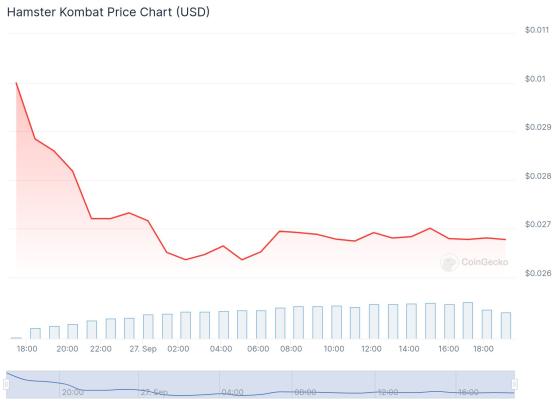
26 сентября цена токена стартовала с отметки $0,01, а затем пользователей постигло большое разочарование, так как стоимость HMSTR упала до $0,07. На текущий момент токен оценивается в $0,006, таким образом потери с момента его выпуска достигли 21%.

Изменение цены токена HMSTR. Источник: CoinGecko

Эта ситуация лишний раз доказывает, что ликвидность токена не зависит от оперативности технических специалистов криптобирж, прежде всего она поддерживается активностью пользователей. Судя по всему, они действительно утратили доверие к команде «тапалки», которая обещала самый грандиозный airdrop за всю историю существования криптовалют, но игроки назвали его наихудшим.

Неудача с Hamster Combat не означает, что у сторонников криптовалют не осталось интересных возможностей с получением вознаграждением. Недавно команда CoinEx проводила акцию, в рамках которой было необходимо отвечать на вопросы и получать за это нативные токены CET. Биржевой токен позволяет экономить на комиссиях за транзакции и получать массу других преимуществ.

Весьма вероятно, что скоро клиентов биржи будут ждать новые акции. Отдельно следует подчеркнуть, что CoinEx продолжает оказывать россиянам полный перечень криптоуслуг, а на P2P-платформе поддерживаются рублёвые платежи с использованием Системы быстрых платежей и по картам Сбербанка (MCX:SBER) и Тинькофф (LON:TCSq).

Если вы планируете воспользоваться этими возможностями, регистрируйтесь на торговой платформе и внимательно следите за новыми предложениями.

Криптобиржа CoinEx была создана в 2017 году и всё это время компания стремится улучшать свои сервисы и продвигать новую технологию блокчейн. Платформа адаптирована для 18 языковых рынков, благодаря чему охватывает более 200 стран и регионов. На ней представлены более 1200 криптовалют, а аудитория CoinEx уже превысила 10 миллионов зарегистрированных пользователей.

За семь лет работы команда CoinEx смогла создать комплексную экосистему, которая включает кошелёк CoinEx Wallet, собственную сеть CoinEx Smart Chain, обозреватель CoinEx Explorer и благотворительную программу CoinEx Charity.

Читайте оригинальную статью на сайте Happycoin.club
Пов'язані матеріали

Will the Ethereum Foundation Evolve into a 'Mascot'? Diversified Organizations Are Fragmenting Its Functions

The Ethereum Foundation (EF) is undergoing significant internal turmoil and functional erosion. Following its largest-ever layoff of 54 staff (20% of its workforce) and a major organizational restructuring announced in June, its Protocol Support Team has been officially dissolved. This comes alongside the high-profile resignation of key figures like co-executive director Xiaowei Wang, bringing senior departures this year to at least eight. Criticism of EF's rigid structure, opaque decision-making, and perceived lack of a clear value narrative for ETH has intensified within the community. The layoffs have catalyzed the emergence of independent, non-profit organizations like Ethlabs and Ethereum Institutional, founded by former EF researchers and members. These entities are now taking on core functions such as protocol research/development and institutional adoption, effectively fragmenting the EF's traditional leadership role. Concurrently, EF's security team is adapting to technological change, deploying specialized AI agents to audit Ethereum's codebase, which successfully discovered a critical vulnerability (CVE-2026-34219). While EF states AI complements rather than replaces researchers, it signals a potential future shift in its operational model. Faced with these challenges—internal restructuring, talent drain, the rise of competing organizations, and AI integration—the Ethereum Foundation appears to be stepping back from a central commanding role. Analysts and community observers speculate it may increasingly transition towards a symbolic "ecosystem mascot" function, while decentralized initiatives drive Ethereum's future growth and institutional adoption.

marsbit23 хв тому

Will the Ethereum Foundation Evolve into a 'Mascot'? Diversified Organizations Are Fragmenting Its Functions

marsbit23 хв тому

Nearly a Hundred Players Rush into Embodied Data: With 4.47 Billion Yuan in Financing in One Year, Who Can Really Make Money by 'Selling Data'?

The domestic embodied AI data industry has attracted nearly 100 players, with 70 focused on data collection and 27 on data infrastructure. In the past year, 15 independent embodied data service providers raised approximately 4.47 billion yuan. Despite this growth, the sector remains early-stage, fragmented, and faces significant challenges. Data collection methods are diverse, categorized into four main routes: teleoperation of real robots, human demonstration without a robot (using motion capture, exoskeletons, etc.), simulation synthesis, and distillation from internet videos. Most companies (43%) adopt hybrid approaches, combining multiple routes, as no single method can meet all training needs. Teleoperation alone is pursued by 31% of players, often by state-owned platforms and robot companies, while newer firms favor asset-light, no-hardware human demonstration. Independent data service providers now form the largest player group (40%), indicating the emergence of a distinct industry segment rather than just a subsidiary function for robot makers. Two-thirds of all players are "embodied-native" startups, while one-third are companies that pivoted from fields like AI data annotation, which are more prevalent in the data infrastructure layer. Current annual industry capacity is estimated at 1.6-1.8 million hours plus 70-80 million data points, with a short-term goal to increase this 15-20 fold within 1-3 years. Data collection factories are spread across 20 provinces in China, concentrated in the Yangtze River Delta, Beijing-Tianjin-Hebei, and Pearl River Delta regions. Financially, the 4.47 billion yuan raised in the past year pales compared to the 43.8 billion yuan raised by the broader embodied intelligence sector in just the first half of 2026, highlighting that data remains a less "sexy" bet for investors. The 15 funded independent providers show clear stratification: a top tier led by a unicorn (Lightwheel Intelligence, 3.1 billion yuan), a middle tier of 11 firms raising tens to hundreds of millions, and an early-stage tier of 3 companies. Sixty-nine investment institutions have participated, but none have made concentrated bets, reflecting uncertainty about viable business models. Over half of these funded companies are less than a year old, most are at pre-A or A rounds, and profitability remains largely unproven. In summary, the embodied data industry has become an independent track creating jobs and local economic activity. However, it is still nascent, with unformed consensus, unsolved problems, and unproven business models. The coming 1-2 years will be a critical validation window to see if companies can build sustainable, profitable businesses purely by "selling data."

marsbit3 год тому

Nearly a Hundred Players Rush into Embodied Data: With 4.47 Billion Yuan in Financing in One Year, Who Can Really Make Money by 'Selling Data'?

marsbit3 год тому

Dialogue with Multicoin Partner: The Crypto Market Has Bottomed Out, Favoring Three Cryptocurrencies in This Cycle

In a recent interview, Multicoin Capital managing partner Tushar Jain shared his views on the crypto market. He believes the market has bottomed and is at an inflection point, citing that negative news no longer causes significant price declines and application adoption continues to grow. Jain remains highly bullish on Solana, viewing it as the correct architectural choice for internet capital markets, particularly for spot and tokenized security trading. He is also positive on Hyperliquid, noting its leadership in decentralized derivatives trading. His investment approach focuses on concentrating capital in top convictions rather than equal allocation. A distinct opportunity he highlights is Zcash (ZEC), which he sees as a return to the industry's cypherpunk ethos and a potential top-five asset by market cap. For assets like Zcash without cash flows, his valuation framework is based on relative market cap ranking. Regarding investment strategy, Jain employs a "three-part" entry method to avoid timing pitfalls and emphasizes long-term "active management" over "active trading." He outlines four sources of investment edge: informational, analytical, behavioral/psychological, and structural. On portfolio management, the fund uses Bitcoin as its "cash," selling assets into Bitcoin during market euphoria to reduce beta risk and using Bitcoin to buy dips. Sales occur only if a better opportunity arises, the investment thesis breaks, or valuations become excessively overheated. While respectful of Ethereum's resilience, he questions its unclear scaling roadmap. Finally, Jain reaffirms his commitment to the thesis that blockchains will form the foundational architecture for future capital markets.

marsbit3 год тому

Dialogue with Multicoin Partner: The Crypto Market Has Bottomed Out, Favoring Three Cryptocurrencies in This Cycle

marsbit3 год тому

Торгівля

Спот
活动图片