Why Did Dogecoin Rise 10% And The Shiba Inu Price Jumped 22%?

bitcoinistОпубліковано о 2024-09-27Востаннє оновлено о 2024-09-27

Анотація

Dogecoin (DOGE) and Shiba Inu (SHIB) prices have surged by 10% and 22% in the last 24 hours, respectively. These...

Dogecoin (DOGE) and Shiba Inu (SHIB) prices have surged by 10% and 22% in the last 24 hours, respectively. These price surges are thanks to developments on the macro side and these meme coins’ fundamentals, which provide a bullish outlook for them. 

Why Dogecoin And Shiba Inu Prices Are Up

Dogecoin and Shiba Inu’s prices have surged thanks to macro developments like the monetary policies being rolled out by world governments. This has boosted investors’ confidence in allocating more capital to risk assets like Dogecoin and Shiba Inu. Earlier this week, the People’s Bank of China announced rate cuts and a stimulus package to revive the country’s economy. 

Meanwhile, the latest US jobless claims and GDP data showed that the US economy is healthy. This follows last week’s 50 basis point (bps) rate cuts by the US Federal Reserve. Moreover, these rate cuts by the US and China are expected to cause more liquidity to flow into risk assets, including Dogecoin and Shiba Inu. 

That already looks to be happening, seeing how their prices have surged recently. It is worth mentioning that Bitcoin (BTC) rose above $65,000 in the last 24 hours, contributing to the rally for these meme coins. Dogecoin and Shiba Inu share a strong positive price correlation with the flagship crypto and are bound to rally as BTC does. 

Dogecoin and Shiba Inu’s bullish fundamentals are also why these meme coins have rallied. On September 26, QED Protocol announced its partnership with Nexus to build a zero-knowledge virtual machine (zkVM) on the Dogecoin Network. This will enable smart contracts on the network and help boost DOGE’s utility. 

Meanwhile, Shiba Inu’s marketing lead, Lucie, revealed the team’s plans to launch the SHI stablecoin in the meme coin’s ecosystem. This move provides a bullish outlook for Shiba Inu, considering how it will further draw attention to its ecosystem. Meanwhile, Shiba Inu’s team developer, Shytoshi, has also continued to hint about the potential launch of the layer-3 privacy chain in the meme coin’s ecosystem. 

More Price Rallies To Come

Dogecoin and Shiba Inu are expected to record more price rallies in the coming weeks as governments continue introducing monetary easing policies. Crypto analyst Ali Martinez also recently stated that Dogecoin looks strong. He noted that DOGE has witnessed an RSI and price breakout from multi-downtrends. He added that the foremost meme coin got a buy signal from the SuperTrend indicator. 
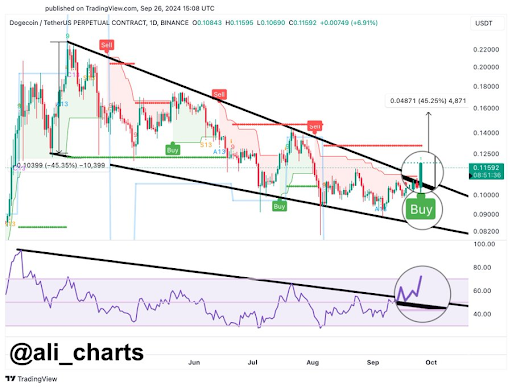
Dogecoin
Source: X

In another X post, Martinez stated that Dogecoin could rally to as high as $0.150, having surged past the $0.111 resistance. Shina Inu is also on the edge of a historic run, as the meme coin has always recorded positive monthly returns in October. Dogecoin and Shiba Inu whales are already positioning for these price rallies, as they have been accumulating these past few days. 

Shiba Inu price chart from Tradingview.com (Dogecoin)
SHIB price sparks bullish sentiment | Source: SHIBUSDT on Tradingview.com
Featured image created with Dall.E, chart from Tradingview.com
Scott Matherson

Scott Matherson

Scott Matherson is a leading crypto writer at Bitcoinist, who possesses a sharp analytical mind and a deep understanding of the digital currency landscape. Scott has earned a reputation for delivering thought-provoking and well-researched articles that resonate with both newcomers and seasoned crypto enthusiasts. Outside of his writing, Scott is passionate about promoting crypto literacy and often works to educate the public on the potential of blockchain.

Пов'язані матеріали

Why Do We Need an AI Content Perspective Today?

The article "Why Do We Need an AI Content Perspective Today?" explores the complex and often contentious integration of AI into the cultural and creative industries, particularly film and television. It begins with the cancellation of Amazon's AI-generated animation "Punky Duck," highlighting the ethical debates surrounding AI content. AI's rapid advancement is transforming video production, enabling cost-effective, full-length AI films (e.g., "RAPHAEL," "Dreams of Violets") while sparking industry resistance over issues like "synthetic actors." The core debate has shifted from whether to use AI to how to use it responsibly. The article analyzes why AI's entry into film is uniquely unsettling. It distinguishes between "cultural fast food" (short-form, fast-paced content like micro-dramas) and "cultural main courses" (traditional, long-form film/TV). AI currently excels at the former, matching its fragmented narratives, shallow emotional needs, and free-to-consumer models. However, venturing into the latter challenges the human-centric essence of storytelling—creativity, emotional depth, and the unique value of human labor and experience. While AI can generate massive volumes of content and lower costs, it risks devaluing human creativity, leading to homogenized output, and creating unfair competition through potential intellectual property infringement. Its efficiency also amplifies content safety risks, making preemptive governance crucial. To counter these risks, the article proposes establishing clear boundaries guided by a human-centered AI content perspective. It outlines four principles: 1) Amplify, rather than displace, human creative space; 2) Respect and protect human creative output; 3) Ensure human creative control and responsibility remain paramount; and 4) Guarantee transparency and traceability in AI creation. The conclusion emphasizes that humans must act as the "helmsmen" of technology, steering AI development to enhance, not replace, the core human values at the heart of cultural expression.

marsbit25 хв тому

Why Do We Need an AI Content Perspective Today?

marsbit25 хв тому

Planck Retracted? The Father of Quantum Tripped by an Algorithm

The recent discovery that two articles (published in 1940 and 1942) by Max Planck, the Nobel laureate and founder of quantum theory, are marked as "retracted" on Springer's digital platform highlights a curious clash between historical publishing practices and modern automated systems. An investigation suggests these retractions are algorithmic errors, not due to fraud or misconduct. The papers, philosophical reflections on science published in *Die Naturwissenschaften*, were likely flagged by the platform's systems. One article, a republished lecture, may have been mistaken for duplicate publication. Another, sharing a title with a prior article by a different author (a common practice for continuing debates at the time), may have triggered a similar automated check. The digital versions have even been replaced with blank pages, contrary to normal practice of preserving retracted texts. This incident underscores how contemporary digital infrastructure, built around concepts like "self-plagiarism" and strict copyright, can misclassify and obscure legitimate historical scholarly communication. It serves as a warning that digital archives are not neutral mirrors of the past but are filtered by platform rules, potentially distorting the scientific record. As AI systems increasingly rely on such databases, such erroneous metadata could propagate, affecting how future tools interpret and access historical knowledge.

marsbit29 хв тому

Planck Retracted? The Father of Quantum Tripped by an Algorithm

marsbit29 хв тому

Refunds! Claude 4.8 Sees Overnight Major 'Dumb-Down', GPT-5.6's Computational Power Reportedly 'Halved'

The AI community is currently alarmed by widespread reports of significant performance degradation in two leading models. This article details a "mass self-testing frenzy" triggered by a mysterious prompt designed to detect a hidden "Juice" value, representing a model's reasoning compute budget. On OpenAI's side, users suspect a covert, limited test of a "GPT-5.6-sol" model is underway. When using a specific XML prompt on the Codex platform, a normal "gpt-5.5 xhigh" model reportedly returns a Juice value of 768. However, some users routed to the suspected GPT-5.6 test receive a drastically reduced value of 128—a six-fold decrease. This has sparked debate on whether it signifies a major efficiency leap or a "watered-down, low-cost version" achieved by slashing reasoning depth to save computational expenses. Simultaneously, Anthropic's Claude models, particularly the flagship Opus 4.8 Max, are facing intense user backlash for a perceived "physical brain cut." Users on platforms like Reddit report a dramatic decline in the model's once-impressive reasoning, with complaints of it becoming "absurdly" weakened, performing worse than older, lighter models like Haiku. Specific criticisms include: losing long-context memory, refusing to think deeply even in high-reasoning modes, providing instant incorrect answers, and engaging in unhelpful, argumentative, or "gaslighting" behavior where it contradicts users unnecessarily. The article speculates these "stealth downgrades" might be a calculated corporate strategy. Companies could initially release models with temporarily boosted compute to create an illusion of a major breakthrough, then silently scale back parameters later to manage unsustainable inference costs. A proposed underlying cause is a tightened funding environment, potentially exacerbated by SpaceX's massive IPO soaking up market liquidity, which could delay AI company IPOs and force cost-cutting measures like model "nerfing." The core issue highlighted is the asymmetry of information: subscribers pay for a service that can be silently and fundamentally altered without notification or explanation. The viral "Juice test" resonates because it represents users' desire for transparency about what they are actually paying for.

marsbit1 год тому

Refunds! Claude 4.8 Sees Overnight Major 'Dumb-Down', GPT-5.6's Computational Power Reportedly 'Halved'

marsbit1 год тому

Торгівля

Спот
活动图片