Is Bitcoin Price Lagging? Record Global M2 Money Supply Could Be a Springboard for BTC's Rise
Bitcoin Price Lagging? Record Global Money Supply M2 Could Springboard BTC Growth
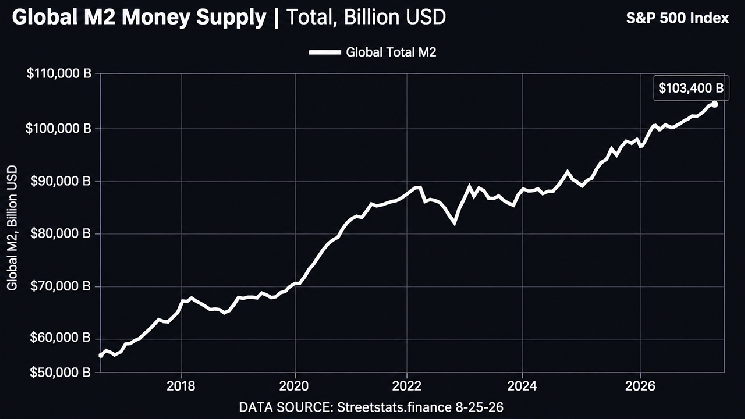
The global money supply (M2) is expanding rapidly, similar to global debt. The US M2, representing all money circulating in its economy, has reached a record $23.16 trillion. Combined with figures from major economies like the Eurozone, China, and Japan, the global M2 is approximately $103 trillion. Some estimates, however, place it closer to $195 trillion. This surge in liquidity is significant because excess capital often seeks higher returns in assets like precious metals, stocks, and cryptocurrencies.
Bitcoin's recent price surge above $81,000 has brought the global M2 metric back into focus. Following a sharp rise in early August after a US Treasury bond buyback announcement, BTC still trades about 37% below its October 2025 all-time high exceeding $126,000. This gap presents a potential "catch-up" trade thesis. Bitcoin's fixed supply of 21 million contrasts with governments' ability to print fiat currency, making scarce assets like BTC attractive if monetary expansion continues. Historically, Bitcoin's bull cycles in 2017-2018 and 2020-2021 coincided with M2 expansion and increased liquidity.
Over the past year, the correlation seemed broken as M2 grew while Bitcoin's price fell sharply from its peak. Observers believe fresh dollars may have remained locked in cash-favorable investments. Some, like Ash Crypto, now suggest a long-awaited alignment between Bitcoin and M2 may be starting, especially as a weakening US Dollar Index this month has seen assets like gold and Bitcoin surge. A softer dollar pressures cash havens and prompts holders to act.
While record M2 doesn't guarantee higher Bitcoin prices, a sustained influx of liquidity, a weak dollar, and capital flowing into alternative assets could trigger a catch-up rally sooner than expected. However, changes in these conditions could lead to the opposite outcome.
cryptonews.ru1 год тому