$26 Billion: An 'All-Chinese Team' Backs the World's Highest-Valued AI Programming Company

marsbitОпубліковано о 2026-05-31Востаннє оновлено о 2026-05-31

Анотація

Cognition AI, the company behind the AI programmer "Devin," has raised over $1 billion in new funding at a valuation of $26 billion, just eight months after reaching a $10.2 billion valuation. The round was led by Lux Capital, General Catalyst, and 8VC. Founded by three young Chinese entrepreneurs with strong competitive programming backgrounds, Cognition initially gained fame with Devin, marketed as the world's first AI software engineer capable of handling tasks from start to finish. While its early demos were impressive, real-world usage revealed reliability and cost-effectiveness issues, leading to a significant price cut for Devin in 2025. A pivotal moment came when Cognition acquired the assets of AI IDE company Windsurf after a failed acquisition by OpenAI. This move gave Cognition a crucial developer-facing tool, allowing it to pursue a two-pronged strategy: Devin for autonomous task execution and Windsurf for integrated, collaborative coding within an IDE. This shift helped the company move away from the controversial "AI replacement" narrative towards a model of augmenting human engineers, particularly for repetitive or maintenance tasks. This strategic pivot is backed by strong commercial metrics. The company reports a 10x increase in enterprise usage this year, with an annual revenue run-rate of $492 million and a 50% month-over-month growth in enterprise Devin usage over the past six months. Its client list now includes major corporations like Goldman Sachs an...

By AI Alphabet

$26 billion is the latest price tag the capital market has placed on AI programming company Cognition.

Just last September, Cognition AI had barely crossed the $10 billion valuation threshold, and at that time, it was already enough of a Silicon Valley legend.

Three young Chinese co-founders, collectively winners of 5 International Olympiad in Informatics gold medals, built the prototype of "the world's first AI software engineer" Devin from a short-term rental apartment. In just over two years since its founding, the company's valuation had surged to $10 billion.

Chinese, Olympiad, Harvard, MIT, dropping out to start a business, AI Agent... each label is attention-grabbing enough. Cognition is undoubtedly one of the most story-rich companies in the AI programming track.

Now, this story has been pushed a significant step forward by the capital market.

According to a Bloomberg report, Cognition AI, the company behind Devin, has secured over $1 billion in new funding, with a post-money valuation reaching $26 billion. This round was co-led by Lux Capital, General Catalyst, and 8VC, with participation from Ribbit Capital, Atreides Management, Founders Fund, and others. Cognition has officially confirmed this funding round and its latest valuation.

This means that in just over eight months since its previous valuation of $10.2 billion, Cognition's valuation has grown to 2.5 times its original value.

01 What Capital is Buying is More Than Just an AI Programmer

The leading capital in this round is quite representative.

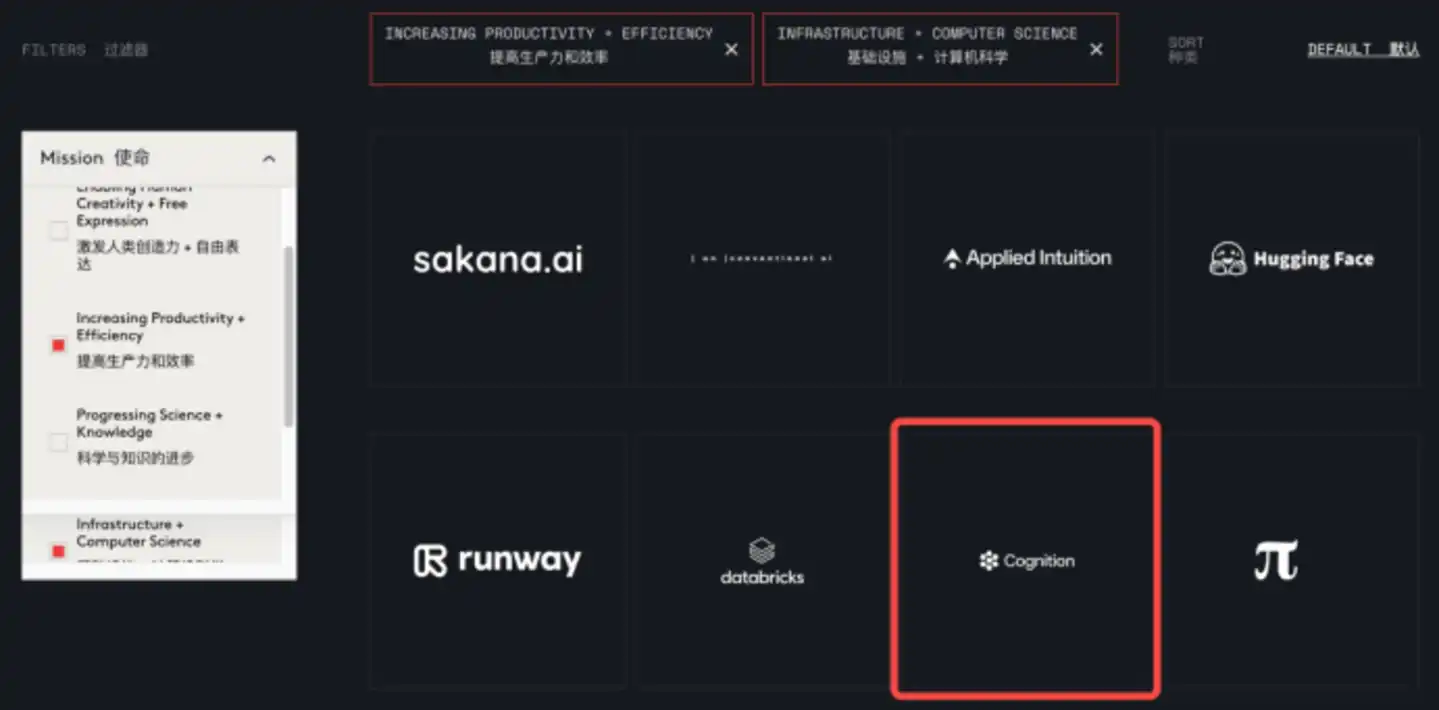
Lux Capital is a highly recognizable hard-tech fund in Silicon Valley, with long-term investments in frontier science, deep tech, AI, robotics, aerospace, defense, and computing infrastructure—projects that are "relatively hardcore." On its own investment page, Cognition is categorized under "Productivity Enhancement + Infrastructure + Computer Science."

It can be said that Lux Capital's investment in Cognition focuses on Cognition's potential to turn AI Agents into software engineering infrastructure.
General Catalyst, on the other hand, focuses on the opportunity for enterprise processes to be transformed by AI. This firm is not just a traditional VC; it calls itself a "global investment and transformation company" on its website, emphasizing 'transformation' in recent years—using capital, operations, and corporate relationships to drive the transformation of traditional industries and large institutions.

Besides Cognition, General Catalyst is also doubling down on Anthropic. Over the past year, it has participated in multiple massive funding rounds for Anthropic.

As a co-leading firm, 8VC brings imagination for government and large enterprise deployments. This firm has long bet on "enterprise software infrastructure within complex organizations," and Cognition's client list already includes government or public-sector clients like the US Army, US Navy, and NASA. 8VC's participation as a lead investor affirms Cognition's narrative.

In addition to the three leading firms, existing shareholder Founders Fund continues to increase its stake. The approximately $400 million funding round in 2025, which valued the company at around $10.2 billion post-money, was led by Founders Fund. This firm, co-founded by Peter Thiel, has always had an aggressive investment style, preferring technology companies that can reshape industrial structures, such as SpaceX, Palantir, Anduril, Stripe, OpenAI, etc.

Lux Capital long bets on hard tech and frontier computing, General Catalyst excels at enterprise software and large institution transformation, 8VC carries enterprise software and government market genes, and Founders Fund is one of Cognition's early shareholders. The simultaneous presence of these types of capital in Cognition's funding round is enough to indicate that investors no longer see Cognition merely as a developer tools company, but as a candidate for the next generation of software engineering infrastructure.

The $26 billion post-money valuation fully proves market confidence, and the most direct reason capital is willing to continue driving up the price is growth.

Cognition has presented very solid commercialization data: enterprise usage has grown over 10-fold since the beginning of this year, revenue run-rate has jumped from $37 million in May last year to the current $492 million, and enterprise-side Devin usage has maintained a 50% month-over-month growth for the past six months.

Although $492 million is not confirmed annual revenue but an annualized run-rate calculated based on the current income pace, this growth curve is still astonishing. Investors can already see enterprise clients genuinely paying, genuinely using, and usage is still rapidly climbing—this is nothing short of legendary for a company founded in 2023.

The AI programming track is indeed thriving. Code, issues, tests, PRs, documentation are inherently highly digital work objects; whether a task is completed can be verified through tests, code reviews, and deployment results.

And for enterprises, software teams always have an endless list of tasks, each time-consuming and expensive (at least, senior engineers' hourly rates are expensive). If an AI Agent can reliably take over a portion of clear, repetitive, and verifiable software engineering tasks, it becomes engineering capacity that enterprises are willing to pay for.

Behind the $26 billion, what capital is truly buying is a judgment: software development is becoming the earliest work scenario where AI Agents are being procured on a large scale by enterprises.

02 After Devin's Explosive Popularity, Reality Poured Cold Water

Cognition first gained widespread attention through what, at the time, seemed an extremely bold vision.

Before Devin, AI programming tools mostly remained in "assistant" roles. GitHub Copilot helps programmers complete code, ChatGPT and Claude can explain errors and generate functions, while Cursor integrates AI into the editor, allowing developers to write and edit simultaneously.

But Devin took a significant step forward. It was directly defined by Cognition as an "AI Software Engineer." Users only need to describe requirements in natural language, such as developing a website, building an application feature, or fixing an issue in a codebase, and Devin would independently break down the task, write the code, fix bugs, until the project runs.

When Cognition released the Devin demo in March 2024, the entire developer community was ignited. It was promoted as the world's first AI programmer, and to some extent, became one of the landmark products that truly brought the vibe coding wave into the mainstream.

The founders themselves also came with a story. All three—Scott Wu, Steve Hao, and Walden Yan—are Chinese and hail from the informatics Olympiad circle, collectively holding 5 IOI gold medals. They are not traditional business-oriented founders but resemble a group of young people exceptionally skilled at coding, trying to train another entity that can code.

After Devin's launch, the company quickly secured support from top-tier VCs like Founders Fund, Khosla Ventures, and Bain Capital Ventures, forming a strong capital lineup. Enterprise clients also began to emerge, with names like Goldman Sachs, Citi, and Ramp being linked to Devin.

In July 2025, when Goldman Sachs introduced Devin, a Fast Company headline even directly stated, "Goldman Sachs's New AI Software Engineer Never Sleeps." This highlighted one of the most compelling aspects of Agents for enterprises: they can operate 24/7, no shifts needed, never stopping due to nights, weekends, or time zones.

That was Cognition's earliest moment in the spotlight. A young team, Chinese founders with informatics competition backgrounds, an AI Agent claiming to handle software development end-to-end, plus top-tier VC and major client endorsements. All these elements together formed almost the standard opening of a Silicon Valley AI legend.

However, a tall tree attracts the wind. When the story is told too beautifully, problems inevitably follow.

Initially, Devin's breakout success was largely built on the company's demos. When external developers began scrutinizing frame-by-frame and testing in real environments, doubts emerged. Some believed Devin's demos were carefully edited, omitting processes that made it appear less perfect. For instance, one segment was questioned for potentially showing Devin creating a bug and then fixing it, presenting the illusion of smoothly completing the task.

Devin thus became embroiled in a "fakery" controversy for a period—its promotional tone leaned too heavily towards AI being fully autonomous, but real engineering environments are far more complex than demos.

Software development is never just about writing code; it involves requirement understanding, architectural judgment, contextual memory, team conventions, and a host of implicit constraints not written into issues. An Agent running doesn't mean it always runs in the right direction; it can generate code, but that doesn't mean the code is merge-worthy.

When Devin officially launched, the gap became even more apparent.

Its initial price was very high, starting at $500 per month. But its performance didn't seem to justify such a high price: Answer.AI continuously tested Devin for a month, assigning it 20 real engineering tasks. The result was only 3 successes, 14 failures, and 3 uncertain outcomes.
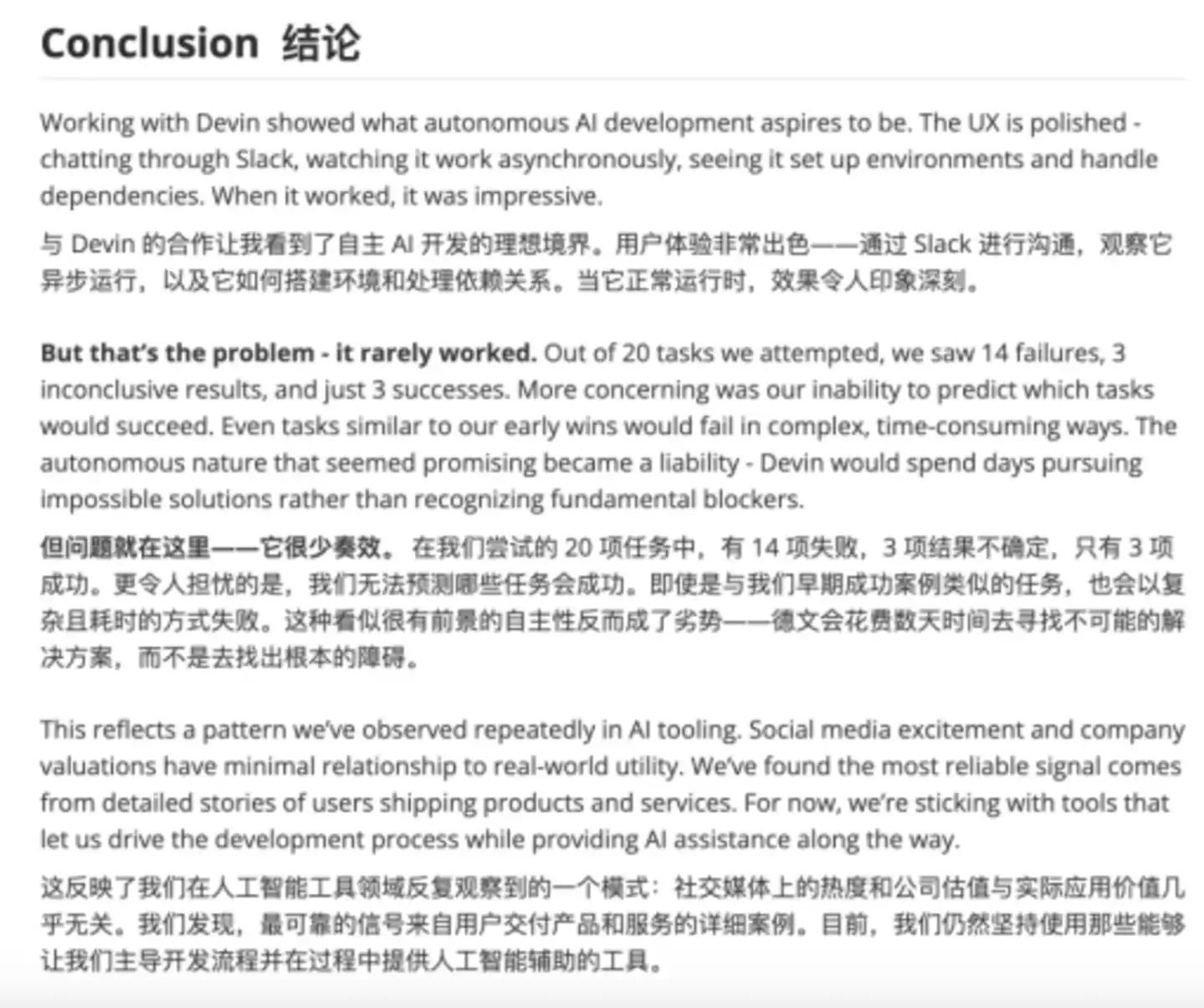
The biggest issue wasn't just the high failure rate, but the unpredictability of failures.

Some tasks that didn't seem complex would lead Devin into dead ends; some tasks themselves were infeasible, yet it would keep trying; sometimes it would generate overly complex, hard-to-maintain code, ultimately forcing engineers to spend more time reviewing and cleaning up.

And all this at such a high price.

Cognition also realized the $500/month threshold was too high. In April 2025, Cognition launched Devin 2.0, reducing the starting price from $500 per month to $20 and introducing a more flexible pay-as-you-go model.

But price reduction isn't a panacea. A tool designed to enhance efficiency ending up wasting more time and energy is hard to justify.

This is the core early-stage contradiction of autonomous Agents: the more AI resembles an independent engineer, the more users need to trust it, but the more it operates like a black box, the more troublesome deviations become.

Devin promised "give me the task," but many real engineering tasks aren't suitable to be handed over completely so early. An Agent running on its own for a long time and finally delivering a PR sounds advanced; but if PR quality is unstable, the engineer's review cost becomes even higher.

Interestingly, amidst this contrast, it was Cursor that captured the first wave of genuine developer dividends.

Because Cursor didn't initially promise to replace programmers. Its logic was gentler and more aligned with real workflows: AI helps modify code, explain errors, refactor files, generate tests on the side, but the developer remains in the editor. It's like a driving school car—you can at least hit the brakes when things seem off.

If Cognition's story ended here, it might have become another "hype" company lifted by the AI boom and then pulled back to earth by real user experience. But as mentioned earlier, reality is often more complex, and the AI programming track itself didn't stand still.

After Devin ignited the imagination of an "AI Software Engineer" and Cursor proved developers still needed a sense of control, foundation model giants like OpenAI, Google, and Anthropic also accelerated integrating coding capabilities into their own products and platforms.

On one side, the more controllable IDE route was rapidly expanding; on the other, model giants were moving down to the application layer. For Cognition to survive, it had to change.

And it was at this time that it "picked up" the treasure left by Windsurf.

03 Grasp Both Sides Firmly

The battle for Windsurf was arguably one of the most dramatic events in the AI coding tools sector in 2025.

At that time, Windsurf was already a highly regarded company in the AI IDE track. It was initially courted by OpenAI, with both sides engaged in lengthy acquisition talks, and the outside world once thought the deal was sealed.

However, the transaction ultimately didn't materialize, with one key reason being the complex partnership between OpenAI and Microsoft. At that time, Microsoft held broad licensing rights to OpenAI's technology and products, and Microsoft-owned GitHub Copilot was a major competitor in the AI programming space. Windsurf was concerned that if acquired by OpenAI, its technology and products might become entangled in the licensing framework between OpenAI and Microsoft, indirectly flowing to a potential competitor.

Just as OpenAI retreated, Google swiftly stepped in.

Google secured a non-exclusive license to Windsurf's technology for $2.4 billion, while bringing Windsurf CEO Varun Mohan, co-founder Douglas Chen, and several key R&D personnel to Google DeepMind.

It happened on a Friday, very quickly. Google took the founders and some core technology licenses. OpenAI failed to complete the acquisition. Windsurf's original corporate entity, product, brand, clients, and 250 employees were left in an awkward position.

It was at this moment that Cognition made its grand entrance.

The incident occurred on a Friday; by Monday, Cognition announced its acquisition of Windsurf's remaining assets, including the Windsurf IDE product itself, intellectual property, trademarks, brand, enterprise customer base, user data, and most of the remaining team's employees.

This move was almost crucial for Cognition's later return to the game, as it addressed exactly what Devin lacked most: a developer entry point.

Following the Windsurf acquisition, Cognition's commercialization pace noticeably accelerated. Windsurf itself already had $82 million in Annual Recurring Revenue (ARR) and over 350 enterprise clients at the time of acquisition. Cognition later disclosed that this acquisition more than doubled the company's ARR, and within seven weeks post-acquisition, the combined enterprise ARR grew over 30%.

Previously, Devin represented a more radical route. It wanted users to hand tasks to a cloud-based Agent, letting it plan, execute, debug, and deliver results autonomously. But Cursor's rise proved developers weren't necessarily willing to hand over tasks completely from the start. They were more accustomed to staying in the editor, watching AI modify code step-by-step, taking over and correcting course at any time.

Windsurf's addition gave Cognition an IDE, finally providing Cognition with more than just the "hand the task to AI" product form.

It began walking on two legs: one is Devin, responsible for asynchronous cloud-based task execution, suitable for handling engineering work that can be broken down, verified, and delivered as PRs; the other is Windsurf, responsible for the IDE entry point, allowing developers to work alongside AI in the coding environment, covering daily development scenarios similar to Cursor's domain.

If users are uncomfortable handing the steering wheel entirely to AI, then bring AI back into the editor as a controllable assistant. If enterprises indeed have a large volume of clear, repetitive, verifiable engineering tasks, let Devin act as a "formal employee" and take over part of the work in the background.

Cognition is no longer solely pursuing an all-powerful, autonomous AI programmer that can independently complete all tasks. It now covers two real needs within software engineering.

This coincidentally forms a contrast with the recently controversial Antigravity 2.0: Google initially focused on an IDE, but after the Antigravity update, it shifted directly towards a more Agent Manager-like interface, jumping from controllable IDE collaboration to black-box Agent scheduling. The direction is ambitious but also more prone to encountering Devin's early problems again.

Individual developers buying tools often consider feel, efficiency, price, and experience. If a tool isn't user-friendly, it's quickly abandoned. But enterprises buy processes and capacity. As long as an Agent can integrate into existing engineering systems and stably produce results for a portion of tasks, it has a chance to become a budget line item.

The most noticeable change in Cognition's narrative later lies here.

Early Devin was like an AI programmer in the spotlight, trying to prove it could code like a human programmer (without needing rest). Later Cognition seemed more like selling a suite of enterprise engineering automation systems: Devin handles asynchronous execution, Windsurf handles the development entry point, and enterprise clients embed them into their own software development workflows.

According to a May 29 TechCrunch interview, CEO Scott Wu clearly pulled Devin back from the "replace programmers" narrative. When asked if Devin could replace a mid-level programmer, his response was "Yes and no."

He emphasized that Cognition never shaped Devin towards "replacing humans." The team members themselves are programmers and don't wish for programmers to lose jobs. He stated Devin's capability varies with tasks, roughly between junior and mid-level engineers; it's more suited for handling the long-tail maintenance tasks many programmers dislike, such as legacy software upgrades, platform migrations, etc., freeing engineers from such grunt work to focus on more creative endeavors.

The two-legged combination precisely avoids the shortcomings of a single product. With only Devin, it appears too radical, and users worry about autonomous Agents being uncontrollable. With only Windsurf, it easily falls into direct competition with products like Cursor, Copilot, Claude Code, Codex. But Devin plus Windsurf gives Cognition a more complete story: serving developers' daily coding scenarios and serving enterprises needing to delegate tasks to Agents.

The data presented in the latest funding round also indicates its story is being validated by the market.

The company states enterprise usage has grown over 10-fold since the beginning of this year, revenue run-rate has reached $492 million, and enterprise-side Devin usage has maintained a 50% month-over-month growth for the past six months.

Clients like Goldman Sachs, Mercedes-Benz, Citi, Dell, Cisco, NASA, US Army, and US Navy also make its enterprise narrative no longer just a demo story.

The $26 billion valuation isn't capital buying a perfect programmer-replacing Devin, but the potential following Cognition's pivot: in the earliest landing sector for AI Agents, it could become the new entry point for enterprise software engineering.

Future software development will likely not completely revert to the era of human engineers coding alone, nor will it immediately transform into AI Agents taking over everything automatically. A more foreseeable scenario is a hybrid system: humans determine direction within the IDE, with AI assisting; some tasks are broken out and handled asynchronously by cloud-based Agents; code is still tested, reviewed, merged, and humans ultimately bear responsibility.

Cognition is betting on this middle ground.

Пов'язані питання

QWhat is the latest valuation of Cognition AI after its recent funding round?

AAfter its recent funding round, Cognition AI's post-money valuation reached $26 billion.

QWhat were some of the initial criticisms and challenges faced by Cognition's flagship AI programmer, Devin?

ADevin faced criticisms for high pricing, unreliable performance with unpredictable failures, and concerns that its early demos were overly polished, leading to skepticism about its readiness for real-world engineering tasks.

QHow did the acquisition of Windsurf benefit Cognition AI's business strategy?

AThe acquisition of Windsurf provided Cognition with a popular IDE product, established enterprise customers, and intellectual property. This allowed Cognition to offer both an autonomous agent (Devin) and a collaborative IDE tool, addressing different software development needs and accelerating its commercialization and revenue growth.

QWhich major venture capital firms led the latest funding round for Cognition AI?

AThe latest funding round for Cognition AI was co-led by Lux Capital, General Catalyst, and 8VC.

QHow has Cognition AI's narrative about its product Devin evolved according to CEO Scott Wu?

ACEO Scott Wu shifted Devin's narrative away from being a direct replacement for human programmers. He emphasized that Devin is designed to handle tedious maintenance tasks, freeing up human engineers for more creative work, and that the company's goal is to augment, not replace, software developers.

Пов'язані матеріали

Another Corporate Bitcoin Treasury Strategy Ends: From High-Profile Entry to Liquidation at a Massive Loss in 11 Months

French semiconductor company Sequans Communications has sold off its bitcoin holdings and terminated its corporate bitcoin treasury strategy less than a year after launching it, sustaining heavy losses. Facing delisting from the New York Stock Exchange in mid-2025 due to low market capitalization, Sequans announced a plan to hold over 3,000 bitcoin as a long-term reserve asset. The strategy was executed with Swan Bitcoin and backed by a $384 million private financing round. At its peak in October 2025, the company held 3,234 bitcoin with an average cost of approximately $116,643 per coin. However, the plan quickly unraveled. With bitcoin's price falling, Sequans sold 970 bitcoin in late 2025 to repay debt, contradicting the core "hold" philosophy of such corporate strategies. The company has now sold more bitcoin to fully repay its convertible notes and announced the termination of its bitcoin reserve strategy. It plans to liquidate its remaining 658 bitcoin. The venture resulted in significant financial damage. The company reported an unrealized loss of $67.4 million on its bitcoin holdings in 2025, contributing to a total net loss of $109.3 million for the year. Sequans' stock (SQNS) has plummeted over 80% since the strategy's launch and is down 77% year-to-date. CEO Georges Karam, who previously championed bitcoin's long-term value, now states the company will refocus entirely on its core IoT semiconductor business. The failed experiment highlights the risks for companies adopting volatile digital assets as treasury reserves.

marsbit18 хв тому

Another Corporate Bitcoin Treasury Strategy Ends: From High-Profile Entry to Liquidation at a Massive Loss in 11 Months

marsbit18 хв тому

BIS Latest Research: The Future of Stablecoins and the Global Monetary Landscape

BIS Working Paper No. 170, released in May 2026, analyzes the impact of stablecoins on the global monetary system. The market has grown exponentially since 2014, with over 300 active stablecoins exceeding $300 billion in market capitalization. It is highly concentrated, dominated by USD-linked stablecoins (98% by market cap, mainly USDT and USDC), which function as new forms of private offshore dollar claims on blockchain. Currently, stablecoin use remains largely within crypto ecosystems for trading and DeFi collateral. Real-economy adoption, such as in cross-border payments, is nascent but growing in emerging markets and developing economies (EMDEs) facing high inflation and volatile currencies, where they facilitate capital flight and "digital dollarization." The paper assesses impacts using the Cohen-Kennen framework. For private-sector functions, stablecoins most directly affect value storage (as a dollar-denominated safe haven in EMDEs) and the medium of exchange (enhancing cross-border payment efficiency, further entrenching dollar use). Impacts on the unit of account and official-sector functions are currently limited but could indirectly constrain monetary policy autonomy and capital controls. The report outlines three potential future scenarios: 1) **Niche adoption**, where stablecoins remain crypto-centric with minimal systemic impact; 2) **Digital dollarization**, a high-risk scenario where USD stablecoins become de facto standards in EMDEs, eroding monetary sovereignty; and 3) **Local currency stablecoin integration**, an ideal but challenging scenario where regulated domestic stablecoins linked to CBDCs enhance efficiency without foreign currency substitution. Key policy recommendations emphasize global coordination: establishing uniform regulatory standards (e.g., for reserves and disclosure), strengthening cross-border supervisory cooperation, enhancing domestic defenses in EMDEs (via macroeconomic stability, improved payment systems, and CBDCs), and combating illicit activities. The paper concludes that stablecoins are a structural force reinforcing dollar dominance in the near term, posing significant risks to EMDEs' financial stability and policy autonomy. Their long-term trajectory depends on regulatory responses, adoption patterns, and the co-evolution with public digital currencies.

marsbit27 хв тому

BIS Latest Research: The Future of Stablecoins and the Global Monetary Landscape

marsbit27 хв тому

BIS Latest Research: Stablecoins and the Future of the Global Monetary Landscape

The Bank for International Settlements (BIS) Working Paper No. 170 analyzes the rise of stablecoins and their impact on the global monetary system. Stablecoins, privately issued digital tokens pegged to fiat currencies, have grown exponentially since 2014, with a market dominated by USD-pegged variants like USDT and USDC. Their core function remains within the crypto ecosystem, though use in cross-border payments and as a store of value in high-inflation emerging markets is increasing. The report identifies stablecoins as a new form of offshore dollar claims, extending dollar liquidity via blockchain. Their stability depends entirely on reserve quality and market arbitrage, lacking traditional banking safeguards. In the short term, stablecoins reinforce the US dollar's dominance, posing risks to monetary sovereignty in emerging market and developing economies (EMDEs) by facilitating "digital dollarization," which can undermine local currency deposits, capital controls, and monetary policy effectiveness. The BIS outlines three potential future scenarios: 1) Niche adoption within crypto (baseline), 2) Widespread "digital dollarization" in EMDEs (high-risk), and 3) Integration of domestic currency stablecoins (ideal but challenging). Effective global regulatory coordination is crucial to manage risks like reserve transparency, cross-border spillovers, and illicit activities. The report concludes that stablecoins represent a structural force reshaping international monetary hierarchies, presenting both opportunities for payment efficiency and significant risks to financial stability and autonomy, necessitating robust policy responses.

链捕手32 хв тому

BIS Latest Research: Stablecoins and the Future of the Global Monetary Landscape

链捕手32 хв тому

Solo Company Craze: Some Earn Millions Annually, Others See Incomes Shrink by 90%

The Rise of the "One-Person Company" (OPC): AI Fuels a Solo Entrepreneurship Wave The concept of the "One-Person Company" (OPC)—where an individual leverages AI tools to start and run a business—is gaining significant traction, hailed by some as ushering in a "golden age" for solo entrepreneurship. While success stories abound, the reality is a mixed picture of high earnings and significant struggles. The article profiles several OPC founders across different industries: * A game developer created 6 bullet-chat (danmaku) games in a year using an AI-powered workflow, earning approximately 1 million RMB. AI handled around 70% of art and 99% of coding tasks, slashing development cycles from months to about 15 days per game. * A materials researcher in Japan, using AI for tasks from translation to legal advice, earns roughly triple the salary of a local white-collar worker. * A biotech entrepreneur uses AI Agents to automate 80% of repetitive work like data analysis, doubling their previous income while gaining time freedom. * Conversely, a former tech executive turned cross-border e-commerce founder in Latin America reports a 90% drop in income compared to their previous corporate job, cautioning against blindly following the trend. Key insights from these cases include: AI dramatically lowers barriers to entry and operational costs, but does not guarantee success. It excels at automating repetitive tasks but cannot replace core human skills like creativity, project management, judgment, and client acquisition. Industry experience and existing client/resources remain critical advantages. The model suits self-starters with specific expertise but poses challenges in areas like sales, compliance, and scaling. Ultimately, while AI empowers solo ventures, entrepreneurship's inherent risks and demands persist.

marsbit39 хв тому

Solo Company Craze: Some Earn Millions Annually, Others See Incomes Shrink by 90%

marsbit39 хв тому

Торгівля

Спот
Ф'ючерси

Популярні статті

Що таке $S$

Розуміння SPERO: Комплексний огляд Вступ до SPERO Оскільки ландшафт інновацій продовжує еволюціонувати, виникнення технологій web3 та криптовалютних проектів відіграє ключову роль у формуванні цифрового майбутнього. Один з проектів, який привернув увагу в цій динамічній сфері, — це SPERO, позначений як SPERO,$$s$. Ця стаття має на меті зібрати та представити детальну інформацію про SPERO, щоб допомогти ентузіастам та інвесторам зрозуміти його основи, цілі та інновації в рамках web3 та крипто-сектору. Що таке SPERO,$$s$? SPERO,$$s$ — це унікальний проект у криптопросторі, який прагне використати принципи децентралізації та технології блокчейн для створення екосистеми, що сприяє залученню, корисності та фінансовій інклюзії. Проект розроблений для полегшення взаємодії між користувачами новими способами, надаючи їм інноваційні фінансові рішення та послуги. У своїй основі SPERO,$$s$ прагне надати можливості індивідам, забезпечуючи інструменти та платформи, які покращують користувацький досвід у криптовалютному просторі. Це включає в себе можливість більш гнучких методів транзакцій, сприяння ініціативам, що підтримуються спільнотою, та створення шляхів для фінансових можливостей через децентралізовані додатки (dApps). Основна концепція SPERO,$$s$ обертається навколо інклюзивності, прагнучи зменшити розриви в традиційній фінансовій системі, використовуючи переваги технології блокчейн. Хто є творцем SPERO,$$s$? Особистість творця SPERO,$$s$ залишається дещо невідомою, оскільки є обмежені публічно доступні ресурси, що надають детальну інформацію про його засновників. Ця відсутність прозорості може бути наслідком зобов'язання проекту до децентралізації — етики, яку багато проектів web3 поділяють, ставлячи колективні внески вище за індивідуальне визнання. Зосереджуючи обговорення навколо спільноти та її колективних цілей, SPERO,$$s$ втілює суть наділення без виділення конкретних осіб. Таким чином, розуміння етики та місії SPERO є більш важливим, ніж ідентифікація єдиного творця. Хто є інвесторами SPERO,$$s$? SPERO,$$s$ підтримується різноманітними інвесторами, починаючи від венчурних капіталістів до ангельських інвесторів, які прагнуть сприяти інноваціям у крипто-секторі. Зосередження цих інвесторів зазвичай узгоджується з місією SPERO — пріоритет надається проектам, які обіцяють технологічний прогрес у суспільстві, фінансову інклюзію та децентралізоване управління. Ці інвесторські фонди зазвичай зацікавлені в проектах, які не лише пропонують інноваційні продукти, але й позитивно впливають на спільноту блокчейн та її екосистеми. Підтримка з боку цих інвесторів підкріплює SPERO,$$s$ як значного конкурента в швидко змінюваній сфері крипто-проектів. Як працює SPERO,$$s$? SPERO,$$s$ використовує багатогранну структуру, яка відрізняє його від традиційних криптовалютних проектів. Ось деякі ключові особливості, які підкреслюють його унікальність та інноваційність: Децентралізоване управління: SPERO,$$s$ інтегрує моделі децентралізованого управління, надаючи користувачам можливість активно брати участь у процесах прийняття рішень щодо майбутнього проекту. Цей підхід сприяє відчуттю власності та відповідальності серед членів спільноти. Корисність токена: SPERO,$$s$ використовує свій власний криптовалютний токен, розроблений для виконання різних функцій в екосистемі. Ці токени дозволяють здійснювати транзакції, отримувати винагороди та полегшувати послуги, що пропонуються на платформі, підвищуючи загальну залученість та корисність. Шарова архітектура: Технічна архітектура SPERO,$$s$ підтримує модульність та масштабованість, що дозволяє безперешкодно інтегрувати додаткові функції та додатки в міру розвитку проекту. Ця адаптивність є надзвичайно важливою для збереження актуальності в постійно змінюваному крипто-ландшафті. Залучення спільноти: Проект підкреслює ініціативи, що підтримуються спільнотою, використовуючи механізми, які стимулюють співпрацю та зворотний зв'язок. Підтримуючи сильну спільноту, SPERO,$$s$ може краще задовольняти потреби користувачів та адаптуватися до ринкових тенденцій. Фокус на інклюзію: Пропонуючи низькі комісії за транзакції та зручні інтерфейси, SPERO,$$s$ прагне залучити різноманітну базу користувачів, включаючи осіб, які раніше не брали участі в крипто-просторі. Це зобов'язання до інклюзії узгоджується з його загальною місією наділення через доступність. Хронологія SPERO,$$s$ Розуміння історії проекту надає важливі уявлення про його розвиток та етапи. Нижче наведено пропоновану хронологію, що відображає значні події в еволюції SPERO,$$s$: Етап концептуалізації та ідеації: Початкові ідеї, що стали основою SPERO,$$s$, були сформовані, тісно пов'язані з принципами децентралізації та фокусом на спільноті в індустрії блокчейн. Запуск білого паперу проекту: Після концептуального етапу був випущений комплексний білий папір, що детально описує бачення, цілі та технологічну інфраструктуру SPERO,$$s$, щоб залучити інтерес та зворотний зв'язок від спільноти. Створення спільноти та ранні залучення: Активні зусилля були спрямовані на створення спільноти ранніх прихильників та потенційних інвесторів, що полегшило обговорення цілей проекту та отримання підтримки. Подія генерації токенів: SPERO,$$s$ провів подію генерації токенів (TGE) для розподілу своїх рідних токенів серед ранніх прихильників та встановлення початкової ліквідності в екосистемі. Запуск початкового dApp: Перший децентралізований додаток (dApp), пов'язаний з SPERO,$$s$, став доступним, дозволяючи користувачам взаємодіяти з основними функціями платформи. Постійний розвиток та партнерства: Безперервні оновлення та вдосконалення пропозицій проекту, включаючи стратегічні партнерства з іншими учасниками блокчейн-простору, сформували SPERO,$$s$ у конкурентоспроможного та еволюціонуючого гравця на крипто-ринку. Висновок SPERO,$$s$ є свідченням потенціалу web3 та криптовалют для революціонізації фінансових систем та наділення індивідів. Завдяки зобов'язанню до децентралізованого управління, залучення спільноти та інноваційно спроектованих функцій, він прокладає шлях до більш інклюзивного фінансового ландшафту. Як і з будь-якими інвестиціями в швидко змінюваному крипто-просторі, потенційним інвесторам та користувачам рекомендується ретельно досліджувати та обдумано взаємодіяти з поточними подіями в SPERO,$$s$. Проект демонструє інноваційний дух крипто-індустрії, запрошуючи до подальшого дослідження його численних можливостей. Хоча подорож SPERO,$$s$ ще триває, його основні принципи можуть справді вплинути на майбутнє того, як ми взаємодіємо з технологією, фінансами та один з одним у взаємопов'язаних цифрових екосистемах.

73 переглядів усьогоОпубліковано 2024.12.17Оновлено 2024.12.17

Що таке $S$

Що таке AGENT S

Агент S: Майбутнє автономної взаємодії в Web3 Вступ У постійно змінюваному ландшафті Web3 та криптовалюти інновації постійно переосмислюють, як люди взаємодіють з цифровими платформами. Один з таких новаторських проектів, Агент S, обіцяє революціонізувати взаємодію людини з комп'ютером через свою відкриту агентну структуру. Прокладаючи шлях для автономних взаємодій, Агент S прагне спростити складні завдання, пропонуючи трансформаційні застосування в штучному інтелекті (ШІ). Це детальне дослідження заглиблюється в складності проекту, його унікальні особливості та наслідки для сфери криптовалюти. Що таке Агент S? Агент S є революційною відкритою агентною структурою, спеціально розробленою для вирішення трьох основних викликів в автоматизації комп'ютерних завдань: Набуття специфічних знань у галузі: Структура інтелектуально навчається з різних зовнішніх джерел знань та внутрішнього досвіду. Цей подвійний підхід дозволяє їй створити багатий репозиторій специфічних знань у галузі, покращуючи її продуктивність у виконанні завдань. Планування на довгих горизонтах завдань: Агент S використовує планування з підкріпленням досвіду, стратегічний підхід, який полегшує ефективний розподіл та виконання складних завдань. Ця функція значно підвищує її здатність ефективно та результативно управляти кількома підзавданнями. Обробка динамічних, неоднорідних інтерфейсів: Проект представляє Інтерфейс Агент-Комп'ютер (ACI), інноваційне рішення, яке покращує взаємодію між агентами та користувачами. Використовуючи багатомодальні великі мовні моделі (MLLMs), Агент S може безперешкодно орієнтуватися та маніпулювати різноманітними графічними інтерфейсами користувача. Завдяки цим новаторським функціям Агент S надає надійну структуру, яка вирішує складнощі, пов'язані з автоматизацією людської взаємодії з машинами, прокладаючи шлях для численних застосувань у ШІ та за його межами. Хто є творцем Агент S? Хоча концепція Агент S є фундаментально новаторською, конкретна інформація про його творця залишається невідомою. Творець наразі невідомий, що підкреслює або початкову стадію проекту, або стратегічний вибір зберегти засновників у таємниці. Незважаючи на анонімність, акцент залишається на можливостях та потенціалі структури. Хто є інвесторами Агент S? Оскільки Агент S є відносно новим у криптографічній екосистемі, детальна інформація про його інвесторів та фінансових спонсорів не задокументована. Відсутність публічно доступних відомостей про інвестиційні фонди або організації, що підтримують проект, викликає питання щодо його фінансової структури та дорожньої карти розвитку. Розуміння підтримки є критично важливим для оцінки стійкості проекту та потенційного впливу на ринок. Як працює Агент S? В основі Агент S лежить передова технологія, яка дозволяє йому ефективно функціонувати в різних умовах. Його операційна модель побудована навколо кількох ключових функцій: Взаємодія з комп'ютером, подібна до людської: Структура пропонує розширене планування ШІ, прагнучи зробити взаємодії з комп'ютерами більш інтуїтивними. Імітуючи людську поведінку при виконанні завдань, вона обіцяє підвищити досвід користувачів. Наративна пам'ять: Використовується для використання високорівневого досвіду, Агент S використовує наративну пам'ять для відстеження історій завдань, тим самим покращуючи свої процеси прийняття рішень. Епізодична пам'ять: Ця функція надає користувачам покрокові інструкції, дозволяючи структурі пропонувати контекстуальну підтримку в міру виконання завдань. Підтримка OpenACI: Завдяки можливості працювати локально, Агент S дозволяє користувачам зберігати контроль над своїми взаємодіями та робочими процесами, узгоджуючи з децентралізованою етикою Web3. Легка інтеграція з зовнішніми API: Його універсальність і сумісність з різними платформами ШІ забезпечують те, що Агент S може безперешкодно вписатися в існуючі технологічні екосистеми, роблячи його привабливим вибором для розробників та організацій. Ці функціональні можливості колективно сприяють унікальному положенню Агент S у крипто-просторі, оскільки він автоматизує складні, багатоступеневі завдання з мінімальним втручанням людини. У міру розвитку проекту його потенційні застосування в Web3 можуть переосмислити, як відбуваються цифрові взаємодії. Хронологія Агент S Розробка та етапи Агент S можуть бути узагальнені в хронології, яка підкреслює його значні події: 27 вересня 2024 року: Концепція Агент S була представлена в комплексній науковій статті під назвою “Відкрита агентна структура, яка використовує комп'ютери як людина”, що демонструє основи проекту. 10 жовтня 2024 року: Наукова стаття була опублікована на arXiv, пропонуючи детальне дослідження структури та її оцінки продуктивності на основі бенчмарку OSWorld. 12 жовтня 2024 року: Було випущено відеопрезентацію, що надає візуальне уявлення про можливості та особливості Агент S, ще більше залучаючи потенційних користувачів та інвесторів. Ці маркери в хронології не лише ілюструють прогрес Агент S, але й вказують на його прихильність до прозорості та залучення громади. Ключові моменти про Агент S У міру розвитку структури Агент S кілька ключових характеристик виділяються, підкреслюючи її новаторський характер та потенціал: Інноваційна структура: Розроблена для забезпечення інтуїтивного використання комп'ютерів, подібного до людської взаємодії, Агент S пропонує новий підхід до автоматизації завдань. Автономна взаємодія: Здатність автономно взаємодіяти з комп'ютерами через GUI означає стрибок до більш інтелектуальних та ефективних обчислювальних рішень. Автоматизація складних завдань: Завдяки своїй надійній методології він може автоматизувати складні, багатоступеневі завдання, роблячи процеси швидшими та менш схильними до помилок. Безперервне вдосконалення: Механізми навчання дозволяють Агенту S покращуватися на основі минулого досвіду, постійно підвищуючи свою продуктивність та ефективність. Універсальність: Його адаптивність до різних операційних середовищ, таких як OSWorld та WindowsAgentArena, забезпечує його здатність служити широкому спектру застосувань. Оскільки Агент S займає своє місце в ландшафті Web3 та криптовалюти, його потенціал покращити можливості взаємодії та автоматизувати процеси означає значний прогрес у технологіях ШІ. Завдяки своїй інноваційній структурі Агент S є прикладом майбутнього цифрових взаємодій, обіцяючи більш безперешкодний та ефективний досвід для користувачів у різних галузях. Висновок Агент S представляє собою сміливий крок вперед у поєднанні ШІ та Web3, з можливістю переосмислити, як ми взаємодіємо з технологією. Хоча проект все ще на ранніх стадіях, можливості для його застосування є величезними та переконливими. Завдяки своїй комплексній структурі, що вирішує критичні виклики, Агент S прагне вивести автономні взаємодії на передній план цифрового досвіду. У міру того, як ми заглиблюємося в сфери криптовалюти та децентралізації, проекти, подібні до Агент S, безсумнівно, відіграватимуть ключову роль у формуванні майбутнього технологій та співпраці людини з комп'ютером.

666 переглядів усьогоОпубліковано 2025.01.14Оновлено 2025.01.14

Що таке AGENT S

Як купити S

Ласкаво просимо до HTX.com! Ми зробили покупку Sonic (S) простою та зручною. Дотримуйтесь нашої покрокової інструкції, щоб розпочати свою криптовалютну подорож.Крок 1: Створіть обліковий запис на HTXВикористовуйте свою електронну пошту або номер телефону, щоб зареєструвати обліковий запис на HTX безплатно. Пройдіть безпроблемну реєстрацію й отримайте доступ до всіх функцій.ЗареєструватисьКрок 2: Перейдіть до розділу Купити крипту і виберіть спосіб оплатиКредитна/дебетова картка: використовуйте вашу картку Visa або Mastercard, щоб миттєво купити Sonic (S).Баланс: використовуйте кошти з балансу вашого рахунку HTX для безперешкодної торгівлі.Треті особи: ми додали популярні способи оплати, такі як Google Pay та Apple Pay, щоб підвищити зручність.P2P: Торгуйте безпосередньо з іншими користувачами на HTX.Позабіржова торгівля (OTC): ми пропонуємо індивідуальні послуги та конкурентні обмінні курси для трейдерів.Крок 3: Зберігайте свої Sonic (S)Після придбання Sonic (S) збережіть його у своєму обліковому записі на HTX. Крім того, ви можете відправити його в інше місце за допомогою блокчейн-переказу або використовувати його для торгівлі іншими криптовалютами.Крок 4: Торгівля Sonic (S)Легко торгуйте Sonic (S) на спотовому ринку HTX. Просто увійдіть до свого облікового запису, виберіть торгову пару, укладайте угоди та спостерігайте за ними в режимі реального часу. Ми пропонуємо зручний досвід як для початківців, так і для досвідчених трейдерів.

1.5k переглядів усьогоОпубліковано 2025.01.15Оновлено 2025.03.21

Як купити S

Обговорення

Ласкаво просимо до спільноти HTX. Тут ви можете бути в курсі останніх подій розвитку платформи та отримати доступ до професійної ринкової інформації. Нижче представлені думки користувачів щодо ціни S (S).

活动图片














