Интерес рынка к Toncoin (TON) резко вырос из-за Павла Дурова

cryptonews.ruОпубліковано о 2024-01-06Востаннє оновлено о 2024-09-06

За последние сутки настроения рынка вокруг Toncoin (TON) резко изменились на более бычьи. Этому поспособствовало обращение, которое опубликовал Павел Дуров

Разбираемся, что ждет Toncoin (TON) в ближайшие дни и готова ли криптовалюта к началу нового ралли.

Первое заявление Павла Дурова

Ранее сегодня основатель мессенджера «Телеграм» Павел Дуров высказался по поводу обвинений в свой адрес. Он заявил, что готов покинуть рынки, несовместимые с концепцией мессенджера, а также выразил благодарность за поддержку общественности.

«Иногда нам не удается прийти к согласию с регулятором страны относительно правильного баланса между конфиденциальностью и безопасностью. В таких случаях мы готовы покинуть эту страну. Мы делали это много раз», — сказал Дуров, приводя в пример Россию и Иран. «Мы готовы покинуть рынки, которые не совместимы с нашими принципами, потому что мы делаем это не ради денег. Нами движут намерения приносить пользу и защищать основные права людей, особенно там, где эти права нарушаются».

В прошлом месяце Дуров был арестован в аэропорту Парижа. Ему было предъявлено обвинение в «соучастии в распространении детской порнографии» и других преступлениях, таких как торговля наркотиками через мессенджер.

Спрос на TON растет

На новостях цена Toncoin смогла выйти в рост. Это восходящее движение поддерживает значительный спрос рынка — его подтверждает дивергенция цены и показателя дневных активных адресов (DAA). Традиционно это считается бычьим сигналом, который намекает на продолжение ралли.

Читайте также: Что такое TON: обзор проекта и криптовалюты Toncoin
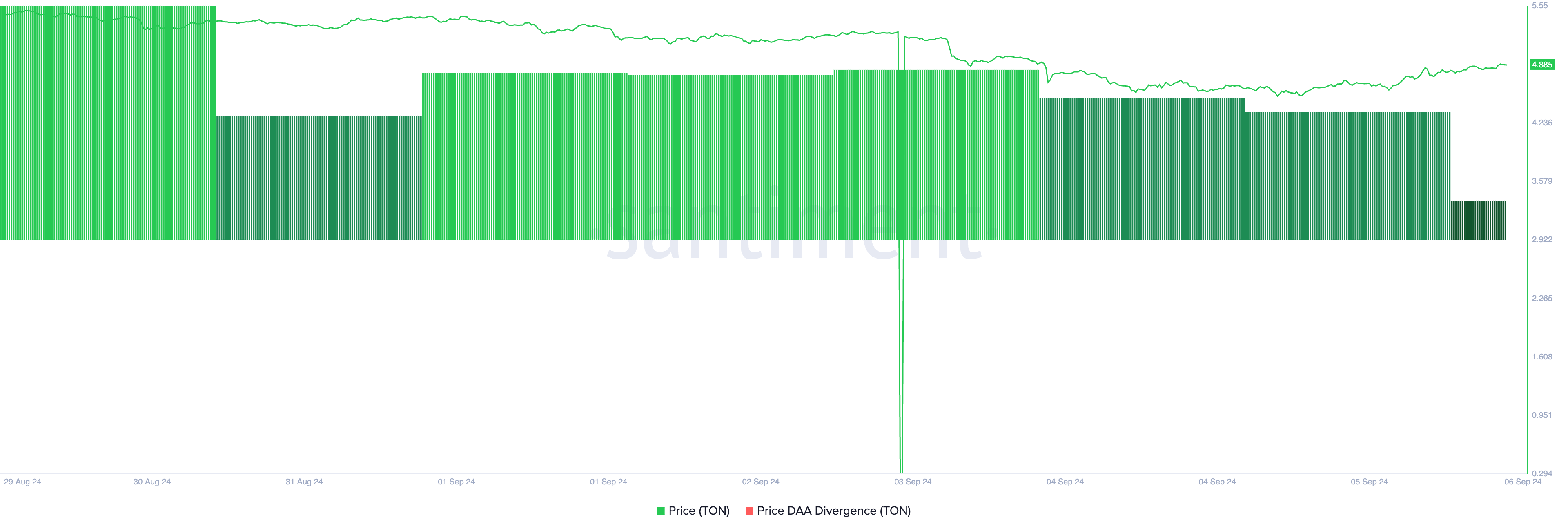
Ежедневное отклонение активных адресов цены Toncoin. Источник: Santiment

Кроме того, настроение рынка по отношению к TON изменилось с негативного на позитивное за последние два дня. Об этом свидетельствуют положительные взвешенные настроения вокруг токена — к моменту написания значения показателя выросли до 0,50.

Читайте также: Как купить Toncoin (TON) за рубли: инструкция
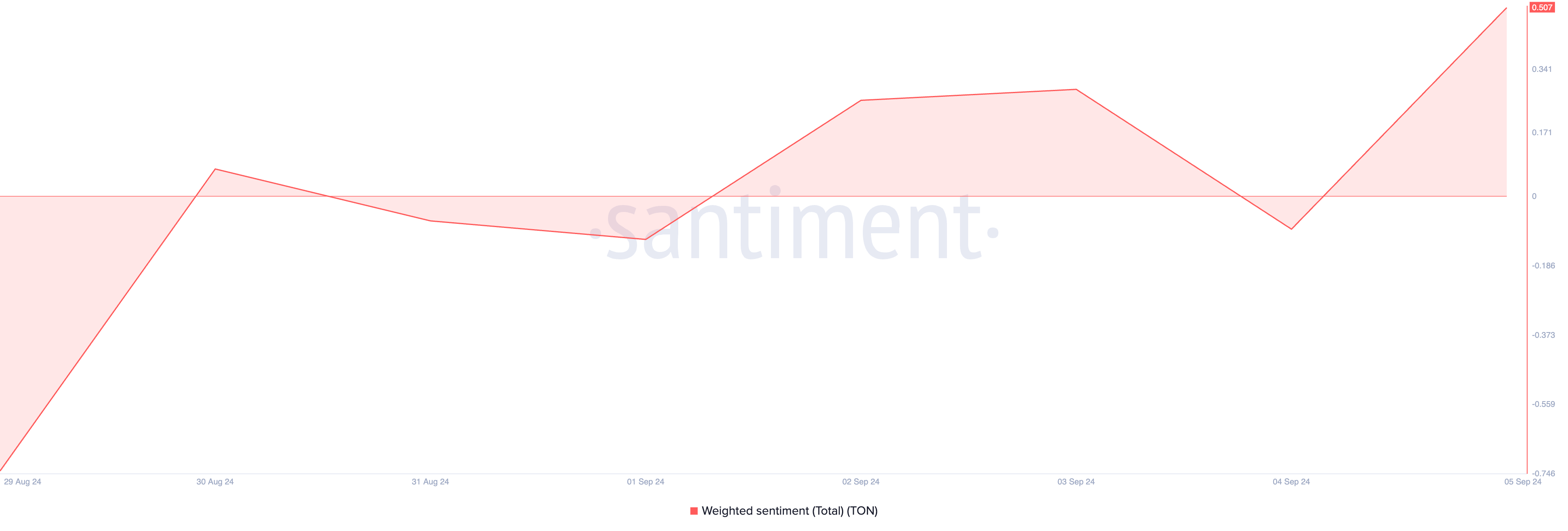
Взвешенное настроение Toncoin. Источник: Santiment

Тем временем на рынке деривативов также наблюдается бычья тенденция с ростом объема торгов и открытого интереса. Согласно Coinglass, объем торгов увеличился на 8% и на данный момент достиг $630 млн. Открытый интерес тоже вырос на 8,17%. Это говорит о том, что все больше трейдеров открывают новые позиции по Toncoin.

Прогноз Toncoin: впереди ралли

На момент написания этого анализа TON торгуется по $4,85, за сутки поднявшись на 3,7%. Анализ 12-часового графика криптовалюты намекает на возможное продолжение ралли.

На графике ниже видно, что синяя линия MACD готова пересечь сигнальную линию (оранжевую). Такое пересечение традиционно считается сигналом о смене медвежьего тренда на бычий. Трейдеры часто интерпретируют его как сигнал к покупке.

Кроме того, индикатор Чайкина (CMF) пытается пересечь нулевую линию. Значения выше нуля указывают на то, что покупатели берут верх над продавцами и, следовательно, начинают контролировать рынок.

Если активность покупателей Toncoin останется высокой, цена токена получит шанс подняться до $5,32. В случае успешного прорыва этого важного сопротивления криптовалюта сможет продолжить ралли и добраться до $5,96.

Читайте также: В «Телеграме» появились новые способы заработать Toncoin (TON)
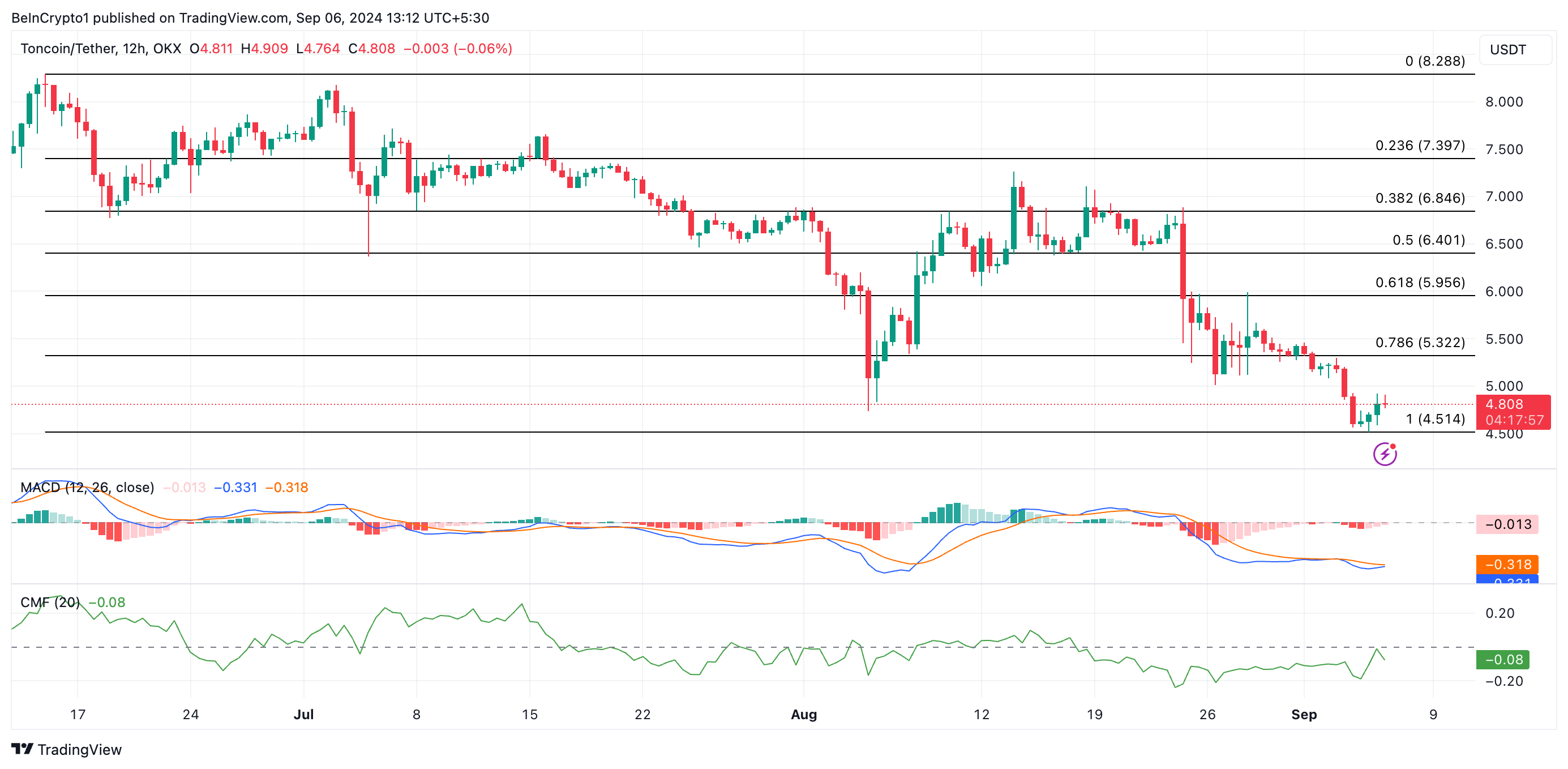
Анализ цены Toncoin. Источник: TradingView

Тем не менее если уровень поддержки на $4,51 будет потерян, то появится риск коррекции. В таком случае TON рискует упасть на 40%.
Пов'язані матеріали

The Largest Upgrade Since The Merge? How Glamsterdam Will Affect Ethereum and Regular Users?

The upcoming Glamsterdam upgrade, scheduled for late 2026, is considered Ethereum's most significant change since The Merge. It focuses on fundamentally restructuring Ethereum's block production, transaction execution, and gas pricing to enable major scalability improvements while preserving decentralization. The upgrade centers on three key innovations: * **Enshrined PBS (ePBS)**: Moves the Proposer-Builder Separation mechanism into the protocol's core, eliminating reliance on external relays. This reorganizes the block pipeline, extending the time window for processing execution payloads, which is crucial for safely increasing block capacity. * **Block-Level Access Lists (BALs)**: Attaches a "map" to each block, declaring in advance which state data its transactions will access. This enables potential parallel transaction processing and faster node synchronization, breaking a key performance bottleneck. * **Gas Repricing**: Introduces a more accurate resource pricing model by separating computation costs from state storage costs. This discourages uncontrolled state growth by making operations that create permanent data (like new accounts) more accurately reflect their long-term network burden. Together, these changes aim to solve the core challenges of increasing Ethereum's throughput (e.g., raising the Gas Limit) without overburdening node hardware or increasing centralization risks. They prepare the infrastructure for higher capacity, targeting a credible post-upgrade capacity of up to 200 million Gas. For users, the impact will be nuanced: * General transaction fees may become lower and more stable as block space increases. * Simple transfers could see cost reductions, while state-intensive operations (like contract deployment) may become relatively more expensive due to the new gas model. * Gas fee estimations by wallets will become more accurate. * L2 networks could benefit long-term from increased data blob capacity. * Standardized logs for all ETH transfers (EIP-7708) will improve tracking for wallets and exchanges. Ultimately, Glamsterdam represents a foundational shift, not a simple block size increase. It seeks to expand Ethereum's capacity by re-engineering its underlying mechanics, maintaining its commitment to decentralization while enabling significant performance gains.

marsbit30 хв тому

The Largest Upgrade Since The Merge? How Glamsterdam Will Affect Ethereum and Regular Users?

marsbit30 хв тому

Circle CEO Responds to the OUSD Challenge: Stablecoin is a Winner-Takes-All Business, and We Won't Slow Down

In response to questions about the OUSD stablecoin initiative, Circle CEO Jeremy Allaire argues that the stablecoin market is a "winner-take-most" platform business driven by powerful network effects, and Circle has no plans to slow down. He outlines three key drivers behind USDC's dominant position: 1. **Protocol/Software Layer Network Effects**: The value of a stablecoin network grows as more developers and services integrate it, creating compounding utility and user preference. Circle has spent nearly a decade building this ecosystem with USDC, now accelerated by mainstream adoption and enhanced by software stacks like CCTP and Gateway for interoperability. 2. **Liquidity Network Effects**: Liquidity begets more liquidity. USDC has achieved top-tier global liquidity—ranking among the top three digital assets alongside BTC and USDT—through nearly a decade of building deep primary and secondary market access across regions and venues. 3. **Regulatory and Policy Integration**: Establishing a global stablecoin requires deep regulatory engagement, licensing, and compliance across key markets—a significant, long-term investment where Circle is a leader. Allaire cites Artemis data showing USDC facilitated 80% of all dollar stablecoin on-chain transaction volume in Q1 2026, with USDT at 20% and all others negligible. He addresses OUSD's purported advantages: "free" minting/burning is often not sustainable in practice; redistributing all revenue can starve essential infrastructure investment; and large consortium models historically struggle with inefficiency and slow execution, unlike focused strategic partnerships. He reaffirms Circle's strong ongoing partnership with Coinbase on USDC and notes Circle collaborates with dozens of other stablecoin issuers through its expanding platform (Arc, CCTP, CPN, etc.). While welcoming OUSD to the ecosystem, Allaire asserts that Circle's vast, trusted network and continued investment make USDC the foundational digital dollar infrastructure for the world.

链捕手37 хв тому

Circle CEO Responds to the OUSD Challenge: Stablecoin is a Winner-Takes-All Business, and We Won't Slow Down

链捕手37 хв тому

Q2 Crypto Market Review: Did Bitcoin Rise for 'Nothing'? Did Money Flow to AI and On-Chain?

Q2 2026 Crypto Market Recap: Bitcoin's Gains Erased Amid Shift to AI and On-Chain Activity The second quarter of 2026 saw a significant reversal for the cryptocurrency market. Bitcoin gave back all its April gains, ending Q2 down approximately 11%, while major stock indices posted strong gains. This divergence was driven by a hawkish shift in Fed rate expectations, capital rotation into AI stocks, and weakening liquidity channels into crypto. Key demand pillars deteriorated simultaneously. Spot Bitcoin ETFs recorded net outflows of $4.08 billion for the quarter, with outflows dominating June. Crypto treasury entity Strategy's bitcoin accumulation slowed markedly, and the total stablecoin market cap contracted by ~$4.2 billion. This created a tighter liquidity environment. Exchange data reflected the downturn. Spot trading volumes fell 28% quarter-over-quarter. The market underwent significant deleveraging, with $8.35 billion in long liquidations for BTC and ETH, primarily in late May/early June. Open interest and order book liquidity also declined. Despite the bearish price action, structural developments point to an expanding on-chain ecosystem. These include the rise of tokenized stocks with full legal rights, the growth of RWA (real-world asset) perpetual contracts for trading stocks and commodities 24/7, and the use of crypto markets for price discovery ahead of major events like the SpaceX IPO. On-chain vaults are also emerging as a core layer for institutional capital allocation.

Foresight News56 хв тому

Q2 Crypto Market Review: Did Bitcoin Rise for 'Nothing'? Did Money Flow to AI and On-Chain?

Foresight News56 хв тому

Торгівля

Спот
活动图片