品牌重塑背后暗藏玄机:Frontier变身Self Chain,用户权益缩水75%

marsbitОпубліковано о 2024-09-01Востаннє оновлено о 2024-09-02

【链上调查】简单的一次品牌重塑,实则暗藏玄机——代币增发 4 倍,而用户却 1:1 兑换,相当于用户被稀释了 75% 最近,Frontier(FRONT)完成了向 Self Chain(SLF)的品牌重塑。根据官方 6.12 主网第二阶段的博客,品牌重塑中的一条重要内容是以 1:1 的比率将 FRONT 兑换为 SLF,并发起了所谓的社区投票。

值得注意的是,无论是 6.12 的博客内容还是社区投票,都没有提及代币总量的增加。这个提案投票本身也很有意思,1:1 兑换比例和总量均没有明确说明,以及仅有 11 个投票者,投了 1,548,149 FRONT 的 100% 的同意票,其中 0x55b6918866B147B2a13C1Dc167aE04D806F035B5 一个人便投了 150 万FRONT。很明显,官方操纵了一切。

https://blog.selfchain.xyz/self-chain-mainnet-update-transition-to-stage-2/…& https://dao.selfchain.xyz/proposal/0x80aa7f26d76afd99d2f26b83494f532ed682d760f228fe52636c59e9841034f5?ref=blog.selfchain.xyz…

在 8.19 的Binance 支持 Frontier-> Self Chain 重塑的公告中提到了代币总量从 9 千万到 3.6 亿的增加以及 1 FRONT = 1 SLF 的兑换;Binance 的公告中链接至 Self Chain 的代币经济学博客中,也提到了代币总量的 4x 增加。 也就是说,在这次品牌重塑中,代币总量增加了 4 倍,而用户却仍然以 1:1 的比率去兑换,用户持有价值相对于总供应量而言减少了 75%。换句话说,用户的代币价值只剩下了原来的 25%,即被稀释了 75%。
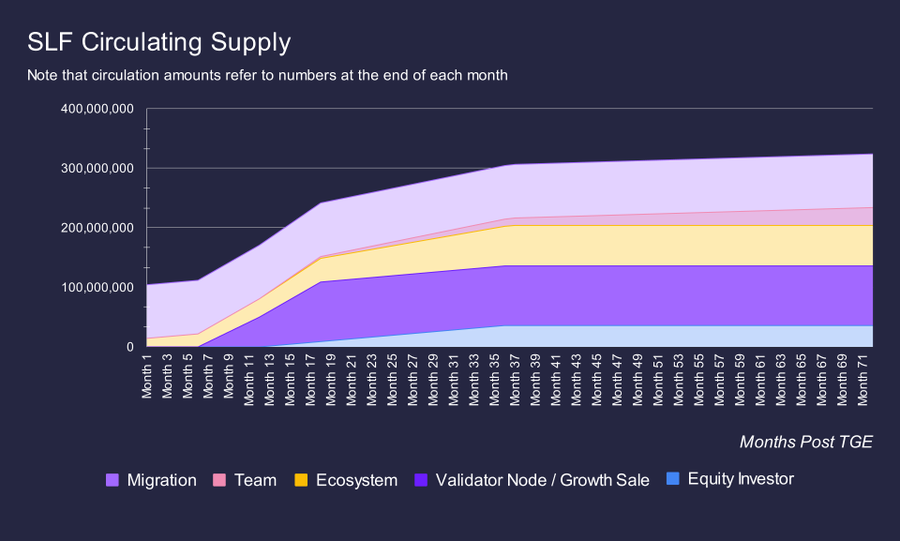
Frontier从 Self Chain(SLF)的代币经济学中可以发现,SLF 的 3.6 亿,除了 9 千万 FRONT(25%)进行置换外,增加的 2.7 亿中的大部分均与用户无关,具体分为股权投资者(10%)、验证节点/增长销售(28%)、生态系统(19%)、基础节点-永久锁定(25%)和团队(8%)。就拿股权投资者和团队来说,合计凭空增长了 6,480 万的 SLF 代币分配,现价值约 3,888 万美元。

这又产生了一个新问题,为什么原有的 SLF 增加了这么多的非用户份额,是原有的 9 千万 FRONT 中早期投资者和团队完全没有份额吗?结果显然不是。
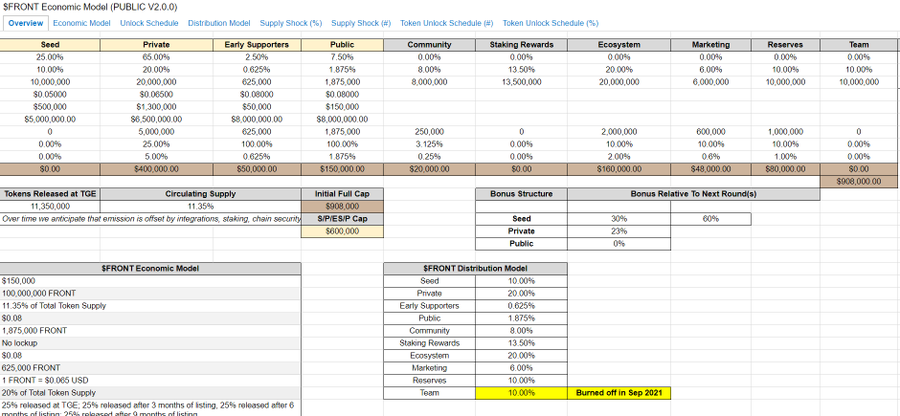
FrontierFRONT 其实是一个在 2020 年就存在的老币。在扒出的 FRONT 代币经济学中,种子分配为 10%,私募为 25%,早期支持者为 0.625%,储备为 10%,团队为 10% 等。除了团队的 10% 被销毁外,其余的早期投资者均已完成了全部的解锁分配,且都在 2022 年就已完成了最后一次分配。

https://docs.google.com/spreadsheets/d/e/2PACX-1vQj9JqXWsknSBVmBcaccneNHAcg2T9jufbn3e6OpLfGGsrXvkheNkw3EaqdTH5n-9dBkHmDbaGuL5ER/pubhtml#…

那这就有意思了,既然早期投资者都全部出清,那这次品牌重塑又引入了新的投资者分配和新的团队分配,是新的投资者入驻呢,还是老的投资者继续获益,那项目方是否已经卖壳重新换了一个新的团队

Пов'язані матеріали

Major Altcoin Market Players Did This During the Massive Rally!

As the cryptocurrency bull market intensifies, large-scale transactions by crypto 'whales' are drawing significant attention. Blockchain data reveals multi-million dollar positions opened and closed in Bitcoin ($BTC), Ethereum ($ETH), and Hyperliquid ($HYPE). A major investor, likely tied to Matrixport, closed a 40,000 $ETH long position worth ~$100.5M for a $9.9M profit. The investor still holds 80,000 $ETH (~$201M) and 500 $BTC (~$39M), with an unrealized profit of ~$22.9M. This turned their previous $92.5M total loss into an approximate $32.8M overall profit. On Hyperliquid, a trader known as loracle.hl reportedly lost over $70M trading $HYPE in the past three months. The investor currently holds ~$54.88M in $HYPE short positions, at risk of liquidation if $HYPE's price reaches $101.15. Notorious trader Machi Big Brother, who reportedly survived 500 liquidations, capitalized on the recent rally. He grew his portfolio from $152K to $12.72M in just three days, yielding over $12.5M in profit. While $HYPE hits a new all-time high, Multicoin Capital has deposited 427,422 $HYPE (~$31.74M) to Coinbase Prime over three days, raising speculation about a potential sale or portfolio rebalance. In Bitcoin markets, an anonymous whale stands out, selling ~2,700 $BTC (~$211.8M) in a recent transaction. Over three days, this whale sold a total of 7,700 $BTC, valued at approximately $576.6M.

cryptonews.ru22 хв тому

Major Altcoin Market Players Did This During the Massive Rally!

cryptonews.ru22 хв тому

Goldman Sachs' Summary After Silicon Valley Investigation: Agents Enter the Execution Era, AI Competition Shifts to Workflows, World Models Rise

Based on a recent field research in Silicon Valley, Goldman Sachs highlights a key shift in the AI industry: moving from systems that "answer questions" to autonomous AI agents that "execute tasks." Commercial models are transitioning from per-seat subscriptions to usage- and outcome-based pricing. The competition is shifting from raw model capability to mastery over specific business workflows, with value accruing to proprietary data, domain context, and operational expertise. A major hurdle for enterprise Agent deployment is not technical ability but "controllability"—issues of accountability, auditability, and error correction, especially in regulated fields. Workflows with clear rules, verifiable outcomes, and reversible actions (e.g., invoice processing) are being automated first. The model landscape is evolving toward a division of labor. Frontier models (like GPT-4) are expected to handle high-value, high-reliability core tasks, while improving open-source models will likely capture the majority (~90%) of inference tokens for standardized, high-volume tasks due to cost advantages. Finally, attention is moving from Large Language Models (LLMs) to "World Models," which understand physical environments, causality, and dynamic interactions. This shift elevates the importance of proprietary, real-world data (from industrial, scientific, and robotic systems) and could drive a second wave of compute demand. Goldman Sachs projects compute needs could grow ~24x over five years, benefiting cloud and infrastructure providers.

marsbit1 год тому

Goldman Sachs' Summary After Silicon Valley Investigation: Agents Enter the Execution Era, AI Competition Shifts to Workflows, World Models Rise

marsbit1 год тому

Fidelity Warns: The Boom in AI Agents May Not Be a Feast for Public Blockchains

Fidelity Digital Assets cautions that the anticipated boom in AI agents does not automatically guarantee a corresponding surge in public blockchain adoption or token value. While AI agents that can autonomously perform tasks like payments and data calls could theoretically utilize blockchain for settlement, a significant gap exists between "can use" and "must use." The analysis highlights six key risks. First, many AI agents, especially in corporate settings, may prefer closed, permissioned systems over public blockchains due to needs for speed, cost, compliance, and control. Second, increased on-chain transactions from AI-driven micropayments may not benefit native tokens if fees remain low or if value is captured by stablecoins and payment service providers instead. Third, while AI lowers development costs and increases the number of projects, more code does not equal more economic value and can lead to market oversaturation. Fourth, AI commoditizes coding, making pure technological advantage less of a sustainable moat; competition may shift to brand, liquidity, and user networks. Fifth, AI can also lower the cost of attacks by making vulnerability discovery easier, potentially outpacing security auditing and increasing ecosystem risk. Sixth, institutions may require "controlled blockchain" systems with robust identity, permissioning, and audit trails, conflicting with the permissionless nature of public chains. Ultimately, Fidelity argues against simply equating AI growth with blockchain prosperity. The narrative requires moving from speculation to a concrete analysis of which infrastructures can convert real AI agent needs into sustainable economic value, critically examining each step of the assumed value chain.

marsbit1 год тому

Fidelity Warns: The Boom in AI Agents May Not Be a Feast for Public Blockchains

marsbit1 год тому

Telegram Introduces WEB-Proxy Technology: Masks Traffic as Regular Website Visits

Telegram has introduced a new experimental WEB-Proxy technology designed to circumvent blocking by disguising messenger traffic as regular, secure website visits. Announced on August 21, 2026, the technology routes MTProxy data through an in-app WebView using HTTPS or WebSocket transport, making the data stream indistinguishable from legitimate web surfing. The core innovation is a multiplexed stream sent through a single WebView session. It uses special frame formats to pack multiple logical Telegram connections into one encrypted channel that externally resembles loading a web page. A server-side relay receives this stream, separates it into individual connections for the standard MTProxy, without decrypting content or knowing final destinations, thus preserving privacy. The WEB-Proxy operates on a standard HTTPS domain that also hosts a public website. The proxy bridge page is only activated by a specific URL parameter derived via HMAC-SHA256 from the proxy configuration; all other requests receive the normal site homepage. This provides reliable cover against automated detection systems. Currently a proof-of-concept, the system includes a desktop implementation, an experimental Android client, and plans for iOS support. The technology represents a shift towards more sophisticated integration with legitimate web infrastructure, complicating filtering systems that must choose between blocking HTTPS traffic entirely or allowing service access. Its long-term value will depend on resilience to adaptive traffic analysis and scalability without performance loss.

cryptonews.ru1 год тому

Telegram Introduces WEB-Proxy Technology: Masks Traffic as Regular Website Visits

cryptonews.ru1 год тому

Торгівля

Спот
活动图片