Chainalysis: мошенники уходят от «сложных» крипто-финансовых пирамид к забою свиней

cryptonews.ruОпубліковано о 2023-10-30Востаннє оновлено о 2024-08-30

Киберпреступники, разбирающиеся в криптовалюте, все чаще обращаются к тактике забоя свиней, а не к долгосрочным «финансовым пирамидам», поскольку правоохранительные органы стали лучше справляться с мошенниками.

Во второй части своего полугодового отчета о криптовалютных преступлениях, опубликованного 29 августа, компания Chainalysis, занимающаяся безопасностью и соответствием требованиям блокчейна, сообщила, что в 2024 году число мошенничеств с забоем свиней возрастет.

В ней отмечено, что крипто-мошенники адаптируют свою тактику как в блокчейне, так и за его пределами, чтобы проводить более разрушительные мошенничества меньшей продолжительности.

Средняя продолжительность жизни криптомошенничеств значительно сократилась: с 271 дня для мошенничеств, начавшихся в 2020 году, до 42 дней для мошенничеств, начавшихся в 2024 году.
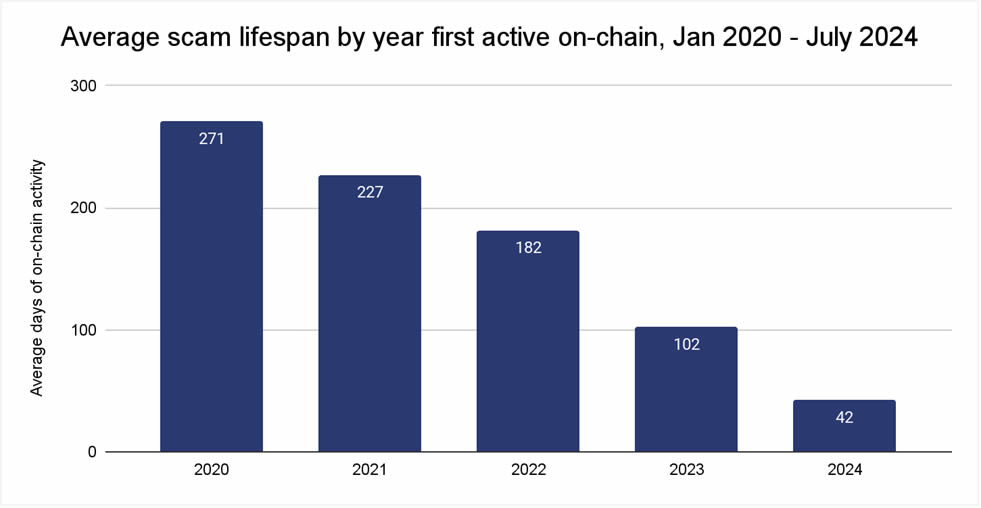

Средняя продолжительность жизни мошенничеств сокращается. Источник: Chainalysis

Эрик Джардин, руководитель исследования киберпреступности в Chainalysis, сказал, что сокращение продолжительности жизни мошенничества является свидетельством эффективности усилий правоохранительных органов.

«Эти вмешательства вынудили мошенников быстрее сдавать свою инфраструктуру, что усложнило их отслеживание в блокчейне. Тем не менее, усложнение отслеживания и сокрытие не означает невозможность, и данные об успешном вмешательствах правоохранительных органов и возврате активов обнадёживают», — сказал он.

Кроме того, 43% годовых мошеннических поступлений ушли на кошельки, которые стали активными в 2024 году, что говорит о всплеске новых мошенничеств, многие из которых связаны с забоем свиней. В отчете отмечено:

«Эта макротенденция согласуется с продолжающимся поворотом мошенников от сложных схем Понци, которые широко раскидывают сеть, к более целенаправленным кампаниям, таким как забой свиней»,

Забой свиней — это метод, при котором мошенник выстраивает онлайн-отношения с жертвой, которую «откармливают», прежде чем заманить ее вложить средства в мошеннический криптопроект, что в конечном итоге приводит к вытягиванию ковра или другим финансовым потерям.

Chainalysis заявил, что поворот был частично обусловлен усилением мер по обеспечению соблюдения нормативных требований и внесением эмитентами стейблкоинов в черный список мошеннических адресов.

Он показал, что один из крупнейших мошеннических кошельков, активных в 2024 году, связан с KK Park в Мьянме, печально известной бандой по забою свиней, которая в этом году заработала более 100 миллионов долларов.

Кроме того, мошенники покупают профили в социальных сетях с таких платформ, как Facebook*, Tinder и Match.com, у китайских сервисов для использования в своих кампаниях по забою свиней.
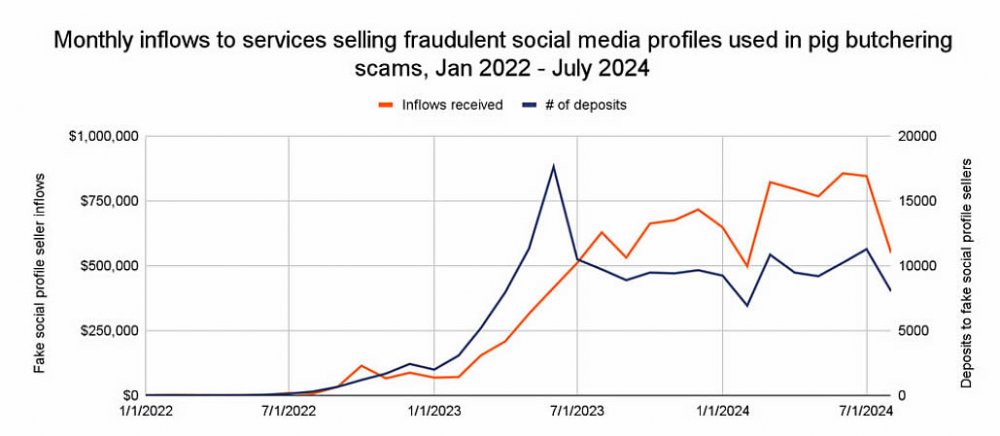

Ежемесячные поступления в незаконные сервисы, продающие профили в социальных сетях. Источник: Chainalysis.

Незаконные сервисы, продающие аккаунты в социальных сетях, за последние два года демонстрируют устойчивый рост криптовалютных потоков, общий объем которых превысил 10 миллионов долларов, и мошенники могли купить до двух миллионов профилей в социальных сетях для нацеливания на жертв, отмечается в нем.

Одной из незаконных торговых площадок, где отмываются средства, является Huione Guarantee, которая с 2021 года обработала более 49 миллиардов долларов в криптовалютных транзакциях.

Платформа способствует различным незаконным действиям, включая разделку свиней, инвестиционное мошенничество и отмывание денег, а также связывает покупателей и продавцов на платформах обмена сообщениями, таких как Telegram.

Что касается демографических характеристик этих мошенничеств, Джардин отметил, что межличностные мошенничества используют отношения между мошенником и жертвой, добавив:

«Те, кто с наибольшей вероятностью изначально сформирует эти отношения, потенциально наиболее уязвимы. Это могут быть пожилые люди, люди в переходном возрасте и те, кто ищет дружбу или романтические отношения в Интернете».


Пов'язані матеріали

Opinion: AI Bubble Bursts, Bitcoin and Other Risky Assets Are the First to Be Impacted

BIS Warns AI Investment Boom Could Trigger Market Stress, Impacting Bitcoin First The Bank for International Settlements (BIS) warns that a potential bursting of the "AI bubble" could tighten liquidity and severely impact risk assets like Bitcoin in the near term. Major tech firms are projected to spend over $1 trillion on AI infrastructure in 2025-2026. The BIS cautions that if returns fail to meet expectations, a sudden withdrawal of financing could turn this investment boom into a prolonged bust, creating ripple effects across financial markets. While AI holds long-term economic promise, the current scale and speed of investment, coupled with intense competition and physical bottlenecks (e.g., semiconductors, power grids), mirror historical bubbles. The report highlights that the AI funding web—spanning corporate debt, private credit, and complex vendor agreements—makes systemic risks harder to see. A disappointment in AI adoption could transmit stress through this chain, widening credit spreads and pressuring weaker borrowers. For Bitcoin, the initial reaction to such a market shock would likely be defensive. As liquidity tightens, investors typically sell liquid assets first, and Bitcoin often trades in line with other risk assets during portfolio de-risking. Recent correlations, like Bitcoin's drop following a sharp decline in South Korea's stock market, support this view. However, the longer-term outcome for Bitcoin depends on the policy response. If an AI-driven credit crunch forces central banks to inject liquidity and ease policy eventually, it could reignite Bitcoin's narrative as a hedge against monetary debasement. Yet, traders betting on this outcome may first have to endure significant market volatility and potential price declines.

marsbit9 хв тому

Opinion: AI Bubble Bursts, Bitcoin and Other Risky Assets Are the First to Be Impacted

marsbit9 хв тому

South Korea Reaps Riches, America Turns Hostile

The US has filed a collective antitrust lawsuit in California against Samsung, SK Hynix, and US-based Micron, alleging they colluded to create a "RAMpocalypse" by slashing traditional DRAM production and raising prices 700% over four years amid the AI boom. This lawsuit targets the heart of the AI supply chain: High Bandwidth Memory (HBM), critical for Nvidia's GPUs. Currently, SK Hynix (57%), Samsung (22%), and Micron (21%) dominate global HBM production. The case highlights a deeper US concern: in the AI era, South Korea, through its HBM dominance, is capturing an estimated 35% of global AI profits, second only to the US (49%). SK Hynix's operating profit margin recently hit a record 72%. In response to the lawsuit, South Korea announced a massive $800 trillion won investment to build four new chip plants, doubling down on its strategic position. Analysts see the lawsuit not merely as a consumer price issue but as strategic pressure. It aims to support Micron's US manufacturing expansion (subsidized by the CHIPS Act) and secure America's share of AI profits by bringing more HBM production onshore. However, South Korea's rapid execution and massive cash flow from current HBM sales give it a significant speed advantage over US build-out timelines. The conflict underscores a fundamental shift: AI infrastructure like GPUs and HBM is becoming a new form of strategic national resource, akin to oil. While Nvidia and Korean memory giants are interdependent, the struggle over profit distribution and industrial sovereignty in this new landscape is just beginning. This lawsuit may be the first major skirmish in the AI resource wars.

marsbit21 хв тому

South Korea Reaps Riches, America Turns Hostile

marsbit21 хв тому

AAVE Rallies 30% in a Week, Is It Back on Track?

Over the past week, the price of AAVE surged from around $70 to nearly $100, a rebound exceeding 30%. This occurred despite Aave's TVL continuing to decline following the Kelp DAO security incident. The price movement was partly driven by market rumors, first reported by CoinDesk, that Kraken was negotiating to acquire a stake in Aave. While Aave founder Stani Kulechov denied the specific terms, he confirmed discussions with multiple parties about purchasing Aave Labs' AAVE tokens. He also revealed ongoing work on Tokenomics 3.0, featuring an automated buyback mechanism, and plans to expand into securities-backed lending. Analysts remain optimistic about Aave's long-term prospects. Standard Chartered gave an extremely bullish $3,500 price target for 2030, citing DeFi revival and RWA tokenization. Grayscale offered a more conservative one-year target of $175. However, competitors like Morpho are gaining traction, with recent reports highlighting its advantages in capital efficiency and customization. Morpho also secured a massive $175 million funding round. Fundamentally, Aave maintains its dominance as the leading DeFi lending protocol. Its TVL is nearly double that of second-place Morpho and rivals the combined total of the next several competitors. Key metrics like active borrowing, total supply, and revenue significantly outpace rivals. While Aave faces challenges from newer, more flexible protocols, its deep liquidity and established position make it a preferred choice for large, yield-seeking users. The article concludes that despite setbacks, Aave's long-tested protocol merits ongoing attention in a market with increasingly scarce quality projects.

Foresight News58 хв тому

AAVE Rallies 30% in a Week, Is It Back on Track?

Foresight News58 хв тому

Торгівля

Спот
活动图片