В Glassnode предупредили о переходе в фазу повышенной волатильности

cryptonews.ruОпубліковано о 2024-01-28Востаннє оновлено о 2024-08-28

Относительное спокойствие рынка биткоина на прошлой неделе не продлится долго и сменится периодом повышенной волатильности. Об этом сообщили в Glassnode.

Market speculation remains relatively subdued for #Bitcoin, with investors locking in only marginal profit and losses, and a reset across perpetual swap markets.

Historically, periods of quiet and calm market structure are short-lived, and often precede an expectation for… pic.twitter.com/Yy8TTjdbtS

— glassnode (@glassnode) August 27, 2024

И в ончейн-индикаторах, и в бессрочных контрактах наступило равновесие. Это отражается как по уменьшению темпов реализации прибылей и убытков, так и по возврату ставок финансирования к нейтральному уровню. Согласно аналитикам, подобные признаки говорят о значительном сокращении спекуляций.

За последние несколько месяцев чистый приток капитала в биткоин начал замедляться — в 89% дней наблюдались значения выше текущих. Специалисты подчеркнули, что подобные периоды бездействия обычно предшествуют значительному росту волатильности.
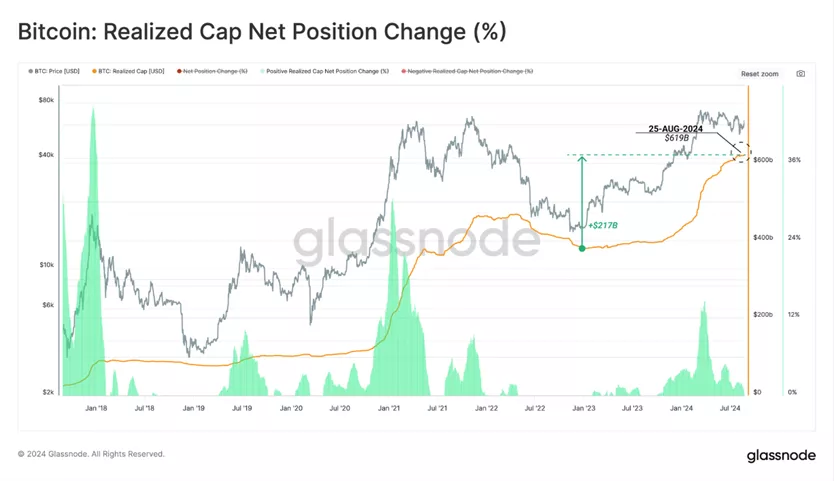
Данные: Glassnode.

Коэффициент MVRV (2,03) вернулся к своему равновесному показателю (1,72), сигнализируя о затухании ажиотажа после запуска ETF. Исторически эта критическая отметка знаменовала переход между бычьим и медвежьим рынками.
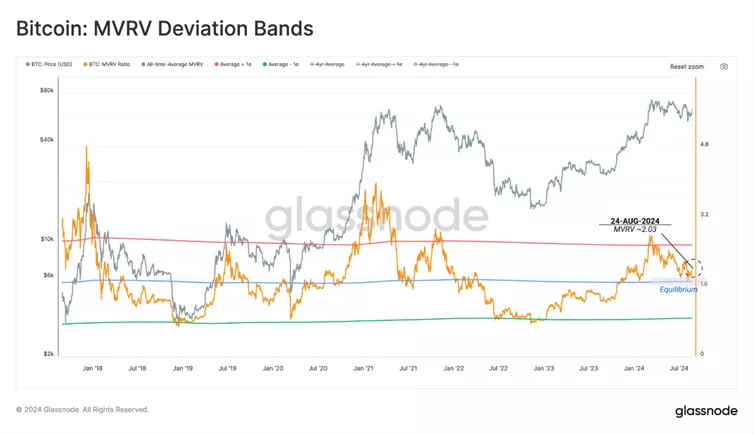
Данные: Glassnode.

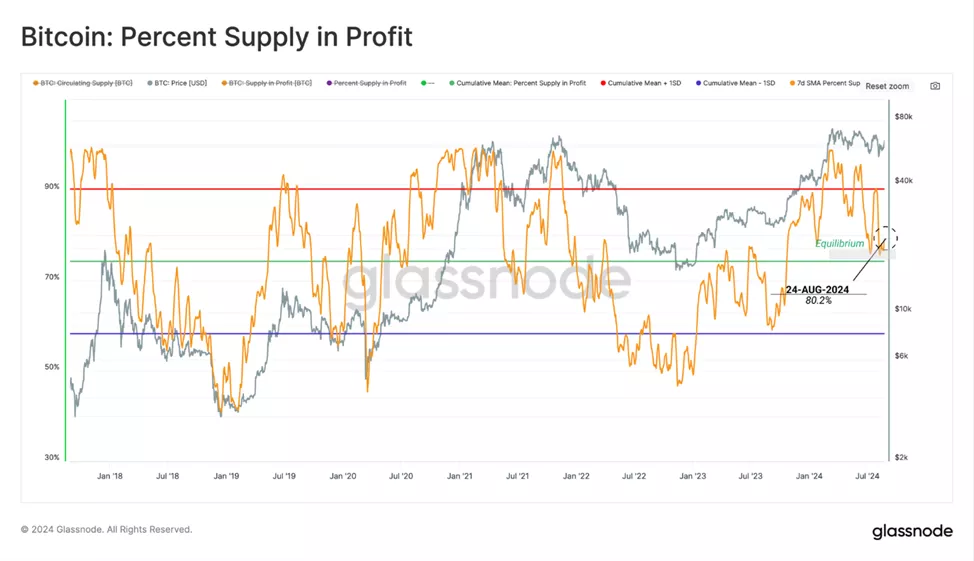
Аналогичная картина сложилась и в показателе доли монет в прибыли (80,2%).
Данные: Glassnode.

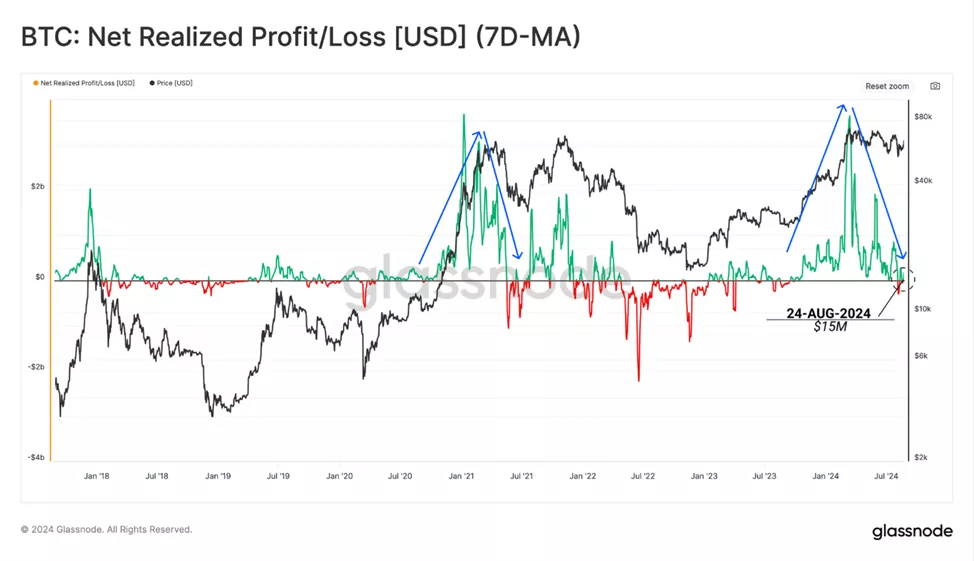
Суточный показатель чистой реализованной прибыли опустился до $15 млн, что резко контрастирует с $3,6 млрд в момент обновления ATH в марте.

Обычно эта метрика возвращается к нейтральному уровню вблизи точек перегиба, таких как продолжение тенденции или разворот обратно в нисходящий тренд, указали эксперты.
Данные: Glassnode.

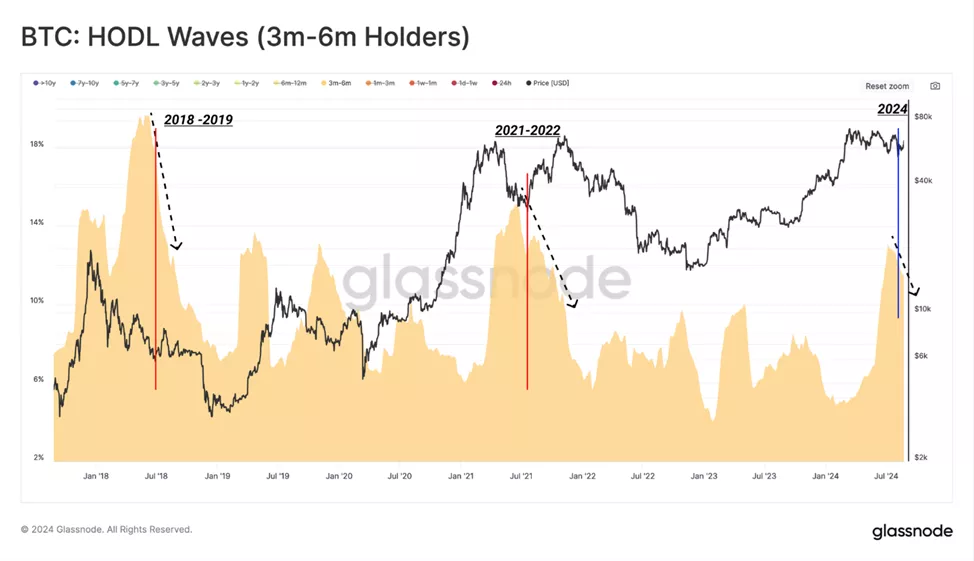
В настоящее время монеты в «возрасте» трех-шести месяцев составляют более 12,5% от общего объема доступного предложения, что демонстрирует сходство с распродажей середины 2021 года и пиком медвежьего рынка 2018 года.

Рост доли биткоинов в этом временном диапазоне указывает на проверку доверия новых инвесторов, часть из которых переходит в разряд ходлеров.
Данные: Glassnode.

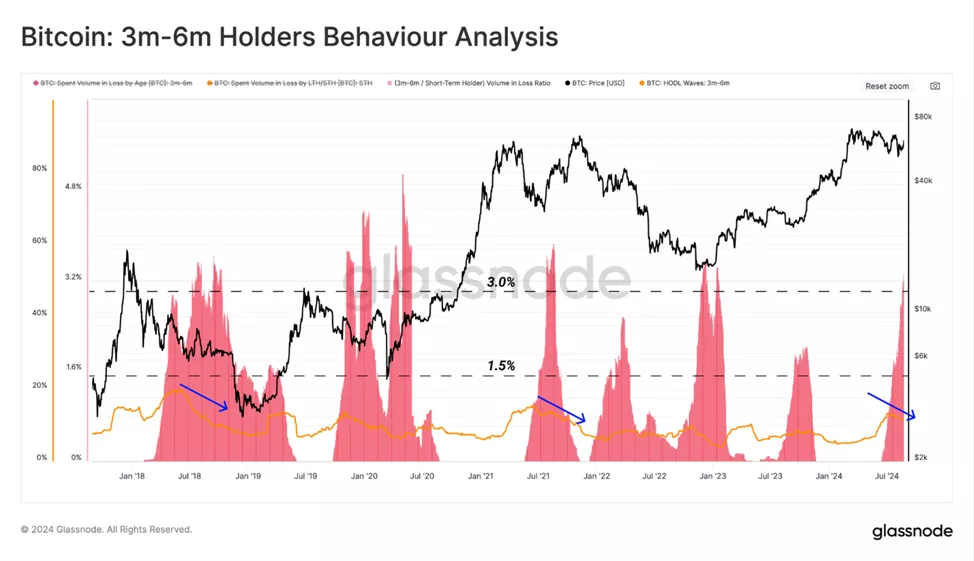
Аналитики зафиксировали значительный всплеск убытков у недавних покупателей биткоинов с начала июля. По своим масштабам капитуляция сравнима с крупными точками перегиба в прошлом. Оставшиеся нереализованными монеты по статистике с меньшей вероятностью потратят в ближайшее время.
Данные: Glassnode.

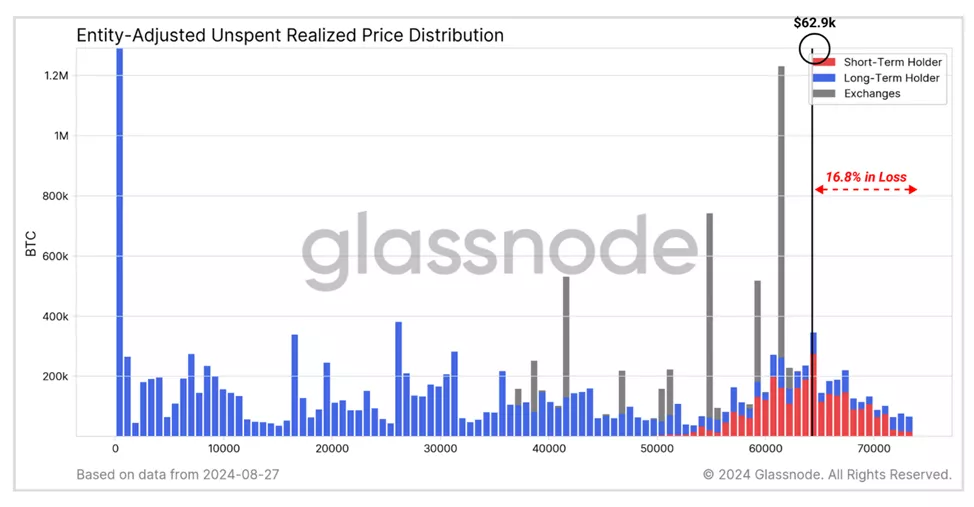
Согласно графику структуры уровней реализованной цены в контексте UTXO (URPD), 480 000 BTC из тех биткоинов, которые инвесторы приобрели выше $62 900, наблюдавшихся на момент написания, находятся в статусе «ходлинга». Нереализованный убыток по ним достигает 16,9%.
Данные: Glassnode.

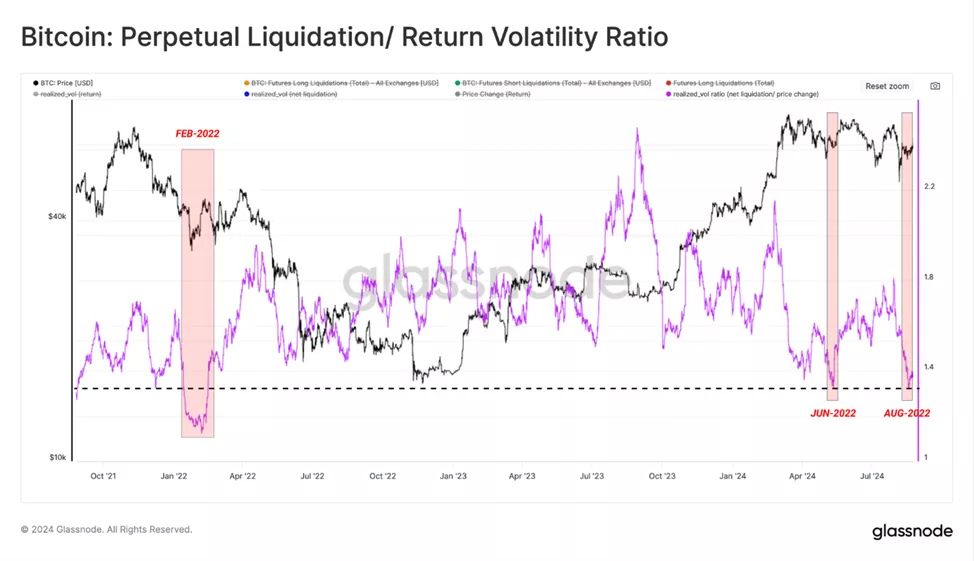
В заключении специалисты рассмотрели ситуацию на рынке бессрочных контрактов. Они обнаружили снижение соотношения стоимости и объема ликвидаций до отметок февраля 2022 года. Это позволило утверждать о значительном ослаблении спекулятивного интереса.
Данные: Glassnode.

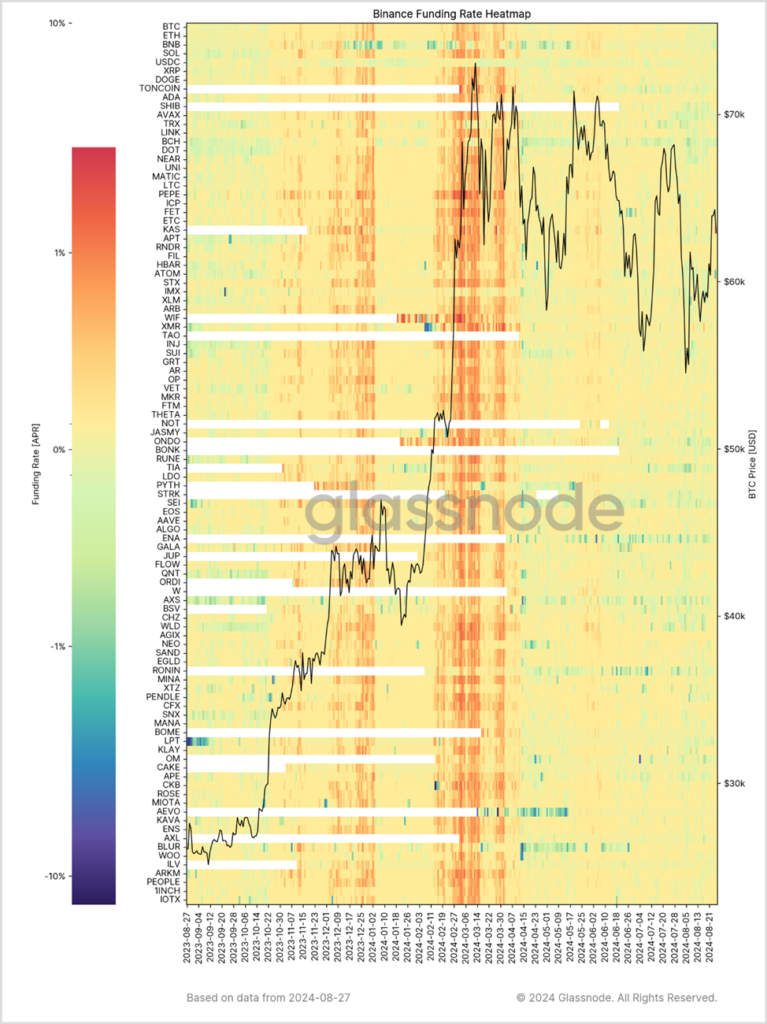
Подобное явление характерно и для более широкой экосистемы цифровых активов, если судить через призму ставки финансирования. Это подтверждает гипотезу о серьезной перезагрузке спекулятивного интереса, и поэтому спотовые рынки, скорее всего, в ближайшей перспективе будут играть ведущую роль, указали эксперты.
Данные: Glassnode.

Напомним, в ночь на среду, 28 августа, котировки первой криптовалюты опустились ниже психологического уровня $60 000. Динамику усилил срыв стоп-приказов, о чем говорит увеличение объема торгов.

Ранее в QCP Capital спрогнозировали, что курс первой криптовалюты останется в узком коридоре от $62 000 до $67 000 в ближайшей перспективе, о чем говорит нерешительность в опционах.
Пов'язані матеріали

Robinhood Chain Mainnet Goes Live: Can Stocks Finally Be Moved Into Wallets?

Robinhood has officially launched its public mainnet, Robinhood Chain, along with stock-like tokens, the USDG yield product, and a DeFi lending portal. This marks a significant shift where a major online broker is integrating its user interface, regulatory compliance, self-custody wallet, and on-chain protocols into a single, streamlined experience. The goal is to simplify access to stock exposure, stablecoin yields, collateralized lending, and AMM trading for mainstream users. Eligible non-U.S. users can hold these "Stock Tokens"—structured as tokenized debt securities—in the Robinhood Wallet for 24/7 exposure to assets like U.S. stocks or ETFs. U.S. users can access an estimated ~7% APY on dollar-backed USDG through the Robinhood Earn program via self-custody wallets, with lending infrastructure powered by Morpho protocol. Built as a Layer 2 on Arbitrum, Robinhood Chain leverages existing DeFi protocols like Uniswap. The core strategy is not to reinvent DeFi but to channel Robinhood's large traditional finance user base (27.4 million funded customers as of Q1 2026) into on-chain finance, lowering the technical barriers. However, key limitations exist. The stock tokens are not direct equity ownership and are unavailable in the U.S. and some jurisdictions due to regulatory constraints. The ~7% yield is variable and carries inherent DeFi risks, not guaranteed principal protection. Furthermore, while AMMs enable trading, price discovery for major stocks will likely remain anchored in traditional markets like NASDAQ for the foreseeable future. Ultimately, Robinhood Chain is an early experiment in "on-chain brokerage." Its success will depend on real-world metrics like trading volume, sustained user migration to self-custody, stable yield performance, and regulatory feedback, rather than its launch narrative.

marsbit8 хв тому

Robinhood Chain Mainnet Goes Live: Can Stocks Finally Be Moved Into Wallets?

marsbit8 хв тому

Circle CEO Responds to OUSD Challenge: Stablecoin Market Is 'Winner-Takes-All', Consortium Model Doomed to Fail

Circle CEO Jeremy Allaire addresses market concerns following the announcement of the Open USD (OUSD) stablecoin project backed by 140 global companies. Allaire argues the stablecoin market exhibits "winner-takes-all" dynamics due to powerful network effects. He cites USDC's near-decade lead in three key areas: 1) **Application Integration & Protocol Development**: Thousands of integrated services and protocols (like CCTP) create utility and lock-in for developers and users. 2) **Liquidity Network Effects**: A deeply embedded, globally distributed liquidity infrastructure across primary and secondary markets, built over years. 3) **Regulatory Integration**: Extensive licensing and compliance groundwork ensuring USDC's acceptance in major markets like Europe and Japan. Allaire challenges OUSD's proposed advantages. He contends that promises of free redemption, while appealing, face market realities where such models can become exit routes for other stablecoins. He also questions the feasibility of fully distributing all revenue to an alliance, stating it would "starve" the critical infrastructure investments needed for scale and utility. Furthermore, he expresses skepticism about large alliance governance models, noting they often lead to slow decision-making and misaligned incentives. While welcoming OUSD to the ecosystem, Allaire reaffirms confidence in USDC's dominant position, backed by its long-term infrastructure investments and strong partnerships, including its ongoing collaboration with Coinbase.

marsbit11 хв тому

Circle CEO Responds to OUSD Challenge: Stablecoin Market Is 'Winner-Takes-All', Consortium Model Doomed to Fail

marsbit11 хв тому

Circle CEO Responds to OUSD Challenge: Alliance Model Doomed to Fail, It's a 'Winner-Takes-All' Game

Circle CEO Jeremy Allaire addresses the challenge posed by the new Open USD (OUSD) stablecoin project, backed by 140 global companies. He argues that the stablecoin market exhibits "winner-take-all" characteristics, where USDC's near-decade-long lead in application integrations, global liquidity, and regulatory compliance secures its dominant position. Allaire outlines three key network effects underpinning USDC's strength: 1) Extensive integration as an internet protocol layer, 2) Deep, globally distributed liquidity networks, and 3) Deep integration with global policy and regulatory frameworks. He cites data showing USDC facilitated 80% of on-chain USD stablecoin transaction volume in Q1 2026. He directly counters OUSD's proposed advantages: 1) "Free minting and redemption" may not be sustainable against market realities, which USDC addresses via contractual mechanisms. 2) "Sharing all revenue" risks starving the infrastructure of necessary investment for growth and reliability. 3) A "consortium model" often leads to slow innovation and poor coordination compared to focused, independent operators like Circle. Allaire reaffirms Circle's strong partnership with Coinbase and notes that Circle continues to collaborate with many OUSD founding members. He concludes by welcoming OUSD to the ecosystem while expressing confidence in USDC's entrenched network advantages and continued expansion.

Odaily星球日报14 хв тому

Circle CEO Responds to OUSD Challenge: Alliance Model Doomed to Fail, It's a 'Winner-Takes-All' Game

Odaily星球日报14 хв тому

dYdX Changes Tack and Starts Anew, This Time Partnering with Robinhood: Will It Succeed?

On July 1st, dYdX Labs, in partnership with Robinhood Crypto, launched the Beta version of Arcus, a new decentralized exchange (DEX). Deployed on the newly launched Robinhood Chain (an L2 built on Arbitrum), Arcus supports spot trading for 95 tokenized stocks and plans to introduce cross-asset perpetual contracts. This marks a separate, new product line for the dYdX team, distinct from the existing dYdX Chain. Arcus's core features promise 24/7 trading, self-custody, and institutional-grade liquidity. Initial offerings include zero-fee web-based spot trading and a perpetual contracts testnet. Future plans involve using tokenized stocks as collateral and providing access to Pre-IPO investments. The platform is not available to users in the US, Canada, the UK, and other restricted jurisdictions. This move follows dYdX's v4 upgrade, which, while achieving full decentralization, faced criticism over performance and tokenomics, leading to a loss of market share. Arcus represents a strategic pivot, leveraging Robinhood's vast user base to target the RWA (Real World Assets) sector and global 24/7 trading. The dYdX Foundation clarified that Arcus is a parallel product incubated by dYdX Labs, and the original dYdX Chain continues to operate independently. While no official token plans have been announced, market participants speculate about potential new tokens or airdrops from the Arcus project.

Foresight News21 хв тому

dYdX Changes Tack and Starts Anew, This Time Partnering with Robinhood: Will It Succeed?

Foresight News21 хв тому

Торгівля

Спот
活动图片