BlocksBridge Consulting: Майнинг биткоина становится сложным бизнесом

cryptonews.ruОпубліковано о 2022-01-11Востаннє оновлено о 2024-08-11

Эксперты компании BlocksBridge Consulting заявили, что майнинг криптовалют оказался на грани рентабельности у участников рынка, не имеющих доступа к дешевой электроэнергии.

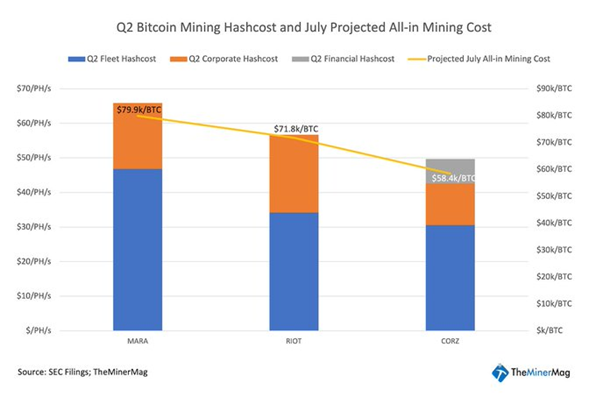
Даже после восстановления стоимости биткоина показатель хешпрайса остался на уровнях, едва превышающих $40 за PH/s.
«В текущих условиях майнинг остается „непростой средой“, особенно для тех, у кого нет доступа к конкурентоспособным ценам на электричество», - отметили аналитики BlocksBridge Consulting.

Согласно оценке экспертов, самостоятельный майнинг в условиях растущей стоимости электроэнергии вряд ли принесет чистую прибыль до вычета налогов. В финансовых отчетах трех крупных компаний, MARA (Marathon Digital), Core Scientific и Riot, указано, что себестоимость добычи биткоина в июле у них превысила $60 000 за монету.

MARA и Riot перешли к политике накапливания биткоин-резервов, включая приобретение первой криптовалюты на рынке. А Core собирается для покрытия своих расходов распродать 100% добытых монет.

У выбранных стратегий есть свои преимущества, отметили в BlocksBridge Consulting, так как компании могут не обращать внимания на краткосрочное движение стоимости криптовалюты, рассчитывая на будущее повышение цены BTC.

С начала 2024 года компании смогли привлечь свыше $1,5 млрд через размещение акций, но и капитальные затраты за первые полгода составили более $1 млрд.

Ранее аналитики криптобиржи Bitfinex заявили, что биткоин является эффективным активом-убежищем. По мнению специалистов, ценность первой криптовалюты еще больше возрастает при экономической рецессии.


Пов'язані матеріали

Uniswap v4 Hook Analysis: Architecture Design, Common Vulnerabilities, and Protection Practices

Uniswap v4's Hook mechanism is a major innovation, enabling custom logic injection into liquidity pool lifecycle events like swaps and liquidity provisioning. This transforms the AMM into programmable infrastructure, shifting the security model from protocol-level to pool-level, as each pool's safety now depends on its bound Hook contract. The core architecture revolves around the singleton PoolManager contract, which manages all pools via a flash accounting system. State changes are tracked in transient storage and must be settled by the end of a transaction. Hook contracts are permanently bound to pools via a PoolKey, with their permissions encoded directly into their address via specific low-order bits. This design introduces unique security considerations and challenges for future upgrades. Key vulnerabilities and best practices identified include: - **Access Control Gaps:** Early versions of the BaseHook abstract contract only protect `unlockCallback()`, leaving other lifecycle functions (`beforeSwap`, `afterSwap`, etc.) exposed unless explicitly secured by developers. - **Unrestricted Pool Binding:** The `initialize()` function does not validate if a Hook "consents" to a new pool. Hooks must implement their own whitelisting in `beforeInitialize` to prevent unauthorized pool creation. - **Async/Custom Curve Hooks:** These high-risk Hooks can completely replace Uniswap's swap logic. Their security depends entirely on their own implementation, as they operate outside the native protocol's pricing safeguards. - **Delta Accounting Risks:** The system ensures final balance (NonzeroDeltaCount == 0) but cannot guarantee the *correctness* of intermediate delta states, which attackers could manipulate. - **Token Confusion:** Protocols must implement semantic validation for tokens in user-created markets, not just interface checks, to prevent cross-market confusion attacks. The article emphasizes that Hook auditing requires a "sub-protocol" approach due to extended interaction chains, highlighting a significant shift in security methodology for the v4 ecosystem.

marsbit38 хв тому

Uniswap v4 Hook Analysis: Architecture Design, Common Vulnerabilities, and Protection Practices

marsbit38 хв тому

Chips, Open-Source Models, and $50 Trillion: Joe Tsai Reassesses Alibaba Once Again

Alibaba Executive Chairman Joe Tsai recently outlined the company's comprehensive AI strategy in a public discussion. He believes AI represents a massive opportunity, estimating its potential economic impact at up to $50 trillion, stemming from the automation of human intelligence and productivity. Tsai detailed Alibaba's four-layer investment approach across the AI stack: starting from the chip level, moving to cloud infrastructure (Alibaba Cloud), then the model layer with its open-source Qwen model, and finally applications within its vast digital ecosystem (e-commerce, logistics, etc.). The company avoids the energy layer due to China's efficient infrastructure. This broad strategy is designed to ensure Alibaba captures value regardless of where it ultimately concentrates in the AI value chain. He dismissed concerns about an AI investment bubble, pointing to the enormous $50 trillion opportunity. While acknowledging U.S. cloud giants' higher capital expenditure, he argued Chinese firms, including Alibaba (funded by its cash-generative e-commerce core), need to invest more in AI infrastructure. A key theme was technological sovereignty. Tsai positioned open-source models like Qwen as a solution for companies, especially in Europe, seeking independence from proprietary U.S. models and greater data privacy control. He contrasted this with the trend of U.S. giants keeping their models closed-source. Tsai highlighted Alibaba's collaborations with European manufacturers like Bosch and Siemens, using AI for design and quality control. He concluded with an optimistic vision of AI agents enhancing productivity, ultimately freeing up human time for leisure, family, and experiences like live entertainment.

marsbit53 хв тому

Chips, Open-Source Models, and $50 Trillion: Joe Tsai Reassesses Alibaba Once Again

marsbit53 хв тому

Торгівля

Спот
Ф'ючерси
活动图片