Индикатор бычьего рынка загорелся зеленым: биткоин удерживает отметку $60 000

cryptonews.ruОпубліковано о 2022-06-10Востаннє оновлено о 2024-08-10

Ну что, биткоин снова в зеленой зоне! После небольшого падения ниже $50 000, которое заставило многих понервничать, индикаторы главной криптовалюты вновь указывают на бычий тренд.

Индикатор бычьего рынка загорелся зеленым

Помните те три дня, когда биткоин рухнул и все думали, что это конец? Что ж, похоже, слухи о его смерти были несколько преувеличены. Индикатор бычье-медвежьего рынка биткоина снова подмигивает нам зеленым глазом. А ведь совсем недавно он подавал первый медвежий сигнал с января 2023 года.

Но что это за зверь такой — индикатор бычье-медвежьего рынка биткоина? Представьте себе этакий криптовалютный светофор. Он отслеживает фазы настроений инвесторов и сигнализирует: зеленый — покупай, все отлично; красный — держись подальше, медведи вышли на охоту. Этот индикатор анализирует кучу данных из блокчейна и рынка, чтобы определить, куда же дует ветер — в паруса быков или в берлогу медведей.
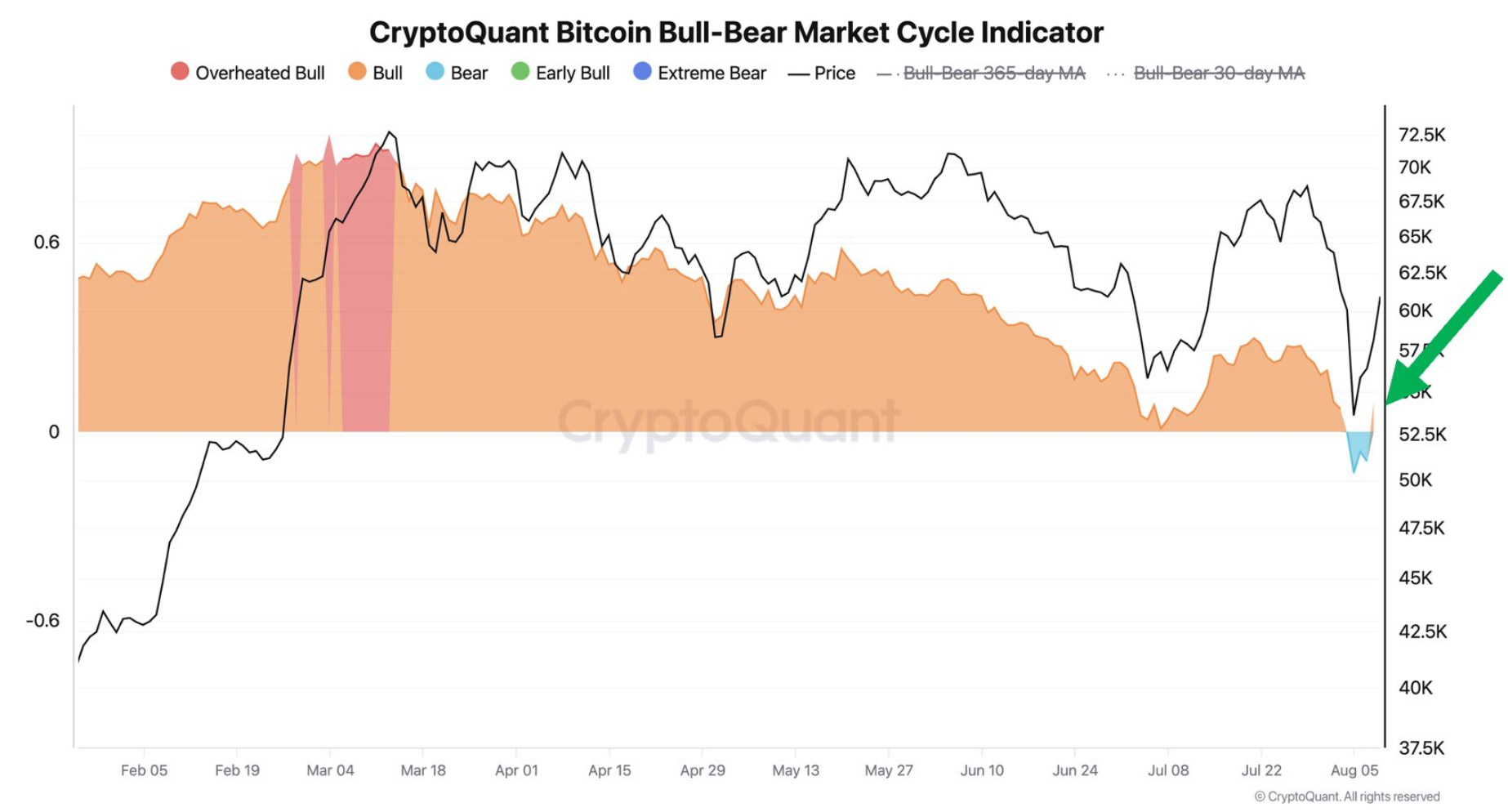
Индикатор бычье-медвежьего рынка биткоина. Источник: CryptoQuant

Ки Янг Джу (Ki Young Ju), основатель и генеральный директор CryptoQuant, не скрывает своего оптимизма: «Большинство циклических индикаторов биткоина, которые балансировали на грани, теперь снова сигнализируют о бычьем рынке». И знаете что? Он не одинок в своем мнении.

Популярный в соцсети X трейдер PlanB вторит ему: «Биткоин все еще находится на бычьем рынке». Ну надо же, какое единодушие!

Черный понедельник? Не смешите мои биткоины!

Помните то падение до $49 751 5 августа? Некоторые уже успели окрестить этот день «Черным криптопонедельником». Но Ки Янг Джу считает, что это была всего лишь трехдневная распродажа. Три дня! За это время я успела пересмотреть столько видео с предсказаниями курса биткоина, что мой ютуб-аккаунт начал советовать мне видео о том, как справиться с зависимостью от криптовалют.

Биткоин, конечно, поиграл на нервах трейдеров, торгуясь ниже критического уровня $60 000 до 8 августа. Но сейчас? На момент написания этой статьи его курс уже $60 687. Неплохо для «умирающей» криптовалюты, не так ли?
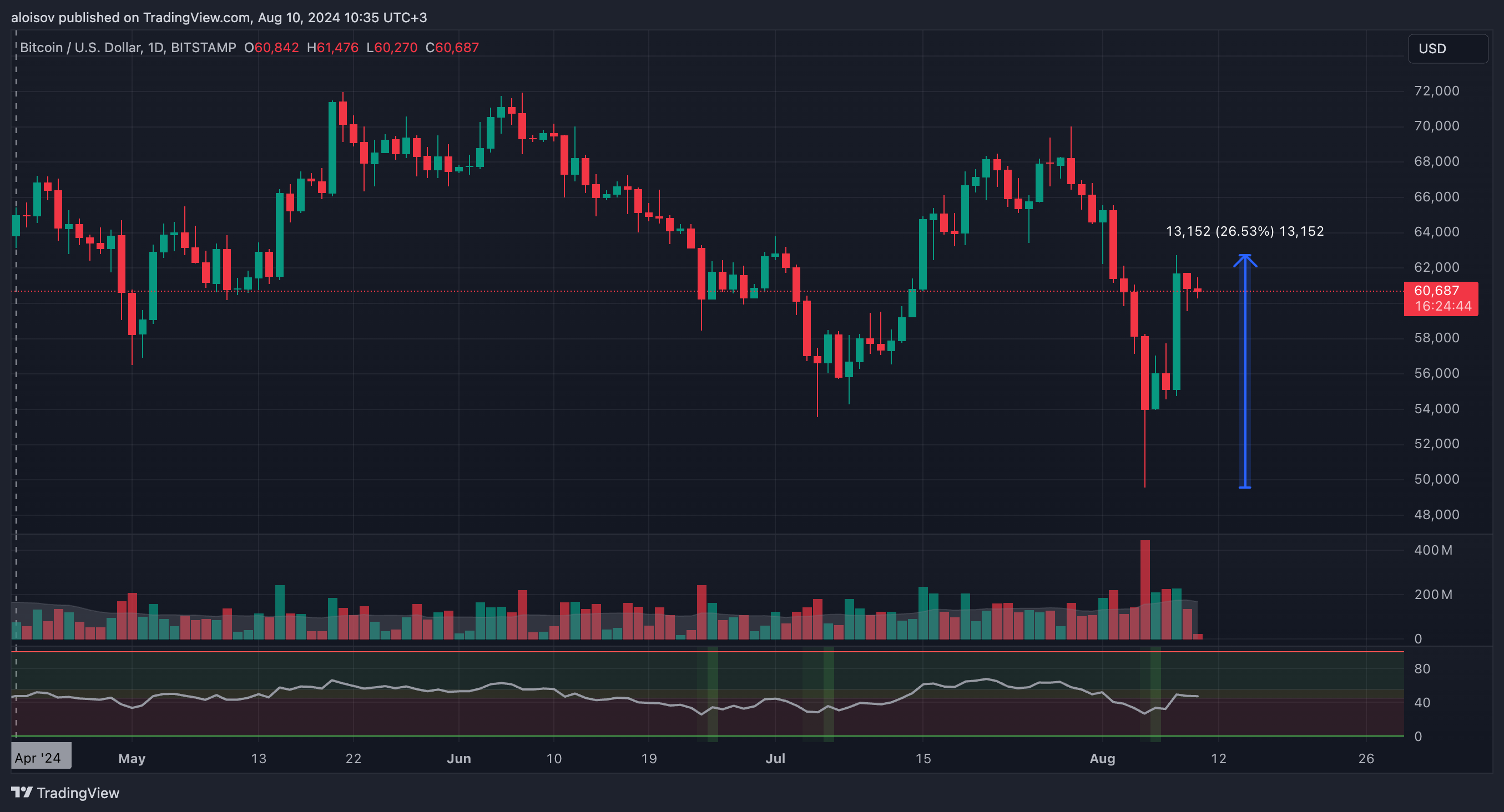
1-дневный график BTC/USD. Источник: Bitstamp/TradingView

Страх и ненависть в Лас-Вегасе? Нет, на крипторынке!

Индекс страха и жадности в криптовалютах тоже решил поиграть на нервах инвесторов. 6 августа он показал значение «Экстремальный страх» со счетом 17. Последний раз такое было после краха FTX. Но не спешите уходить с рынка — сейчас индекс уже вернулся к «нейтральному» значению 48.

Медвежья ловушка или реальное падение?

Некоторые трейдеры считают, что быстрый разворот может указывать на медвежью ловушку. Это когда опытные трейдеры намеренно снижают цену актива, чтобы поймать в ловушку игроков на понижение. Хитро, не правда ли?

А что дальше?

Аналитики, как всегда, разделились во мнениях. Маркус Тилен (Markus Thielen) из 10x Research считает, что идеальная точка входа в следующий бычий рынок — это когда цена биткоина упадет ниже $45 000.

Инвестиционная компания Ark Invest Кэти Вуд (Cathie Wood) видит важные уровни поддержки на отметках $52 000 и $46 000.

А опытный трейдер Питер Брандт (Peter Brandt) сравнивает нынешнее снижение с циклом 2015-2017 годов, предполагая начало бычьего ралли.

Пов'язані матеріали

The Ethereum Foundation Has Split?! An In-depth Look at Ethlabs' "Bright Future"

"Ethereum Foundation Splits? Understanding Ethlabs and Its 'Bright Future'" Former Ethereum Foundation members Ansgar Dietrichs, Barnabé Monnot, Caspar Schwarz-Schilling, Josh Rudolf, and Julian Ma have announced the launch of Ethlabs, an independent non-profit research and development lab. Announced on June 22nd, the initiative comes amidst discussions about the need for new organizational structures within the Ethereum ecosystem, a point highlighted by Bankless founder David Hoffman. Ethlabs' mission is to establish Ethereum as the foundational settlement layer for the global economy. The organization positions itself as a bridge connecting frontline developers, applications, and user needs with the core protocol. It aims to translate real-world demands into protocol improvements, industry standards, and deployable products. The founding team brings significant expertise: Dietrichs and Monnot are highly cited researchers in areas like Proposer-Builder Separation (PBS) and MEV, while Schwarz-Schilling, Rudolf, and Ma contribute backgrounds in economic modeling, consensus research, and applied cryptography. Initial supporters include BitMine, a major corporate ETH treasury; Sharplink, another treasury firm; and Consensys founder Joe Lubin in a personal capacity. Community backers include figures like Uniswap's Hayden Adams and Base's Jesse Pollak. The timing coincides with internal Ethereum Foundation discussions about "spinout" projects. While Ethlabs and the Foundation share research interests like MEV mitigation, Ethlabs frames its role not as a competitor but as part of a shift from a "single-core coordination model" to a "multi-R&D entity collaboration model." It views Ethereum as a public project belonging to all builders, with Ethlabs as one node in a broader governance network. Ultimately, Ethlabs represents an organizational evolution within the maturing Ethereum ecosystem. The key question is whether multiple research bodies can collaborate effectively to advance Ethereum as a competitive global settlement infrastructure.

Odaily星球日报4 хв тому

The Ethereum Foundation Has Split?! An In-depth Look at Ethlabs' "Bright Future"

Odaily星球日报4 хв тому

'Bear' Doomsday Prophecy: AI 'Reaching Its Peak', U.S. Stocks to Top Out Fastest in Q3, Down 30-50%

"A Short Seller's Dire Prediction: AI Boom Fading, US Stocks to Peak by Q3 with 30-50% Decline" Prominent macro investors Jeffrey Gundlach and Felix Zulauf warn that the AI-driven market rally is nearing its end, forecasting a major US stock market correction of 30-50%, potentially beginning as early as Q3. Their analysis points to alarming parallels with historical market tops, citing extreme concentration in the top AI-related stocks within the S&P 500. Zulauf's bearish thesis hinges on unsustainable capital expenditure trends among major cloud companies, negative free cash flow emergence, and soaring semiconductor prices. Gundlach highlights dangerous parallels to the 1999 tech bubble peak. A key divergence from conventional wisdom is Gundlach's view that long-term Treasury yields will not fall meaningfully even during a recession, due to America's structurally out-of-control fiscal deficits and soaring interest costs. He warns this could force the government into yield curve control or even a sovereign debt restructuring. Both investors express severe concerns about the opaque private credit market, drawing parallels to the pre-2008 financial crisis environment. They allege widespread rating inflation, misrepresented credit quality, liquidity illusions, and fraudulent asset valuations within this sector. The analysis links the AI boom and private credit crisis through financing costs. They argue that as AI companies' cash flows weaken and they seek funding, a high and sticky long-term interest rate environment will severely stress lower-rated corporate borrowers, exposing cracks in credit markets. Finally, they predict a regime shift where the US dollar weakens and US equities underperform global markets, marking the end of their long dominance. The stage is set for a significant market reversal.

marsbit11 хв тому

'Bear' Doomsday Prophecy: AI 'Reaching Its Peak', U.S. Stocks to Top Out Fastest in Q3, Down 30-50%

marsbit11 хв тому

Why Does No One Buy DeFi Insurance?

**Title: Why Isn't DeFi Insurance Being Bought?** DeFi insurance, which promised automated, unbiased payouts via smart contracts, has failed to gain traction. The core issue is economic: high premiums severely erode the yields that attract users to DeFi in the first place. For example, insuring a USDC deposit on Aave V3 could cost 1.5–2.5% of the annual yield, leaving a net return barely above a savings account. For riskier platforms like Maple Finance or Ethena, premiums can even turn net yields negative. Consequently, users often forgo insurance, as it nullifies their profit motive. The market also suffers from structural flaws. First, DeFi risks are highly correlated (e.g., an oracle failure can impact multiple protocols simultaneously), unlike the independent risks in traditional insurance. This makes large-scale events potentially catastrophic for insurers. Second, the total capital in DeFi insurance pools (e.g., Nexus Mutual's ~$81.5M) is minuscule compared to the hundreds of billions in total value locked (TVL), creating a massive capacity gap. A single major hack could drain the entire industry's reserves. Furthermore, the governance model where tokenholders vote on claims creates a conflict of interest, incentivizing them to deny payouts to protect their own funds. As a result, the sector is shrinking. While pioneers like Nexus Mutual are pivoting to preventative measures (bug bounties) and seeking external capital via reinsurance, the fundamental problems remain. DeFi insurance represents a public good—its stability benefits the entire ecosystem—but without a mechanism to share costs, a "tragedy of the commons" ensues where no one is willing to pay, leaving the system vulnerable.

marsbit25 хв тому

Why Does No One Buy DeFi Insurance?

marsbit25 хв тому

Торгівля

Спот
Ф'ючерси
活动图片