Объём транзакций с биткоином на DEX достиг рекордных $1,14 млрд

cryptonews.ruОпубліковано о 2020-04-07Востаннє оновлено о 2024-08-07

По данным аналитического сервиса Blockchain.com, по состоянию на 6 августа централизованные криптовалютные биржи обработали биткоин-транзакции на сумму $1,14 млрд.

В последний раз такой показатель был отмечен в марте 2024 года перед запланированным на апрель халвингом. В то время BTC торговался выше $72 000 после почти двух лет падения. Тогда активность в сети биткоина достигла рекордного уровня, поскольку инвесторы вновь поверили в криптовалюты и боялись упустить выгоду.

После халвинга ежедневные биткоин-транзакции на децентрализованных биржах упали до $30 млн и оставались на такой отметке до 5 августа. В понедельник ситуация изменилась, так как цена BTC опускалась ниже отметки в $50 000.

Помимо роста объёма биткоин-транзакций, увеличилась и активность в блокчейне главной криптовалюты.
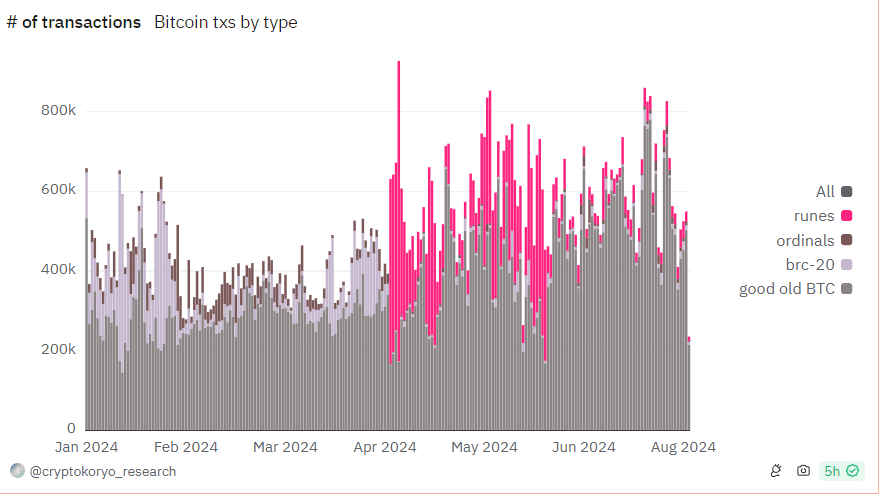
По данным платформы Dune, на блокчейн биткоина приходилось 90% всех криптовалютных транзакций, обработанных в сети 5 августа. Оставшиеся 10% были распределены между другими протоколами, такими как Ordinals, BRC-20 и Runes.

Транзакции в сети биткоина совершали как криптотрейдеры, так и хакеры, которые использовали украденные средства для покупки подешевевшей криптовалюты. Криптокиты неизменно покупали монеты.


Пов'язані матеріали

NVIDIA CPU Advances, China's RISC-V Responds: Semiconductor Deep Dive - Part Four

NVIDIA is set to launch its new Vera AI data center CPU in China as early as August, with high pricing. While this move offers a new option, it highlights China's continued dependence on foreign-controlled Arm architecture. In response, the Chinese semiconductor industry is increasingly turning to RISC-V as a strategic alternative for achieving high-performance computing autonomy. The article explores the concept of the "impossible triangle" in CPU development—balancing prosperity, control, and autonomy—and posits that RISC-V's open-source, modular nature offers a unique path to achieving all three. While RISC-V is already dominant in embedded systems, the focus is now shifting to data centers and AI workloads. China has become a global hotspot for RISC-V development, driven by AI-driven compute demand, supply chain concerns from export controls, cost benefits of open-source, and strong policy support. Multiple Chinese companies have reportedly crossed the key performance threshold of 15 SPECint per GHz, a benchmark for entering the high-performance CPU club. Progress extends beyond single-core benchmarks. Companies are developing complete computing subsystems, including commercial-grade coherent network-on-chip (NoC) technology and server processors with up to 40 cores that strictly adhere to the RVA23 standard to ensure software compatibility. Real-world applications are emerging in areas like video transcoding and edge AI. However, significant challenges remain. The RISC-V ecosystem faces fragmentation, immature toolchains and verification processes, and gaps in single-core performance and energy efficiency compared to mature x86 and Arm architectures. The formidable software moat, epitomized by NVIDIA's CUDA, is a long-term hurdle. In conclusion, while RISC-V cannot immediately replace offerings like NVIDIA's Vera, it represents a viable long-term path for China to develop a self-sufficient, high-performance CPU ecosystem. The journey is acknowledged to be long and arduous, requiring sustained effort to overcome technical and ecosystem challenges.

marsbit6 год тому

NVIDIA CPU Advances, China's RISC-V Responds: Semiconductor Deep Dive - Part Four

marsbit6 год тому

Торгівля

Спот
Ф'ючерси
活动图片