专业化 vs 通用化,谁才是ZK的未来?

Odaily星球日报Опубліковано о 2024-08-02Востаннє оновлено о 2024-08-02

Анотація

专用的 ZK 基础设施正变得越来越通用,而通用 ZKVM 也正变得越来越专业化。

原文作者:mo

原文编译:Luffy,Foresight News

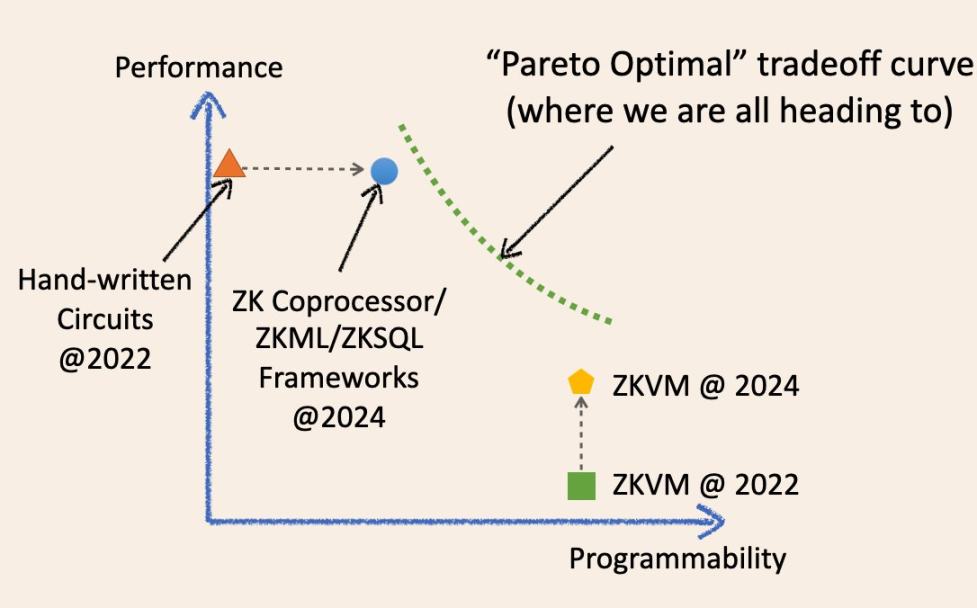
专业化和通用化,哪一个才是 ZK 的未来?让我尝试用一张图来回答这个问题:
专业化 vs 通用化,谁才是ZK的未来?

如图所示,未来我们有可能收敛到权衡坐标系上一个神奇的最佳点吗?

不,链下可验证计算的未来是一条连续的曲线,它模糊了专用和通用 ZK 之间的界限。请允许我解释一下这些术语的历史演变,以及它们在未来将如何融合。

两年前,「专用」 ZK 基础设施意味着诸如 circom、Halo 2 和 arkworks 之类的低级电路框架。使用这些框架构建的 ZK 应用本质上是手写的 ZK 电路。它们对于特定的任务来说速度快且成本低,但通常难以开发和维护。它们类似于当今 IC(集成电路)行业中的各种专用集成电路芯片(物理硅片),例如 NAND 芯片和控制器芯片。

然而,在过去的两年里,专用 ZK 基础设施逐渐变得更加「通用化」。

我们现在拥有 ZKML、ZK 协处理器和 ZKSQL 框架,它们提供易于使用且高度可编程的 SDK,用于构建不同类别的 ZK 应用,而无需编写一行 ZK 电路代码。例如,ZK 协处理器允许智能合约以无需信任的方式访问区块链历史状态、事件和交易,并对这些数据运行任意计算。ZKML 使智能合约能够以无需信任的方式利用 AI 推理结果来处理广泛的机器学习模型。

这些演变的框架显著提高了其目标领域内的可编程性,同时由于抽象层(SDK/API)单薄且接近于裸机电路,因此仍保持高性能和低成本。

它们类似于 IC 市场中的 GPU、TPU 和 FPGA:它们是可编程的领域专家。

ZKVM 在过去两年中也取得了长足的发展。值得注意的是,所有通用的 ZKVM 都是建立在低级、专用的 ZK 框架之上的。其理念是,你可以用高级语言(甚至比 SDK/API 更方便用户使用)编写 ZK 应用,这些应用可以编译为专用电路和指令集的组合(RISC-V 或类似 WASM)。它们就像 IC 行业中的 CPU 芯片。

ZKVM 是低级 ZK 框架之上的一层抽象层,就像 ZK 协处理器等一样。

正如一位智者曾经说过的,一层抽象可以解决所有计算机科学问题,但同时也会产生另一个问题。权衡,这是关键所在。从根本上讲,对于 ZKVM,我们在性能和通用性之间进行权衡。

两年前,ZKVM 的「裸机」性能确实很糟糕。然而,短短两年间,ZKVM 的性能得到了显著提升。

为什么?

因为这些「通用」的 ZKVM 已经变得更加「专业化」了。性能提升的一个关键原因是「预编译」。这些预编译是专门的 ZK 电路,可以计算常用的高级程序,例如 SHA 2 和各种签名验证,速度比将它们分解为指令电路片段的正常流程要快得多。

因此,现在的趋势已经非常明显了。

专用的 ZK 基础设施正变得越来越通用,而通用 ZKVM 也正变得越来越专业化。

过去几年,这两种解决方案的优化都实现了比以前更好的权衡点:在不牺牲另一点的情况下,在某一点上取得进步。这就是为什么双方都觉得「我们绝对是未来」。

然而,计算机科学的智慧告诉我们,在某一时刻,我们会遇到「帕累托最优墙」(绿色虚线),即我们无法在不牺牲另一个性能的情况下改善一个性能。

因此,一个价值百万美元的问题出现了:一个技术是否会在适当的时候完全取代另一个技术?

在借助 IC 行业来理解:CPU 的市场规模为 1260 亿美元,而整个 IC 行业(加上所有「专用」IC)的规模为 5150 亿美元。我确信,从微观角度看,历史会在这里重演,它们不会相互取代。

话虽如此,今天没有人会说,「嘿,我正在使用一台完全由通用 CPU 驱动的计算机」,或者「嘿,这个是由专用 IC 驱动的花哨机器人」。

是的,我们确实应该从宏观的角度来看待这个问题,未来会有一个权衡曲线,让开发者根据自己的需求灵活选择。

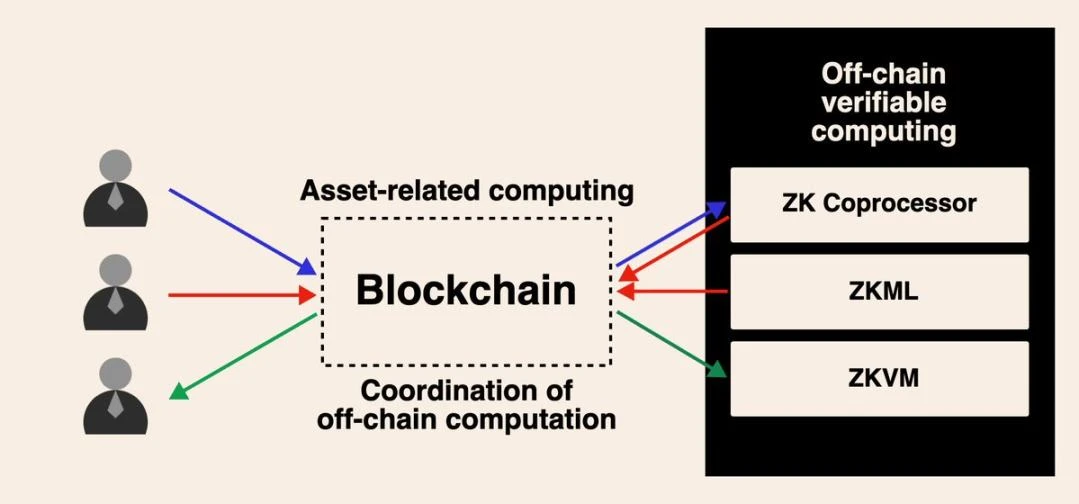
未来,专用 ZK 基础设施和通用 ZKVM 可以协同工作。这可以以多种形式实现。最简单的方法现在已经可以实现。例如,你可以使用 ZK 协处理器在区块链交易历史中生成一些计算结果,但这些数据之上的计算业务逻辑非常复杂,你无法简单地在 SDK/API 中表达。

你可以做的是获取数据和中间计算结果的高性能和低成本的 ZK 证明,然后通过证明递归将它们汇聚到通用 VM。
专业化 vs 通用化,谁才是ZK的未来?

虽然我认为这类辩论很有趣,但我知道我们都在为区块链构建这种由链下可验证计算驱动的异步计算未来。随着未来几年大规模用户采用的用例出现,我相信这场辩论终会出现结果。

Трендові криптовалюти

Пов'язані матеріали

Preferred Stock Is Not the Trigger for Corporate Bankruptcy, MicroStrategy's Dollar Reserves Can Cover Dividend and Interest Payments Until February 2027

Preferred Shares Are Not the Catalyst for Corporate Bankruptcy; MicroStrategy's Dollar Reserves Can Cover Dividend and Interest Payments Until February 2027. This article analyzes the nature of preferred shares used by MicroStrategy (MSTR). Legally equity but economically similar to debt, these shares, including its Bitcoin-linked STR convertible preferred notes (STRC), offer fixed or floating dividends. Crucially, MicroStrategy's preferred shares lack rigid redemption clauses, meaning they are not classified as traditional debt. This eliminates principal repayment pressure and means missed dividends do not constitute default or trigger bankruptcy, creating a "self-contradictory virtuous cycle." The article clarifies that if funds are short, MicroStrategy can defer or suspend preferred share dividends (except for non-cumulative types like STRD) without immediate risk. The real potential crisis point lies with its convertible bonds. If a prolonged bear market prevents conversion, MicroStrategy might need to sell Bitcoin to repay these bonds starting from the earliest maturity in September 2027, potentially creating a downward spiral. Preferred dividend suspensions would only exacerbate market panic in such a scenario. Recent financial activity shows MicroStrategy strengthened its position through four weeks of common stock (MSTR) issuances, raising over $851 million without issuing new preferred shares. It increased its dollar reserves to approximately $1.4 billion, which is sufficient to cover all preferred share dividends and interest until around March 2027. While Bitcoin purchases slowed recently, this prioritization of cash reserves enhances the company's near-term financial safety. The analysis concludes that if the Bitcoin bear market ends by early 2025 as anticipated, MicroStrategy can resume issuing MSTR stock in a rising market to replenish reserves and manage future dividend obligations, thereby reducing the long-term pressure from its preferred share structure.

marsbit51 хв тому

Preferred Stock Is Not the Trigger for Corporate Bankruptcy, MicroStrategy's Dollar Reserves Can Cover Dividend and Interest Payments Until February 2027

marsbit51 хв тому

Giants Wage the Context War, Reconstructing AI Moats

The article "Giants Launch the Context War, Reconstructing AI's Moat" discusses how leading AI companies—OpenAI, Anthropic, and Google—are shifting their competitive focus from model size to acquiring, managing, and utilizing user context (Context). Initially, Context referred to the length of text a model could process, leading to a "arms race" for longer context windows. However, the competition has evolved through three key phases: expanding text capacity (long context windows), enabling memory across sessions, and finally, integrating AI into real user environments like browsers and desktops to capture dynamic task states. Each company is pursuing a distinct strategy. OpenAI is building Context around the ChatGPT account, turning it into a central hub that accumulates user understanding across various integrated applications and tools. Anthropic, lacking a major user base, focuses on high-value verticals like coding, empowering its Claude model to actively gather Context through GUI interaction (Computer Use) and system connections (MCP protocol). Google, with vast existing user data from products like Search and Gmail, faces the challenge of restructuring this data into actionable, AI-understandable Context for its Gemini model within its ecosystem. The core argument is that the nature of competitive advantage in AI is changing. The internet era prized network effects—connecting more users. The AI era values "individual depth": the ability to build deep, task-specific understanding of a user. This creates a new moat through 1) the compounding value of accumulated Context, 2) deep integration with user tools and permissions, and 3) the establishment of trust for complex tasks. Therefore, the battle for Context is fundamentally about capturing "task entry points" and converting existing digital ecosystems into environments where AI can effectively understand and act, rather than merely scaling user numbers.

marsbit1 год тому

Giants Wage the Context War, Reconstructing AI Moats

marsbit1 год тому

Foundation Steps Back, Ethlabs Steps Forward: Ethereum Undergoes Its Largest Restructuring in History

On June 23rd, the Ethereum ecosystem witnessed two major shifts, signaling a significant governance realignment. First, former Ethereum Foundation researchers established Ethlabs, a new independent non-profit. Backed by major ETH holders like Bitmine and SharpLink, Ethlabs aims to address practical needs for institutional adoption, including faster settlement, native asset issuance, cross-chain transactions, and mainnet scaling. Secondly, the Ethereum Foundation announced a major restructuring, laying off 54 employees (20% of its staff) to become a leaner entity focused on protocol governance and maintenance rather than being the primary builder. This move represents a pivotal correction. Criticisms had mounted over the Foundation's perceived slowness, lack of clear strategy, and over-reliance on Vitalik Buterin's influence. Ethlabs emerges as a more execution-oriented, "industrialized" layer focused on market adoption—bridging the gap between research and real-world use. Notably, Vitalik Buterin is absent from its list of supporters, interpreted as an intentional step to avoid excessive personal endorsement and allow the organization to build independent credibility. The Ethereum Foundation's downsizing and redefinition mark a retreat from its former central coordinating role. It now aims to share the "privilege of stewarding Ethereum" with other emerging groups like Ethlabs, the Ethereum Applications Guild, and The Ethereum Economic Zone. Analysts frame this dual shift as the Foundation ensuring Ethereum remains "correct" (credibly neutral), while Ethlabs must prove it remains "effective" (competitive and attractive for capital and adoption). This addresses community "shareholder-like anxiety" about ETH's market performance. While risks exist—such as concerns over shifting from Foundation centrality to large-holder influence—the consensus is that the greater risk for Ethereum was inaction, caught between technical idealism and organizational inertia. These steps aim to create a more multi-stakeholder, execution-driven future for the network.

链捕手9 год тому

Foundation Steps Back, Ethlabs Steps Forward: Ethereum Undergoes Its Largest Restructuring in History

链捕手9 год тому

Second Half of U.S. Crypto Policy: The Clarity Act Aims for 60 Votes, CFTC's "One-Person Commission" Becomes Biggest Variable

In a pivotal year for US crypto policy, the "CLARITY Act" is advancing in the Senate but faces a high hurdle, needing 60 votes to pass. Key challenges include bridging partisan divides on ethics and swaying undecided Republican senators within a tight legislative calendar of only about 40 working days. The policy "second half" involves intense negotiations on a broader framework for Web3 and DeFi, including crypto tax reforms and the Blockchain Regulatory Certainty Act. A significant uncertainty is the understaffed CFTC, operating with four commissioner vacancies, which complicates regulatory clarity. Meanwhile, the departure of key "crypto champions"—SEC Commissioner Hester Peirce and Senator Cynthia Lummis—will impact ongoing policy efforts. Industry experts are cautiously optimistic but realistic. Sara K. Weed notes that while progress is being made, CLARITY is unlikely to pass this Congress, pushing agencies like the SEC and CFTC to provide more guidance. Sulolit Mukherjee suggests meaningful crypto tax legislation is more likely to be attached to larger must-pass bills. Rashan Colbert discusses the jurisdictional debate over prediction markets, emphasizing the need for a regulatory framework that fosters their development as financial tools rather than treating them broadly as gambling. The clock is ticking, but opportunities remain for substantive progress through continued bipartisan dialogue and pragmatic efforts.

marsbit11 год тому

Second Half of U.S. Crypto Policy: The Clarity Act Aims for 60 Votes, CFTC's "One-Person Commission" Becomes Biggest Variable

marsbit11 год тому

Торгівля

Спот
Ф'ючерси

Популярні статті

Як купити ZK

Ласкаво просимо до HTX.com! Ми зробили покупку ZKsync (ZK) простою та зручною. Дотримуйтесь нашої покрокової інструкції, щоб розпочати свою криптовалютну подорож.Крок 1: Створіть обліковий запис на HTXВикористовуйте свою електронну пошту або номер телефону, щоб зареєструвати обліковий запис на HTX безплатно. Пройдіть безпроблемну реєстрацію й отримайте доступ до всіх функцій.ЗареєструватисьКрок 2: Перейдіть до розділу Купити крипту і виберіть спосіб оплатиКредитна/дебетова картка: використовуйте вашу картку Visa або Mastercard, щоб миттєво купити ZKsync (ZK).Баланс: використовуйте кошти з балансу вашого рахунку HTX для безперешкодної торгівлі.Треті особи: ми додали популярні способи оплати, такі як Google Pay та Apple Pay, щоб підвищити зручність.P2P: Торгуйте безпосередньо з іншими користувачами на HTX.Позабіржова торгівля (OTC): ми пропонуємо індивідуальні послуги та конкурентні обмінні курси для трейдерів.Крок 3: Зберігайте свої ZKsync (ZK)Після придбання ZKsync (ZK) збережіть його у своєму обліковому записі на HTX. Крім того, ви можете відправити його в інше місце за допомогою блокчейн-переказу або використовувати його для торгівлі іншими криптовалютами.Крок 4: Торгівля ZKsync (ZK)Легко торгуйте ZKsync (ZK) на спотовому ринку HTX. Просто увійдіть до свого облікового запису, виберіть торгову пару, укладайте угоди та спостерігайте за ними в режимі реального часу. Ми пропонуємо зручний досвід як для початківців, так і для досвідчених трейдерів.

214 переглядів усьогоОпубліковано 2024.12.13Оновлено 2026.06.02

Як купити ZK

Обговорення

Ласкаво просимо до спільноти HTX. Тут ви можете бути в курсі останніх подій розвитку платформи та отримати доступ до професійної ринкової інформації. Нижче представлені думки користувачів щодо ціни ZK (ZK).

活动图片