专用 ZK 与通用 ZK,谁才是未来?

深潮Опубліковано о 2024-08-02Востаннє оновлено о 2024-08-02

专用的 ZK 基础设施正变得越来越通用,而通用 ZKVM 也正变得越来越专业化。

撰文:mo

编译:Luffy,Foresight News

专业化和通用化,哪一个才是 ZK 的未来?让我尝试用一张图来回答这个问题:
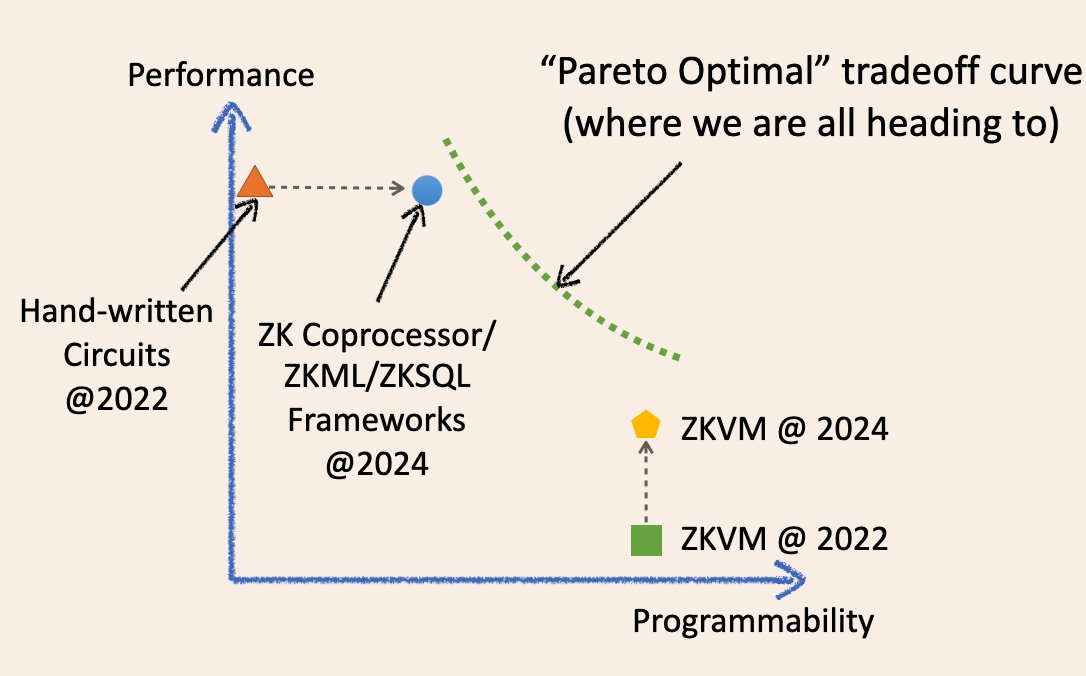
如图所示,未来我们有可能收敛到权衡坐标系上一个神奇的最佳点吗?

不,链下可验证计算的未来是一条连续的曲线,它模糊了专用和通用 ZK 之间的界限。请允许我解释一下这些术语的历史演变,以及它们在未来将如何融合。

两年前,「专用」 ZK 基础设施意味着诸如 circom、Halo2 和 arkworks 之类的低级电路框架。使用这些框架构建的 ZK 应用本质上是手写的 ZK 电路。它们对于特定的任务来说速度快且成本低,但通常难以开发和维护。它们类似于当今 IC(集成电路)行业中的各种专用集成电路芯片(物理硅片),例如 NAND 芯片和控制器芯片。

然而,在过去的两年里,专用 ZK 基础设施逐渐变得更加「通用化」。

我们现在拥有 ZKML、ZK 协处理器和 ZKSQL 框架,它们提供易于使用且高度可编程的 SDK,用于构建不同类别的 ZK 应用,而无需编写一行 ZK 电路代码。例如,ZK 协处理器允许智能合约以无需信任的方式访问区块链历史状态、事件和交易,并对这些数据运行任意计算。ZKML 使智能合约能够以无需信任的方式利用 AI 推理结果来处理广泛的机器学习模型。

这些演变的框架显著提高了其目标领域内的可编程性,同时由于抽象层(SDK/API)单薄且接近于裸机电路,因此仍保持高性能和低成本。

它们类似于 IC 市场中的 GPU、TPU 和 FPGA:它们是可编程的领域专家。

ZKVM 在过去两年中也取得了长足的发展。值得注意的是,所有通用的 ZKVM 都是建立在低级、专用的 ZK 框架之上的。其理念是,你可以用高级语言(甚至比 SDK/API 更方便用户使用)编写 ZK 应用,这些应用可以编译为专用电路和指令集的组合(RISC-V 或类似 WASM)。它们就像 IC 行业中的 CPU 芯片。

ZKVM 是低级 ZK 框架之上的一层抽象层,就像 ZK 协处理器等一样。

正如一位智者曾经说过的,一层抽象可以解决所有计算机科学问题,但同时也会产生另一个问题。权衡,这是关键所在。从根本上讲,对于 ZKVM,我们在性能和通用性之间进行权衡。

两年前,ZKVM 的「裸机」性能确实很糟糕。然而,短短两年间,ZKVM 的性能得到了显著提升。

为什么?

因为这些「通用」的 ZKVM 已经变得更加「专业化」了。性能提升的一个关键原因是「预编译」。这些预编译是专门的 ZK 电路,可以计算常用的高级程序,例如 SHA2 和各种签名验证,速度比将它们分解为指令电路片段的正常流程要快得多。

因此,现在的趋势已经非常明显了。

专用的 ZK 基础设施正变得越来越通用,而通用 ZKVM 也正变得越来越专业化。

过去几年,这两种解决方案的优化都实现了比以前更好的权衡点:在不牺牲另一点的情况下,在某一点上取得进步。这就是为什么双方都觉得「我们绝对是未来」。

然而,计算机科学的智慧告诉我们,在某一时刻,我们会遇到「帕累托最优墙」(绿色虚线),即我们无法在不牺牲另一个性能的情况下改善一个性能。

因此,一个价值百万美元的问题出现了:一个技术是否会在适当的时候完全取代另一个技术?

在借助 IC 行业来理解:CPU 的市场规模为 1260 亿美元,而整个 IC 行业(加上所有「专用」IC)的规模为 5150 亿美元。我确信,从微观角度看,历史会在这里重演,它们不会相互取代。

话虽如此,今天没有人会说,「嘿,我正在使用一台完全由通用 CPU 驱动的计算机」,或者「嘿,这个是由专用 IC 驱动的花哨机器人」。

是的,我们确实应该从宏观的角度来看待这个问题,未来会有一个权衡曲线,让开发者根据自己的需求灵活选择。

未来,专用 ZK 基础设施和通用 ZKVM 可以协同工作。这可以以多种形式实现。最简单的方法现在已经可以实现。例如,你可以使用 ZK 协处理器在区块链交易历史中生成一些计算结果,但这些数据之上的计算业务逻辑非常复杂,你无法简单地在 SDK/API 中表达。

你可以做的是获取数据和中间计算结果的高性能和低成本的 ZK 证明,然后通过证明递归将它们汇聚到通用 VM。
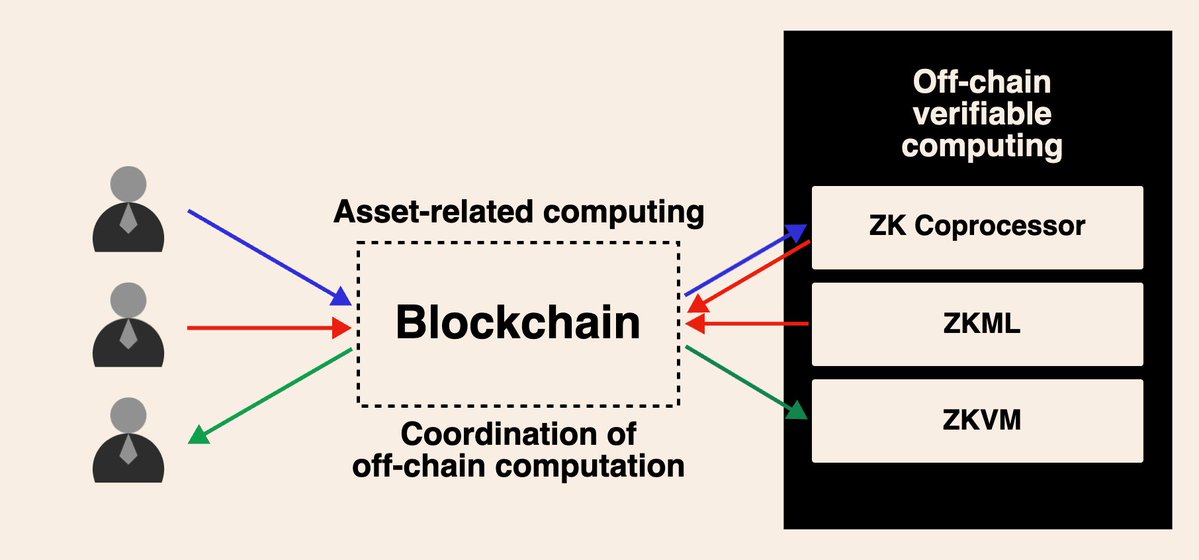
虽然我认为这类辩论很有趣,但我知道我们都在为区块链构建这种由链下可验证计算驱动的异步计算未来。随着未来几年大规模用户采用的用例出现,我相信这场辩论终会出现结果。

Трендові криптовалюти

Пов'язані матеріали

Don't Just Focus on Layoffs, The New Structure of the Ethereum Foundation is More Worthy of Appreciation

The Ethereum Foundation (EF) has undergone a significant organizational restructuring, with the most notable change being a strategic refocusing of its priorities rather than just a 20% staff reduction (approximately 54 people). The new structure clearly prioritizes the Protocol and Access layers, which now comprise the largest teams (57 and 34 people, respectively). This signals EF's intent to concentrate its core resources on fundamental, hard-to-outsource aspects of Ethereum: protocol evolution, security, privacy, client development, and the foundational access layer. Key areas within the Protocol layer, led by an architecture group including Vitalik Buterin and Justin Drake, receive heightened emphasis. These include post-quantum security, zkEVM, formal verification, and long-term roadmap development ("Strawmap"). This reflects a shift towards tackling complex, interdependent challenges like scalability, privacy, and future-proofing the protocol, potentially moving from a pure "redundant security" multi-client model towards more specialized clients aided by AI-assisted formal verification. Financially, EF's budget is being reduced by approximately 40%. The goal is to transition from spending about 15% of its remaining funds annually to a more sustainable 5% rate, akin to a long-term endowment, ensuring its longevity. Concurrently, the restructuring involves pushing certain responsibilities—such as application development, adoption, and ecosystem coordination—to external organizations like EthLabs, the Ethereum Apps Guild, and others. This "multi-node" model aims to increase ecosystem resilience by decentralizing functions beyond the EF, though it introduces new coordination challenges. In essence, the reorganization represents EF consciously narrowing its scope to focus on the hardest, most critical protocol-level problems while fostering a more distributed and sustainable ecosystem structure for Ethereum's future growth.

Foresight News7 хв тому

Don't Just Focus on Layoffs, The New Structure of the Ethereum Foundation is More Worthy of Appreciation

Foresight News7 хв тому

Report Analysis: What Is Coherent Planning as CPO Booms?

Title: Report Interpretation: What Moves Is Coherent Making Amid the CPO Boom? Summary: JP Morgan analyst Samik Chatterjee reiterates an Overweight rating on Coherent (COHR), citing undervalued growth potential across three core areas: data center optical transceivers, co-packaged optics (CPO) chips, and industrial lasers/thermal management. COHR's 1.6T data center transceivers are in high demand, with pricing remaining firm. The rise of CPO is seen not as a threat but as a catalyst, creating higher demand for sophisticated optical components, an area where COHR holds a competitive edge with its comprehensive portfolio (lasers, isolators, VCSELs, thermoelectric coolers). Each CPO chip offers significantly greater revenue potential than traditional transceivers. Furthermore, its Optical Circuit Switch (OCS) technology targets a potential $4B market with reliability and power advantages. The company is expanding its InP (Indium Phosphide) device capacity fourfold within two years, securing substrate supply and transitioning to more cost-effective 6-inch wafers. As one of only two major suppliers of high-quality pump lasers—currently in severe shortage—COHR can now move up the value chain from components to complete line cards/systems, boosting ASP over tenfold. Gross margin targets (>42%) may be revised upward due to high-end product premiums, cost improvements from the wafer transition, and contributions from new high-margin products like CPO and OCS. Its efficient thermadite thermal material also offers long-term growth. Industrial segment revenue grows at a steady 5-10%, supported by semiconductor equipment orders. Changes in Apple's Face ID protocol present a re-competition opportunity for 3D sensing. Overall, Coherent is positioned as a key infrastructure provider, with AI-driven compute demand fueling the need for high-speed optical interconnectivity. Growth from CPO/OCS, stable industrial performance, and margin improvement support the bullish thesis. *Disclaimer: This summary interprets a third-party analyst report from JP Morgan. It does not constitute investment advice.*

marsbit29 хв тому

Report Analysis: What Is Coherent Planning as CPO Booms?

marsbit29 хв тому

Dan Koe's New Article: Escape the Fate of the Wage Slave, How to Survive in the Tide of AI Replacement?

Dan Koe's article argues that the real threat in the AI era is not technology itself, but financial dependency on employers. He critiques the "wage slavery" of unfulfilling work and identifies five core skills for resilience: agency, taste, persuasion, persistence, and iteration. These are developed not by consuming content, but by starting your own venture. The key to escaping the "employee mindset" is a radical identity shift. This requires: 1) Drastically changing your environment and daily inputs, 2) Choosing a creative medium (like content or code) that provides real-world feedback through trial and error, and 3) Using that feedback to learn and adapt. Koe strongly advocates for content creation over coding for beginners, as it builds irreplaceable subjective taste and audience connection. The practical starting point is a 15-minute self-inquiry to define your "life's work." Answer: What do you know deeply? What innate abilities do you have? What childhood interests were suppressed? Then, identify your contrarian beliefs—what does the mainstream get wrong in your area? The overlap is your unique direction. The final, non-negotiable step is to publish your first piece of content tomorrow. Embrace that it will be bad; the goal is to enter the feedback loop of creation, learning, and iteration, which is the true path to independence.

marsbit39 хв тому

Dan Koe's New Article: Escape the Fate of the Wage Slave, How to Survive in the Tide of AI Replacement?

marsbit39 хв тому

After Laying Off 20% of Staff, What Are the Key Points of EF's New Structure?

Following the completion of a months-long organizational restructuring, the Ethereum Foundation (EF) announced a 20% workforce reduction (approximately 54 employees) on June 23rd. It reorganized its teams into five new core clusters: Protocol, Access, User, Community, and Institutional (plus Operations/Management support units). Officially, this move implements the EF's 2026 Mandate and 2025 Treasury Management Policy, aiming to create a more focused and "self-sovereign" organization. The restructuring prioritizes the CROPS principles—Censorship Resistance, Openness & Freedom, Privacy, and Security—as foundational organizational tenets. The Protocol cluster will focus on core protocol R&D, including MEV reduction and zkEVM. The Access cluster emphasizes preserving user "zero option" for non-custodial, permissionless interaction. The User, Community, and Institutional clusters will manage external engagement, with the latter handling institutional and regulatory matters. While offering enhanced severance and transition support for affected employees, the EF did not disclose budget allocations or specific KPIs for the new clusters. This has led to market uncertainty about the impact on project funding and development priorities. Analysts note the announcement's positive tone of mission focus contrasts with a backdrop of recent EF leadership changes and broader ecosystem pressures. The true impact—whether this signifies strategic realignment or reactive contraction—will become clearer as the new structure's resource allocation and project prioritization are revealed in the coming months.

marsbit40 хв тому

After Laying Off 20% of Staff, What Are the Key Points of EF's New Structure?

marsbit40 хв тому

Top-Tier MEV Bot Loses $7.5 Million: Is 'Approval' the Most Overlooked Fatal Risk On-Chain?

The article discusses a sophisticated attack on a prominent Ethereum MEV (Miner Extractable Value) bot, Jaredfromsubway.eth, resulting in a loss exceeding $7.5 million. Unlike typical exploits involving key leaks or smart contract bugs, this attack was a carefully orchestrated "reverse hunt." The attacker spent weeks deploying fake tokens and liquidity pools that mimicked legitimate assets like WETH and USDC. These pools were designed to appear as profitable arbitrage opportunities, tricking the automated bot's trading logic. During its normal operation, the bot was induced to grant ERC-20 token approvals to the malicious contracts. Once sufficient permissions were accumulated, the attacker drained the bot's funds by calling these pre-approved allowances. This incident highlights the often-underestimated risks associated with token approvals in Web3. The article explains that approvals are a fundamental mechanism, allowing smart contracts (like DEXs) to move a user's tokens on their behalf. However, risks arise from practices like granting infinite approvals, the persistence of approvals even after disconnecting from a dApp, and the potential for a once-trusted contract to become compromised later. The piece concludes with advice for managing approval risks: users should adopt the principle of least privilege (approving only the needed amount), use separate wallets for storage versus interactions, and regularly audit and revoke unnecessary approvals using tools like Revoke.cash. It also emphasizes the role of wallets like imToken in providing proactive defenses, such as risk warnings and clear, readable transaction signing interfaces, to help users make informed decisions. Ultimately, wallet security must extend beyond private key protection to include active management of token approvals.

marsbit45 хв тому

Top-Tier MEV Bot Loses $7.5 Million: Is 'Approval' the Most Overlooked Fatal Risk On-Chain?

marsbit45 хв тому

Торгівля

Спот
Ф'ючерси

Популярні статті

Як купити ZK

Ласкаво просимо до HTX.com! Ми зробили покупку ZKsync (ZK) простою та зручною. Дотримуйтесь нашої покрокової інструкції, щоб розпочати свою криптовалютну подорож.Крок 1: Створіть обліковий запис на HTXВикористовуйте свою електронну пошту або номер телефону, щоб зареєструвати обліковий запис на HTX безплатно. Пройдіть безпроблемну реєстрацію й отримайте доступ до всіх функцій.ЗареєструватисьКрок 2: Перейдіть до розділу Купити крипту і виберіть спосіб оплатиКредитна/дебетова картка: використовуйте вашу картку Visa або Mastercard, щоб миттєво купити ZKsync (ZK).Баланс: використовуйте кошти з балансу вашого рахунку HTX для безперешкодної торгівлі.Треті особи: ми додали популярні способи оплати, такі як Google Pay та Apple Pay, щоб підвищити зручність.P2P: Торгуйте безпосередньо з іншими користувачами на HTX.Позабіржова торгівля (OTC): ми пропонуємо індивідуальні послуги та конкурентні обмінні курси для трейдерів.Крок 3: Зберігайте свої ZKsync (ZK)Після придбання ZKsync (ZK) збережіть його у своєму обліковому записі на HTX. Крім того, ви можете відправити його в інше місце за допомогою блокчейн-переказу або використовувати його для торгівлі іншими криптовалютами.Крок 4: Торгівля ZKsync (ZK)Легко торгуйте ZKsync (ZK) на спотовому ринку HTX. Просто увійдіть до свого облікового запису, виберіть торгову пару, укладайте угоди та спостерігайте за ними в режимі реального часу. Ми пропонуємо зручний досвід як для початківців, так і для досвідчених трейдерів.

214 переглядів усьогоОпубліковано 2024.12.13Оновлено 2026.06.02

Як купити ZK

Обговорення

Ласкаво просимо до спільноти HTX. Тут ви можете бути в курсі останніх подій розвитку платформи та отримати доступ до професійної ринкової інформації. Нижче представлені думки користувачів щодо ціни ZK (ZK).

活动图片