加息并缩表,日本央行会更“鹰”一步吗?

深潮Опубліковано о 2024-07-31Востаннє оновлено о 2024-07-31

“超预期”加息,缩表“不及预期”。

作者:赵颖,华尔街见闻

日本央行“鹰派”了一回,同时宣布加息、缩表,彰显政策正常化的决心。

7月31日周三,日本央行宣布最新利率决议,宣布加息15个基点,将政策利率上调至0.15%-0.25%,日本央行以7-2的投票比例通过利率决议,此前市场预期维持不变。

同时,日本央行公布缩表计划,国债购买规模每个季度减少4000亿日元,将不再提供债券购买范围而是提供指定金额。日本央行一致投票决定缩减债券购买规模,但不及此前每月缩减1万亿日元的预期。

新的货币市场操作指引将于2024年8月1日起生效。分析认为:

日本央行指出今明两年通胀风险偏向上行,这可能是其采取行动的原因。如果这种前景被证明是正确的,那么日本央行可能会进一步加息。

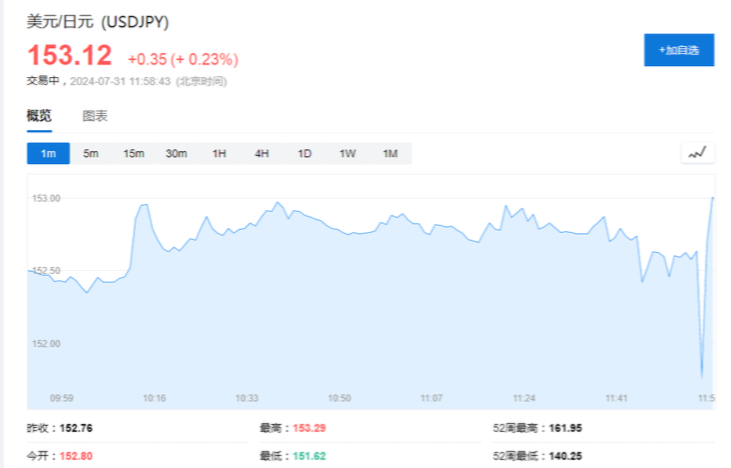
消息发布后,日元兑美元短线剧烈震荡,目前跌破153,稍早一度快速拉升破152关口。日经225指数在日本央行决策后继续下跌,日本10年期国债期货在日本央行宣布利率后缩小盘中跌幅。
“超预期”加息,缩表“不及预期”

日本央行本次“超预期”加息,市场预计7月加息可能性仅约40%;而缩表不及预期,市场普遍预期购买量下月将减少至5万亿日元,日本央行行长植田和男曾强调削减幅度将相当显著。

具体来看:

目前每月购债规模约6万亿日元,7月份月度购债规模约为5.7万亿日元,从8-9月起月度购债规模约为5.3万亿日元,10-12月的月度购债规模约为4.9万亿日元......

到2026年一季度月度购债规模将约为3万亿日元,日本国债持有量预计将在2024年中期减少约7-8%。
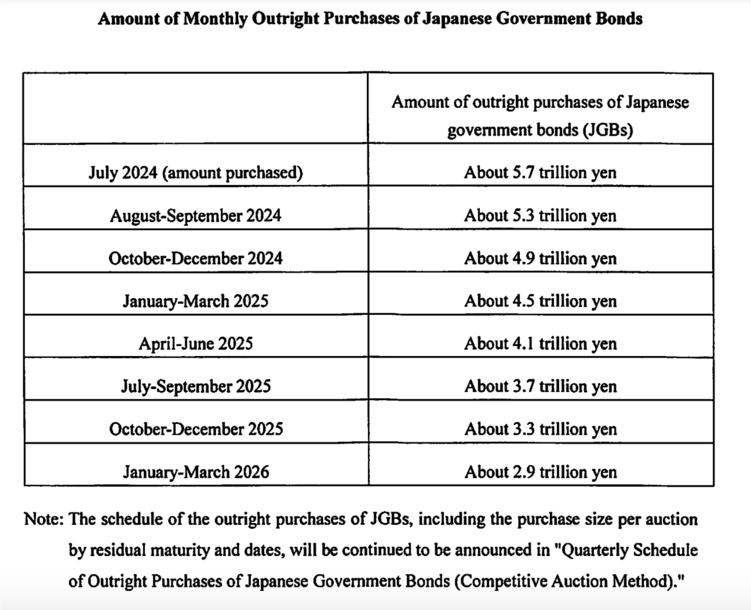
日本央行补充称,对金融机构在日本央行持有的活期账户余额适用0.25%的利率;将以可预测的方式减少国债购买,将在每个季度宣布债券购买规模,根据需要调整债券购买计划,在2025年6月对购债实施中期评估,如有必要将在政策会议上评估债券购买计划。

值得一提的是,消息公布前,日本媒体曾“泄密”,日本放送协会NHK、日经新闻和时事通讯都指出了日本央行可能的加息举动,8-9月的购债时间表也如期公布,购债金额都较此前减少。

物价存在上行风险,或进一步加息

日本央行表示:

随着经济前景发生实质性变化,将调整宽松政策,实际利率明显偏低。

若通胀前景成为现实,将继续加息,工资涨幅明显高于去年,2024、2025财年的物价风险偏向于上行。

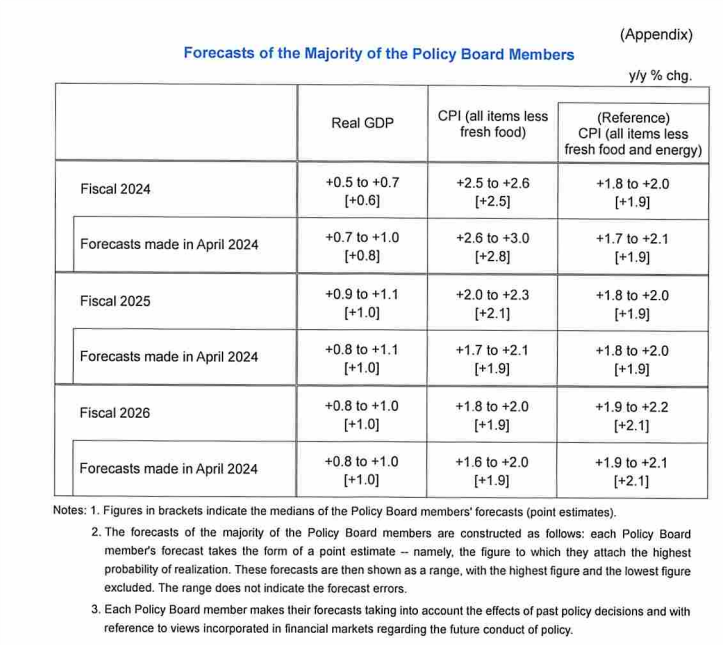
通胀预测方面,日本央行将2024/25财年核心CPI小幅下调,除能源外的核心CPI保持不变:

2024财年核心CPI为2.5%,此前预测为2.8%;2025财年核心CPI为2.1%,此前预测为1.9%;2026财年核心CPI为1.9%,此前预测为1.9%。

2024财年除能源外核心CPI为1.9%,此前预测为1.9%;预计2025财年除能源外核心CPI为1.9%,此前预测为1.9%;预计2026财年除能源外核心CPI为2.1%,此前预测为2.1%。
同时,日本还表示:

日元汇率比以往更有可能影响物价,进口价格再次上涨,必须警惕通胀超调风险。

此外,尽管受到价格影响,私人消费仍有弹性,近期企业行为正逐渐转向提高工资和价格。

宽松的货币政策环境将继续支撑经济,实际利率预计仍将显著为负。

日本央行会更“鹰”一步吗?

分析师认为,这次利率决议并不鸽。日本央行以书面形式承诺,如果经济活动和通胀前景的良好情况继续下去,将进一步加息。这是第一次,也是我们在植田和男领导下看到的日本央行的鹰派姿态。对于购债规模,ATFX Global Markets的分析师Nick Twidale认为,日本央行债券缩减规模远低于预期,这对日元造成了沉重打击。

然而,分析师 Toru Fujioka和Sumio Ito认为,日元疲软来到了转折点:

日本央行将其政策利率上调,还表示将在2026年第一季度把每月购债速度降至约3万亿日元。行长植田和男在采取这些措施的同时,也表明了该行继续推进正常化进程的意愿,周三的行动可能会助长今年可能再加息一次的猜测。在美联储即将召开会议的几个小时前,日本央行的鹰派倾向可能意味着受困的日元的一个转折点,因为交易员们认为美日利率差距将缩小。美联储任何暗示可能在9月降息的言论都将支持这种说法。

OTAN研究公司首席经济学家Izuru Kato表示:

加息的决定很可能是为了纠正过度宽松的货币政策,反映出实际政策利率已深入负值区域。尽管日本央行一直解释说货币政策不以货币为目标,但鉴于日元疲软对日本农村地区的中小企业造成了打击,因此日元疲软肯定是今天决定背后的一个重要因素。加息的幅度很小,只是象征性的。不必担心加息速度加快,因为日本央行在3月和7月的加息幅度只是达到了普通央行一次性加息的幅度。这并不意味着日本央行突然转向鹰派。展望未来,日本央行仍将保持谨慎,避免过于仓促地收紧政策。
Пов'язані матеріали

Fu Peng's First Public Speech in 2026: What Exactly Are Crypto Assets? Why Did I Join the Crypto Asset Industry?

Fu Peng, a renowned macroeconomist and now Chief Economist at New火 Group, delivered his first public speech of 2026 at the Hong Kong Web3 Festival. He explained his perspective on crypto assets and why he joined the industry, framing it within the context of macroeconomic trends and financial evolution. Fu emphasized that crypto assets are transitioning from an early, belief-driven phase to a mature, institutionally integrated asset class. He drew parallels to the 1970s-80s, when technological advances (like computing) revolutionized traditional finance, leading to the rise of FICC (Fixed Income, Currencies, and Commodities). Similarly, current advancements in AI, data, and blockchain are reshaping finance, with crypto assets becoming part of a new "FICC + C" (C for Crypto) framework. He noted that institutional capital, including traditional hedge funds, avoided early crypto due to its speculative nature but are now engaging as regulatory clarity emerges (e.g., stablecoin laws, CFTC classifying crypto as a commodity). Fu predicted that 2025-2026 marks a turning point where crypto becomes a standardized, financially viable asset for diversified portfolios, akin to commodities or derivatives in traditional finance. Fu defined Bitcoin not as "digital gold" in a simplistic sense but as a value-preserving, financially tradable asset. He highlighted that crypto's future lies in regulated, institutional adoption, moving away from retail-dominated trading. His entry into crypto signals this maturation, where traditional finance integrates crypto into mainstream asset management.

marsbit45 хв тому

Fu Peng's First Public Speech in 2026: What Exactly Are Crypto Assets? Why Did I Join the Crypto Asset Industry?

marsbit45 хв тому

Justin Sun Sues Trump Family: What $75 Million Bought Was Only a Blacklist

Justin Sun, founder of Tron, has filed a lawsuit in federal court against World Liberty Financial (WLF), alleging he was made the "primary target of a fraudulent scheme" after investing $75 million. Sun claims the investment secured him an advisor title and WLFI tokens, which were later frozen by WLF, causing "hundreds of millions in losses." The dispute began in late 2024 when Sun's investment helped revive WLF's struggling token sale, which ultimately raised $550 million. Shortly after, the SEC dropped its lawsuit against Sun following Donald Trump's inauguration. However, relations soured when Sun refused WLF's demands for additional funding. In August 2025, WLF added a "blacklist" function to its smart contract, allowing it to unilaterally freeze tokens. Sun's holdings, worth approximately $107 million, were frozen, and he was threatened with token destruction. The lawsuit highlights WLF's structure, which directs 75% of token sale profits to the Trump family, who had earned $1 billion by December 2025. WLF's CEO is Zach Witkoff, son of U.S. Middle East envoy Steve Witkoff. The project faces scrutiny for opaque operations, including a controversial loan arrangement on the Dolomite platform, co-founded by a WLF advisor. Despite Sun's history with the SEC, the case underscores centralization risks within DeFi, as WLF controls governance and holds powers to freeze assets arbitrarily. Sun's tokens remain frozen as legal proceedings begin.

marsbit52 хв тому

Justin Sun Sues Trump Family: What $75 Million Bought Was Only a Blacklist

marsbit52 хв тому

$500 to Buy OpenAI Stock: Silicon Valley's Most Respectable Liquidity Invitation

Silicon Valley's largest venture capital platform, AngelList, has launched a new fund called USVC, allowing U.S. retail investors to buy into high-profile AI companies like OpenAI, Anthropic, and xAI with a minimum investment of $500—no accredited investor status required. Promoted by AngelList co-founder Naval Ravikant, the fund is framed as an opportunity for ordinary people to access high-growth private tech investments traditionally reserved for VCs. However, critics argue it functions more like an exit vehicle for early insiders. USVC acquires shares not through primary rounds but largely via secondary transactions—purchasing stakes from early investors, VC funds, and employees looking to cash out at peak valuations. With companies like xAI heavily weighted in the portfolio, the fund effectively channels retail money into providing liquidity for insiders who entered at much lower valuations. The fund’s structure raises concerns: shares are illiquid, with no secondary market, and buybacks are limited and discretionary. The actual annual fee reaches 3.61%, far above the advertised 1% management fee. This model parallels the "low float, high fully diluted valuation" strategy seen in crypto, where early investors profit by selling to latecomers at inflated prices. The timing—alongside similar moves by platforms like Robinhood—suggests that Silicon Valley’s sudden interest in retail inclusion may be less about democratizing access and more about securing exits for insiders.

marsbit1 год тому

$500 to Buy OpenAI Stock: Silicon Valley's Most Respectable Liquidity Invitation

marsbit1 год тому

Торгівля

Спот
Ф'ючерси
活动图片