本周精选项目推荐:PEPE、ONDO、BONK、UNI

金色财经Опубліковано о 2024-07-08Востаннє оновлено о 2024-07-08

图片

上周,多种顶级加密货币出现第二轮价格上涨,延续了前一周的复苏趋势。 

结果,全球加密货币市值增长了 1400 亿美元,增长了 5.7%,达到 2.57 万亿美元。 

以下是我们挑选出的本周最值得关注的加密货币,以下是这些资产的显著走势:
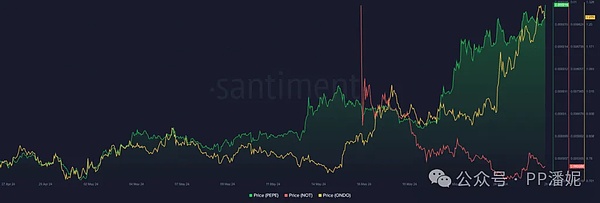
图片PEPE、NOT 和 ONDO 价格 – 5 月 26 日 PEPE:连续第二周创下新高

尽管在此期间大盘出现不稳定,但Pepe ( PEPE ) 自 4 月中旬以来一直处于持续上涨趋势。市场数据证实,自 4 月 20 日以来,这款 meme 币已连续四次盘中上涨。

这一趋势发生在4月20日至23日、5月1日至4日以及5月11日至14日。

尽管本周未能实现类似的涨势,但 Pepe在 5 月 21 日和 22 日飙升了 45.86%,而其他市场则面临回调。回想一下,两周前,这枚以青蛙为主题的 meme 代币创下了0.00001161 美元的历史新高。

上周, Pepe价格于 5 月 25 日上涨至 0.00001577 美元,创下另一个历史新高。此次价格上涨逆转了由比特币(BTC)于 5 月 20 日从 71,000 美元的高点回撤引发的市场整体看跌趋势。

Pepe 在过去 7 天内飙升了 75.88%,成为这段时间内前 100 种资产中涨幅最大的一种。这款 meme 币目前正处于价格发现阶段,截至发稿时,其 24 小时交易量为 19.46 亿美元,在加密货币市场中排名第七。 

Pepe 的累积/分配指标证实,上周的上涨主要是由大量需求引发的。截至 5 月 19 日,该指标的价值为 615.79 万亿 PEPE,但到本周末已飙升至 775.91 万亿代币。PEPE 目前的交易价格为 0.00001606 美元,有望确保其对该门槛的主张。

ONDO:创下新纪录 

翁多 (ONDO) 是上周表现最好的股票之一。与大盘一样,该资产本周开盘时表现疲软,5 月 19 日下跌 3.82%。 

然而,它借助市场反弹的势头收复了损失,并于 5 月 20 日收盘上涨 8.29%。

当天,尽管其他市场回吐涨幅,但 RWA 代币化平台Ondo Finance的原生代币 Ondo却出现了温和回调,随后恢复了上涨趋势。最终,该代币于 5 月 24 日创下了1.16 美元的历史新高。

此后,该资产已超过这一水平,并加入了 PEPE 的价格发现模式。截至报告时,ONDO 的价格为 1.28 美元,过去七天上涨了 40.73%,成为这段时间内涨幅第五大的股票。

该代币目前已收复 4 月份 23% 的损失,本月上涨了 71.88%。

不过,翁多币在 1.28 美元上方的位置依然脆弱,尤其是 77.29 的 RSI 暗示其处于超买水平。

该资产即将进行修正,但多头需要在 23.6% 斐波那契回撤位(1.1873 美元)找到支撑,以防止大幅下跌至 1 美元门槛的下限。

BONK:上升通道有望达到 100% 

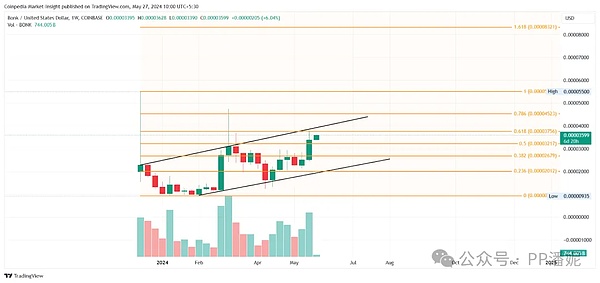
上周BONK 价格上涨了 35%,1W 图表呈现出看涨吞没蜡烛。此外,该 meme 代币在日线图中呈现上升通道模式,有望突破反弹。 
图片

随着更广泛的市场复苏,BONK 的突破机会正在增加。根据斐波那契水平,本周 meme 币的突破反弹可能达到 1.618 斐波那契水平,即 0.000082 美元。乐观地讲,上涨趋势可能会挑战 0.00010 美元的心理关口。

UNI:价格保持上涨

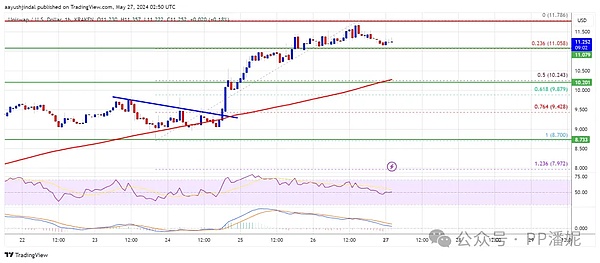
在 8.80 美元上方形成基础后,Uniswap 开始像比特币和以太坊一样新一轮上涨。UNI 价格加速突破 9.20 美元和 9.50 美元的阻力位。

UNI/USD 对的小时图上突破了连接看跌趋势线,阻力位在 9.50 美元附近。多头甚至将价格推高至 10.50 美元和 11.20 美元阻力位上方。最后,空头出现在 11.75 美元区域附近。

高点形成于 11.78 美元附近,目前价格正在巩固从 8.70 美元的摆动低点到 11.78 美元高点的上行 23.6% 斐波那契回撤位附近的涨幅。
图片

UNI 目前交易价格高于 11.00 美元和 100 小时简单移动平均线。直接阻力位在 11.50 美元附近。下一个关键阻力位在 11.75 美元附近。收盘价高于 11.75 美元可能为短期内进一步上涨打开大门。下一个关键阻力位可能在 12.20 美元附近,多头可能会在此之上测试 12.50 美元的水平。如果再上涨,UNI 可能会跌至 13.50 美元。


Пов'язані матеріали

Domestic First Explosion-Proof Certification, World's First Fueling Brain Solution: How Did They Secure Two 'Firsts'?

China's embodied AI sector is booming, with over ¥37 billion in funding this year. The focus has shifted decisively to real-world application, particularly in hazardous, repetitive tasks humans should avoid. A key, often prohibitive, barrier to entry for robots in environments like gas stations and oil fields is obtaining explosion-proof certification, requiring meticulous hardware and circuit design from the ground up. The article explores three main application areas. At gas stations, the challenge lies in executing a long, precise sequence of actions (opening caps, handling the fuel nozzle) with millimeter accuracy across diverse car models. For facility inspections, robots need sustained autonomous patrols combined with real-time anomaly detection and response. Port scenarios introduce the complexity of multi-robot coordination. Addressing the core challenge of long-horizon tasks, the piece highlights a technical breakthrough: a "world model"-driven approach. This enables predictive planning, allowing the AI to visualize the desired end-state (e.g., nozzle returned, cap closed) and work backward to synthesize intermediate visual frames. This "imagination" of the task trajectory, as implemented in the H-GAR architecture, guides action generation, significantly reducing cumulative error in multi-step operations. The three-step H-GAR process involves generating a coarse action draft, synthesizing target-conditioned observation frames, and then refining actions based on visual context and a memory of past successful motions. The conclusion emphasizes that success in specialized, safety-critical fields requires long-term commitment and deep integration of the "embodied brain" (AI) with a purpose-built, certified physical "body." Mastering this brain-body-data闭环 (closed-loop) is positioned as a crucial competitive advantage for commercialization.

marsbit38 хв тому

Domestic First Explosion-Proof Certification, World's First Fueling Brain Solution: How Did They Secure Two 'Firsts'?

marsbit38 хв тому

Bitcoin Bear Market Triggers Crypto Layoffs, Yet Fuels Industry's Most Aggressive M&A Wave Ever

A prolonged Bitcoin downturn is forcing crypto companies to lay off employees and automate operations, but has simultaneously triggered the industry's most aggressive wave of mergers and acquisitions (M&A). In the first half of 2026, crypto M&A deal value reached $93.7 billion, 26 times higher than the same period last year. This activity is primarily driven by traditional financial institutions—banks, payment processors, and asset managers—who are acquiring compliant crypto infrastructure like custody solutions, payment rails, and regulatory licenses instead of building them internally. Examples include Mastercard's acquisition of stablecoin firm BVNK and Franklin Templeton's launch of a dedicated crypto division via acquisition. This consolidation contrasts sharply with a shrinking crypto labor market, where active job openings have plummeted. Companies like Coinbase are restructuring to become "AI-native," leading to a sharp increase in roles requiring AI skills, while engineering and compliance positions now dominate hiring. Financially pressured crypto firms, such as Messari which was acquired at a fraction of its prior valuation, are becoming prime targets. Capital remains available but is highly selective, flowing overwhelmingly into businesses that bridge digital assets with traditional finance, such as tokenization platforms and regulated trading venues. The trend indicates a market where capital is rewarding compliant, utility-focused infrastructure while weaker models consolidate or downsize.

marsbit39 хв тому

Bitcoin Bear Market Triggers Crypto Layoffs, Yet Fuels Industry's Most Aggressive M&A Wave Ever

marsbit39 хв тому

Trillion-Dollar Pension Fund Entry? Franklin Bitcoin Dividend Reinvestment ETF Comes with a Built-in Selling Pressure Ceiling

Franklin Templeton has filed to launch two ETFs that embed a "default configuration" logic into Bitcoin investment, aiming to tap into massive pension fund flows. These "Bitcoin Dividend Reinvestment Index ETFs" will initially hold 95% equities and 5% Bitcoin, automatically reinvesting stock dividends to buy Bitcoin. However, a quarterly rebalancing rule forces selling of Bitcoin if its allocation exceeds 5%, capping its maximum holding at 20%. While the product cleverly circumvents advisor reluctance and compliance hurdles by labeling itself as a U.S. equity product, its actual Bitcoin buying power is minimal. Given low dividend yields (e.g., ~1% for broad market indices), annual Bitcoin purchases from a fund the size of Franklin's existing Bitcoin ETF would be a mere $3.6 million—negligible against Bitcoin's daily trading volume. Crucially, during bull markets, the fund becomes a programmed, passive *seller* of Bitcoin, potentially creating sustained sell pressure if many similar funds emerge. The strategy leverages investor inertia and automatic enrollment, similar to the success of target-date funds in 401(k) plans. It also uses an offshore Cayman subsidiary for holding Bitcoin and raises a tax complication where investors must pay taxes on dividends they never receive as cash. Although recent U.S. regulatory changes allow crypto in retirement plans, widespread adoption as a default option faces legal hurdles. The core premise remains: the system doesn't need to convince anyone to buy Bitcoin actively; it simply relies on people doing nothing.

marsbit1 год тому

Trillion-Dollar Pension Fund Entry? Franklin Bitcoin Dividend Reinvestment ETF Comes with a Built-in Selling Pressure Ceiling

marsbit1 год тому

Торгівля

Спот
Ф'ючерси
活动图片