XRP、ADA、BCH、LTC、STX 被福布斯选入 20 种僵尸加密货币

金色财经Опубліковано о 2024-07-08Востаннє оновлено о 2024-07-08

图片

以其对金融市场的深刻分析而闻名的著名商业出版物《福布斯》最近发布了一份综合报告,揭示了加密货币的神秘世界。在这项开创性的研究中,《福布斯》确定了一组选定的加密货币,将其称为“僵尸区块链”。
图片

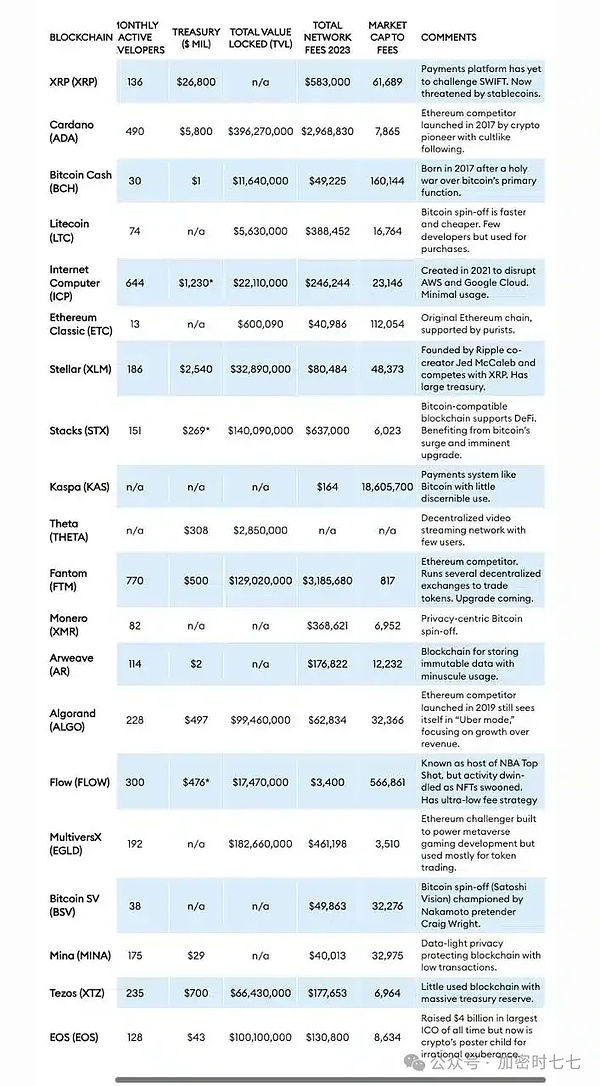
尽管加密货币市场呈指数级增长,拥有超过 14,000 种代币,总市值高达 2.4 万亿美元,但这些选定的加密货币似乎在现实世界中的效用或用户采用率极低,从而违背了传统的成功指标。此列表中的知名名称包括瑞波币 (XRP)、卡尔达诺 (ADA)、莱特币 (LTC)、比特币现金 (BCH) 和以太坊经典 (ETC)。

这些加密货币的与众不同之处在于它们的持续运营和交易活动没有实现实际目的的切实证据。“僵尸区块链”一词恰如其分地描述了这些项目,让人想起不死生物,它们的存在在效用或重要用户群方面没有显示出生命的重要迹象。

Ripple 的 XRP 和其他主要加密货币受到严格评估

在受到《福布斯》严格审查的众多加密货币中,Ripple 的 XRP成为审查的焦点。XRP 最初被认为是 SWIFT 银行网络的强大竞争者,承诺提供快速且具有成本效益的国际银行转账,但此后一直在努力实现其崇高愿望。尽管 XRP 未能颠覆 SWIFT,但它仍然是市场上最有价值的加密货币之一,市值高达 360 亿美元。然而,《福布斯》分析师断言,XRP 的市场主导地位在很大程度上是由投机交易而非真正的实用性支撑的。

这一观察结果提出了有关 XRP 的基本可行性和目的的相关问题,凸显了加密货币生态系统中市场估值与实际应用之间日益扩大的鸿沟。同样,莱特币、比特币现金、比特币 SV 和以太坊经典等其他主要加密货币也受到了《福布斯》敏锐分析的审查。

“以太坊杀手”面临的挑战和缺乏治理

除了评估现有的加密货币之外,《福布斯》的报告还对经常被称为“以太坊杀手”的新兴竞争者给予了批判性的关注,包括Tezos (XTZ)、Algorand (ALGO) 和 Cardano (ADA)。尽管这些加密货币拥有强大的技术实力和巨大的市场估值,但尚未得到广泛采用或大量用户活动。例如,对卡尔达诺的投机兴趣似乎主要是由其创始人查尔斯·霍斯金森(Charles Hoskinson)的声望推动的,而不是现实世界实用性的切实证据。

这些实体在没有监管监督或对股东承担义务的情况下运营,经常发现自己陷入困境,评估其长期生存能力变得越来越具有挑战性。尽管遭受重大安全漏洞,以太坊经典的持续交易活动清楚地提醒人们,投资缺乏健全治理结构的加密货币存在相关风险。
Пов'язані матеріали

Bitcoin at 59,000 Is Not the Bottom, One Last Drop Needed! Chain Data and Liquidity Analysis: Where is BTC's True Bottom?

Based on analysis by trader Mr. Beggar, Bitcoin's (BTC) recent low of $59k is likely not the final cycle bottom. He argues that while a bottom is near, a final downward movement is still probable to target liquidity below that level, making a deeper low healthier for a sustainable reversal. Mr. Beggar's framework combines on-chain data for long-term cycles and liquidity-based technical analysis for shorter-term trades. His "four deep bear buying models" include Cointime Price (market cost weighted by coin holding time) and AVIV (an enhanced MVRV indicator), which currently suggest prices are nearing cyclical bottom zones. While a PSIP (Percent Supply in Profit) signal has flashed below 50%, it alone is not considered definitive; typically, the first signal is not the final bottom. He presents three potential scenarios for the current market: 1) a direct drop from here, 2) an upward liquidity sweep (stop hunt) of the recent high near $67.3k before declining, and 3) a direct reversal without new lows. He heavily discounts the third scenario due to significant un-swept liquidity in the $59k-$62.3k range, suggesting the market must revisit these levels. Mr. Beggar shares that he used on-chain signals to identify potential cycle tops in late 2024/early 2025 and later established low-leverage BTC-denominated short positions. He emphasizes the importance of risk management and staying within one's expertise ("strike zone"), warning against investing in assets like AI/semiconductor stocks simply because they are rising.

marsbit11 хв тому

Bitcoin at 59,000 Is Not the Bottom, One Last Drop Needed! Chain Data and Liquidity Analysis: Where is BTC's True Bottom?

marsbit11 хв тому

From Signal Monitoring to Strategy Copy Trading: How PPP Lowers the Barrier to Trading on Polymarket?

From Signal Monitoring to Strategy Copy Trading: How PPP Lowers the Barrier to Polymarket Trading The surge in trading demand on prediction markets like Polymarket, especially during events like the World Cup, exposes a common challenge for novice users: emotional and impulsive trading due to a lack of stable strategies and reliable signals. Prediction Position Platform (PPP) addresses this by serving as a Telegram-based tool for strategy discovery and automated copy-trading on Polymarket. PPP offers a suite of features through a subscription model. Key functionalities include 24/7 market signal monitoring (tracking smart money movements and rapid probability shifts), an "AI Address Analysis" tool to evaluate trader performance metrics, and specialized sections like a "World Cup Zone" for quick access to related markets. Its core value lies in two curated lists: the "Strategy Square," which identifies addresses suitable for long-term tracking based on comprehensive metrics like returns, win rate, and drawdowns, and the "Trading Leaderboard," highlighting recently outperforming addresses for short-term opportunities. Users can manually analyze any address or set up automated copy-trading with customizable parameters like investment amount and stop-loss. After initiating copy-trades, users can manage all positions from a unified dashboard, adjusting parameters or stopping follows as needed, and review historical performance data. Crucially, PPP employs a non-custodial wallet model, meaning user funds remain in their own self-custodied wallets, enhancing security and trust. In summary, PPP aims to reduce the learning curve and trial-and-error cost for Polymarket users by aggregating signals, curating and analyzing profitable traders, and facilitating automated, yet manageable, copy-trading execution.

Odaily星球日报11 хв тому

From Signal Monitoring to Strategy Copy Trading: How PPP Lowers the Barrier to Trading on Polymarket?

Odaily星球日报11 хв тому

From the White-Haired Stock God to the Billion-Dollar Fund Titan: The Smart People Shorting NVIDIA Are Getting Rich Using the Same Framework

From "white-haired stock god" to billionaire fund manager, those profiting from shorting NVIDIA share a common framework. The article analyzes the critical bottlenecks in the AI hardware supply chain, which have become key investment focal points. The core argument is that the real constraint on the AI boom isn't software or algorithms, but fundamental physical infrastructure. The piece dissects nine major bottlenecks, organized around the lifecycle of an AI accelerator circuit board. *Before the Board*: The pre-manufacturing stage faces constraints in EDA tools, new materials (like GaN, SiC, InP) replacing silicon, and the critical, non-renewable supply of helium for semiconductor fabrication. *On the Board*: The primary bottlenecks are High-Bandwidth Memory (HBM), essential for unleashing GPU power, and advanced packaging (e.g., CoWoS), required to integrate components. Both are in severe shortage. *Between Boards*: Chip-to-chip communication is hitting limits with copper, pushing photonics and optical interconnects (CPO) as the next-gen solution, with NVIDIA heavily investing in this area. *Around the Board*: Power delivery requires new materials (GaN/SiC) for efficient voltage conversion from 48V to sub-1V. High-density AI racks (120kW+) are forcing a shift from air to liquid cooling as the standard. *Beyond the Board*: The ultimate bottleneck is electricity. AI data centers consume power equivalent to mid-sized cities, and grid expansion lags far behind demand, causing project delays and a scramble for power contracts. Prominent investors like Leopold and "white-haired stock god" are heavily betting on these infrastructure bottlenecks. Leopold's fund, for instance, holds no NVIDIA stock but uses massive put options to short the semiconductor sector while going long on power and physical infrastructure. His thesis is that while chip competition may eventually erode margins, the scarcity of foundational elements like electricity is more persistent. The framework's validity is tied to the supply-demand gap. Major new capacity in HBM and photonics is scheduled for 2027-2028, but demand continues to outpace it. Experts like Intel's CEO suggest no relief before 2028. However, the article warns of a potential reversal around 2028-2029 if AI capex slows and new capacity floods the market, turning scarcity into oversupply. Until then, the imbalance persists.

链捕手42 хв тому

From the White-Haired Stock God to the Billion-Dollar Fund Titan: The Smart People Shorting NVIDIA Are Getting Rich Using the Same Framework

链捕手42 хв тому

Торгівля

Спот
Ф'ючерси
活动图片