Carbon Browser: Built for Web 3, Designed for you

mediumОпубліковано о 2024-07-01Востаннє оновлено о 2024-07-04

Анотація

Carbon Browser (CSIX) is a fast, private, and secure web browser designed specifically for Web3. It is based on the open-source Chromium browser code and the Blink engine, ensuring a smooth user experience. Carbon Browser introduces several custom features, including a multi-chain wallet, cross-chain bridge, VPN, ad blocking, and browse-to-earn rewards.

What is Carbon Browser?

Carbon Browser (CSIX) is a fast, private, and secure web browser designed specifically for Web3. It is based on the open-source Chromium browser code and the Blink engine, ensuring a smooth user experience. Carbon Browser introduces several custom features, including a multi-chain wallet, cross-chain bridge, VPN, ad blocking, and browse-to-earn rewards.

Utilizing decentralized virtual private network (dVPN) technology, Carbon Browser encrypts user data and reroutes traffic through a peer-to-peer node network, effectively preventing third-party tracking and surveillance. Additionally, it integrates firewall and Tor end-to-end encryption technology to further enhance security and privacy, making it an ideal choice for users exploring the Web3 world.
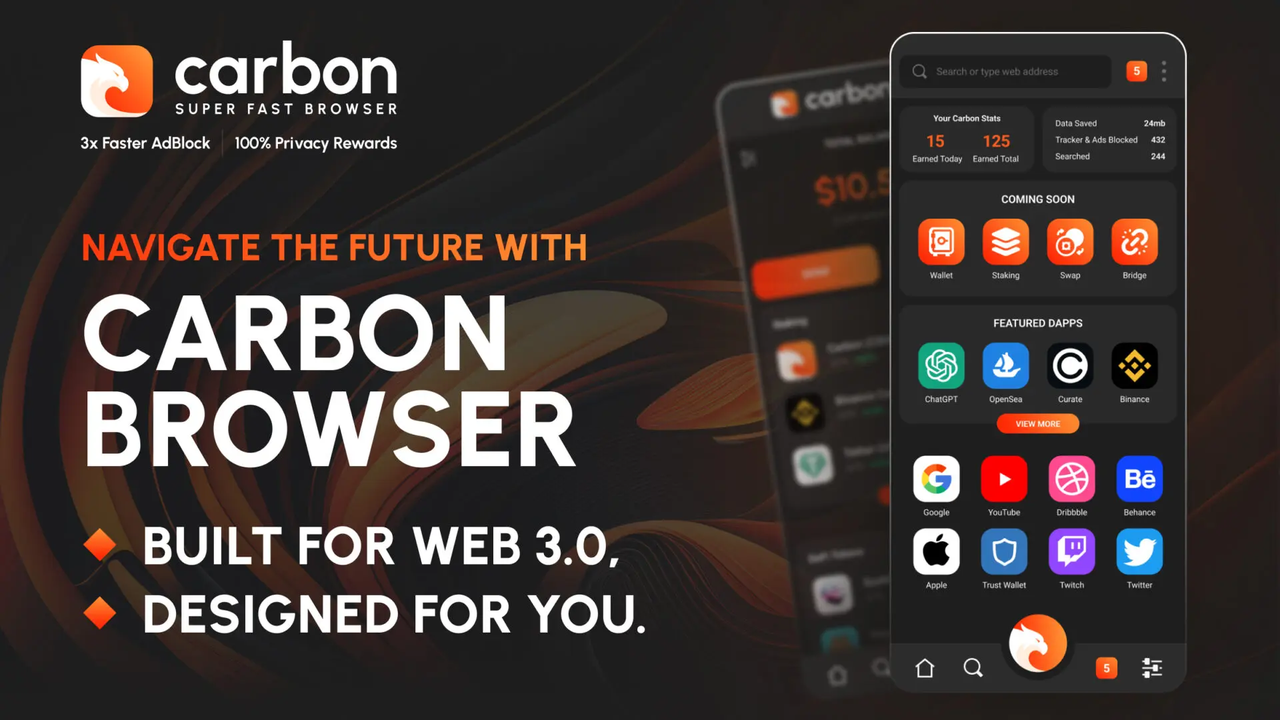
Three key issues that Carbon Browser aims to address

1. Lack of privacy, excessive centralization, and slow browsing speeds in current browsers.

2. Lack of standard Web 3.0 functionalities in current browsers.

3. Inadequate ad blocking/filtering and ineffective solutions for ad fraud in current browsers.

What does Carbon Browser bring to users?

Carbon Browser offers a comprehensive set of features aimed at enhancing user browsing experiences and improving efficiency in accessing and utilizing blockchain technology. Through continuous innovation and development, it provides the following key functionalities:

1. Speed and Security:

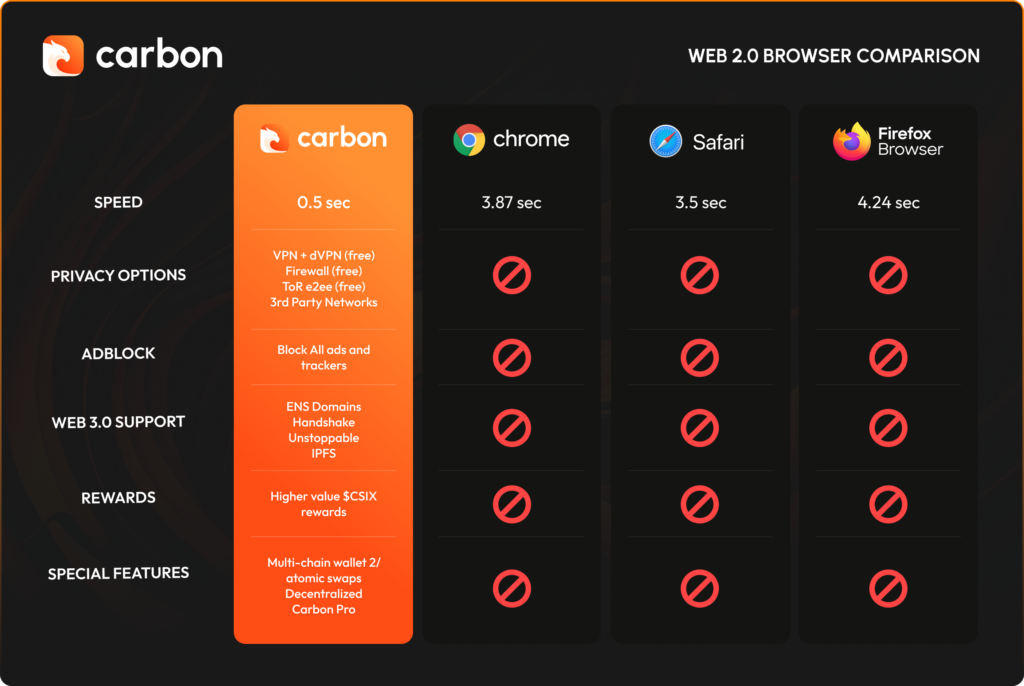
Built on the Chromium browser with the Blink engine, Carbon Browser ensures faster page loading speeds and enhanced security features, including protection against ad tracking. It reduces space usage by up to 56.7% compared to other browsers.

2. Native Cryptocurrency Integration:

The browser includes a multi-chain cryptocurrency wallet for seamless management of digital assets. It supports atomic swaps and staking services, serving as a gateway to decentralized applications (dApps) and the metaverse.

3. Ad Block and Ad Marketplace:

Carbon Browser features a robust ad blocking system developed in collaboration with Eyeo, alongside the Carbon AdX Marketplace. This marketplace enables sustainable value exchange between advertisers and publishers without compromising user experience.

4. VPN and Firewall:

Integrated VPN and firewall services ensure user privacy and security. Additionally, users have the option to utilize the TOR network for enhanced anonymity.

5. Browse-to-Earn Rewards:

Users earn CSIX token rewards while browsing, which can be used within a growing partner network including NFTs, charities, and selected merchants. Rewards are distributed based on daily active usage and do not require KYC for redemption.

6. Carbon Pro:

Designed for advanced users, Carbon Pro offers premium features such as upgraded VPN, dVPN, firewall, and 24/7 support. Access to this advanced version is available through a subscription model using CSIX tokens.

In summary, Carbon Browser combines speed, privacy, and innovative features to deliver a robust and secure Web3 experience, catering to the diverse needs of modern internet users.
Carbon Browser Tokenomics

CSIX is the primary token of Carbon Browser and plays a crucial role within the Carbon ecosystem. It offers benefits such as fee discounts, gas fee payments, ad campaign discounts, staking rewards, DAO governance voting rights, and product feature upgrades.

CSIX has a total supply of 1 billion tokens, with a current market value of approximately $11.35 million USD and a circulating supply of about 400 million tokens.

The token distribution is as follows:

Seed investors: 8%

Public sale: 9.5%

PancakeSwap pool and farms: 3%

Team and advisors: 1.95%

Key opinion leaders (KOL): 0.55%

Marketing & partnerships: 24.1%

Development: 24.1%

Staking and rewards: 11.3%

Liquidity, MM, and listings: 11.3%

Community governance DAO: 6.2%

Here is more information about Carbon

- Official Website: https://carbon.website

- Twitter: https://twitter.com/trycarbonio

- Telegram: https://t.me/trycarbonio

- Whitepaper: https://carbon.website/whitepaper/

- Start Trading: https://www.htx.com/zh-cn/trade/csix_usdt?type=spot
Пов'язані матеріали

The Crypto Industry Enters the 'Show Me' Era: Vision Alone Is No Longer Enough

The crypto industry has entered a "Show Me" era, where grand visions and white papers are no longer sufficient to gain traction. This shift is driven by increased skepticism, high-profile bad actors, and notably, the serious entry of traditional finance (TradFi) institutions like BlackRock, Fidelity, and JPMorgan Chase, which are launching real, scaled products such as tokenized funds and blockchain-based settlement. This raises the bar for what constitutes a credible project. The communication dynamic has fundamentally changed. The focus is no longer on "what you are building" but on "what you have built and who is using it." Startups must now provide a "proof stack": verifiable data like mainnet transaction volume and active wallets, genuine partnerships with signed contracts, and evidence of organic product-market fit from real users, not just investors. Announcements must be backed by concrete, chain-verifiable evidence. For communication strategies, this means leading with proven facts and hard data—even if modest—rather than speculative narratives. A compelling story must be grounded in demonstrated results. While vision remains important, the balance has inverted from 80% vision/20% substance to the opposite. This higher threshold ultimately benefits builders with genuine traction, filtering out noise and allowing their real signals to stand out clearly. The "Show Me" era is a permanent maturation, demanding that communication strategies prove value, not just promise it.

链捕手24 хв тому

The Crypto Industry Enters the 'Show Me' Era: Vision Alone Is No Longer Enough

链捕手24 хв тому

Meta Follows the Trend into Prediction Markets: Can It Avoid Repeating the Failure of the Metaverse?

Meta, the tech giant behind Facebook, has reportedly formed a team to develop "Arena," a new application focused on prediction markets. Users would use platform points to place bets on outcomes in politics, sports, and global events. This move follows Meta's massive, nearly $900 billion, losses from its heavily-invested metaverse division, Reality Labs. The prediction market industry is already showing strong demand, with leading platforms like Kalshi and Polymarket facilitating hundreds of billions in annual volume. Meta, with its 3.56 billion daily active users across its apps, possesses the unprecedented scale to bring this niche activity to a mainstream audience, similar to its past success in cloning features like Stories and Reels. However, Arena faces significant hurdles. Meta plans to start with a points-based system to avoid strict financial regulations, but this may dilute the core incentive of accurate prediction that real-money markets provide. More critically, Meta enters the space with a major trust deficit stemming from its past regulatory battles, notably the failed Libra/Diem stablecoin project, and its controversial history with political content and misinformation. The prediction market sector itself is under increasing regulatory scrutiny, with recent CFTC actions including fines and the first-ever insider trading case. While Meta's vast user base offers a unique opportunity to expand the market, its success hinges on navigating complex regulations and rebuilding the credibility necessary for a platform dealing with sensitive topics like elections. The outcome could range from Meta dramatically growing the industry to Arena becoming a high-profile regulatory target before it can scale.

Foresight News42 хв тому

Meta Follows the Trend into Prediction Markets: Can It Avoid Repeating the Failure of the Metaverse?

Foresight News42 хв тому

Stock Soars 1200% on First Day, 80s Sales Engineer's Reversal: From Selling FRP to a Fortune of 29 Billion

On its first day of listing, Zhenbao Technology (stock code "N Zhenbao") surged by 1207%, marking itself as the second "ten-bagger" new stock of the year on the STAR Market. The closing price of 585 yuan propelled it into the top 20 of the A-share market by stock price. Dubbed the "first share of semiconductor consumables," the company is backed by a comprehensive shareholder list including National Integrated Circuit Industry Investment Fund Phase II, SMIC, BOE, and YMTC. Zhenbao's business model focuses on supplying critical consumable components like silicon rings and quartz parts to semiconductor fabs. Unlike expensive core equipment with low repurchase rates, these consumables require frequent replacement as long as production lines are running, generating stable recurring revenue—a key reason for its high market valuation. Founder Wang Bing, an 80s-born former sales engineer, built the company by identifying a supply chain vulnerability: foreign monopolies on high-purity materials led to high costs and unstable deliveries for domestic fabs. Zhenbao's strategy emphasized reliability and speed over absolute top-tier performance, offering products at about 50% of the price with 80% of the performance but 100% on delivery and responsiveness. To achieve this, the company vertically integrated its operations across "raw materials + components + surface treatment," ensuring supply chain control and cost reduction. Its clientele now spans major domestic fabs like BOE and Huahong, as well as international players like SK Hynix and Texas Instruments. However, risks accompany its rapid expansion. The IPO raised approximately 1.605 billion yuan primarily for capacity expansion, which will bring significant annual depreciation costs, potentially impacting future profitability. The company's growth is heavily reliant on sustained high levels of fab expansion, making it vulnerable to the semiconductor industry's cyclical downturns. Other concerns include high accounts receivable (70.83% of revenue at one point in 2025), heavy reliance on its top five customers (over 70% of sales), and questions about the stability and authenticity of its R&D investments, evidenced by volatile R&D headcount and unusual spikes in R&D energy consumption. While the "consumables story" commands a premium, long-term valuation will depend on maintaining high capacity utilization and healthy cash flow conversion.

marsbit48 хв тому

Stock Soars 1200% on First Day, 80s Sales Engineer's Reversal: From Selling FRP to a Fortune of 29 Billion

marsbit48 хв тому

Торгівля

Спот
Ф'ючерси
活动图片