24-Year-Old "Wall Street Newcomer" Portfolio Adjustments Revealed: Shorts Chips Heavily in Q1, Bullish on Energy and AI Infrastructure

marsbitОпубліковано о 2026-05-19Востаннє оновлено о 2026-05-19

Анотація

A 24-year-old Wall Street prodigy, Leopold Aschenbrenner, has disclosed the Q1 portfolio adjustments for his fund, Situational Awareness LP. The fund's assets under management skyrocketed from $5.52 billion to $13.7 billion. The most significant move was a massive bearish bet on the semiconductor sector. The fund established $8.46 billion in put options, targeting chipmakers like NVIDIA ($1.6B in puts) and the VanEck Semiconductor ETF (SMH, $2B in puts). This bearish stance extended to Broadcom, Oracle, AMD, Micron, ASML, Intel, Corning, and TSMC. However, the fund made a selective bullish exception, adding shares and call options for memory chip maker SanDisk. The fund maintained its core bullish thesis on energy and AI infrastructure. Bloom Energy remained its largest long equity holding. It also increased stakes in cryptocurrency mining/data center firms like CleanSpark, Riot Platforms, Applied Digital, and IREN Limited, viewing them as providers of critical ready-to-use infrastructure—land, power, and grid permits—for AI expansion. The 13F filing was submitted one day late. Overall, the fund's strategy involves substantial bearish semiconductor bets while maintaining concentrated, high-volatility investments in selective tech, computing, and infrastructure plays aligned with AI growth.

Source: Cailian Press

On Monday Eastern Time, the eagerly awaited Q1 US stock portfolio adjustment report (13F) for the fund "Situational Awareness LP," managed by the much-watched Wall Street newcomer, 24-year-old Leopold Aschenbrenner, was finally released. (Related Reading: Liquidated NVIDIA, Frenzied Buying of Fuel Cells: The 'Physical Arbitrage' Logic of a 24-Year-Old Investment Prodigy)

As described in our previous report, as the world's youngest manager of a mega-fund, Leopold Aschenbrenner foresaw the importance of AI infrastructure "logistics" as early as 2024, making significant investments in power, land, and infrastructure, propelling his fund to massive expansion in less than two years since its inception.

This belated report shows that the market value of the fund managed by Leopold Aschenbrenner has surged from $5.52 billion in the previous quarter to $13.7 billion—and just under two years ago, the fund's initial AUM was only $255 million.
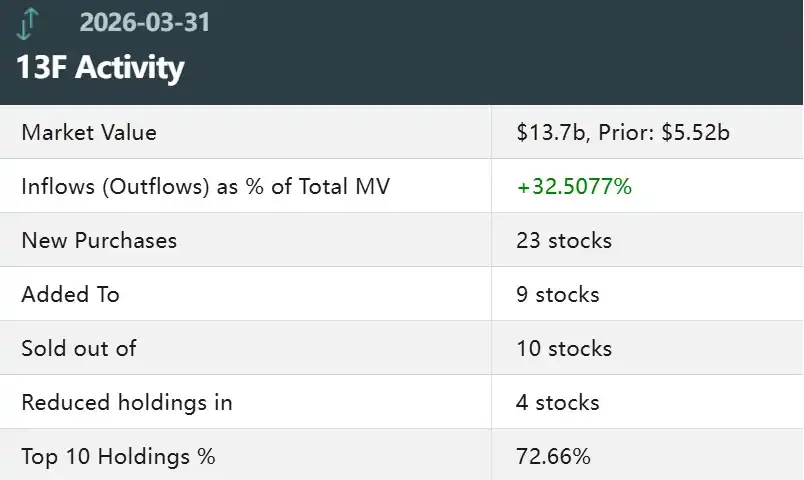
Such a rocket-like surge in assets under management indicates that the "Situational Awareness" fund has clearly become a star fund highly sought after on Wall Street—in fact, Leopold Aschenbrenner's portfolio moves have already become one of the most closely watched sources for "copying homework" among Wall Street institutions and retail investors in recent quarters.

Let's take a closer look at what this Wall Street star has done in the first quarter of this year.

Heavily Buys Short Positions in Chipmakers

From this adjustment report, the most significant move made by Leopold Aschenbrenner in Q1 was heavily shorting chipmakers.

As of the end of Q1, the fund aggressively purchased put options with a notional value of up to $8.46 billion, covering numerous chipmaker stocks, including a $2 billion put option on the VanEck Semiconductor ETF (ticker: SMH) and a $1.6 billion put option on AI giant NVIDIA.
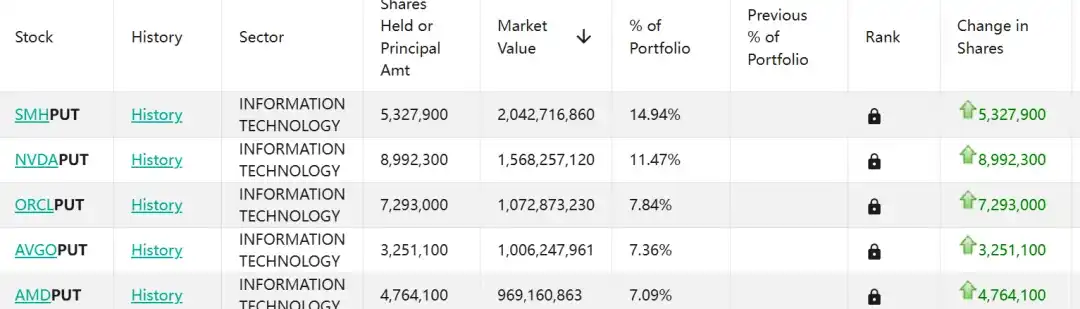
Massive Purchase of Chip Put Options

Additionally, the fund established put option positions on Broadcom, Oracle, AMD, Micron Technology, ASML, Intel, Corning, and TSMC.

These bearish options are not only among the fund's top five purchases for Q1 but also rank among its top five holdings. This undoubtedly highlights Leopold Aschenbrenner's pessimistic outlook on the prospects of chip stocks.

However, Leopold Aschenbrenner is not bearish on all chip stocks.

In Q1, the fund slightly increased its holdings of memory giant SanDisk by 80,000 shares and established a SanDisk call value option position worth $380 million, possibly hinting that it expects the memory boom to continue and that the fund is making selective bets within the semiconductor industry.

Still Heavily Betting on Energy and AI Infrastructure

As of the end of Q1, US biofuel company Bloom Energy (ticker: BE) remained Aschenbrenner's largest bullish bet on an individual stock. His fund holds 6.5 million shares of Bloom Energy, valued at $879 million, and holds 409,000 Bloom Energy call options with a notional value of $55 million.

Furthermore, Situational Awareness increased its holdings in cryptocurrency mining/data center operators CleanSpark (ticker: CLSK), Riot Platforms (ticker: RIOT), Applied Digital (ticker: APLD), and IREN Limited (ticker: IREN).

As we previously analyzed, Aschenbrenner's bet on Bitcoin miners is not for cryptocurrency speculation but for the ready-to-use land, power, and grid permits held by these miners. In the era of massive AI infrastructure expansion, these resources are equivalent to "ready-made" AI infrastructure, saving years of approval time.

A Belated 13F Report

It is worth noting that Aschenbrenner's 13F filing was originally due last Friday—according to regulations, all institutional investment management companies holding securities over $100 million must submit this disclosure document to the U.S. Securities and Exchange Commission within 45 days after the quarter ends—but Situational Awareness did not submit the report until Monday morning.

Typically, late or missed 13F filings can lead to civil penalties at the SEC's discretion, ranging from small fines to a maximum of $750,000.

However, investors' attention is certainly focused on Aschenbrenner's specific portfolio adjustments.

Overall, while he aggressively established semiconductor put option positions in Q1, his fund still holds a significant amount of highly volatile tech stocks and continues to make selective investments in computing, memory, and data center infrastructure. This adjustment trend might be worth investors' reference.


Пов'язані питання

QWho is the 24-year-old fund manager mentioned in the article and what is the name of his fund?

AThe fund manager is Leopold Aschenbrenner, and his fund is called 'Situational Awareness LP'.

QWhat was the most significant action taken by Situational Awareness LP in Q1 regarding the semiconductor industry?

AThe fund's most significant action was establishing a large short position in chipmakers by purchasing put options with a notional value of $8.46 billion against companies like Nvidia and the VanEck Semiconductor ETF (SMH).

QDespite the broad short position, which specific semiconductor stock did the fund show bullish sentiment towards in Q1?

AThe fund showed selective bullishness towards SanDisk by increasing its stock holdings by 80,000 shares and establishing $380 million in call options on the company.

QWhat is the fund's largest long stock position as of the end of Q1?

AThe fund's largest long stock position is in Bloom Energy (BE), holding 6.5 million shares valued at $879 million.

QWhy does the fund invest in Bitcoin mining companies like CleanSpark and Riot Platforms, according to the article's analysis?

AThe fund invests in Bitcoin mining companies not for cryptocurrency speculation, but for their valuable physical infrastructure assets like land, power supply, and grid permits, which are seen as 'ready-made' AI infrastructure that can save years of approval time.

Пов'язані матеріали

From South Korea to the United States: Blue-Collar Jobs Are Becoming Increasingly Popular, Thanks to AI

AI is reshaping the labor market's value proposition. The traditional four-year college degree is losing its appeal as a guaranteed career path, while skilled blue-collar trades like electricians, welders, and plumbers are experiencing historic demand and wage premiums. This shift is driven by dual pressures: AI's displacement of certain white-collar roles and a booming need for physical infrastructure and data center construction. Data confirms the trend. In the U.S., vocational school revenue surged, and a significant portion of recent layoffs are AI-related. Surveys show a majority of Gen Z adults plan to pursue blue-collar work, citing better job security against AI automation. Vocational education interest has exploded recently. Experts cite a psychological shift as younger generations seek tangible, AI-resistant careers and avoid high student debt. In many cases, salaries for skilled trades now match or exceed those requiring a bachelor's degree. In South Korea, semiconductor vocational high schools boast near-total employment, with graduates securing high-paying roles at companies like Samsung. The shortage is structural, exacerbated by a retiring baby boomer workforce and massive infrastructure projects. Companies like JPMorgan Chase, Meta, and Lowe's are investing heavily in training programs. However, overcoming historical stigma and a "perception gap" around trade careers remains a key challenge to closing the talent gap.

marsbit54 хв тому

From South Korea to the United States: Blue-Collar Jobs Are Becoming Increasingly Popular, Thanks to AI

marsbit54 хв тому

Qualcomm: AI Hype Subsides, When Will Smartphones Emerge from the Gloom?

Qualcomm reported its Q3 FY2026 results (ending June 2026), with revenue of $9.95B, down 4% YoY but above expectations. Gross margin declined to 53.1%, pressured by rising costs across manufacturing and memory. Key business segments showed mixed performance: Handset revenue fell 19.6% YoY to $5.09B, dragged by an 11% decline in non-Apple Android shipments and weaker high-end mix. Conversely, Automotive revenue surged 61% to $1.59B, and IoT grew 9% to $1.83B. Core operating profit dropped 41% YoY due to margin compression and higher expenses. Management's Q4 FY2026 guidance projects revenue of $9.7B-$10.5B, in line with consensus, but Non-GAAP EPS guidance of $2.05-$2.25 fell short of expectations. Amidst persistent weakness in its core handset market, Qualcomm is pursuing growth in AI, focusing on Edge AI (smartphones, PCs, automotive) and Data Center AI. Its data center strategy includes four pillars: AI accelerators (e.g., AI200), commercial CPUs (Dragonfly C1000), custom silicon, and connectivity solutions. While these initiatives initially boosted its stock, concerns over AI capital expenditure sustainability have since erased those gains. The company targets $5B in data center revenue for FY2027 and $15B for FY2029. The report concludes that with the traditional handset business still under pressure, the data center opportunity is currently viewed as a longer-term option, and a more conservative valuation based on core operations may be warranted until AI contributions materialize.

marsbit59 хв тому

Qualcomm: AI Hype Subsides, When Will Smartphones Emerge from the Gloom?

marsbit59 хв тому

From TPU to Self-Evolving Agents: How Jeff Dean Predicts the Next Step in AI

At the 2026 YC Startup School, Jeff Dean outlined his vision for AI's next phase, shifting focus from simply scaling models to building intelligent, autonomous systems. He believes AI's progress is no longer just about creating smarter models, but about integrating them into systems capable of long-term, iterative work, automated experimentation, and continuous learning. This evolution moves the competition from "who has the bigger model" to "who can best organize intelligence." Dean suggests AI capabilities are now comparable to a junior engineer, enabling the automation of complex workflows. However, the true challenge and opportunity lie in managing these AI "workers" at scale. He emphasizes the importance of **context engineering**—structuring tools, memory, and feedback loops—over raw model power. For startups, this means building deep expertise in niche domains where general models currently fail (near 0-1% success rates), leveraging proprietary data, specialized tools, and domain-specific evaluators. A recurring theme is re-examining fundamental constraints. Dean's past work, like moving Google's search index to memory or creating the TPU, stemmed from questioning outdated assumptions about hardware and cost. He sees similar inflection points today, particularly in **specialized inference hardware** to drastically reduce latency and energy consumption for real-time Agent operation. Notably, he points out that in modern AI systems, the dominant cost is often not computation but **data movement**. Reliable, long-running Agents require robust system design, borrowing concepts from distributed computing like checkpointing, state management, and parallel exploration to handle failures and maintain progress over days or weeks. As AI automates execution, the scarcest human skills will shift to **defining clear specifications**, **judging what problems are worth solving** (taste), and designing effective feedback loops. Ultimately, Dean's framework prioritizes understanding the problem deeply, identifying the true bottlenecks, and systematically building closed-loop systems where AI can not only perform tasks but also improve AI itself.

marsbit59 хв тому

From TPU to Self-Evolving Agents: How Jeff Dean Predicts the Next Step in AI

marsbit59 хв тому

Торгівля

Спот
活动图片




